Autonomous Facility Operation Optimization Pipeline


Autonomous Facility Operation Optimization Pipeline

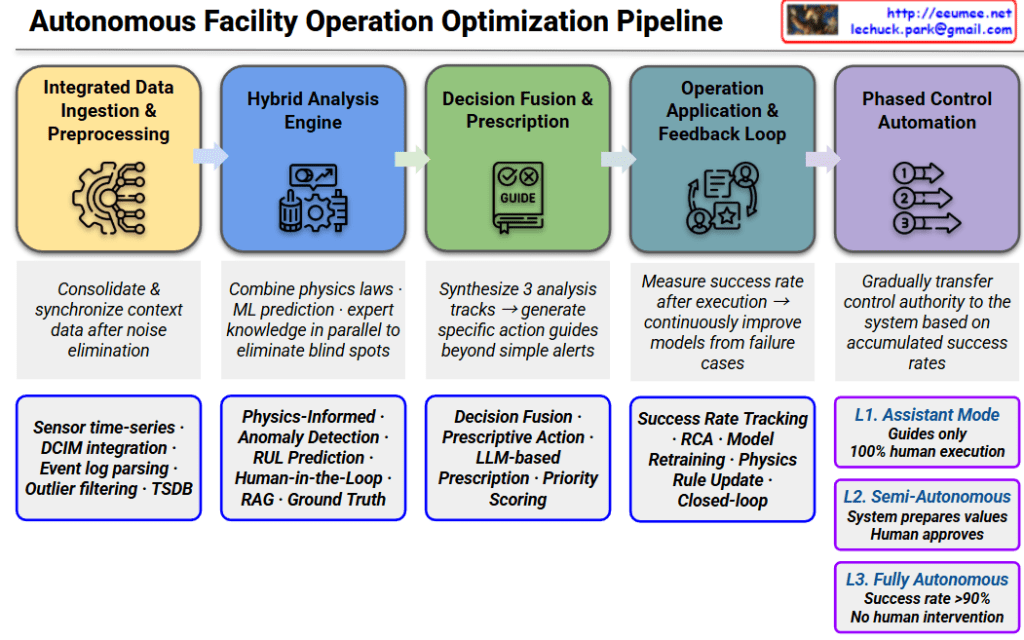
This pipeline represents a sophisticated 5-stage workflow designed to transition facility management from manual oversight to full AI-driven autonomy, ensuring reliability through hybrid modeling.

1. Integrated Data Ingestion & Preprocessing

  • Role: Consolidates diverse data streams into a synchronized, high-fidelity format by eliminating noise.
  • Key Components: Sensor time-series data, DCIM integration, Event log parsing, Outlier filtering, and TSDB (Time Series Database).

2. Hybrid Analysis Engine

  • Role: Eliminates analytical blind spots by running physical laws, machine learning predictions, and expert knowledge in parallel.
  • Key Components: Physics-Informed Machine Learning (PIML), Anomaly Detection, RUL (Remaining Useful Life) Prediction, and RAG-enhanced Ground Truth analysis.

3. Decision Fusion & Prescription

  • Role: Synthesizes multi-track analysis to move beyond simple alerts, generating specific, actionable “prescriptions.”
  • Key Components: Decision Fusion, Prescriptive Action, LLM-based Prescription, and Priority Scoring to rank urgency.

4. Operation Application & Feedback Loop

  • Role: Establishes a closed-loop system that measures success rates post-execution to continuously refine models.
  • Key Components: Success Rate Tracking, RCA (Root Cause Analysis), Model Retraining, and Physics/Rule updates based on real-world performance.

5. Phased Control Automation

  • Role: A risk-mitigated transition of control authority from humans to AI based on accumulated performance data.
  • Automation Levels:
    • L1. Assistant Mode: System provides guides only; 100% human execution.
    • L2. Semi-Autonomous: System prepares optimized values; human provides final approval.
    • L3. Fully Autonomous: System operates without human intervention (triggered when success rate >90%).

Strategic Insight

The hallmark of this architecture is the integration of Physics-Informed ML and LLM-based reasoning. By combining the rigid reliability of physical laws with the adaptive reasoning of Large Language Models, the pipeline solves the “black box” problem of traditional AI, making it suitable for mission-critical infrastructures like AI Data Centers.

#DataCenter #AIOps #AutonomousInfrastructure #PhysicsInformedML #DigitalTwin #LLM #PredictiveMaintenance #DataCenterOptimization #TechVisualization #SmartFacility #EngineeringExcellence

DC Data Service Model


DC Data Service Model Overview

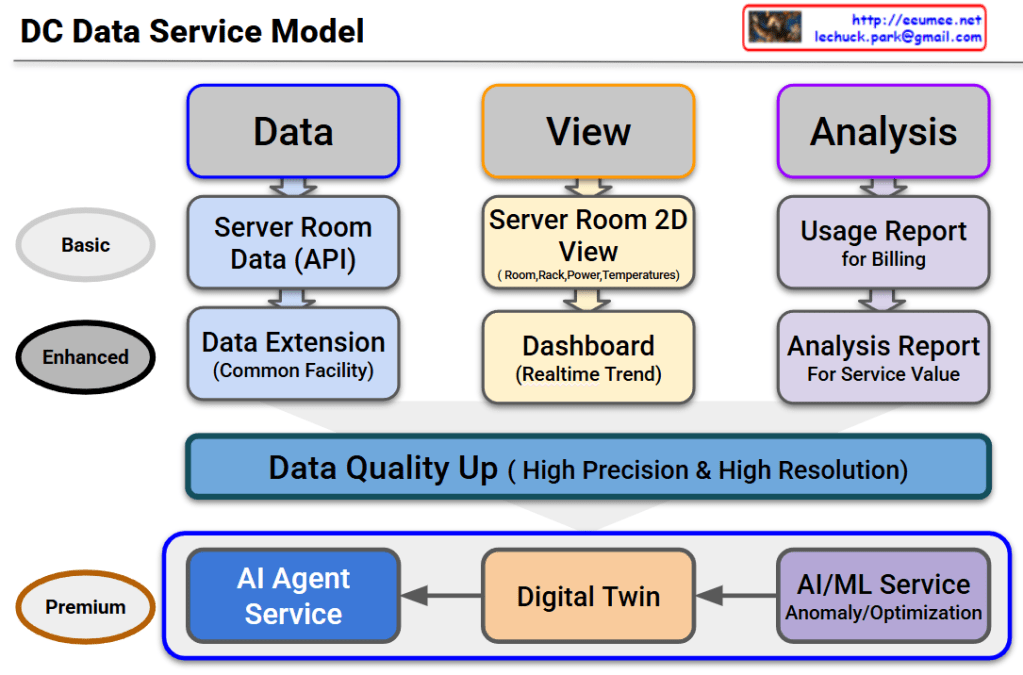
This diagram outlines the evolutionary roadmap of a Data Center (DC) Data Service Model. It illustrates how data center operations advance from basic monitoring to a highly autonomous, AI-driven environment. The model is structured across three functional pillars—Data, View, and Analysis—and progresses through three key service tiers.

Here is a breakdown of the evolving stages:

1. Basic Tier (The Foundation)

This is the foundational level, focusing on essential monitoring and billing.

  • Data: It begins with collecting Server Room Data via APIs.
  • View: Operators use a Server Room 2D View to track basic statuses like room layouts, rack placement, power consumption, and temperatures.
  • Analysis: The collected data is used to generate a basic Usage Report, primarily for customer billing.

2. Enhanced Tier (Real-time & Expanded Scope)

This tier broadens the monitoring scope and provides deeper operational insights.

  • Data: Data collection is expanded beyond the server room to include the Common Facility (Data Extension).
  • View: The user interface upgrades to a dynamic Dashboard that displays real-time operational trends.
  • Analysis: Reporting evolves into an Analysis Report, designed to extract deeper insights and improve overall service value.

3. The Bridge: Data Quality Up

Before transitioning to the ultimate AI-driven tier, there is a critical prerequisite layer. To effectively utilize AI, the system must secure data of High Precision & High Resolution. High-quality data is the fuel for the advanced services that follow.

4. Premium Tier (AI Agent as the Ultimate Orchestrator)

This is the ultimate goal of the model. The updated diagram highlights a clear, sequential flow where each advanced technology builds upon the last, culminating in a comprehensive AI Agent Service:

  • AI/ML Service: The high-quality data is first processed here to automatically detect anomalies and calculate optimizations (e.g., maximizing cooling and power efficiency).
  • Digital Twin: The analytical insights from the AI/ML layer are then integrated into a Digital Twin—a virtual, highly accurate replica of the physical data center used for real-time simulation and spatial monitoring.
  • AI Agent Service: This is the final and most critical layer. The AI Agent does not just sit alongside the other tools; it acts as the central brain. Through this final Agent Service, the capabilities of all preceding services are expanded and put into action. By leveraging the predictive power of the AI/ML models and the comprehensive visibility of the Digital Twin, the AI Agent can autonomously manage, resolve issues, and optimize the data center, maximizing the ultimate value of the entire data pipeline.

#DataCenter #DCIM #AIAgent #DigitalTwin #MachineLearning #ITOperations #TechInfrastructure #FutureOfTech #SmartDataCenter

AI Data Center Operation Platform Layer

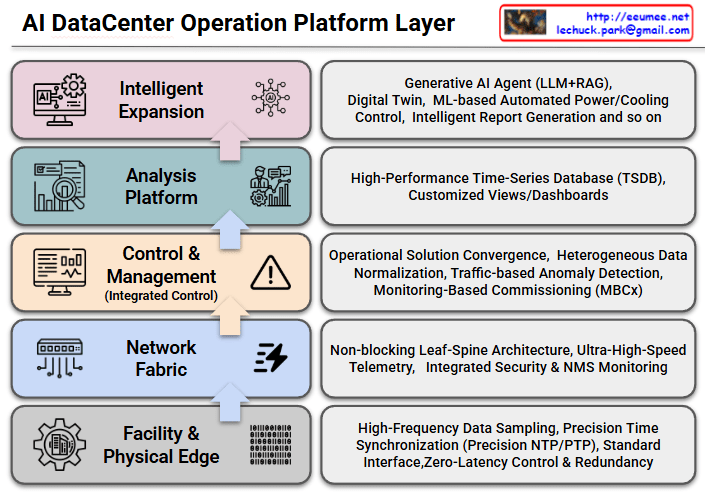
The provided image illustrates the architecture of an AI DataCenter Operation Platform, mapping it out in five distinct stages from the physical foundation layer up to the top-tier artificial intelligence application layer.

The upward-pointing arrows depict the flow of raw data collected from the infrastructure, demonstrating the system’s upward evolution and how the data is ultimately utilized intelligently by AI.

Here is the breakdown of the core roles and components of each layer:

  • Layer 1: Facility & Physical Edge
    • Role: The foundational layer responsible for collecting data and controlling the physical infrastructure equipment of the data center, such as power and cooling systems.
    • Key Elements: High-Frequency Data Sampling, Precision Time Synchronization (Precision NTP/PTP), Standard Interfaces, and Zero-Latency Control & Redundancy. This layer focuses on extracting data and issuing control commands to hardware with extreme speed and accuracy.
  • Layer 2: Network Fabric
    • Role: The neural network of the data center. It reliably and rapidly transmits the massive amounts of collected data to the upper platforms without bottlenecks.
    • Key Elements: Non-blocking Leaf-Spine Architecture, Ultra-High-Speed Telemetry, and Integrated Security & NMS (Network Management System) Monitoring. These elements work together to efficiently handle large-scale traffic.
  • Layer 3: Control & Management (Integrated Control)
    • Role: The layer that integrates and normalizes heterogeneous data streaming in from various facilities and solutions to execute practical operations and management.
    • Key Elements: Operational Solution Convergence, Heterogeneous Data Normalization, Traffic-based Anomaly Detection, and Monitoring-Based Commissioning (MBCx). It acts as a critical gateway to identify infrastructure issues early and improve overall operational efficiency.
  • Layer 4: Analysis Platform
    • Role: The stage where refined data is stored, analyzed, and visualized, allowing administrators to intuitively grasp the system’s status at a glance.
    • Key Elements: Utilizes a High-Performance Time-Series Database (TSDB) to record state changes over time and provides Customized Views/Dashboards for tailored monitoring.
  • Layer 5: Intelligent Expansion
    • Role: The ultimate destination of this platform. It is the highest layer where AI autonomously operates and optimizes the data center, leveraging the well-organized data provided by the lower layers.
    • Key Elements: Generative AI Agent (LLM+RAG), Digital Twin technology, ML-based Automated Power/Cooling Control, and Intelligent Report Generation.

This blueprint clearly demonstrates the overall solution architecture: precisely collecting and transmitting raw data from hardware facilities (Layers 1-2), standardizing, storing, and analyzing that data (Layers 3-4), and ultimately achieving advanced, autonomous operations through intelligent, automatic control of power and cooling systems via a Generative AI Agent (Layer 5).


#AIDataCenter #AIOps #DataCenterManagement #GenerativeAI #DigitalTwin #NetworkFabric #ITInfrastructure #SmartDataCenter #MachineLearning #TechArchitecture

With Gemini

Numeric Data Processing


Architecture Overview

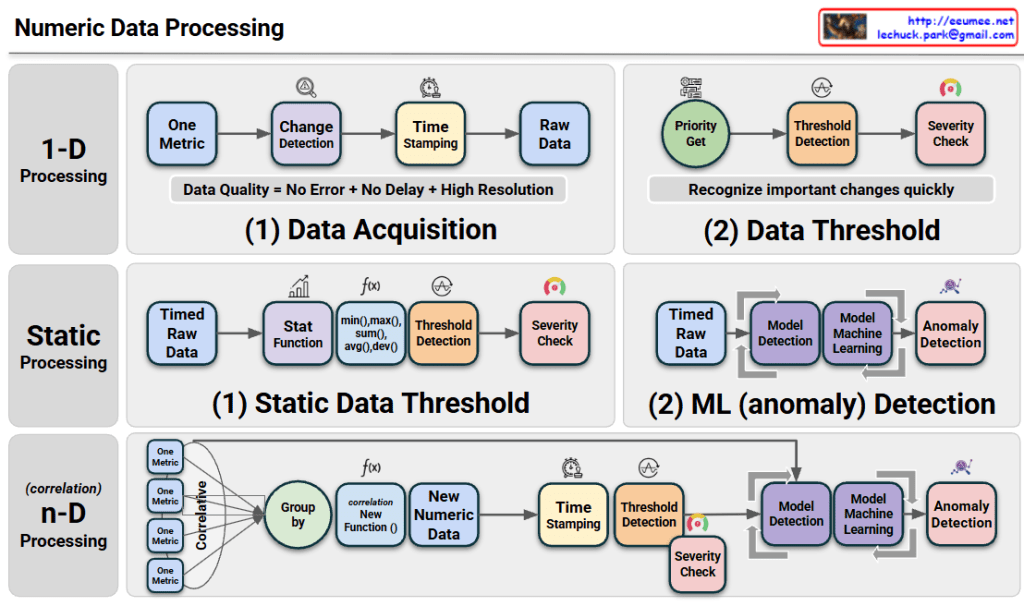
The diagram illustrates a tiered approach to Numeric Data Processing, moving from simple monitoring to advanced predictive analytics:

  • 1-D Processing (Real-time Detection): This layer focuses on individual metrics. It emphasizes high-resolution data acquisition with precise time-stamping to ensure data quality. It uses immediate threshold detection to recognize critical changes as they happen.
  • Static Processing (Statistical & ML Analysis): This stage introduces historical context. It applies statistical functions (like averages and deviations) to identify trends and uses Machine Learning (ML) models to detect anomalies that simple thresholds might miss.
  • n-D Processing (Correlative Intelligence): This is the most sophisticated layer. It groups multiple metrics to find correlations, creating “New Numeric Data” (synthetic metrics). By analyzing the relationship between different data points, it can identify complex root causes in highly interleaved systems.

Summary

  1. The framework transitions from reactive 1-D monitoring to proactive n-D correlation, enhancing the depth of system observability.
  2. It integrates statistical functions and machine learning to filter noise and identify true anomalies based on historical patterns rather than just fixed limits.
  3. The ultimate goal is to achieve high-fidelity data processing that enables automated severity detection and complex pattern recognition across multi-dimensional datasets.

#DataProcessing #AIOps #MachineLearning #Observability #Telemetry #SystemArchitecture #AnomalyDetection #DigitalTwin #DataCenterOps #InfrastructureMonitoring

With Gemini

Ready For AI DC


Ready for AI DC

This slide illustrates the “Preparation and Operation Strategy for AI Data Centers (AI DC).”

In the era of Generative AI and Large Language Models (LLM), it outlines the drastic changes data centers face and proposes a specific three-stage operation strategy (Digitization, Solutions, Operations) to address them.

1. Left Side: AI “Extreme” Changes

Core Theme: AI Data Center for Generative AI & LLM

  • High Cost, High Risk:
    • Establishing and operating AI DCs involves immense costs due to expensive infrastructure like GPU servers.
    • It entails high power consumption and system complexity, leading to significant risks in case of failure.
  • New Techs for AI:
    • Unlike traditional centers, new power and cooling technologies (e.g., high-density racks, immersion cooling) and high-performance computing architectures are essential.

2. Right Side: AI Operation Strategy

Three solutions to overcome the “High Cost, High Risk, and New Tech” environment.

A. Digitization (Securing Data)

  • High Precision, High Resolution: Collecting precise, high-resolution operational data (e.g., second-level power usage, chip-level temperature) rather than rough averages.
  • Computing-Power-Cooling All-Relative Data: Securing integrated data to analyze the tight correlations between IT load (computing), power, and cooling systems.

B. Solutions (Adopting Tools)

  • “Living” Digital Twin: Building a digital twin linked in real-time to the actual data center for dynamic simulation and monitoring, going beyond static 3D modeling.
  • LLM AI Agent: Introducing LLM-based AI agents to assist or automate complex data center management tasks.

C. Operations (Innovating Processes)

  • Integration for Multi/Edge(s): Establishing a unified management system that covers not only centralized centers but also distributed multi-cloud and edge locations.
  • DevOps for the Fast: Applying agile DevOps methodologies to development and operations to adapt quickly to the rapidly changing AI infrastructure.

💡 Summary & Key Takeaways

The slide suggests that traditional operating methods are unsustainable due to the costs and risks associated with AI workloads.

Success in the AI era requires precisely integrating IT and facility data (Digitization), utilizing advanced technologies like Digital Twins and AI Agents (Solutions), and adopting fast, integrated processes (Operations).


#AIDataCenter #AIDC #GenerativeAI #LLM #DataCenterStrategy #DigitalTwin #DevOps #AIInfrastructure #TechTrends #SmartOperations #EnergyEfficiency #EdgeComputing #AIInnovation

With Gemini

3 Layers for Digital Operations

3 Layers for Digital Operations – Comprehensive Analysis

This diagram presents an advanced three-layer architecture for digital operations, emphasizing continuous feedback loops and real-time decision-making.

🔄 Overall Architecture Flow

The system operates through three interconnected environments that continuously update each other, creating an intelligent operational ecosystem.


1️⃣ Micro Layer: Real-time Digital Twin Environment (Purple)

Purpose

Creates a virtual replica of physical assets for real-time monitoring and simulation.

Key Components

  • Digital Twin Technology: Mirrors physical operations in real-time
  • Real-time Real-Model: Processes high-resolution data streams instantaneously
  • Continuous Synchronization: Updates every change from physical assets

Data Flow

Data Sources (Servers, Networks, Manufacturing Equipment, IoT Sensors) → High Resolution Data QualityReal-time Real-ModelDigital Twin

Function

  • Provides granular, real-time visibility into operations
  • Enables predictive maintenance and anomaly detection
  • Simulates scenarios before physical implementation
  • Serves as the foundation for higher-level decision-making

2️⃣ Macro Layer: LLM-based AI Agent Environment (Pink)

Purpose

Analyzes real-time data, identifies events, and makes intelligent autonomous decisions using AI.

Key Components

  • AI Agent: LLM-powered intelligent decision system
  • Deterministic Event Log: Captures well-defined operational events
  • Add-on RAG (Retrieval-Augmented Generation): Enhances AI with contextual knowledge and documentation

Data Flow

Well-Defined Deterministic ProcessingDeterministic Event Log + Add-on RAGAI Agent

Function

  • Analyzes patterns and trends from Digital Twin data
  • Generates actionable insights and recommendations
  • Automates routine decision-making processes
  • Provides context-aware responses using RAG technology
  • Escalates complex issues to human operators

3️⃣ Human Layer: Operator Decision Environment (Green)

Purpose

Enables human oversight, strategic decision-making, and intervention when needed.

Key Components

  • Human-in-the-loop: Keeps humans in control of critical decisions
  • Well-Cognitive Interface: Presents data for informed judgment
  • Analytics Dashboard: Visualizes trends and insights

Data Flow

Both Digital Twin (Micro) and AI Agent (Macro) feed into → Human Layer for Well-Cognitive Decision Making

Function

  • Reviews AI recommendations and Digital Twin status
  • Makes strategic and high-stakes decisions
  • Handles exceptions and edge cases
  • Validates AI agent actions
  • Provides domain expertise and contextual understanding
  • Ensures ethical and business-aligned outcomes

🔁 Continuous Update Loop: The Key Differentiator

Feedback Mechanism

All three layers are connected through Continuous Update pathways (red arrows), creating a closed-loop system:

  1. Human Layer → feeds decisions back to Data Sources
  2. Micro Layer → continuously updates Human Layer
  3. Macro Layer → continuously updates Human Layer
  4. System-wide → all layers update the central processing and data sources

Benefits

  • Adaptive Learning: System improves based on human decisions
  • Real-time Optimization: Immediate response to changes
  • Knowledge Accumulation: RAG database grows with operations
  • Closed-loop Control: Decisions are implemented and their effects monitored

🎯 Integration Points

From Physical to Digital (Left → Right)

  1. High-resolution data from multiple sources
  2. Well-defined deterministic processing ensures data quality
  3. Parallel paths: Real-time model (Micro) and Event logging (Macro)

From Digital to Action (Right → Left)

  1. Human decisions informed by both layers
  2. Actions feed back to physical systems
  3. Results captured and analyzed in next cycle

💡 Key Innovation: Three-Way Synergy

  • Micro (Digital Twin): “What is happening right now?”
  • Macro (AI Agent): “What does it mean and what should we do?”
  • Human: “Is this the right decision given our goals?”

Each layer compensates for the others’ limitations:

  • Digital Twins provide accuracy but lack context
  • AI Agents provide intelligence but need validation
  • Humans provide wisdom but need information support

📝 Summary

This architecture integrates three operational environments: the Micro Layer uses real-time data to maintain Digital Twins of physical assets, the Macro Layer employs LLM-based AI Agents with RAG to analyze events and generate intelligent recommendations, and the Human Layer ensures well-cognitive decision-making through human-in-the-loop oversight. All three layers continuously update each other and feed decisions back to the operational systems, creating a self-improving closed-loop architecture. This synergy combines real-time precision, artificial intelligence, and human expertise to achieve optimal digital operations.


#DigitalTwin #AIAgent #HumanInTheLoop #ClosedLoopSystem #LLM #RAG #RetrievalAugmentedGeneration #RealTimeOperations #DigitalTransformation #Industry40 #SmartManufacturing #CognitiveComputing #ContinuousImprovement #IntelligentAutomation #DigitalOperations #AI #IoT #PredictiveMaintenance #DataDrivenDecisions #FutureOfManufacturing

With Claude

Modular Data Center

Modular Data Center Architecture Analysis

This image illustrates a comprehensive Modular Data Center architecture designed specifically for modern AI/ML workloads, showcasing integrated systems and their key capabilities.

Core Components

1. Management Layer

  • Integrated Visibility: DCIM & Digital Twin for real-time monitoring
  • Autonomous Operations: AI-Driven Analytics (AIOps) for predictive maintenance
  • Physical Security: Biometric Access Control for enhanced protection

2. Computing Infrastructure

  • High Density AI Accelerators: GPU/NPU optimized for AI workloads
  • Scalability: OCP (Open Compute Project) Racks for standardized deployment
  • Standardization: High-Speed Interconnects (InfiniBand) for low-latency communication

3. Power Systems

  • Power Continuity: Modular UPS with Li-ion Battery for reliable uptime
  • Distribution Efficiency: Smart Busway/Busduct for optimized power delivery
  • Space Optimization: High-Voltage DC (HVDC) for reduced footprint

4. Cooling Solutions

  • Hot Spot Elimination: In-Row/Rear Door Cooling for targeted heat removal
  • PUE Optimization: Liquid/Immersion Cooling for maximum efficiency
  • High Heat Flux Handling: Containment Systems (Hot/Cold Aisle) for AI density

5. Safety & Environmental

  • Early Detection: VESDA (Very Early Smoke Detection Apparatus)
  • Non-Destructive Suppression: Clean Agents (Novec 1230/FM-200)
  • Environmental Monitoring: Leak Detection System (LDS)

Why Modular DC is Critical for AI Data Centers

Speed & Agility

Traditional data centers take 18-24 months to build, but AI demands are exploding NOW. Modular DCs deploy in 3-6 months, allowing organizations to capture market opportunities and respond to rapidly evolving AI compute requirements without lengthy construction cycles.

AI-Specific Thermal Challenges

AI workloads generate 3-5x more heat per rack (30-100kW) compared to traditional servers (5-10kW). Modular designs integrate advanced liquid cooling and containment systems from day one, purpose-built to handle GPU/NPU thermal density that would overwhelm conventional infrastructure.

Elastic Scalability

AI projects often start experimental but can scale exponentially. The “pay-as-you-grow” model lets organizations deploy one block initially, then add capacity incrementally as models grow—avoiding massive upfront capital while maintaining consistent architecture and avoiding stranded capacity.

Edge AI Deployment

AI inference increasingly happens at the edge for latency-sensitive applications (autonomous vehicles, smart manufacturing). Modular DCs’ compact, self-contained design enables AI deployment anywhere—from remote locations to urban centers—with full data center capabilities in a standardized package.

Operational Efficiency

AI workloads demand maximum PUE efficiency to manage operational costs. Modular DCs achieve PUE of 1.1-1.3 through integrated cooling optimization, HVDC power distribution, and AI-driven management—versus 1.5-2.0 in traditional facilities—critical when GPU clusters consume megawatts.

Key Advantages

📦 “All pack to one Block” – Complete infrastructure in pre-integrated modules 🧩 “Scale out with more blocks” – Linear, predictable expansion without redesign

  • ⏱️ Time-to-Market: 4-6x faster deployment vs traditional builds
  • 💰 Pay-as-you-Grow: CapEx aligned with revenue/demand curves
  • 🌍 Anywhere & Edge: Containerized deployment for any location

Summary

Modular Data Centers are essential for AI infrastructure because they deliver pre-integrated, high-density compute, power, and cooling blocks that deploy 4-6x faster than traditional builds, enabling organizations to rapidly scale GPU clusters from prototype to production while maintaining optimal PUE efficiency and avoiding massive upfront capital investment in uncertain AI workload trajectories.

The modular approach specifically addresses AI’s unique challenges: extreme thermal density (30-100kW/rack), explosive demand growth, edge deployment requirements, and the need for liquid cooling integration—all packaged in standardized blocks that can be deployed anywhere in months rather than years.

This architecture transforms data center infrastructure from a multi-year construction project into an agile, scalable platform that matches the speed of AI innovation, allowing organizations to compete in the AI economy without betting the company on fixed infrastructure that may be obsolete before completion.


#ModularDataCenter #AIInfrastructure #DataCenterDesign #EdgeComputing #LiquidCooling #GPUComputing #HyperscaleAI #DataCenterModernization #AIWorkloads #GreenDataCenter #DCInfrastructure #SmartDataCenter #PUEOptimization #AIops #DigitalTwin #EdgeAI #DataCenterInnovation #CloudInfrastructure #EnterpriseAI #SustainableTech

With Claude