Data-driven Operation & Service

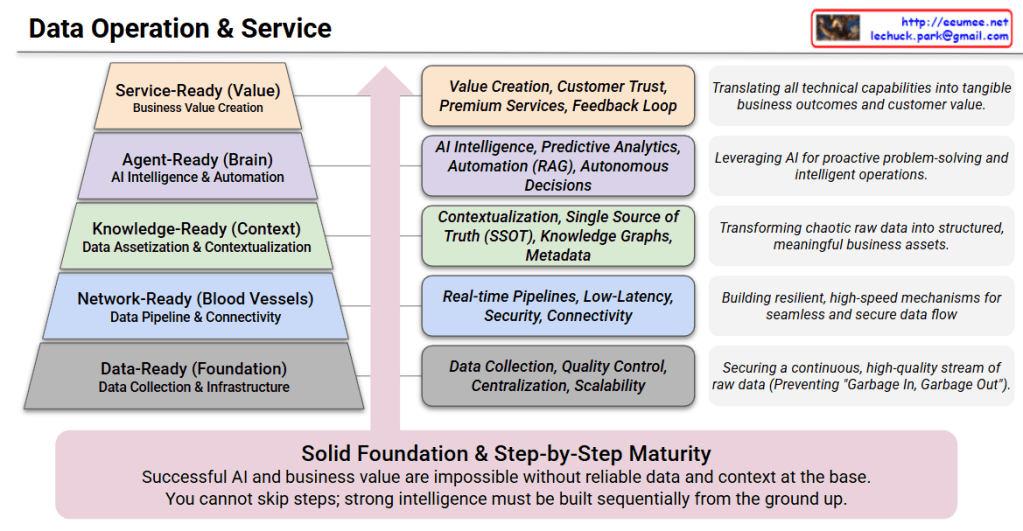
This image illustrates the “Data Operation & Service” 5-tier maturity model in a pyramid structure, outlining the journey a company must take from basic data collection to ultimate business value creation. The upward arrow emphasizes the sequential nature of this process.

  • Tier 1: Data-Ready (Foundation)
    • Concept: Data Collection & Infrastructure.
    • Details: The most fundamental step focused on securing a continuous, high-quality stream of raw data to prevent “Garbage In, Garbage Out.” Key elements include data collection, quality control, centralization, and scalability.
  • Tier 2: Network-Ready (Blood Vessels)
    • Concept: Data Pipeline & Connectivity.
    • Details: Building resilient, high-speed mechanisms for seamless and secure data flow. It focuses on real-time pipelines, low-latency, and security.
  • Tier 3: Knowledge-Ready (Context)
    • Concept: Data Assetization & Contextualization.
    • Details: Transforming chaotic raw data into structured, meaningful business assets. This involves contextualization, establishing a Single Source of Truth (SSOT), Knowledge Graphs, and metadata.
  • Tier 4: Agent-Ready (Brain)
    • Concept: AI Intelligence & Automation.
    • Details: Leveraging AI for proactive problem-solving and intelligent operations. It includes predictive analytics, automation (like RAG), and autonomous decisions based on the context built in Tier 3.
  • Tier 5: Service-Ready (Value)
    • Concept: Business Value Creation.
    • Details: Translating all underlying technical capabilities into tangible business outcomes and customer value. This leads to value creation, customer trust, premium services, and a continuous feedback loop.

💡 Core Philosophy (Bottom Box): Solid Foundation & Step-by-Step Maturity Successful AI and business value are impossible without reliable data and context at the base. You cannot skip steps; strong intelligence must be built sequentially from the ground up.

This framework delivers the core message that true data-driven operations can only be achieved by building a solid foundation from the ground up without skipping any steps—progressing from basic data collection (the foundation), through AI-driven automation (the brain), and ultimately reaching the creation of tangible business value.

#DataOperations #DataMaturityModel #AI_Framework #DataDriven #BusinessValueCreation #DigitalTransformation

With Gemini

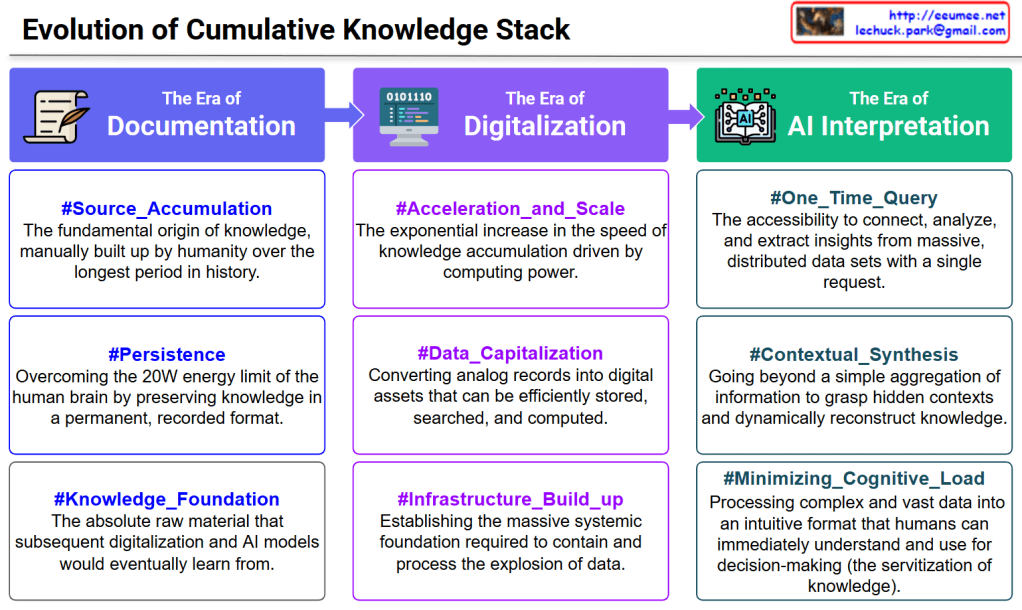
Evolution of Cumulative Knowledge Stack

The Evolution of the Cumulative Knowledge Stack

The provided image is a infographic that categorizes the historical and technological evolution of how humanity accumulates and utilizes knowledge into three distinct paradigms. It highlights a “Cumulative Stack” where each era builds upon the foundational raw materials established by the previous one.

1. The Era of Documentation

This era represents the fundamental origin of knowledge generation and preservation.

  • Overcoming Physical Limits: By permanently recording knowledge in analog formats, humanity overcame the 20W energy limit of the human brain, ensuring the #Persistence of information.
  • The Ultimate Resource: This manual #Source_Accumulation serves as the absolute #Knowledge_Foundation—the essential raw material that subsequent digital systems and AI models would eventually learn from.

2. The Era of Digitalization

This period marks the transformation of analog records into computable assets, driven by the rise of computing power.

  • Speed and Scale: The speed of knowledge accumulation experienced exponential growth (#Acceleration_and_Scale).
  • Asset Creation and Infrastructure: Analog records were transformed into efficiently searchable digital assets (#Data_Capitalization). Concurrently, the massive systemic foundation (#Infrastructure_Build_up) required to contain and process this data explosion was established.

3. The Era of AI Interpretation

The current and future paradigm where AI comprehends vast, digitized datasets to provide contextual insights and actionable intelligence.

  • Unified Access: Massive, distributed datasets can now be connected, analyzed, and queried through a single request (#One_Time_Query).
  • Deep Comprehension: Moving beyond simple data aggregation, AI grasps hidden contexts and dynamically reconstructs knowledge (#Contextual_Synthesis).
  • Servitization of Knowledge: By processing complex, vast data—such as intricate system logs or operational metrics—into an intuitive format, AI drastically reduces human cognitive load (#Minimizing_Cognitive_Load). This enables rapid, data-driven decision-making and seamless platform operations.

Summary

This framework illustrates that advanced AI interpretation is only possible upon a solid foundation of accumulated records and robust digital infrastructure. It perfectly encapsulates the transition toward intelligent platforms, where complex data is seamlessly translated into actionable insights, effectively reducing the cognitive burden on those making critical operational decisions.

#CumulativeKnowledge #DigitalTransformation #AI_Interpretation #ContextualSynthesis #CognitiveOffloading #KnowledgeServitization #TechVisualization #DataCapitalization #InfrastructureEvolution

With Gemini

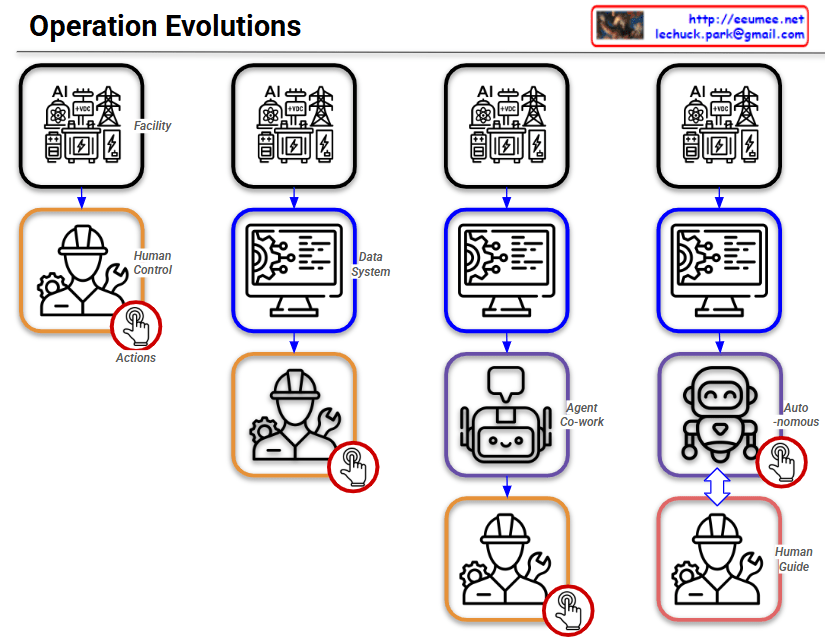
Operation Evolutions

By following the red circle with the ‘Actions’ (clicking hand) icon, you can easily track how the control and operational authority shift throughout the four stages.

Stage 1: Human Control

  • Structure: Facility ➡️ Human Control
  • Description: This represents the most traditional, manual approach. Without a centralized data system, human operators directly monitor the facility’s status and manually execute all Actions based on their physical observations and judgment.

Stage 2: Data System

  • Structure: Facility ➡️ Data System ➡️ Human Control
  • Description: A monitoring or data system (like a dashboard) is introduced. Humans now rely on the data collected by the system to understand the facility’s condition. However, the final Actions are still manually performed by humans.

Stage 3: Agent Co-work

  • Structure: Facility ➡️ Data System ➡️ Agent Co-work ➡️ Human Control
  • Description: An AI Agent is introduced as an intermediary between the data system and the human operator. The AI analyzes the data and provides insights, recommendations, or assistance. Even with this support, the final decision-making and physical Actions remain entirely the human’s responsibility.

Stage 4: Autonomous (Auto-nomous)

  • Structure: Facility ➡️ Data System ➡️ Auto-nomous ↔️ Human Guide
  • Description: This is the ultimate stage of operational evolution. The authority to execute Actions has shifted from the human to the AI. The AI analyzes data, makes independent decisions, and autonomously controls the facility. The human’s role transitions from a direct controller to a ‘Human Guide’, supervising the AI and providing high-level directives. The two-way arrow indicates a continuous, interactive feedback loop where the human and AI collaborate to refine and optimize the system.

Summary:

This slide intuitively illustrates a paradigm shift in infrastructure operations: progressing from Direct Human Intervention ➡️ System-Assisted Cognition ➡️ AI-Assisted Operations (Co-work) ➡️ Fully Autonomous AI Control with Human Supervision.

#AIOps #AutonomousOperations #TechEvolution #DigitalTransformation #DataCenter #FacilityManagement #InfrastructureAutomation #SmartFacilities #AIAgents #FutureOfWork #HumanAndAI #Automation

with Gemini

Operation Digitalization Step

Operation Digitalization Step: A 4-Step Roadmap

Step 1: Digitalization (The Start)

  • Goal: Securing data digitization and observability. It is the foundational phase of gathering and monitoring data before applying any advanced automation.

Step 2: Reactive Enhancement (Human Knowledge)

  • Goal: Applying LLM & RAG agents as a “Human Help Tool.”
  • Details: It relies on pre-verified processes to prevent AI hallucinations. By analyzing text-based event messages and operation manuals, it provides an “Easy and Effective first” approach to assist human operators.

Step 3: Proactive Enhancement (Machine Learning)

  • Goal: Deriving new insights through pattern analysis and machine learning.
  • Details: It utilizes specific and deep AI models based on metric statistics to provide an “AI Analysis Guide.” However, the final action still relies on a “Human Decision.”

Step 4: Autonomous Enhancement (Full-Validated Closed-Loop)

  • Goal: Achieving stable, AI-controlled operations.
  • Details: It prioritizes low-risk, high-gain loops. Through verified machines and strict guide rails, the system executes autonomous “AI Control” under full verification to manage risks.
  • Core Feedback Loop: The outcomes from both human decisions (Step 3) and AI control (Step 4) are ultimately designed to make “Everything Easy to Read,” ensuring transparency and intuitive understanding for operators.

  1. Progressive Evolution: The roadmap illustrates a strategic 4-step journey from basic data observability to fully autonomous, AI-controlled operations.
  2. Practical AI Adoption: It emphasizes a safe, low-risk strategy, starting with LLM/RAG as human-assist tools before advancing to predictive machine learning and closed-loop automation.
  3. Human-Centric Transparency: Regardless of the automation level, the ultimate design ensures all AI actions and system insights remain intuitive and “Easy to Read” for human operators.

#OperationDigitalization #AIOps #AutonomousOperations #DataCenterManagement #ITInfrastructure #LLM #RAG #MachineLearning #DigitalTransformation

Event Processing Functional Architecture

This image illustrates a Data Processing Pipeline (Architecture) where raw data is ingested, analyzed through an AI engine, and converted into actionable business intelligence.


## Image Interpretation: AI-Driven Data Pipeline

### 1. Input Layer (Left: Data Ingestion)

This represents the raw data collected from various sources within the infrastructure:

  • Log Data (Document Icon): System logs and event records that capture operational history.
  • Sensor Data (Thermometer & Waveform Icons): Real-time monitoring of physical environments, specifically focusing on Thermal (heat) and Acoustic (noise) patterns.
  • Topology Map (Network Icon): The structural map of equipment and their interconnections, providing context for how data flows through the system.

### 2. Integration & Processing (Center: The AI Funnel)

  • The Funnel/Pipe Shape: This symbolizes the process of data fusion and refinement. It represents different data types being standardized and processed through an AI model or analytics engine to filter out noise and identify patterns.

### 3. Output Layer (Right: Actionable Insights)

The final results generated by the analysis, designed to provide immediate value to operators:

  • Root Cause Report (Document with Magnifying Glass): Identifies the underlying reason for a specific failure or anomaly.
  • Step-by-Step Recovery Guide (Checklist with Arrows): Provides a sequential, automated, or manual procedure to restore the system to a healthy state.
  • Predictive Maintenance (Gear with Upward Arrow): Utilizes historical trends to predict potential failures before they occur, optimizing maintenance schedules and reducing downtime.

# Summary

The diagram effectively visualizes the transition from complex raw data to actionable intelligence. It highlights the core value of an AI-driven platform: reducing cognitive load for human operators by providing clear, data-backed directions for maintenance and recovery.


#AI #DataCenter #PredictiveMaintenance #DataAnalytics #SmartInfrastructure #RootCauseAnalysis #DigitalTransformation #OperationsOptimization

With Gemini

To the full Automation

This visual emphasizes the critical role of high-quality data as the engine driving the transition from human-led reactions to fully autonomous operations. This roadmap illustrates how increasing data resolution directly enhances detection and automated actions.


Comprehensive Analysis of the Updated Roadmap

1. The Standard Operational Loop

The top flow describes the current state of industrial maintenance:

  • Facility (Normal): The baseline state where everything functions correctly.
  • Operation (Changes) & Data: Any deviation in operation produces data metrics.
  • Monitoring & Analysis: The system observes these metrics to identify anomalies.
  • Reaction: Currently, a human operator (the worker icon) must intervene to bring the system “Back to the normal”.

2. The Data Engine

The most significant addition is the emphasized Data block and its impact on the automation cycle:

  • Quality and Resolution: The diagram highlights that “More Data, Quality, Resolution” are the foundation.
  • Optimization Path: This high-quality data feeds directly into the “Detection” layer and the final “100% Automation” goal, stating that better data leads to “Better Detection & Action”.

3. Evolution of Detection Layers

Detection matures through three distinct levels, all governed by specific thresholds:

  • 1 Dimension: Basic monitoring of single variables.
  • Correlation & Statistics: Analyzing relationships between different data points.
  • AI Analysis with AI/ML: Utilizing advanced machine learning for complex pattern recognition.

4. The Goal: 100% Automation

The final stage replaces human “Reaction” with autonomous “Action”:

  • LLM Integration: Large Language Models are utilized to bridge the gap from “Easy Detection” to complex “Automation”.
  • The Vision: The process culminates in 100% Automation, where a robotic system handles the recovery loop independently.
  • The Philosophy: It concludes with the defining quote: “It’s a dream, but it is the direction we are headed”.

Summary

  • The roadmap evolves from human intervention (Reaction) to autonomous execution (Action) powered by AI and LLMs.
  • High-resolution data quality is identified as the core driver that enables more accurate detection and reliable automated outcomes.
  • The ultimate objective is a self-correcting system that returns to a “Normal” state without manual effort.

#HyperAutomation #DataQuality #IndustrialAI #SmartManufacturing #LLM #DigitalTwin #AutonomousOperations #AIOp

With Gemini

Labeling for AI World

The image illustrates a logical framework titled “Labeling for AI World,” which maps how human cognitive processes are digitized and utilized to train Large Language Models (LLMs). It emphasizes the transition from natural human perception to optimized AI integration.


1. The Natural Cognition Path (Top)

This track represents the traditional human experience:

  • World to Human with a Brain: Humans sense the physical world through biological organs, which the brain then analyzes and processes into information.
  • Human Life & History: This cognitive processing results in the collective knowledge, culture, and documented history of humanity.

2. The Digital Optimization Path (Bottom)

This track represents the technical pipeline for AI development:

  • World Data: Through Digitization, the physical world is converted into raw data stored in environments like AI Data Centers.
  • Human Optimization: This raw data is refined through processes like RLHF (Reinforcement Learning from Human Feedback) or fine-tuning to align AI behavior with human intent.
  • Human Life with AI (LLM): The end goal is a lifestyle where humans and LLMs coexist, with the AI acting as a sophisticated partner in daily life.

3. The Central Bridge: Labeling (Corpus & Ontology)

The most critical element of the diagram is the central blue box, which acts as a bridge between human logic and machine processing:

  • Corpus: Large-scale structured text data necessary for training.
  • Ontology: The formal representation of categories, properties, and relationships between concepts that define the human “worldview.”
  • The Link: High-quality Labeling ensures that AI optimization is grounded in human-defined logic (Ontology) and comprehensive language data (Corpus), ensuring both Quality and Optimization.

Summary

The diagram demonstrates that Data Labeling, guided by Corpus and Ontology, is the essential mechanism that translates human cognition into the digital realm. It ensures that LLMs are not just processing raw numbers, but are optimized to understand the world through a human-centric logical framework.

#AI #DataLabeling #LLM #Ontology #Corpus #CognitiveComputing #AIOptimization #DigitalTransformation

With Gemini