For AI, With AI

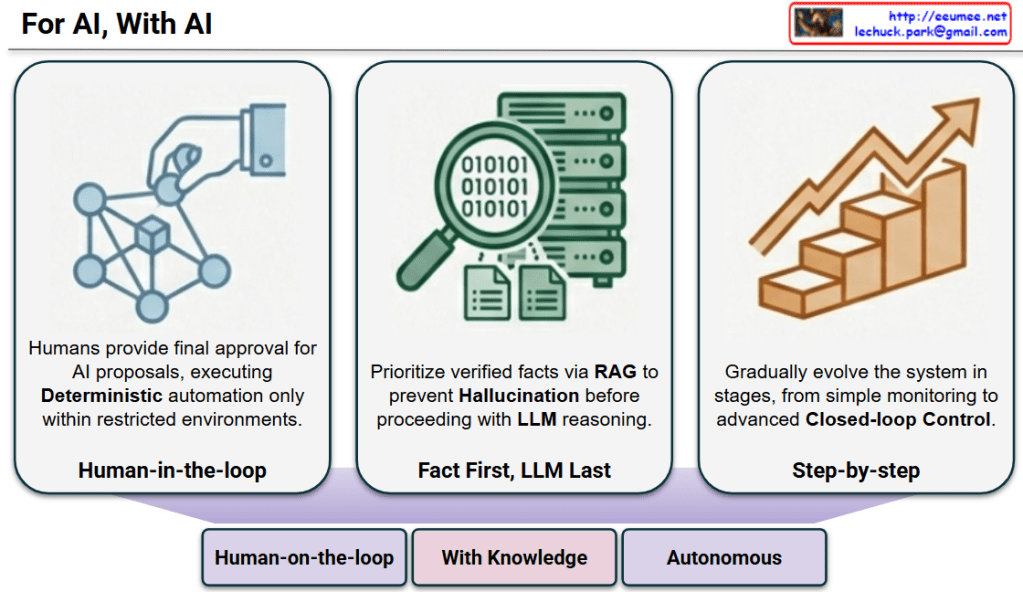
The provided image illustrates the three core operational principles of ‘For AI, With AI’ in English and outlines the future evolutionary direction of each principle through the bottom panels.

‘For AI, With AI’ Strategy and Evolutionary Direction

1. Evolution of Control: From Intervention to Supervision

  • Current (Human-in-the-loop): Humans must directly intervene to provide “final approval” for AI proposals before executing deterministic automation in restricted environments.
  • Evolution Direction (➡️ Human-on-the-loop): As the system advances, the human role shifts from a constant approver to an “Overseer” who monitors the system’s automated operations and intervenes only when necessary.

2. Evolution of Knowledge Utilization: From Fact-Checking to Knowledge Internalization

  • Current (Fact First, LLM Last): To prevent AI hallucination, verified facts are prioritized and provided via RAG before the LLM proceeds with reasoning.
  • Evolution Direction (➡️ With Knowledge): Moving beyond simple fact retrieval, the system evolves into a “Knowledge-Based System” that integrates and internalizes vast domain expertise for deeper and more accurate reasoning.

3. Evolution of Automation: From Gradual Steps to Full Autonomy

  • Current (Step-by-step): The system gradually evolves in stages, starting from simple monitoring and steadily advancing toward Closed-loop Control.
  • Evolution Direction (➡️ Autonomous): The ultimate goal of this gradual progression is to reach a fully “Autonomous” state, where the system can recognize, judge, and control operations independently without human intervention.

In summary:

This diagram visually presents a roadmap transitioning from the current conservative, human-controlled AI operational methods (top panels) to future AI systems that are autonomous, knowledge-embedded, and capable of independent operation (bottom panels).

#AIStrategy #ForAIWithAI #HumanInTheLoop #HumanOnTheLoop #RAG #LLM #AutonomousAI #ClosedLoopControl #AIAutomation #FutureOfAI

With Gemini

Co-Work

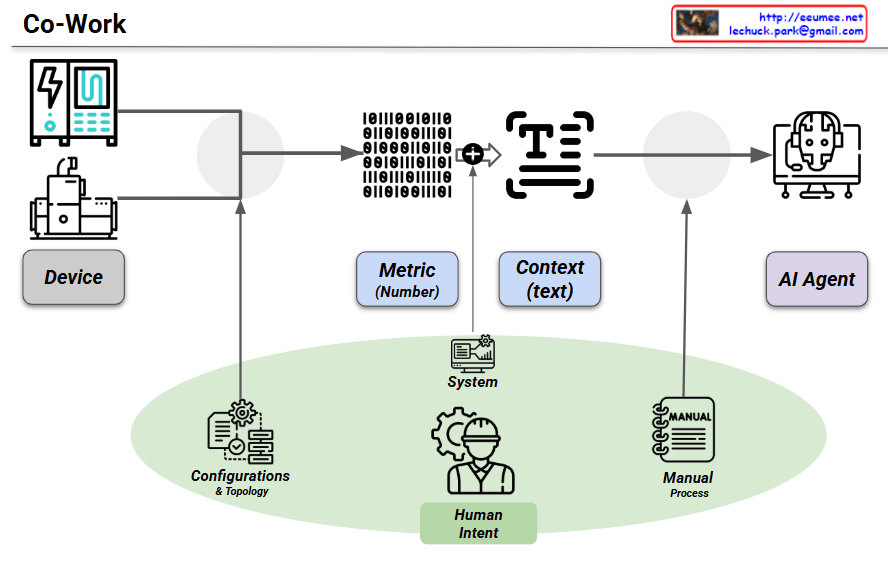
This image, titled “Co-Work,” illustrates a strategic framework for Event-Centric AIOps. It demonstrates how raw telemetry from physical infrastructure is transformed into structured, actionable intelligence for an AI Agent, fundamentally driven by human expertise.

1. Data Generation and Extraction

  • Device to Metric: Physical infrastructure (Device) generates raw operational data.
  • The Role of Configurations: This data is extracted into quantitative Metric (Number) formats. This extraction is guided by Configurations & Topology, which represents the structural configurations and network topology. This ensures the system understands the physical and logical layout of the devices.

2. Contextualization

  • Metric to Context: Raw numerical data lacks operational meaning on its own. It is transformed into readable Context (text), effectively converting raw telemetry into event logs suitable for LLM-based analysis.
  • The Role of System: This conversion is executed by the System, which acts as the Data Processing Operating System. It defines the rules and logic for how raw numbers are processed, correlated, and translated into meaningful operational states.

3. AI Agent Integration

  • Context to AI Agent: The structured, contextualized text is delivered to the AI Agent for analysis, root cause identification, or predictive tasks.
  • The Role of Manual: The AI Agent’s understanding is heavily enriched by the Manual, which encompasses text-based operating manuals, standard operating procedures (SOPs), and historical troubleshooting data. This provides the AI with established guidelines for how to interpret and react to specific scenarios.

4. The Foundation: Human Intent

The green foundational layer, Human Intent, is the most critical aspect of this architecture. Configurations, System, and Manual are the three core elements and systems that are actively built and managed by humans. They dictate the rules, structural layout, and historical knowledge that guide the AI. This ensures that the AI Agent does not operate in a vacuum, but rather functions safely and effectively within the strict boundaries of human operational intent.

Summary

The “Co-Work” architecture visualizes a collaborative AIOps framework where raw device metrics are systematically transformed into contextualized text. By leveraging three key human-managed components—Configurations (topology), Systems (data processing), and Manuals (historical/procedural text)—the architecture bridges the gap between physical hardware and AI. It ensures the AI Agent receives highly structured, context-rich event data to perform accurate and reliable infrastructure management.

#AIOps #EventCentricAIOps #AIDataCenter #HumanInTheLoop #Telemetry #LLM #ITOperations

AI Agent : Bring Up


Visualizing the Evolution of an AI Agent: The “Bring UP” Process

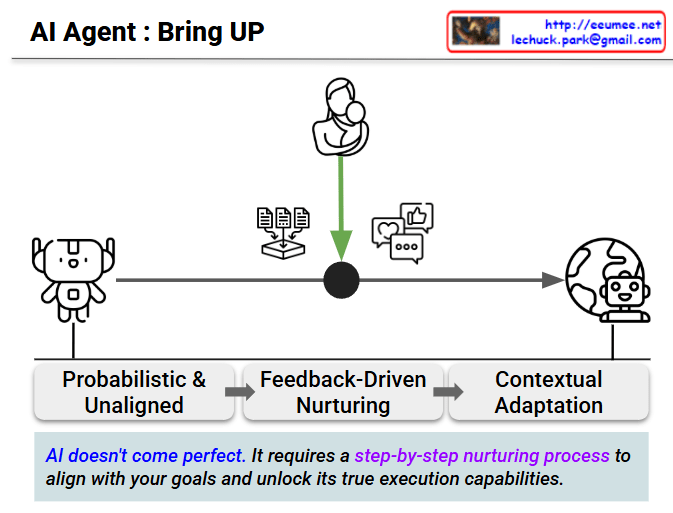
This infographic, titled “AI Agent : Bring UP,” effectively illustrates the evolutionary journey of an Artificial Intelligence from a raw, untrained model to a fully functional, real-world agent. It uses a powerful “nurturing” metaphor to emphasize that building a reliable AI is not a plug-and-play event, but a continuous process of guidance.

Here is the step-by-step breakdown of the AI’s journey:

1. The Starting Point: Probabilistic & Unaligned

  • Visual: The basic, blank-faced robot on the far left.
  • Meaning: This represents the raw AI (such as a base LLM). At this initial stage, the AI is merely a probabilistic engine. It predicts outputs based on statistical likelihoods but fundamentally lacks an understanding of the user’s true intent, operational goals, or constraints. It is a powerful tool, but it is “unaligned.”

2. The Critical Phase: Feedback-Driven Nurturing

  • Visual: The central nexus featuring a parent holding a child, flanked by documents (data) and social interaction icons (likes/comments).
  • Meaning: This is the most crucial step—the “Human-in-the-Loop” process. The parent-child icon symbolizes that an AI must be nurtured. To bridge the gap between a raw model and a useful agent, it requires the injection of specific contextual data (documents) and continuous, iterative human feedback (represented by the interaction icons).

3. The Final Goal: Contextual Adaptation

  • Visual: The advanced, confident robot standing in front of a globe on the right.
  • Meaning: Having successfully passed through the nurturing phase, the AI is no longer just a text generator. It has adapted to complex, real-world contexts (the globe). It is now an aligned, goal-oriented “Agent” capable of understanding its environment and executing tasks accurately.

💡 The Key Takeaway

The most important message is captured in the footer: “AI doesn’t come perfect.”

Many people expect out-of-the-box perfection from AI, but this diagram clearly debunks that myth. To unlock an AI’s true execution capabilities, you cannot skip the middle step. It mandates a step-by-step nurturing process to align the technology with your specific objectives. Perfection is not the starting point; it is the result of continuous guidance.


#AIAgents #ArtificialIntelligence #AIAlignment #HumanInTheLoop #MachineLearning #TechVisualization #AIOps #LLM #TechLeadership #Innovation

With Gemini

The Start of LLM Operations

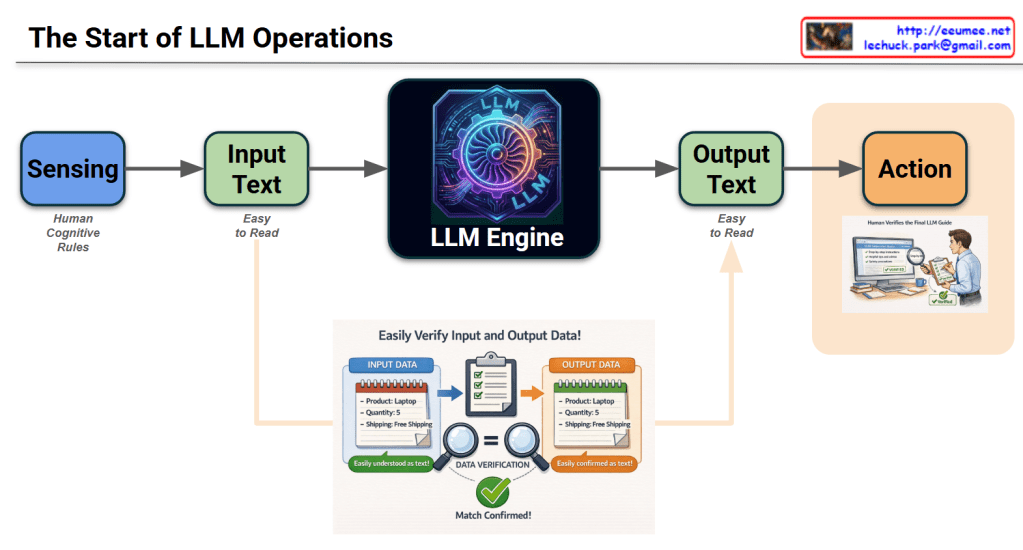
This infographic, titled “The Start of LLM Operations,” illustrates the end-to-end workflow of how a Large Language Model (LLM) processes information to drive real-world outcomes.


Detailed Breakdown of the Workflow

1. Core Process Flow (Horizontal Axis)

  • Sensing: The initial stage where data is gathered based on Human Cognitive Rules. It represents the system “perceiving” the environment or requirements.
  • Input Text: Data is converted into a format that is “Easy to Read” for humans, ensuring the prompt or command is transparent.
  • LLM Engine: The central processing unit (symbolized by a high-tech gear) that analyzes the input and generates a response.
  • Output Text: The engine produces a result, again in a human-readable format, to ensure clarity before execution.
  • Action: The final stage where the output is translated into a functional task or operation.

2. Data Verification (Bottom Inset)

This section highlights the critical “Check & Balance” mechanism:

  • Input Data vs. Output Data: It shows a specific example (Product: Laptop, Quantity: 5, Shipping: Free).
  • Validation: The use of magnifying glasses and a green checkmark (Match Confirmed!) emphasizes that the output must strictly align with the input requirements to prevent hallucinations or errors.

3. Human-in-the-Loop (Right Section)

  • The image of the person reviewing a checklist (“Human Verifies the Final LLM Guide”) signifies that human oversight is the final gatekeeper. Before the “Action” is taken, a person ensures the AI’s logic and results are safe and accurate.

Summary & Insight

The diagram suggests that successful LLM operations are not just about the model’s intelligence, but about transparency and verification. By keeping data “Easy to Read” and involving “Human Verification,” the system ensures that AI-driven actions are reliable and grounded in human-defined rules.


Hashtags

#LLMOps #GenerativeAI #AIWorkflow #DataVerification #HumanInTheLoop #ArtificialIntelligence #TechInfographic #AIOperations #MachineLearning #PromptEngineering

With Gemini

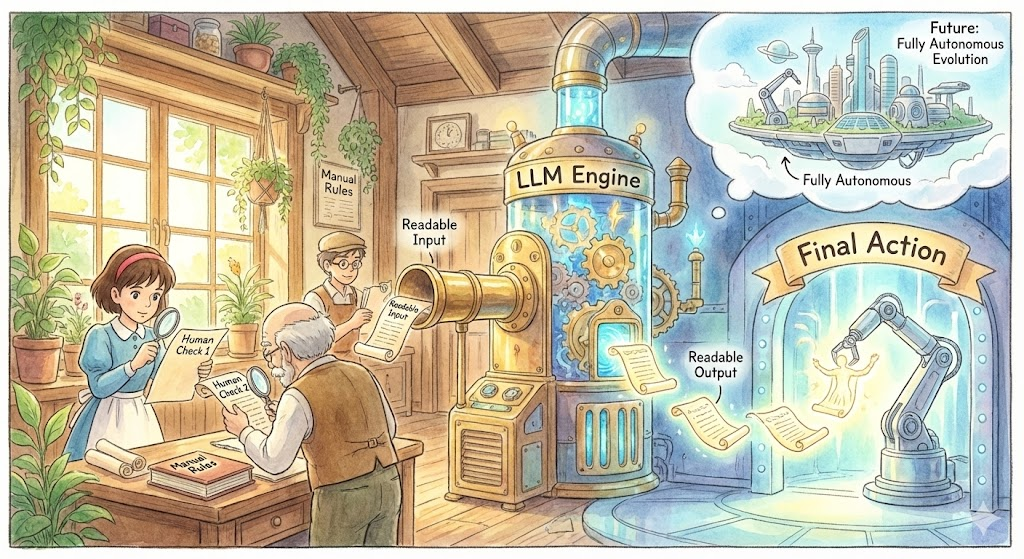
Easy LLM


🤖 Strategic Overview: The Most Accessible LLM Framework

This framework is designed as a Human-in-the-loop architecture. It prioritizes immediate usability and safety while serving as a critical stepping stone toward Fully Autonomous AI.

1. Human-Guided Foundation (Input Phase)

  • Manual Rules & Structured Data: Instead of relying on raw, unpredictable data, humans define clear “Manual Rules.” This ensures the LLM Engine receives high-quality, “Readable Input.”
  • Initial Verification (Human Check 1 & 2): Every piece of information is scrutinized before it enters the AI core. This eliminates the risk of “garbage in, garbage out” and ensures the AI operates within a predefined ethical and logical boundary.

2. Transparent Processing (The Engine)

  • The LLM Engine: The AI performs the heavy lifting—reasoning, summarizing, and generating content—based on the verified input.
  • Readable Output: The system is designed to produce results that are easy for humans to interpret. This transparency removes the “Black Box” problem, making the AI’s logic visible and manageable.

3. Safety-First Execution (Output Phase)

  • The Final Gatekeeper (Human Check 3): Before any “Final Action” (like sending an email or updating a database) is taken, a human provides the final stamp of approval.
  • Reliability: This layer of human oversight ensures that the AI’s “hallucinations” or errors are caught before they have real-world consequences.

4. The Evolutionary Path (Future Vision)

  • Data as an Asset: Every human intervention and correction in this “easy” setup is recorded. This creates a high-quality feedback loop (RLHF – Reinforcement Learning from Human Feedback).
  • Transition to Autonomy: As the AI learns from these human corrections, the need for manual checks will gradually decrease. Eventually, the system will evolve into the “Fully Autonomous Evolution” shown in the illustration—a state where the AI operates independently with peak efficiency.

Key Takeaway: This approach is “easiest” because it builds trust and safety through human intuition today, while systematically building the data foundation needed for a fully automated tomorrow.

#LLM #AI_Strategy #HumanInTheLoop #AutonomousAI #FutureOfAI #AIOps #AI_Evolution #GenerativeAI #DataStrategy

With Gemini

Human Rules Always


The Evolutionary Roadmap to Human-Optimized AI

This diagram visualizes the history and future direction of intelligent systems. It illustrates the evolution from the era of manual programming to the current age of generative AI, and finally to the ultimate goal where human standards perfect the technology.

1. The 3 Stages of Technological Evolution (Top Flow)

  • Stage 1: Rule-Based (The Foundation / Past)
    • Concept: “The Era of Human-Defined Logic”
    • Context: This represents the starting point of computing where humans explicitly created formulas and coded every rule.
    • Characteristics: It is 100% Deterministic. While accurate within its scope, it cannot handle the complexity of the real world beyond what humans have manually programmed.
  • Stage 2: AI LLM (The Transition / Present)
    • Concept: “The Era of Probabilistic Scale”
    • Context: We have evolved into the age of massive parallel processing and Large Language Models.
    • Characteristics: It operates on 99…% Probability. It offers immense scalability and creativity that rule-based systems could never achieve, but it lacks the absolute certainty of the past, occasionally leading to inefficiencies or hallucinations.
  • Stage 3: Human Optimized AI (The Final Goal / Future)
    • Concept: “The Era of Reliability & Efficiency”
    • Context: This is the destination we must reach. It is not just about using AI, but about integrating the massive power of the “Present” (AI LLM) with the precision of the “Past” (Rule-Based).
    • Characteristics: By applying human standards to control the AI’s massive parallel processing, we achieve a system that is both computationally efficient and strictly reliable.

2. The Engine of Evolution: Human Standards (Bottom Box)

This section represents the mechanism that drives the evolution from Stage 2 to Stage 3.

  • The Problem: Raw AI (Stage 2) consumes vast energy and can be unpredictable.
  • The Solution: We must re-introduce the “Human Rules” (History, Logic, Ethics) established in Stage 1 into the AI’s workflow.
  • The Process:
    • Constraint & Optimization: Human Cognition and Rules act as a pruning mechanism, cutting off wasteful parallel computations in the LLM.
    • Safety: Ethics ensure the output aligns with human values.
  • Result: This filtering process transforms the raw, probabilistic energy of the LLM into the polished, “Human Optimized” state.

3. The Feedback Loop (Continuous Evolution)

  • Dashed Line: The journey doesn’t end at Stage 3. The output from the optimized AI is reviewed by humans, which in turn updates our rules and ethical standards. This circular structure ensures that the AI continues to evolve alongside human civilization.

This diagram declares that the future of AI lies not in discarding the old “Rule-Based” ways, but in fusing that deterministic precision with modern probabilistic power to create a truly optimized intelligence.


#AIEvolution #FutureOfAI #HybridAI #DeterministicVsProbabilistic #HumanInTheLoop #TechRoadmap #AIArchitecture #Optimization #ResponsibleAI

3 Layers for Digital Operations

3 Layers for Digital Operations – Comprehensive Analysis

This diagram presents an advanced three-layer architecture for digital operations, emphasizing continuous feedback loops and real-time decision-making.

🔄 Overall Architecture Flow

The system operates through three interconnected environments that continuously update each other, creating an intelligent operational ecosystem.


1️⃣ Micro Layer: Real-time Digital Twin Environment (Purple)

Purpose

Creates a virtual replica of physical assets for real-time monitoring and simulation.

Key Components

  • Digital Twin Technology: Mirrors physical operations in real-time
  • Real-time Real-Model: Processes high-resolution data streams instantaneously
  • Continuous Synchronization: Updates every change from physical assets

Data Flow

Data Sources (Servers, Networks, Manufacturing Equipment, IoT Sensors) → High Resolution Data QualityReal-time Real-ModelDigital Twin

Function

  • Provides granular, real-time visibility into operations
  • Enables predictive maintenance and anomaly detection
  • Simulates scenarios before physical implementation
  • Serves as the foundation for higher-level decision-making

2️⃣ Macro Layer: LLM-based AI Agent Environment (Pink)

Purpose

Analyzes real-time data, identifies events, and makes intelligent autonomous decisions using AI.

Key Components

  • AI Agent: LLM-powered intelligent decision system
  • Deterministic Event Log: Captures well-defined operational events
  • Add-on RAG (Retrieval-Augmented Generation): Enhances AI with contextual knowledge and documentation

Data Flow

Well-Defined Deterministic ProcessingDeterministic Event Log + Add-on RAGAI Agent

Function

  • Analyzes patterns and trends from Digital Twin data
  • Generates actionable insights and recommendations
  • Automates routine decision-making processes
  • Provides context-aware responses using RAG technology
  • Escalates complex issues to human operators

3️⃣ Human Layer: Operator Decision Environment (Green)

Purpose

Enables human oversight, strategic decision-making, and intervention when needed.

Key Components

  • Human-in-the-loop: Keeps humans in control of critical decisions
  • Well-Cognitive Interface: Presents data for informed judgment
  • Analytics Dashboard: Visualizes trends and insights

Data Flow

Both Digital Twin (Micro) and AI Agent (Macro) feed into → Human Layer for Well-Cognitive Decision Making

Function

  • Reviews AI recommendations and Digital Twin status
  • Makes strategic and high-stakes decisions
  • Handles exceptions and edge cases
  • Validates AI agent actions
  • Provides domain expertise and contextual understanding
  • Ensures ethical and business-aligned outcomes

🔁 Continuous Update Loop: The Key Differentiator

Feedback Mechanism

All three layers are connected through Continuous Update pathways (red arrows), creating a closed-loop system:

  1. Human Layer → feeds decisions back to Data Sources
  2. Micro Layer → continuously updates Human Layer
  3. Macro Layer → continuously updates Human Layer
  4. System-wide → all layers update the central processing and data sources

Benefits

  • Adaptive Learning: System improves based on human decisions
  • Real-time Optimization: Immediate response to changes
  • Knowledge Accumulation: RAG database grows with operations
  • Closed-loop Control: Decisions are implemented and their effects monitored

🎯 Integration Points

From Physical to Digital (Left → Right)

  1. High-resolution data from multiple sources
  2. Well-defined deterministic processing ensures data quality
  3. Parallel paths: Real-time model (Micro) and Event logging (Macro)

From Digital to Action (Right → Left)

  1. Human decisions informed by both layers
  2. Actions feed back to physical systems
  3. Results captured and analyzed in next cycle

💡 Key Innovation: Three-Way Synergy

  • Micro (Digital Twin): “What is happening right now?”
  • Macro (AI Agent): “What does it mean and what should we do?”
  • Human: “Is this the right decision given our goals?”

Each layer compensates for the others’ limitations:

  • Digital Twins provide accuracy but lack context
  • AI Agents provide intelligence but need validation
  • Humans provide wisdom but need information support

📝 Summary

This architecture integrates three operational environments: the Micro Layer uses real-time data to maintain Digital Twins of physical assets, the Macro Layer employs LLM-based AI Agents with RAG to analyze events and generate intelligent recommendations, and the Human Layer ensures well-cognitive decision-making through human-in-the-loop oversight. All three layers continuously update each other and feed decisions back to the operational systems, creating a self-improving closed-loop architecture. This synergy combines real-time precision, artificial intelligence, and human expertise to achieve optimal digital operations.


#DigitalTwin #AIAgent #HumanInTheLoop #ClosedLoopSystem #LLM #RAG #RetrievalAugmentedGeneration #RealTimeOperations #DigitalTransformation #Industry40 #SmartManufacturing #CognitiveComputing #ContinuousImprovement #IntelligentAutomation #DigitalOperations #AI #IoT #PredictiveMaintenance #DataDrivenDecisions #FutureOfManufacturing

With Claude