DAS, Distributed Acoustic Sensing

Imagine turning a standard fiber optic cable—the kind buried underground for internet and telecommunications—into a giant, continuous microphone thousands of kilometers long. This is exactly what Distributed Acoustic Sensing (DAS) does. It is a revolutionary technology that monitors environments in real-time, pinpointing disturbances with incredible precision.

How DAS Works: The Step-by-Step Process

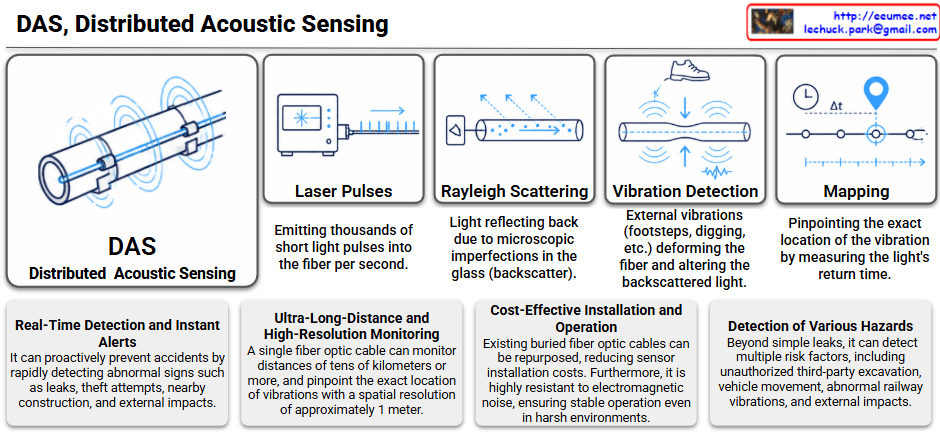
  1. Emitting Laser PulsesThe system begins with a specialized interrogation unit that shoots thousands of short, rapid pulses of laser light down the fiber optic cable every single second.
  2. Catching Rayleigh ScatteringAs the light travels along the cable, it hits microscopic, natural imperfections inherently present inside the glass fiber. When this happens, a tiny fraction of the light bounces back to the source. This phenomenon is called Rayleigh backscatter. Under normal conditions, this return signal is steady and predictable.
  3. Detecting Environmental VibrationsWhen an external event occurs nearby—such as someone walking, a machine digging, a pipe leaking, or a train passing by—it creates acoustic waves or physical vibrations. These waves penetrate the ground and subtly deform (stretch or compress) the fiber optic cable. This tiny physical change alters the pattern of the backscattered light at that exact moment.
  4. Precise Location MappingBy precisely measuring the time delay ($\Delta t$) between sending the laser pulse and receiving the altered reflection back, the system calculates the exact distance along the cable where the disturbance occurred, achieving an accuracy of down to about 1 meter.

Key Benefits of DAS Technology

  • Real-Time Prevention: It provides instant alerts for anomalies like leaks, theft, or unauthorized construction, allowing operators to prevent catastrophic accidents before they happen.
  • Ultra-Long Range & High Resolution: A single cable can monitor vast distances (tens of kilometers) while maintaining a sharp spatial resolution of 1 meter.
  • Cost-Effective & Robust: Because it can utilize existing, already-buried “dark fiber” cables, installation costs are minimal. Additionally, since it relies on light rather than electricity, it is immune to electromagnetic interference and works reliably in harsh environments.
  • Versatile Hazard Detection: It is smart enough to distinguish between various types of threats, from third-party illegal excavations and vehicle movements to railway anomalies.

Summary

Distributed Acoustic Sensing (DAS) transforms existing fiber optic cables into hyper-sensitive, long-distance acoustic sensors. By sending laser pulses and analyzing the reflected light (Rayleigh scattering), it detects minute vibrations caused by external events. This allows for real-time, highly accurate, and cost-effective monitoring of critical infrastructure over tens of kilometers.

#DistributedAcousticSensing #DAS #FiberOpticSensor #InfrastructureMonitoring #SmartSensing #RealTimeDetection #RayleighScattering #TechExplanation #AssetProtection

With Gemini
Tightly Coupled AI Works

📊A Tightly Coupled AI Architecture

1. The 5 Pillars & Potential Bottlenecks (Top Section)

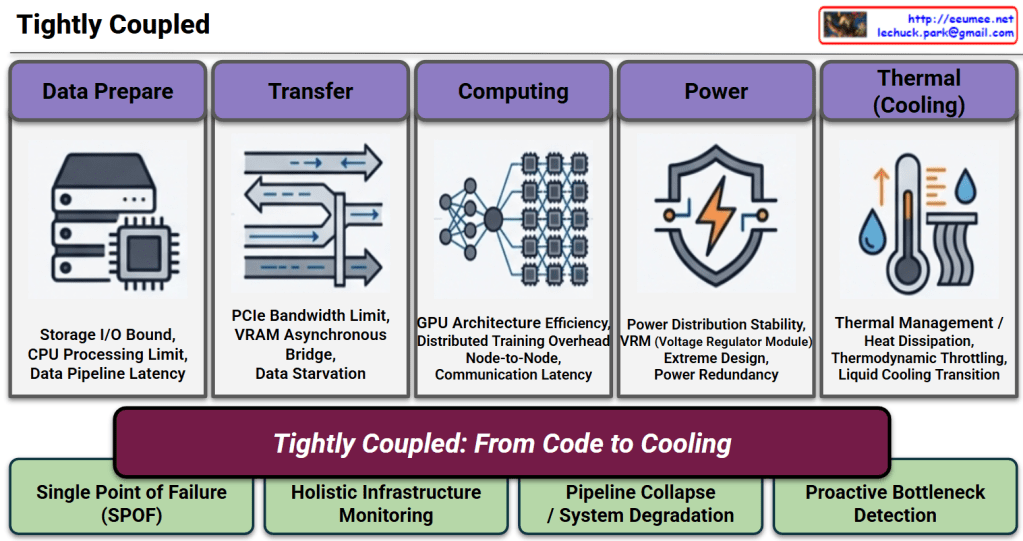
  • The Flow: The diagram visualizes the critical path of an AI workload, moving sequentially through Data PrepareTransferComputingPowerThermal (Cooling).
  • The Risks: Below each pillar, specific technical bottlenecks are listed (e.g., Storage I/O Bound, PCIe Bandwidth Limit, Thermodynamic Throttling). This highlights that each stage is highly sensitive; a delay or failure in any single component can starve the GPU or cause system-wide degradation.

2. The Core Message (Center Section)

  • The Banner: The central phrase, “Tightly Coupled: From Code to Cooling”, acts as the heart of the presentation. It boldly declares that AI infrastructure is no longer divided into “IT” and “Facilities.” Instead, it is a single, inextricably linked ecosystem where the execution of a single line of code directly translates to immediate physical power and cooling demands.

3. Strategic Implications & Solutions (Bottom Section)

  • The Reality (Left): Because the system is so interdependent, any Single Point of Failure (SPOF) will lead to a complete Pipeline Collapse / System Degradation.
  • The Operational Shift (Right): To prevent this, traditional siloed management must be replaced. The slide strongly argues for Holistic Infrastructure Monitoring and Proactive Bottleneck Detection. It visually proves that reacting to issues after they happen is too late; operations must be predictive and unified across the entire stack.

💡Summary

  • Interdependence: AI data centers operate as a single, highly sensitive organism where one isolated bottleneck can collapse the entire computational pipeline.
  • Paradigm Shift: The tight coupling of software workloads and physical facilities (“From Code to Cooling”) makes legacy, reactive monitoring obsolete.
  • Strategic Imperative: To ensure stability and efficiency, operations must transition to holistic, proactive detection driven by intelligent, autonomous management solutions.

#AIDataCenter #TightlyCoupled #InfrastructureMonitoring #ProactiveOperations #DataCenterArchitecture #AIInfrastructure #Power #Computing #Cooling #Data #IO #Memory


With Gemini

Numeric Data Processing


Architecture Overview

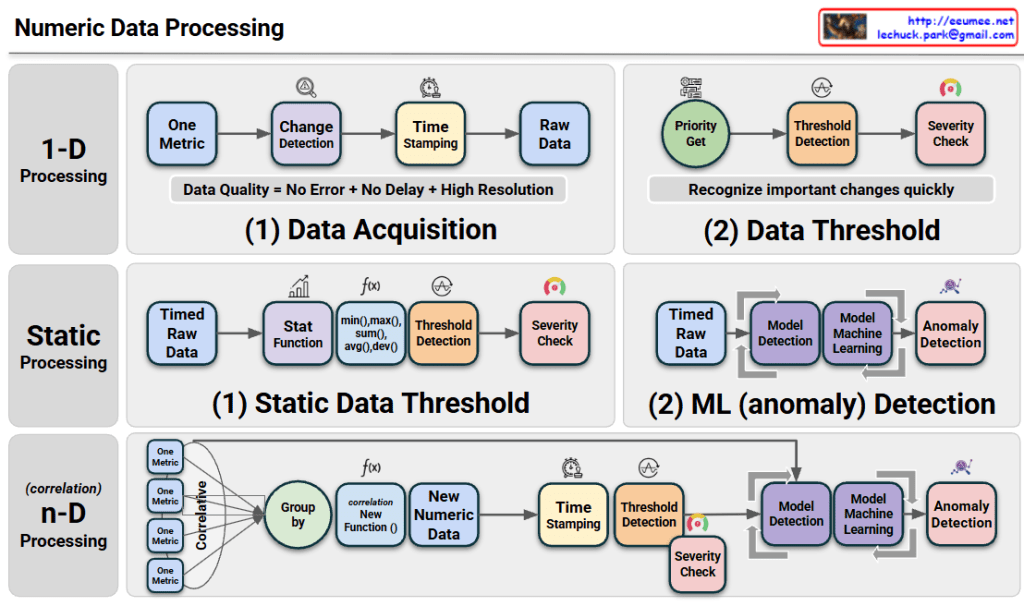
The diagram illustrates a tiered approach to Numeric Data Processing, moving from simple monitoring to advanced predictive analytics:

  • 1-D Processing (Real-time Detection): This layer focuses on individual metrics. It emphasizes high-resolution data acquisition with precise time-stamping to ensure data quality. It uses immediate threshold detection to recognize critical changes as they happen.
  • Static Processing (Statistical & ML Analysis): This stage introduces historical context. It applies statistical functions (like averages and deviations) to identify trends and uses Machine Learning (ML) models to detect anomalies that simple thresholds might miss.
  • n-D Processing (Correlative Intelligence): This is the most sophisticated layer. It groups multiple metrics to find correlations, creating “New Numeric Data” (synthetic metrics). By analyzing the relationship between different data points, it can identify complex root causes in highly interleaved systems.

Summary

  1. The framework transitions from reactive 1-D monitoring to proactive n-D correlation, enhancing the depth of system observability.
  2. It integrates statistical functions and machine learning to filter noise and identify true anomalies based on historical patterns rather than just fixed limits.
  3. The ultimate goal is to achieve high-fidelity data processing that enables automated severity detection and complex pattern recognition across multi-dimensional datasets.

#DataProcessing #AIOps #MachineLearning #Observability #Telemetry #SystemArchitecture #AnomalyDetection #DigitalTwin #DataCenterOps #InfrastructureMonitoring

With Gemini