Why “Definition” Matters More

The revised slide visually and professionally conveys the technical philosophy we discussed through a clear visual narrative. Below is a structured breakdown of the slide, organized by its logical flow, which you can use directly as a presentation script or an executive summary.


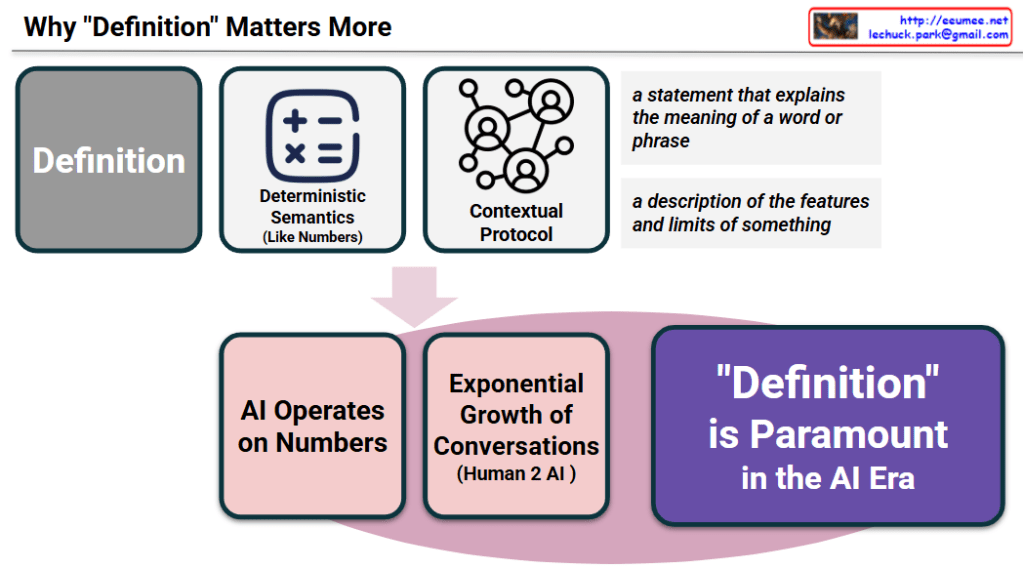
Slide Overview: The Absolute Value of “Definition” in the AI Era

This slide illustrates why the traditional concept of a “definition” becomes critically important when applied to the new technological landscape of Artificial Intelligence. It follows a three-step logical progression: [The Nature of Concepts ➔ Characteristics of the AI Environment ➔ Final Conclusion].

1. Top Section: The Intrinsic Nature of a “Definition”

The upper half of the slide establishes the role of a “definition” from a system architecture perspective.

  • Deterministic Semantics (Like Numbers): As noted in the dictionary excerpts on the right, a definition explains meanings and boundaries. When applied to AI systems, this must function like mathematical symbols ($+, -, \times, =$). It requires an absolute, unchanging standard—a strict “deterministic semantic” that operates with the exactness of numbers.
  • Contextual Protocol: The network node icon signifies that definitions are no longer just dictionary entries. They act as fundamental “communication protocols” that govern, align, and regulate information exchange across complex networks and multiple AI agents.

2. Bottom-Left Section: The New Paradigm of the AI Environment

Moving through the central arrow, the slide transitions to the unique conditions of the current AI era where these definitions must be applied.

  • AI Operates on Numbers: AI does not comprehend text or context through human intuition; it processes information strictly as vectorized, numerical data.
  • Exponential Growth of Conversations (Human 2 AI): Concurrently, the frequency and volume of interactions—especially between humans and AI, and increasingly among AI agents themselves—are expanding at an explosive, unprecedented rate.

3. Bottom-Right Section: The Core Conclusion

  • “Definition” is Paramount in the AI Era: Ultimately, in an environment where machines process information numerically and the volume of communication is exponentially increasing, even a microscopic conceptual discrepancy can cascade into a catastrophic system failure or hallucination. Therefore, establishing “clear definitions” to structure data and strictly control meaning is the absolute, paramount requirement for maintaining a stable, reliable, and functional AI ecosystem.

Overall Summary

As AI exponentially scales the volume of our daily communications and processes them through rigid, mathematical vectors, linguistic ambiguity becomes the greatest systemic risk. A strictly defined semantic baseline—the “Definition”—is no longer just a linguistic tool, but the most essential engineering protocol required to prevent AI hallucinations and ensure precise, automated operations.

#ArtificialIntelligence #DataArchitecture #DeterministicSemantics #SemanticAnchor #DataGovernance #Definition

With Gemini
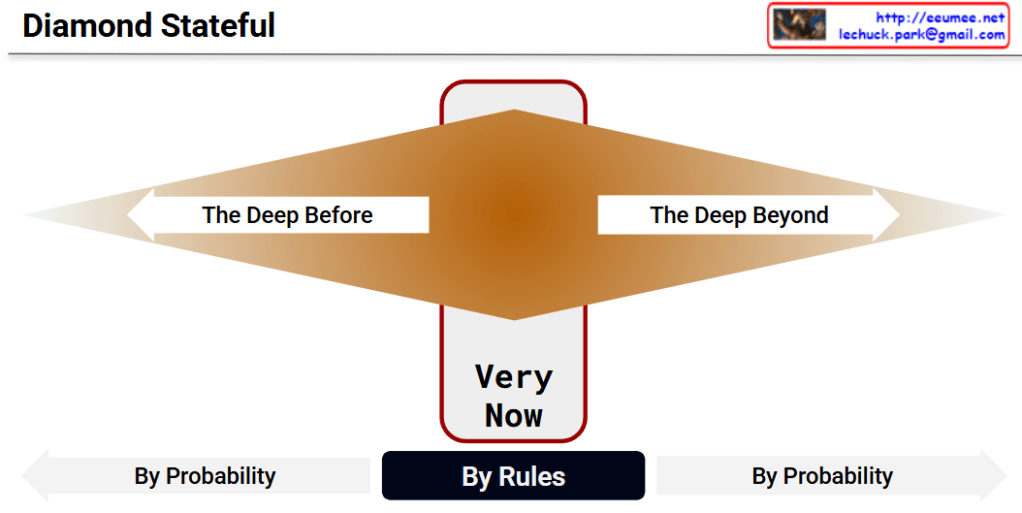
Diamond Stateful


Understanding the “Diamond Stateful” Framework

This diagram, titled “Diamond Stateful,” visually represents a conceptual framework for managing time, context, and system states. It illustrates the balance between deterministic control and probabilistic reasoning across the past, present, and future.

Here is a breakdown of the core components:

  • The Present (“Very Now”): The thickest, vertical center of the diamond represents the exact current moment. This specific state is governed “By Rules.” This indicates that the present system is deterministic, strictly defined, and “Stateful.” We have absolute certainty and control over the current environment using explicit logic and operational rules.
  • The Past (“The Deep Before”): The left side of the diamond tapers off into the past. As we look further back in time, historical context and data become less absolute. Therefore, reconstructing or interpreting the past is governed “By Probability” (e.g., relying on statistical inferences, heuristics, or context retrieval).
  • The Future (“The Deep Beyond”): The right side of the diamond tapers off into the future. Because the future has not yet occurred, predicting upcoming states or generating new outcomes cannot be achieved with rigid rules. It must also be handled “By Probability” (e.g., utilizing predictive algorithms, generative AI, or statistical forecasting).

Key Takeaway:

The core philosophy of the “Diamond Stateful” model is that we should secure and manage the present moment using strict, definitive rules (Stateful), while embracing probability-based models to navigate the vast uncertainties of both the distant past and the unknown future.

#StateManagement #SystemArchitecture #DeterministicVsProbabilistic #DataFramework #SystemDesign #TechConcepts #FutureOfData

Predictive/Proactive/Reactive (EASY)

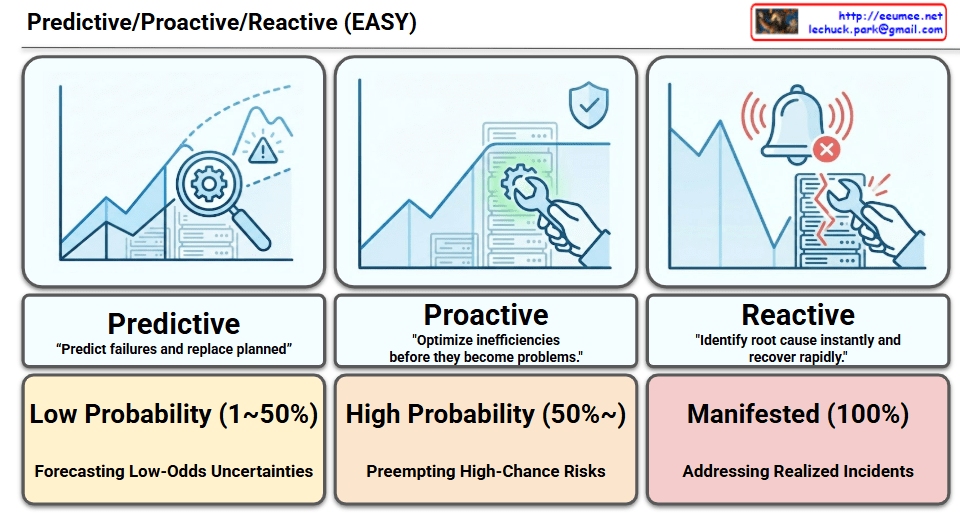
Risk Management Framework by Probability


1. Predictive: Low Probability (~50%)

  • Focus: Forecasting potential failures before they show clear signs.
  • Action: “Predict failures and replace planned”.
  • Key Phrase: Forecasting Low-Odds Uncertainties.

2. Proactive: High Probability (50%~)

  • Focus: Addressing inefficiencies that are very likely to become actual problems.
  • Action: “Optimize inefficiencies before they become problems”.
  • Key Phrase: Preempting High-Chance Risks.

3. Reactive: Manifested (100%)

  • Focus: Dealing with issues that have already occurred and are currently impacting the system.
  • Action: “Identify root cause instantly and recover rapidly”.
  • Key Phrase: Addressing Realized Incidents.

Manage risks by forecasting low-probability (~50%) uncertainties (Predictive), preempting high-probability (50%~) inefficiencies (Proactive), and rapidly recovering from 100% manifested incidents (Reactive).

#RiskManagement #PredictiveMaintenance #ProactiveStrategy #ReactiveResponse #SystemReliability #ProbabilityAssessment

With Gemini

Human Rules Always


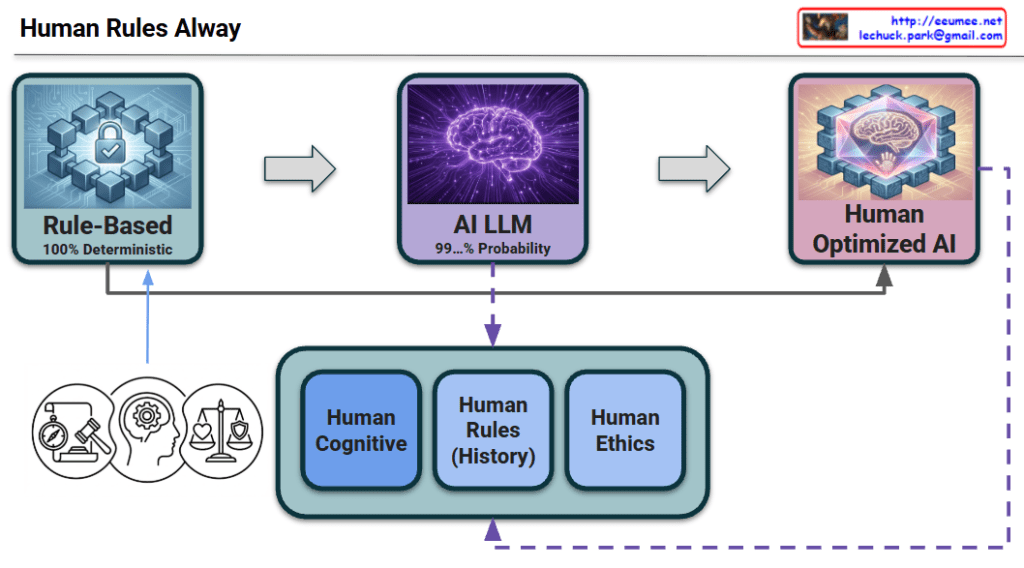
The Evolutionary Roadmap to Human-Optimized AI

This diagram visualizes the history and future direction of intelligent systems. It illustrates the evolution from the era of manual programming to the current age of generative AI, and finally to the ultimate goal where human standards perfect the technology.

1. The 3 Stages of Technological Evolution (Top Flow)

  • Stage 1: Rule-Based (The Foundation / Past)
    • Concept: “The Era of Human-Defined Logic”
    • Context: This represents the starting point of computing where humans explicitly created formulas and coded every rule.
    • Characteristics: It is 100% Deterministic. While accurate within its scope, it cannot handle the complexity of the real world beyond what humans have manually programmed.
  • Stage 2: AI LLM (The Transition / Present)
    • Concept: “The Era of Probabilistic Scale”
    • Context: We have evolved into the age of massive parallel processing and Large Language Models.
    • Characteristics: It operates on 99…% Probability. It offers immense scalability and creativity that rule-based systems could never achieve, but it lacks the absolute certainty of the past, occasionally leading to inefficiencies or hallucinations.
  • Stage 3: Human Optimized AI (The Final Goal / Future)
    • Concept: “The Era of Reliability & Efficiency”
    • Context: This is the destination we must reach. It is not just about using AI, but about integrating the massive power of the “Present” (AI LLM) with the precision of the “Past” (Rule-Based).
    • Characteristics: By applying human standards to control the AI’s massive parallel processing, we achieve a system that is both computationally efficient and strictly reliable.

2. The Engine of Evolution: Human Standards (Bottom Box)

This section represents the mechanism that drives the evolution from Stage 2 to Stage 3.

  • The Problem: Raw AI (Stage 2) consumes vast energy and can be unpredictable.
  • The Solution: We must re-introduce the “Human Rules” (History, Logic, Ethics) established in Stage 1 into the AI’s workflow.
  • The Process:
    • Constraint & Optimization: Human Cognition and Rules act as a pruning mechanism, cutting off wasteful parallel computations in the LLM.
    • Safety: Ethics ensure the output aligns with human values.
  • Result: This filtering process transforms the raw, probabilistic energy of the LLM into the polished, “Human Optimized” state.

3. The Feedback Loop (Continuous Evolution)

  • Dashed Line: The journey doesn’t end at Stage 3. The output from the optimized AI is reviewed by humans, which in turn updates our rules and ethical standards. This circular structure ensures that the AI continues to evolve alongside human civilization.

This diagram declares that the future of AI lies not in discarding the old “Rule-Based” ways, but in fusing that deterministic precision with modern probabilistic power to create a truly optimized intelligence.


#AIEvolution #FutureOfAI #HybridAI #DeterministicVsProbabilistic #HumanInTheLoop #TechRoadmap #AIArchitecture #Optimization #ResponsibleAI

Priority

From DALL-E
The image is a visual representation of task prioritization and management. It comprises various elements that communicate the challenges and strategies of handling multiple tasks effectively:

  1. Multi-Tasking NOT EASY: This indicates that juggling multiple tasks is challenging, and one task could be affected by another, implying the potential for decreased efficiency or interference.
  2. So. The Focusing is required.: It emphasizes the need for focus, suggesting that concentrating on specific tasks is essential for successful completion.
  3. First! Need to find out Which is more priority.: This statement highlights the importance of determining which task has the highest priority to address it appropriately.
  4. Managing with Data.: It suggests that data management is a crucial part of prioritizing and executing tasks.

On the right side, there is a list numbered 1 to 5, indicating a ranked list of tasks:

  • Number 1 is circled, with an arrow pointing to it and the phrases “DO IT” and “Do it Now!!”, stressing the urgency of tackling the most important task immediately.
  • Number 5 has a question mark next to it, and the phrase “Keep it for the future more details.”, suggesting that the lowest priority task may be deferred until more information is available or it becomes more relevant.

The bottom right corner has an “X” symbol with the text “without interruption”, indicating the importance of completing the top priority task without distractions or interruptions. The overall message of the image is to prioritize tasks, focus on the most critical one, manage tasks based on data, and execute them without disruption for effective productivity.