Now, Hardware Era

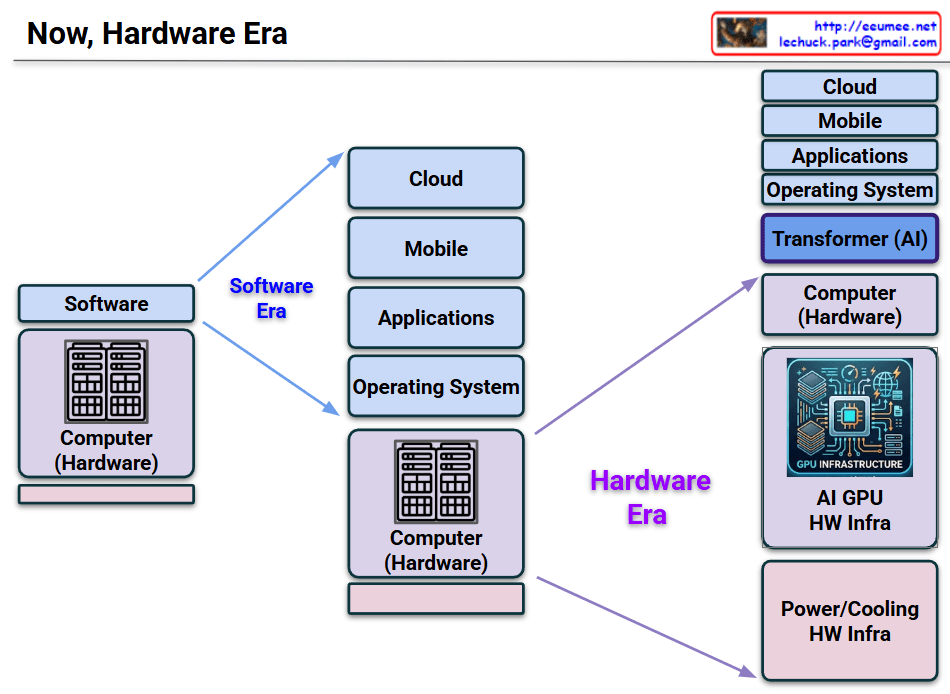
This image is an insightful architectural diagram illustrating the major paradigm shift in the IT industry, transitioning from the past “Software Era” to the current “Hardware Era.”

On the left side, representing the Software Era, the structure is heavily focused on software expansion. A single, traditional “Computer (Hardware)” block serves as a basic foundation to support a growing stack of software components: Operating System, Applications, Mobile, and Cloud. During this time, hardware was largely viewed as a standardized commodity to run software.

On the right side, representing the current Hardware Era, the diagram shows a significant architectural transformation driven by Artificial Intelligence.

Here are the key changes:

  • The Insertion of AI: A new, prominent purple block labeled “Transformer (AI)” is inserted right beneath the traditional software stack. This signifies that AI models have become the core engine and an indispensable layer for modern IT services.
  • Expansion of Hardware Infrastructure: To support the massive computational demands of the AI layer, the hardware section at the bottom has expanded dramatically into three distinct pillars:
    1. Computer (Hardware): The traditional CPU-based computing servers.
    2. AI GPU HW Infra: A large, specialized block featuring a detailed microchip icon. This highlights the absolute necessity of high-performance GPU clusters, high-bandwidth memory (HBM), and high-speed networking to process AI workloads.
    3. Power/Cooling HW Infra: This is perhaps the most critical new addition. It visually emphasizes that running massive AI GPU clusters requires enormous energy and generates immense heat. Consequently, power supply and advanced cooling systems are no longer just facility management issues, but a core component of the IT infrastructure itself.

The diagram visualizes how the advent of AI has shifted the industry’s bottleneck and focus back to building robust, highly specialized hardware and the physical power/cooling infrastructure required to sustain it.

#HardwareEra #AIInfrastructure #GPUComputing #DataCenter #TechTrends #ArtificialIntelligence #PowerAndCooling #ITArchitecture #FutureOfTech

With Gemini

Numeric Data Processing


Architecture Overview

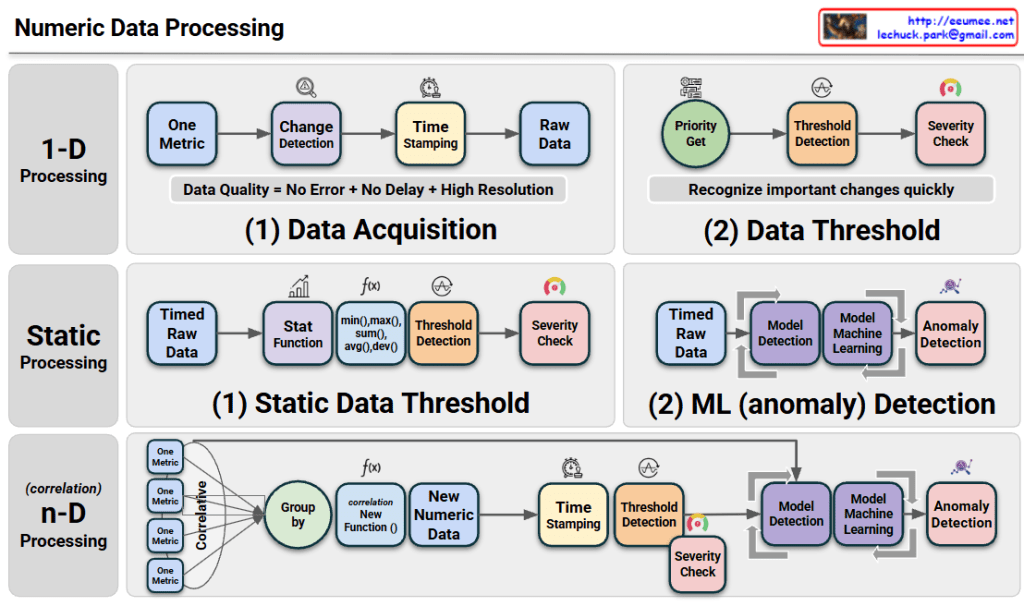
The diagram illustrates a tiered approach to Numeric Data Processing, moving from simple monitoring to advanced predictive analytics:

  • 1-D Processing (Real-time Detection): This layer focuses on individual metrics. It emphasizes high-resolution data acquisition with precise time-stamping to ensure data quality. It uses immediate threshold detection to recognize critical changes as they happen.
  • Static Processing (Statistical & ML Analysis): This stage introduces historical context. It applies statistical functions (like averages and deviations) to identify trends and uses Machine Learning (ML) models to detect anomalies that simple thresholds might miss.
  • n-D Processing (Correlative Intelligence): This is the most sophisticated layer. It groups multiple metrics to find correlations, creating “New Numeric Data” (synthetic metrics). By analyzing the relationship between different data points, it can identify complex root causes in highly interleaved systems.

Summary

  1. The framework transitions from reactive 1-D monitoring to proactive n-D correlation, enhancing the depth of system observability.
  2. It integrates statistical functions and machine learning to filter noise and identify true anomalies based on historical patterns rather than just fixed limits.
  3. The ultimate goal is to achieve high-fidelity data processing that enables automated severity detection and complex pattern recognition across multi-dimensional datasets.

#DataProcessing #AIOps #MachineLearning #Observability #Telemetry #SystemArchitecture #AnomalyDetection #DigitalTwin #DataCenterOps #InfrastructureMonitoring

With Gemini

The optimization

This diagram illustrates the fundamental purpose and stages of optimization.

Basic Purpose of Optimization:

Optimization

  • Core Principle: Perform only necessary actions
  • Code Level: Remove unnecessary elements

Two Goals of Optimization:

1. More Speed

  • O(n): Algorithm (Logic) improvement
  • Techniques: Caching/Parallelization/Recursion optimization

2. Less Resource

  • Memory: Reduce memory usage
  • Management: Dynamic & Static memory optimization

Optimization Implementation Stages:

Stage 1: SW Level (Software Level)

  • Code-level optimization

Stage 2: HW Implementation (Hardware Implementation)

  • Offload heavy workloads to hardware
  • Applied when software optimization is insufficient

Optimization Process:

InputProcessingOutputVerification

  1. Deterministic INPUT Data: Structured input (DB Schema)
  2. Rule-based: Apply rule-based optimization
  3. Deterministic OUTPUT: Predictable results
  4. Verification: Validate speed, resource usage through benchmarking and profiling

Summary:

Optimization aims to increase speed and reduce resources by removing unnecessary operations. It follows a staged approach starting from software-level improvements and extending to hardware implementation when needed. The process ensures predictable, verifiable results through deterministic inputs/outputs and rule-based methods.

#Optimization #PerformanceTuning #CodeOptimization #AlgorithmImprovement #SoftwareEngineering #HardwareAcceleration #ResourceManagement #SpeedOptimization #MemoryOptimization #SystemDesign #Benchmarking #Profiling #EfficientCode #ComputerScience #SoftwareDevelopment

With Claude

Programming … AI

This image contrasts traditional programming, where developers must explicitly code rules and logic (shown with a flowchart and a thoughtful programmer), with AI, where neural networks automatically learn patterns from large amounts of data (depicted with a network diagram and a smiling programmer). It illustrates the paradigm shift from manually defining rules to machines learning patterns autonomously from data.

#AI #MachineLearning #Programming #ArtificialIntelligence #AIvsTraditionalProgramming

Legacy AI (Rule-based)

The image shows a diagram explaining “Legacy AI” or rule-based AI systems. The diagram is structured in three main sections:

  1. At the top: A workflow showing three steps:
    • “Analysis” (illustrated with a document and magnifying glass with charts)
    • “Prioritize” (shown as a numbered list with 1-2-3 and an upward arrow)
    • “Choose the best” (depicted with a network diagram and pointing hand)
  2. In the middle: Programming conditional statement structure:
    • “IF [ ]” section contains analysis and prioritization icons, representing the condition evaluation
    • “THEN [ ]” section includes “optimal choice” icons, representing the action to execute when the condition is true
    • “It’s Rule” label on the right indicates this is a traditional program code processing approach
  3. At the bottom: A pipeline process labeled “It’s Algorithm (Rule-based AI)” showing:
    • A series of interconnected components with arrows
    • Each component contains small icons representing analysis and rules
    • The process ends with “Serialize without duplications”

This diagram effectively illustrates the structure and workflow of traditional rule-based AI systems, demonstrating how they operate like conventional programming with IF-THEN statements. The system first analyzes data, then prioritizes information based on predefined criteria, and finally makes decisions by selecting the optimal choice according to the programmed rules. This represents the foundation of early AI approaches before the advent of modern machine learning techniques, where explicit rules rather than learned patterns guided the decision-making process.

With Claude

There’s such thing as ‘impossible’.

This infographic illustrates a software development philosophy titled “There’s such thing as ‘impossible’.” It emphasizes that there are real limitations in development:

  1. Development process flow:
    • “Machine Code” (represented by binary digits)
    • “Software Dev” (showing code editor)
    • “Application” (showing mobile interface)
    • Arrow pointing to infinity symbol labeled “Unbounded” with a warning sign
  2. Practical constraints:
    • “Reality has no ∞ button. Choose.” (emphasizing limitations exist)
    • Icons representing people and money (resource management)
    • “Everything requires a load” (showing resources are needed)
    • “Energy” and “Time” with cycling arrows (demonstrating finite resources)
  3. Keys to successful development:
    • Clear problem definition (“Clear Definition”)
    • Setting priorities (“Priorities”)
    • Target goals

The overall message highlights that impossibility does exist in software development due to real-world constraints of time, energy, and resources. It emphasizes the importance of acknowledging these limitations and addressing them through clear problem definition and priority setting for effective development.

With Claude

New Coding

The image titled “New Coding” illustrates the historical evolution of programming languages and the emerging paradigm of AI-assisted coding.

On the left side, it shows the progression of programming languages:

  • “Bytecode” (represented by binary numbers: 0110, 1001, 1010)
  • “Assembly” (shown with a gear and conveyor belt icon)
  • “C/C++” (displayed with the C++ logo)
  • “Python” (illustrated with the Python logo)

Below these languages is text reading “Workload for understanding computers” with a blue gradient arrow, indicating how these programming approaches have strengthened our understanding of computers through their evolution.

The bottom section labeled “Using AI with LLM” shows a human profile communicating with an AI chip/processor, suggesting that AI can now code through natural language based on this historical programming experience and data.

On the right side, a large purple arrow points toward the future concepts:

  • “New Coding As you think”
  • “With AI” (in purple text)

The overall message of the diagram is that programming has evolved from low-level languages to high-level ones, and now we’re entering a new era where AI enables coding directly through human thought, speech, and logical reasoning – representing a fundamental shift in how we create software.

With Claude