피곤하다고
Category: Lechuck
Number world (2)
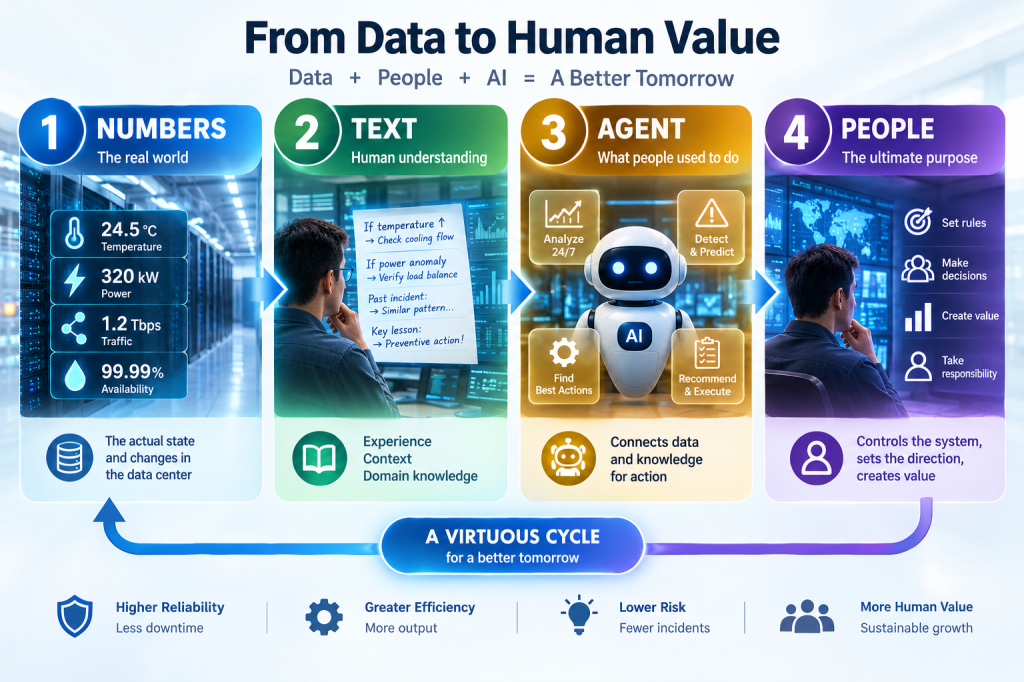
From Data to Human Value
The 4 Core Pillars of AI Technology

This image is a highly structured infographic titled “4 CORE PILLARS OF AI TECHNOLOGY: A CONTINUOUS CYCLE.” It visually explains the architecture of an AI system and its interaction with humans. Arranged around a central AI engine, four primary domains are connected by dynamic arrows, illustrating a continuous, organic flow of information and feedback.
- Center – AI Framework & Reasoning: Situated at the very heart of the diagram as a diamond-shaped core, this represents the “brain” of the AI. It acts as the central hub that ingests data from all pillars, processes it, and generates reasoned outputs.
- Bottom Left – Numbers (Core Logic & Telemetry): Decorated with mathematical symbols, binary code, and various charts. This section symbolizes the quantitative foundation of AI—the raw data, understanding of change, and the prediction logic that form the physical and structural core of the system.
- Bottom Right – Text (Human Knowledge Base): Illustrated with books, documents, and scrolls. It represents the qualitative foundation: human knowledge, context, and language-based insights. This is how the AI learns to understand the nuances and accumulated wisdom of humanity.
- Middle Right – UX Output (Insights & Interface): Depicted as a digital dashboard featuring a robot chatbot icon and data summaries. This domain shows how complex AI computations are translated into user-friendly formats. It provides clear “Key Insights,” “Actionable Steps,” and summaries so humans can easily grasp the results.
- Top & Middle Left – Human Control & Data Verification: At the absolute top, a human figure in a suit stands as “The Ultimate Authority.” This highlights the human responsibility in rule setting, adding knowledge, and execution confirmation. On the left side, the imagery of hands meticulously analyzing a clipboard and charts—now clearly labeled “DATA VERIFICATION”—emphasizes the critical, hands-on role humans play in evaluating, auditing, and refining the AI’s output.
📌 Summary
This diagram intuitively maps the operational loop of modern AI: raw “Numbers” (logic) and qualitative “Text” (knowledge) feed into the AI engine, which then translates its findings into a user-friendly “UX Output.” Crucially, it highlights that this entire automated cycle is overseen, verified, and refined by humans. It serves as a powerful reminder that “Human-in-the-loop” remains the ultimate authority and the indispensable final step in ensuring AI reliability.
#AITechnology #ArtificialIntelligence #DataVerification #HumanInTheLoop #UXDesign #DataScience #TechTrends #AIInfographic
With Gemini
Number World

.
.
Blue Sky


 Lechuck Park