CPU Again

CPU Again for AI: The Evolution of Computing Paradigms

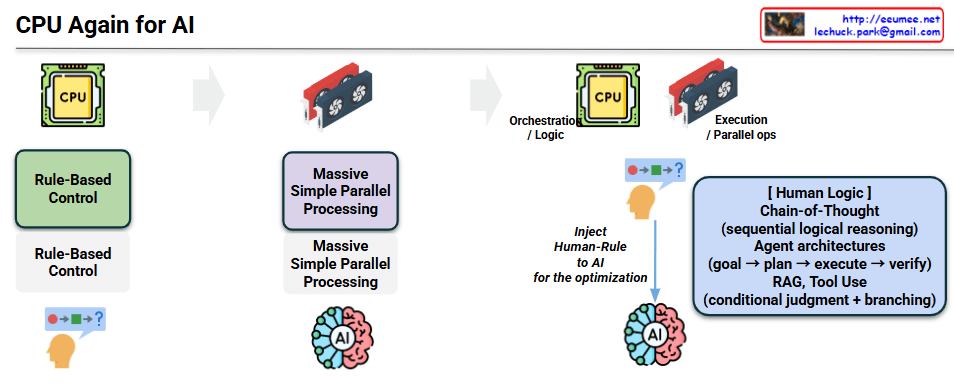
This diagram illustrates the evolutionary journey of computing architectures, highlighting why the CPU is reclaiming its pivotal role in the modern AI era. The flow is divided into three distinct phases:

1. The Era of Traditional Computing (CPU-Centric)

  • Core Concept: Rule-Based Control.
  • Mechanism: Historically, computing relied on explicit human logic. Developers hardcoded sequential rules and conditional branching (represented by the sequence 🔴 ➡️ 🟩 ➡️ ❓).
  • Role: The CPU was the undisputed core, designed specifically to handle complex control flows, logic execution, and sequential operations.

2. The Deep Learning Boom (GPU-Centric)

  • Core Concept: Massive Simple Parallel Processing.
  • Mechanism: With the rise of neural networks and deep learning, the focus shifted from complex branching logic to processing vast amounts of data simultaneously.
  • Role: The GPU took center stage. Its architecture, built for massive parallel operations, was perfectly suited for the mathematical matrix multiplications required by AI models, temporarily overshadowing the CPU’s control capabilities.

3. The Emergence of Agentic AI (CPU + GPU Synergy)

This represents the core message of the diagram. As AI systems become more sophisticated, they require more than just raw processing power; they need structured logic and control.

  • Division of Labor:
    • CPU (Orchestration / Logic): Reclaims its role as the system’s brain for control flow. It manages the overall pipeline, making conditional judgments and coordinating tasks.
    • GPU (Execution / Parallel Ops): Remains the workhorse for heavy computational lifting and model inference.
  • Injecting Human Logic: To optimize AI and make it capable of solving complex, real-world problems, we are injecting “Human-Rule” back into the system. This is achieved through advanced frameworks:
    • Chain-of-Thought: Enabling sequential, logical reasoning rather than instant, black-box outputs.
    • Agent Architectures: Implementing autonomous workflows that follow human-like cognitive steps (Goal ➡️ Plan ➡️ Execute ➡️ Verify).
    • RAG & Tool Use: Requiring conditional judgment and branching to fetch external data, trigger APIs, or utilize specific tools.

Summary

While the initial AI boom was heavily reliant on the sheer parallel processing power of GPUs, the current transition towards advanced AI Agents and RAG systems necessitates complex workflow management, conditional branching, and logical reasoning. Consequently, the CPU is once again becoming a critical component within AI architectures, serving as the essential orchestrator that guides, plans, and controls the raw execution power of the GPU.

#AIArchitecture #ComputingParadigm #AgenticAI #LLMOps #RAG #CPUvsGPU #SystemArchitecture #AIOrchestration #TechTrends

With Gemini

Fault Detection and Recovery: Data Pipeline


Fault Detection and Recovery: Data Pipeline

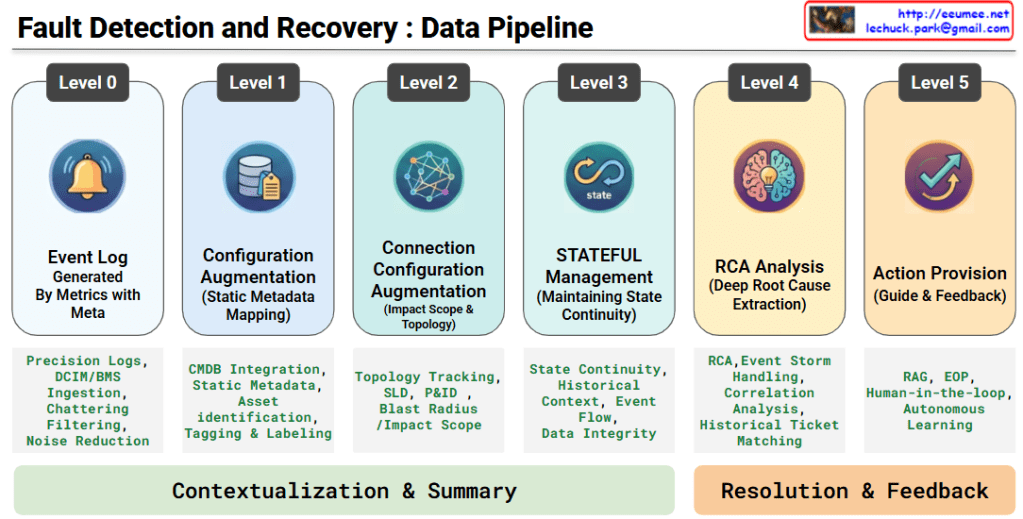
This architecture illustrates an advanced, six-stage, end-to-end data pipeline designed for an AI-driven infrastructure agent. It demonstrates how raw telemetry is systematically transformed into actionable, automated remediation through two primary phases.

Phase 1: Contextualization & Summary

This phase is dedicated to building a high-resolution, stateful understanding of the infrastructure. It takes raw alerts and layers them with critical physical and logical context.

  • Level 0: Event Log (Generated By Metrics with Meta)The foundation of the pipeline. High-precision logs and telemetry are ingested from DCIM/BMS systems. Crucially, this stage performs chattering filtering and noise reduction to isolate genuine anomalies from meaningless alerts.
  • Level 1: Configuration Augmentation (Static Metadata Mapping)Raw events are enriched by integrating with the CMDB. By mapping static metadata to the alerts, the system performs precise asset identification, tagging, and labeling to know exactly which component is affected.
  • Level 2: Connection Configuration Augmentation (Impact Scope & Topology)The pipeline maps the isolated asset against physical and logical topologies (such as Single Line Diagrams and P&IDs). This enables the system to track dependencies and accurately calculate the blast radius or impact scope of a fault.
  • Level 3: STATEFUL Management (Maintaining State Continuity)Moving beyond isolated, point-in-time alerts, this level links current events with historical context and event flows. It ensures data integrity and maintains a continuous, stateful tracking of the system’s health.

Phase 2: Resolution & Feedback

With a fully contextualized baseline established, the pipeline shifts from situational awareness to intelligent diagnosis and automated remediation.

  • Level 4: RCA Analysis (Deep Root Cause Extraction)During an event storm, the system performs advanced correlation analysis and historical trouble-ticket matching. It sifts through the cascading symptoms to pinpoint the deep root cause (RCA) of the failure.
  • Level 5: Action Provision (Guide & Feedback)In the final stage, the platform leverages RAG (Retrieval-Augmented Generation) to instantly surface the most relevant Emergency Operating Procedures (EOP). By incorporating a Human-in-the-loop (HITL) feedback mechanism, expert operators validate the actions, allowing the AI model to continuously undergo autonomous learning and refine its future responses.

Summary

This data pipeline elegantly maps the journey from raw infrastructure noise to intelligent, automated resolution. By progressively layering static configuration data, topology mapping, and stateful tracking over high-precision logs, the architecture effectively neutralizes event storms. Ultimately, it empowers AI-driven agents to deliver highly accurate root cause analyses and RAG-assisted operational guides, creating a resilient system that continuously learns and improves through expert human feedback.

#AIOps #DataCenterArchitecture #RootCauseAnalysis #SystemObservability #RAG #FaultDetection #Telemetry #HumanInTheLoop #InfrastructureAutomation #TechInfographic

With Gemini

Data for DC

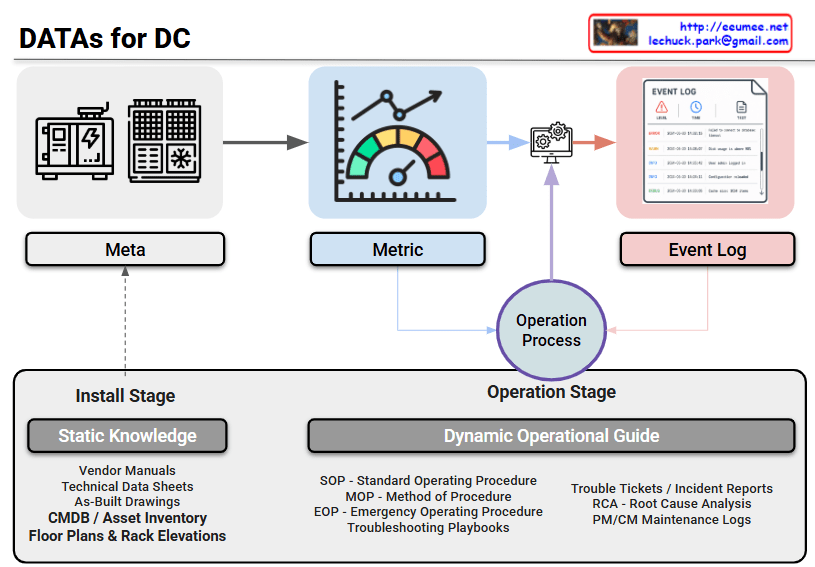
1. The Three Core Data Types (Top Section)

At the top, the diagram maps out the primary real-time and structural data inputs flowing from the infrastructure:

  • Meta: This represents the foundational metadata of the facility—the physical and logical configuration of equipment like generators, server racks, and liquid cooling units. It acts as the anchor point for the entire monitoring ecosystem.
  • Metric: Illustrated by the gauge, this is the continuous, time-series telemetry data. It includes critical real-time performance indicators, such as power loads, latency, or the return temperature from cooling units.
  • Event Log: The document icon on the right captures asynchronous system logs, alerts, and warnings (e.g., error thresholds being breached or state changes).

2. The Knowledge Base / RAG Corpus (Bottom Section)

The bottom half categorizes the facility’s documentation across its lifecycle. This perfectly outlines the corpus structure required to feed an AI’s Retrieval-Augmented Generation (RAG) system:

  • Install Stage (Static Knowledge): This is the baseline documentation established during construction and deployment. It includes Vendor Manuals, Technical Data Sheets, As-Built Drawings, CMDB, and Rack Elevations. Notice the dotted arrow showing how this static knowledge directly informs and establishes the “Meta” data above.
  • Operation Stage (Dynamic Operational Guide): This represents the evolving, lived intelligence of the facility. It captures structured response frameworks (SOP, MOP, EOP) alongside historical operational data like Trouble Tickets, RCA (Root Cause Analysis), and Maintenance Logs.

3. The Operation Process (Center)

The purple “Operation Process” node acts as the cognitive center or the execution engine. Real-time anomalies detected via Metrics and Event Logs flow into this process. The system then queries the Dynamic Operational Guide to find the correct standard operating procedures or historical RCA to resolve the issue. The resulting action or insight is then fed back into the central monitoring and management system.


Summary

This diagram elegantly maps out the data architecture of a modern facility. It visualizes how static foundational knowledge and dynamic operational history combine to inform real-time monitoring and incident response. By categorizing data into Meta, Metric, Event Logs, and structural lifecycle knowledge, it provides a clear, actionable framework for implementing data-driven operations, high-resolution observability, and AI-assisted automation platforms.

#DataCenterArchitecture #AIOps #RAG #InfrastructureObservability #SystemTelemetry #RootCauseAnalysis #TechInfographic

With Gemini

Harness Engineering


The Evolution of LLM Utilization: Toward Autonomous Agents

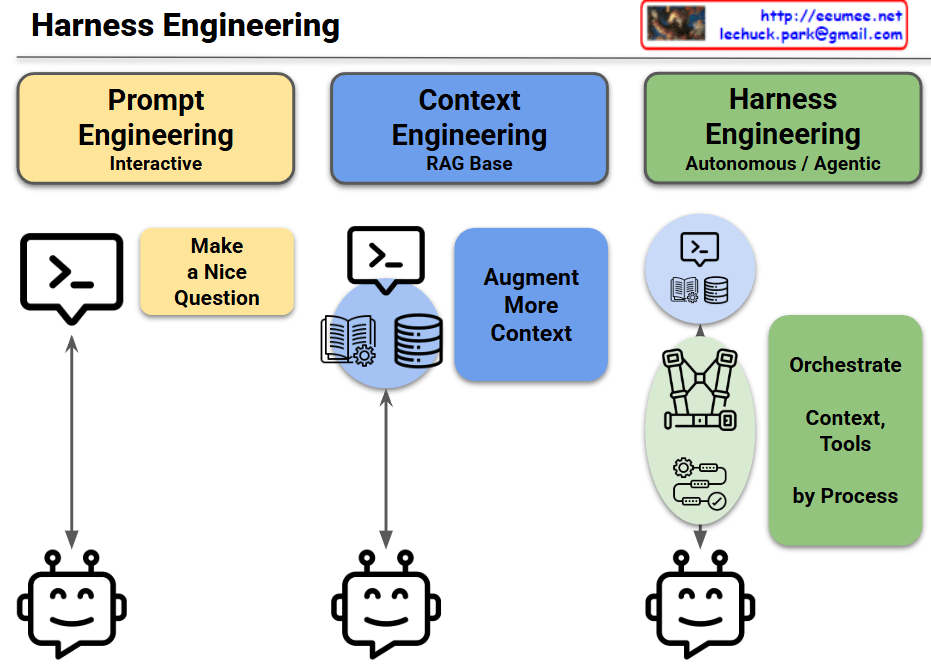
This slide illustrates the evolutionary roadmap of adopting Large Language Models (LLMs) within enterprise operations, transitioning from basic user inputs to fully automated, agentic workflows. The architecture is broken down into three distinct phases:

  • Phase 1: Prompt Engineering (Interactive)This represents the foundational stage of LLM interaction. At this level, the quality of the output depends entirely on human input—the ability to “Make a Nice Question.” It is a strictly interactive, 1:1 process that relies solely on the model’s pre-trained knowledge, which limits its capability to resolve complex, real-time operational issues.
  • Phase 2: Context Engineering (RAG Base)The second stage addresses the limitations of a standalone LLM by injecting trusted external data. Utilizing a Retrieval-Augmented Generation (RAG) base, the system actively retrieves specific domain knowledge—represented by the manual and database icons—to “Augment More Context.” This grounds the AI in reality, significantly reducing hallucinations and providing highly accurate, domain-specific insights.
  • Phase 3: Harness Engineering (Autonomous / Agentic)This is the ultimate target state. Moving beyond simply generating text, the AI evolves into a proactive agent. The “harness” icon symbolizes a secure, controlled framework where the AI can independently “Orchestrate Context, Tools by Process.” In this autonomous phase, the system not only understands the problem but also safely executes predefined workflows and controls physical or software tools to resolve issues with minimal human intervention.

#LLM #AIArchitecture #AIOps #AutonomousAgents #RAG #ContextEngineering #HarnessEngineering #AgenticAI #ITOperations #TechLeadership

With Gemini

Event Roll-Up by LLM

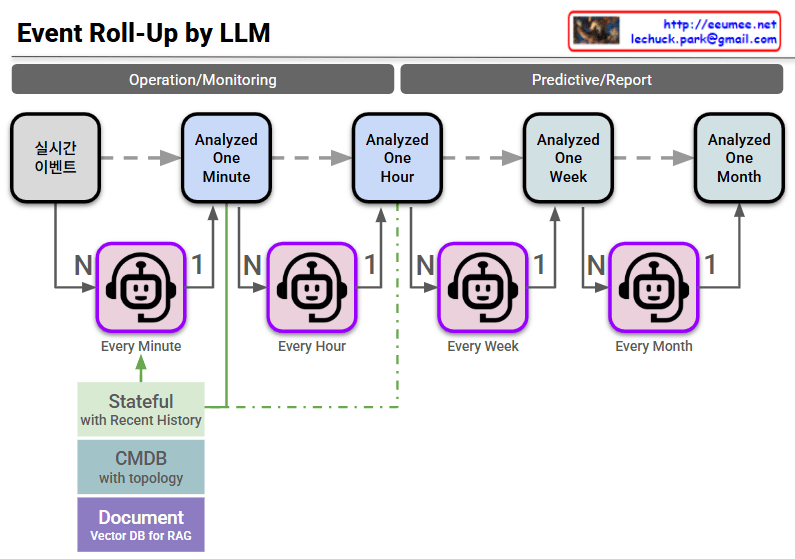
The provided image illustrates an AIOps-based event pipeline architecture. It demonstrates how Large Language Models (LLMs) hierarchically roll up and analyze the flood of real-time events occurring within a data center or large-scale IT infrastructure over time.

The core objective here is to compress countless simple alarms into meaningful insights, drastically reducing alert fatigue and minimizing Mean Time To Repair (MTTR). The architecture can be broken down into three main areas:

1. Separation by Purpose (Top Banner)

  • Operation/Monitoring: Encompasses the 1-minute and 1-hour analysis cycles. This zone is dedicated to immediate anomaly detection and real-time incident response.
  • Predictive/Report: Encompasses the 1-week and 1-month analysis cycles. By leveraging accumulated data, this zone focuses on identifying long-term failure trends, assisting with infrastructure capacity planning, and automatically generating weekly or monthly operational reports.

2. N:1 Hierarchical Roll-Up Mechanism (Center Pipeline)

The robot icons (LLM Agents) deployed at each time interval act as summarization engines, merging data from the lower tier and passing it up the chain.

  • Every Minute: The agent collects numerous real-time events (N) and compresses them into a summarized, 1-minute contextual block (1).
  • Every Hour / Week / Month: The agents aggregate multiple analytical outputs (N) from the preceding stage into a single, comprehensive analysis for the larger time window (1).
  • Through this mechanism, granular noise is progressively filtered out over time, leaving only the macroscopic health status and the most critical issues of the entire infrastructure.

3. Context & Knowledge Injection (Bottom Left)

For an LLM to go beyond simple text summarization and accurately assess the actual state of the infrastructure, it requires grounding. These elements provide that crucial context and are heavily injected during the initial (1-minute) analysis phase.

  • Stateful (with Recent History): Instead of treating events as isolated incidents, the system remembers recent context to track the continuity and transitions of system states.
  • CMDB (with topology): By integrating with the Configuration Management Database, the system understands the physical and logical relationships (e.g., power dependencies, network paths) between the alerting equipment and the rest of the infrastructure.
  • Document (Vector DB for RAG): This is a vectorized repository of operational manuals, past incident resolutions, and Standard Operating Procedures (SOPs). Utilizing Retrieval-Augmented Generation (RAG), it feeds specific domain knowledge to the LLM, enabling it to diagnose root causes and recommend highly accurate remediation steps.

In Summary:

This architecture represents a significant leap from traditional rule-based monitoring. It is a highly systematic blueprint designed to intelligently interpret real-time events by powering LLM agents with RAG and CMDB topology context. Ultimately, it paves the way for reducing manual operator intervention and achieving truly autonomous and proactive infrastructure management.


#AIOps #LLM #AgenticAI #RAG #EventRollUp #ITInfrastructure #AutonomousOperations #MTTR #Observability #TechArchitecture

RAG Works Pipeline

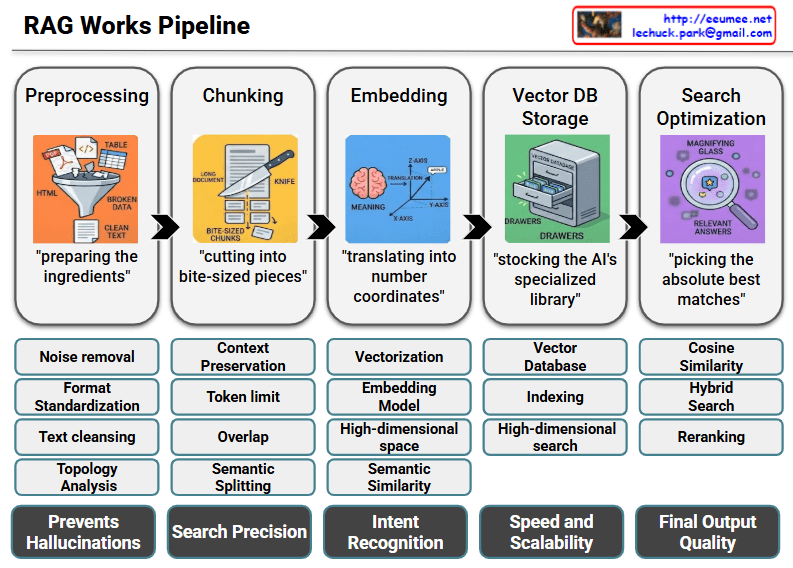
This image illustrates the RAG (Retrieval-Augmented Generation) Works Pipeline, breaking down the complex data processing workflow into five intuitive steps using relatable analogies like cooking and organizing.

Here is a step-by-step breakdown of the pipeline:

  • Step 1: Preprocessing (“preparing the ingredients”)
    Just like prepping ingredients for a meal, this step filters raw, unstructured data from various formats (PDFs, HTML, tables) through a funnel to extract clean text. By handling noise removal, format standardization, and text cleansing, it establishes a solid data foundation that ultimately prevents AI hallucinations.
  • Step 2: Chunking (“cutting into bite-sized pieces”)
    Long documents are sliced into smaller, manageable pieces that the AI model can easily process. Techniques like semantic splitting and overlapping ensure that the original context is preserved without exceeding the AI’s token limits. This careful division drastically improves the system’s overall search precision.
  • Step 3: Embedding (“translating into number coordinates”)
    Here, the text chunks are converted into mathematical vectors mapped in a high-dimensional space (X, Y, Z axes). This vectorization captures the underlying semantic meaning and context of the text, allowing the system to go beyond simple keyword matching and achieve true intent recognition.
  • Step 4: Vector DB Storage (“stocking the AI’s specialized library”)
    The embedded vectors are systematically stored and indexed in a Vector Database. Think of it as a highly organized, specialized filing cabinet designed specifically for AI. Efficient indexing allows for high-dimensional searches, ensuring optimal speed and scalability even as the dataset grows massively.
  • Step 5: Search Optimization (“picking the absolute best matches”)
    Acting as a magnifying glass, this final step identifies and retrieves the most relevant information to answer a user’s query. Using advanced methods like cosine similarity, hybrid search, and reranking, the system pinpoints the exact data needed. This precise retrieval guarantees the highest final output quality for the AI’s generated response.

#RAG #RetrievalAugmentedGeneration #GenerativeAI #LLM #VectorDatabase #DataPipeline #MachineLearning #AIArchitecture #TechExplanation #ArtificialIntelligence

With Gemini

Current Works

The proposed AI DC Intelligent Incident Response Platform upgrades traditional data center monitoring to an “Autonomous Operations” system within a secure, air-gapped on-premise environment. It features a Dual-Path architecture that utilizes lightweight LLMs for real-time automated alerts (Fast Path) and high-performance LLMs with GraphRAG for deep root-cause analysis (Slow Path). By structuring fragmented manuals and comprehensively mapping infrastructure dependencies, this system significantly reduces recovery time (MTTR) and provides a highly scalable, cost-effective solution for hyper-scale AI data centers

With NotebookLM