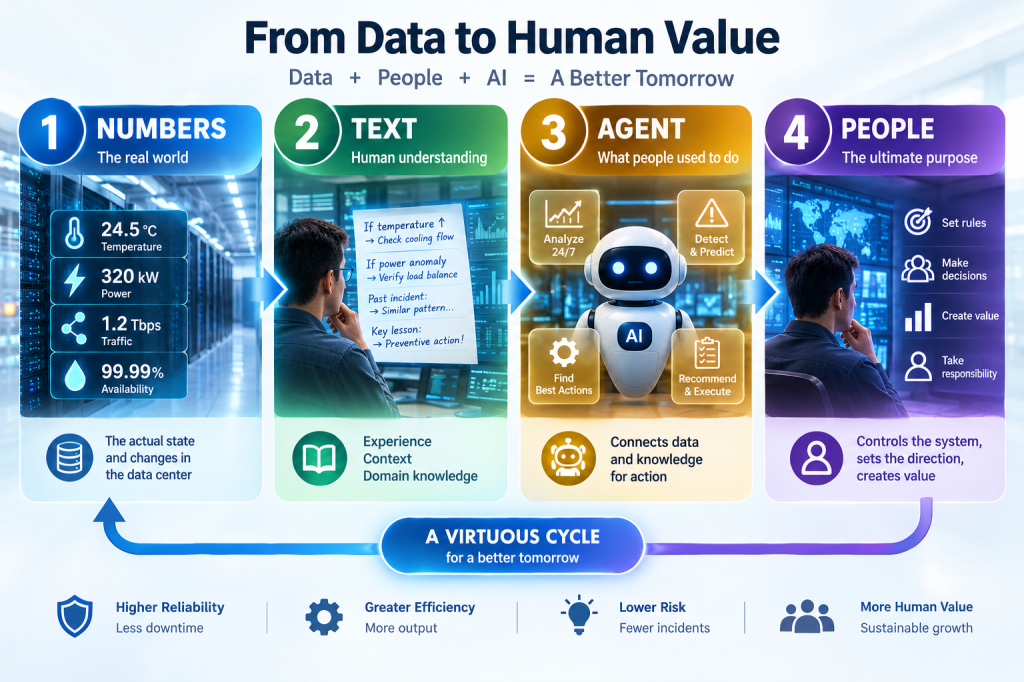
From Data to Human Value
The Computing for the Fair Human Life.
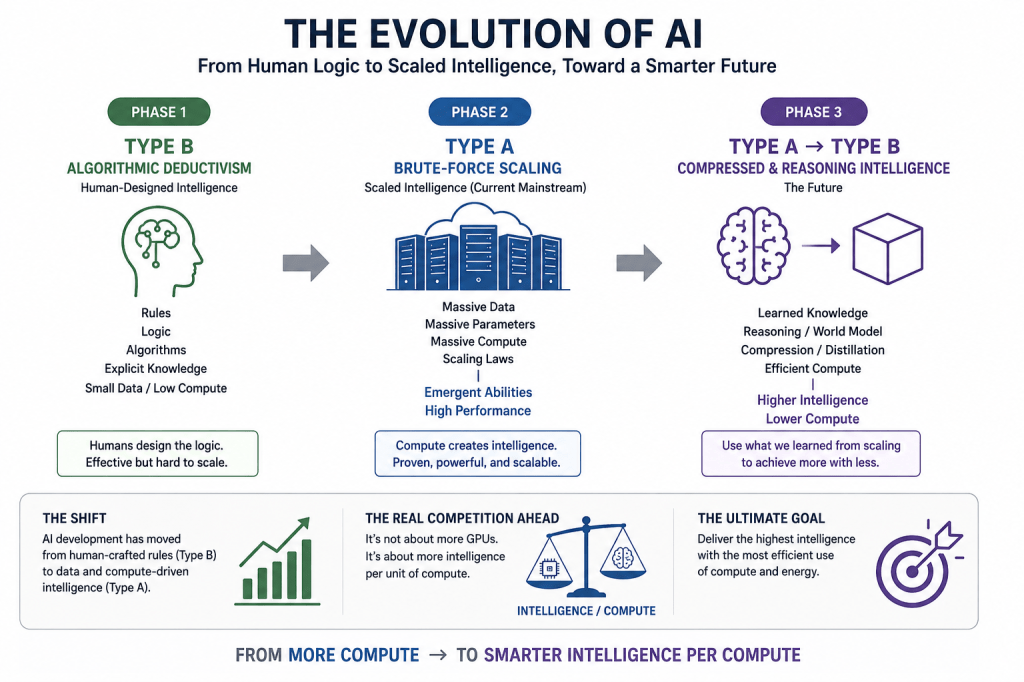
From human-designed rules → massive compute → efficient intelligence.
#AI #ArtificialIntelligence #LLM #AIScaling #AIReasoning #AIInfrastructure #ComputeEfficiency #FutureOfAI
With ChatGPT
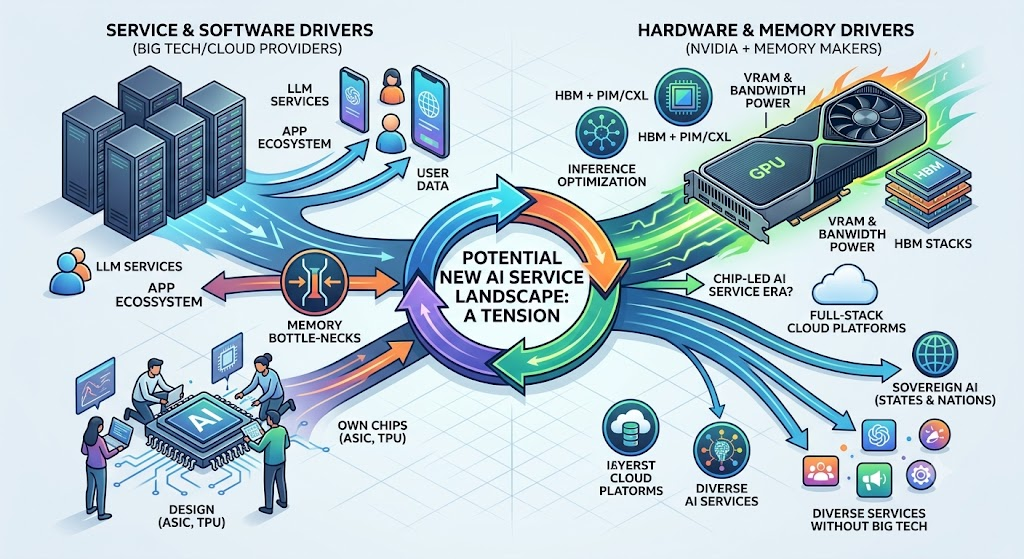
This infographic illustrates the potential future dynamic and tension within the AI industry, pitting Big Tech Service & Software Drivers against Hardware & Memory Drivers (NVIDIA and memory manufacturers).
On the left, cloud providers focus on LLM services and developing their own chips (ASIC, TPU) to overcome a central memory bottleneck.
On the right, hardware makers emphasize the raw power of GPUs, high-bandwidth memory (HBM), and in-memory processing to optimize inference.
A central loop describes this interaction as a “tension” that could lead to various outcomes, from a chip-led AI service era to a diverse range of cloud platforms and independent AI services, including sovereign AI initiatives.
#AI #ArtificialIntelligence #Infographic #TechIndustry #NVIDIA #BigTech #CloudComputing #Semiconductors #HBM #VRAM #ChipDesign #FutureOfTech #AIServices
With Gemini
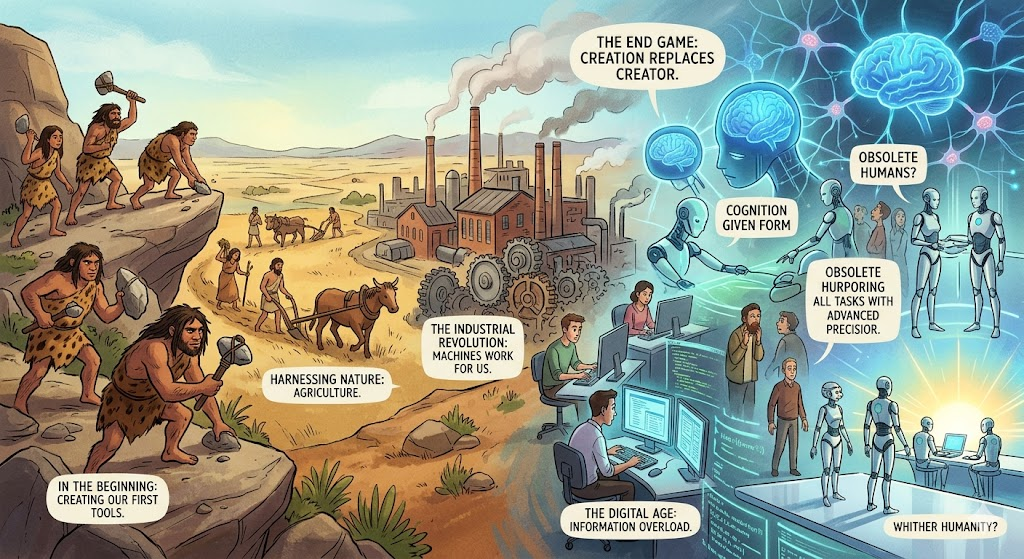
The evolution of human tools is a mirror reflecting our endless desire to transcend not just physical limits, but cognitive ones as well. As AI emerges with the potential to replace our labor and intellect, it marks the beginning of a new evolution. It forces humanity to redefine its intrinsic value, shifting our most fundamental question from “What can we do?” to “Why do we exist?”
With Gemini
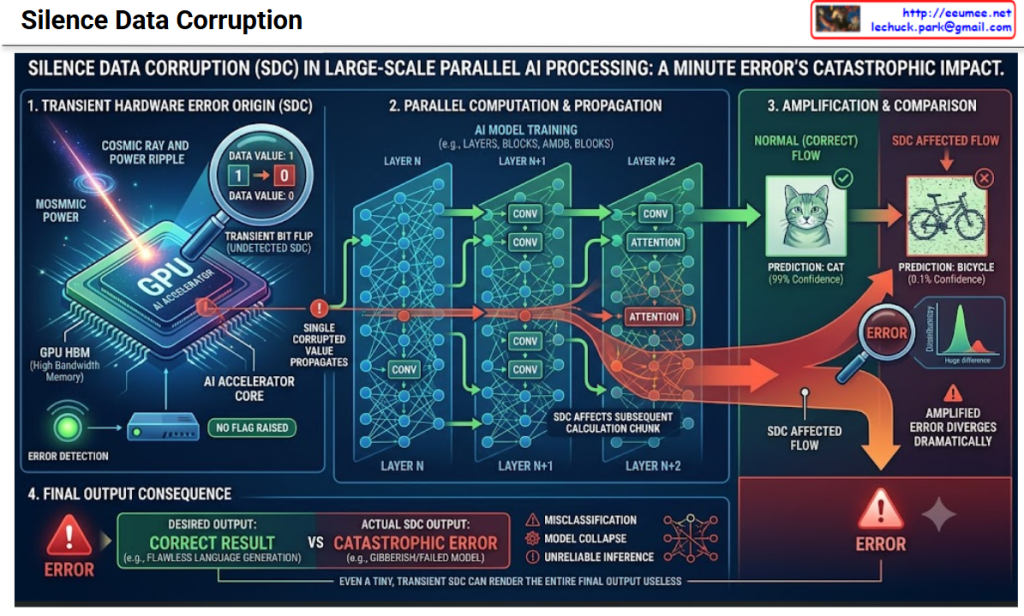
This infographic diagram illustrates the lifecycle of a single, minute, and transient error, showing how it goes undetected and exponentially amplifies through the layers of an AI model to cause a catastrophic final failure.
The diagram is organized horizontally into four sequential stages, moving from the physical hardware level to the final AI application output.
The leftmost section focuses on the physical cause of the error.
1 to 0.The central section illustrates how the corrupted value enters the AI model.
The third section provides a striking side-by-side comparison of the final processed state.
The final, largest section at the bottom summarizes the real-world impact.
The ultimate takeaway, as stated in the title and the final caption, is that EVEN A TINY, TRANSIENT SDC CAN RENDER THE ENTIRE FINAL OUTPUT USELESS. In large-scale, massive parallel AI processing, a single, undetectable bit flip can cascade and multiply, causing a model that looks perfect to fail catastrophically.
#SilentDataCorruption #SDC #AI #MachineLearning #DeepLearning #LargeScaleAI #DistributedComputing #ParallelProcessing #HighPerformanceComputing #HPC
With Gemini (inc. infographic)
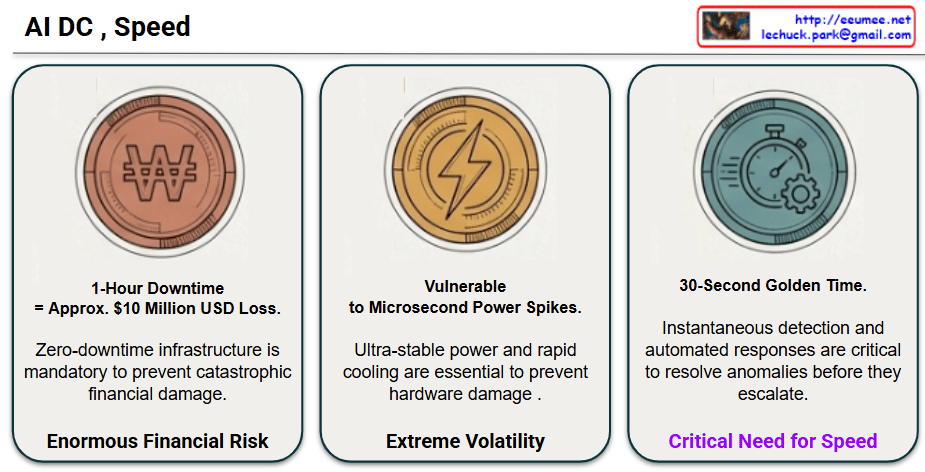
The first section addresses the overwhelming costs associated with system failures. In an AI infrastructure environment handling intensive computing loads, just a single hour of downtime results in an astronomical financial loss of approximately $10 million USD. This indicates that system outages are not merely service delays but catastrophic blows to the business. Therefore, securing a zero-downtime infrastructure architecture is an absolute prerequisite under any circumstances.
The second section warns about the unique vulnerabilities and extreme volatility of AI system hardware. High-density power systems are so sensitive that even microsecond-level power spikes can cause permanent hardware damage. To safely protect these systems, the image highlights that ultra-stable power management, combined with rapid precision or direct liquid cooling infrastructure to immediately control surging heat, is absolutely necessary.
The final section emphasizes “Speed” as the ultimate solution to control the massive financial and physical risks mentioned above. When minor anomalies occur in the system, the “golden time” to prevent them from escalating into irreversible, large-scale failures is a mere 30 seconds. Because human intervention is impossible within this short timeframe, the conclusion is that an AI-driven, fully automated, and ultra-fast response system must be deeply integrated into the infrastructure to instantly detect and autonomously resolve issues.
“The only effective strategy to defend against astronomical downtime costs and microsecond-level hardware damage in AI Data Centers is to build an ultra-fast, automated operational system that instantly detects anomalies and autonomously resolves them within the 30-second golden time.“
#AIDC #ZeroDowntime #AI_Driven_Operations #AutomatedResponse #InfrastructureRisk #HighDensityPower #MTTR_Minimization
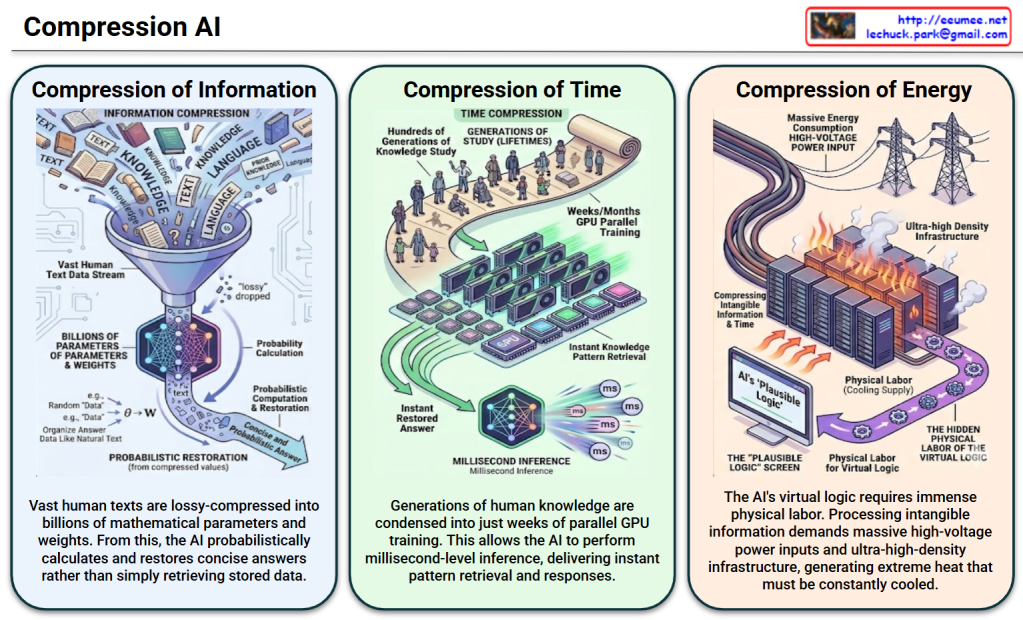
The provided image is an infographic titled “Compression AI”, which explains the underlying mechanisms and realities of modern artificial intelligence, such as Large Language Models (LLMs), through the lens of three types of “compression.” From left to right, it visually details the processes of compressing information, time, and energy.
The first panel demonstrates how humanity’s vast text data is processed internally by the AI.
The second panel illustrates the “compression of time” achieved through the incredible speed of AI’s training and inference.
The third panel addresses the immense physical toll exacted in the real world to run the AI’s invisible virtual logic.
This image effectively highlights that AI (LLM) is not some virtual magic, but a strictly physical and mathematical process. It beautifully visualizes the core mechanism of AI as a massive “compression process”: using mathematical formulas to lossy-compress humanity’s vast information, accelerating hundreds of generations of learning time into a short period via GPU computation, and demanding an enormous amount of physical energy as the cost.
#ArtificialIntelligence #AI #LLM #CompressionAI #InformationCompression #TimeCompression #EnergyConsumption #AITrainingPrinciples #AIInfrastructure #DataCompression
With Gemini

