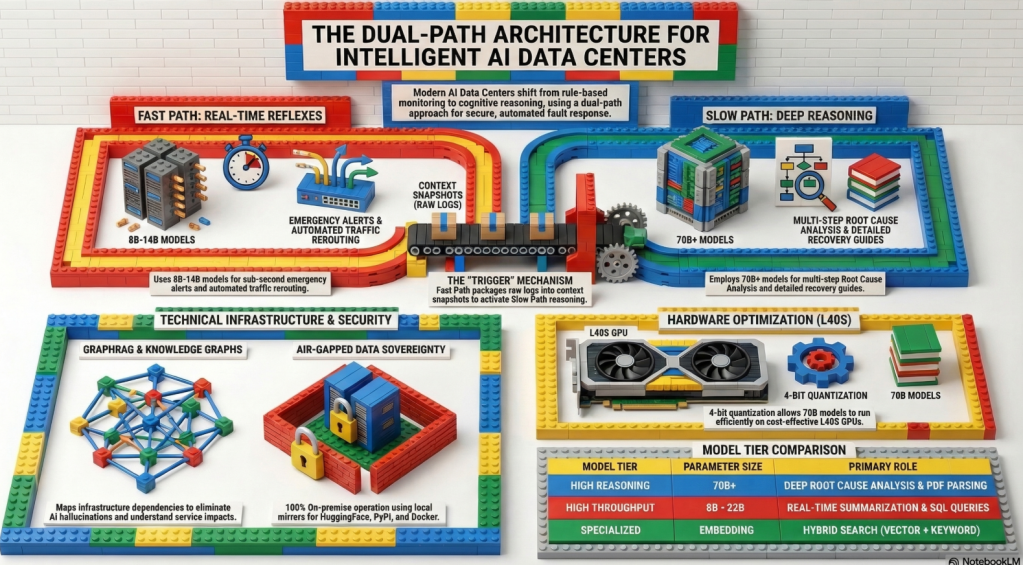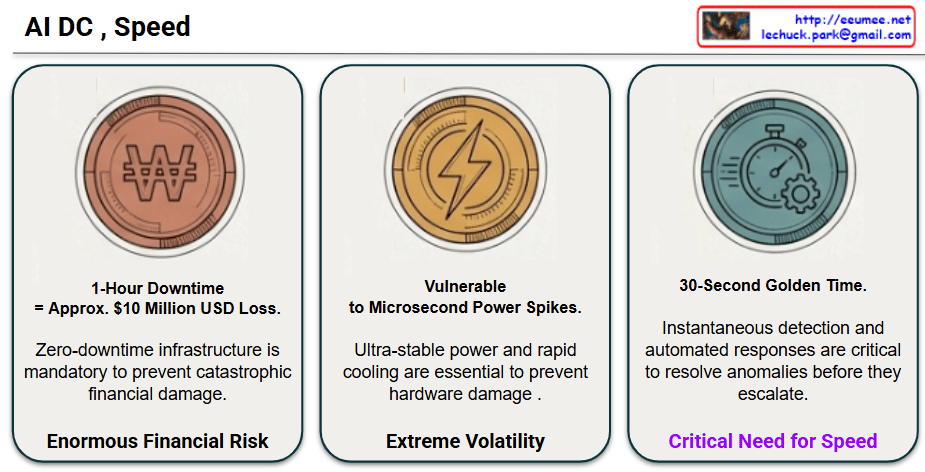
The proposed AI DC Intelligent Incident Response Platform upgrades traditional data center monitoring to an “Autonomous Operations” system within a secure, air-gapped on-premise environment. It features a Dual-Path architecture that utilizes lightweight LLMs for real-time automated alerts (Fast Path) and high-performance LLMs with GraphRAG for deep root-cause analysis (Slow Path). By structuring fragmented manuals and comprehensively mapping infrastructure dependencies, this system significantly reduces recovery time (MTTR) and provides a highly scalable, cost-effective solution for hyper-scale AI data centers
Power Architecture Evolution: From Passive Load to Active Asset
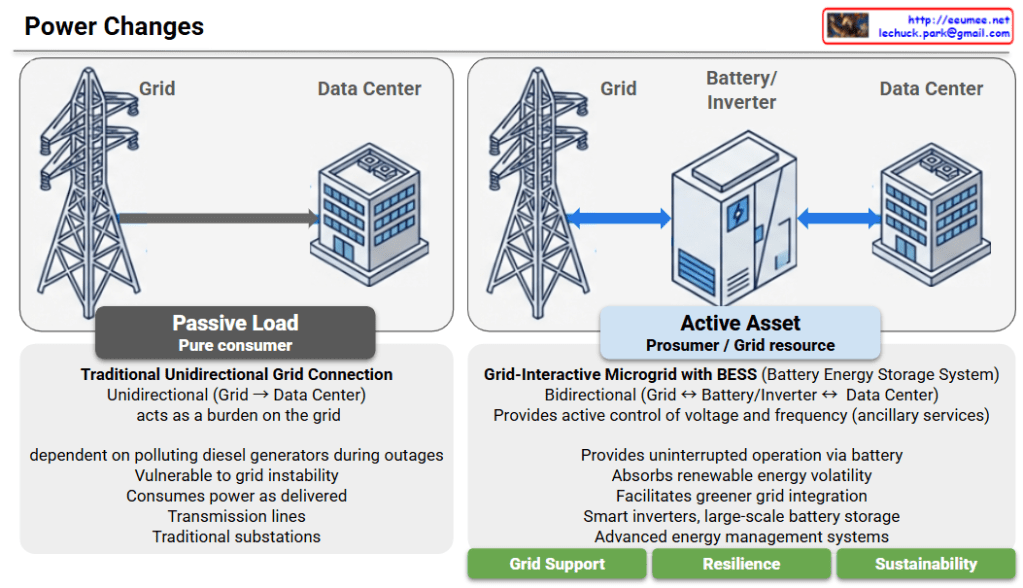
This diagram illustrates the critical evolution of data center power systems, highlighting the shift from a traditional “Passive Load” model to an “Active Asset” model. This transition is emerging as an essential power architecture and strategic direction for future AI Data Centers (AI DCs), which demand massive energy consumption and absolute operational stability.
1. AS-IS: Passive Load (Pure Consumer)
Traditional Unidirectional Grid Connection: Power flows in only one direction (Grid -> Data Center).
Grid Burden: The facility acts solely as a massive energy consumer, placing a heavy burden on the power grid.
Vulnerability & Pollution: It is vulnerable to grid instability and relies heavily on polluting diesel generators during power outages.
Infrastructure: It relies on traditional transmission lines and substations, consuming power exactly as it is delivered without any grid interaction.
2. TO-BE: Active Asset (Prosumer / Grid Resource)
Grid-Interactive Microgrid with BESS: Integrates a Battery Energy Storage System (BESS) for intelligent and flexible power management.
Bidirectional Flow: Power can flow both ways (Grid <-> Battery/Inverter <-> Data Center), allowing the facility to function as a “prosumer.”
Grid Support (Ancillary Services): Actively provides control over voltage and frequency to help stabilize the broader power grid.
Resilience & Sustainability: Ensures uninterrupted operation via large-scale battery storage, significantly reducing diesel dependency. It also absorbs the volatility of renewable energy, facilitating a greener grid integration.
Key Technologies: Driven by smart inverters, large-scale batteries, and Advanced Energy Management Systems (EMS).
Conclusion: An Indispensable Power Direction for AI DCs
Rather than simply acting as facilities that drain massive amounts of electricity, modern data centers must evolve into grid-interactive assets. Given the exponential surge in power demands and the strict continuous operation requirements of AI workloads, adopting this “Active Asset” architecture with BESS and smart inverters is no longer just an eco-friendly alternative—it is an essential and inevitable power infrastructure direction for the successful deployment and scaling of AI Data Centers.
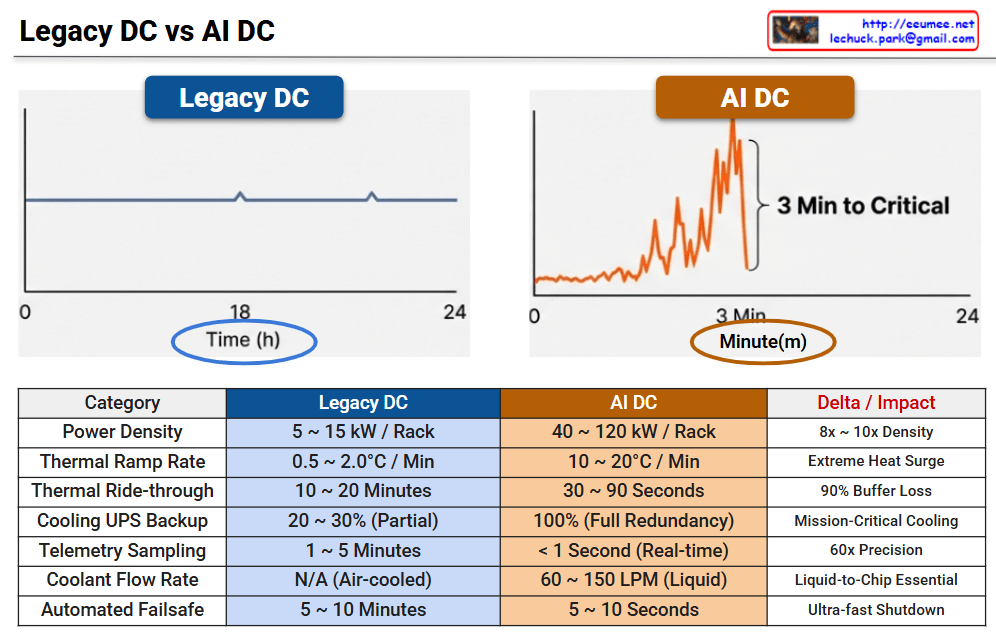
This infographic illustrates the radical shift in operational paradigms between Legacy Data Centers and AI Data Centers, highlighting the transition from “Human-Speed” steady-state management to “Machine-Speed” real-time automation.
📊 Legacy DC vs. AI DC: Operational Metrics Comparison
Category
Legacy DC
AI DC
Delta / Impact
Power Density
5 ~ 15 kW / Rack
40 ~ 120 kW / Rack
8x ~ 10x Density
Thermal Ramp Rate
0.5 ~ 2.0°C / Min
10 ~ 20°C / Min
Extreme Heat Surge
Thermal Ride-through
10 ~ 20 Minutes
30 ~ 90 Seconds
90% Buffer Loss
Cooling UPS Backup
20 ~ 30% (Partial)
100% (Full Redundancy)
Mission-Critical Cooling
Telemetry Sampling
1 ~ 5 Minutes
< 1 Second (Real-time)
60x Precision
Coolant Flow Rate
N/A (Air-cooled)
60 ~ 150 LPM (Liquid)
Liquid-to-Chip Essential
Automated Failsafe
5 ~ 10 Minutes
5 ~ 10 Seconds
Ultra-fast Shutdown
🔍 Graphical Analysis
1. The Volatility Gap
Legacy DC: Shows a stable, predictable power load across a 24-hour cycle. Operations are steady-state and managed on an hourly basis.
AI DC: Features extreme load fluctuations that can reach critical levels within just 3 minutes. This requires monitoring and response to be measured in minutes and seconds rather than hours.
2. The Cooling Imperative
With rack densities reaching 120 kW, air cooling is no longer viable. The shift to Liquid-to-Chip cooling with flow rates up to 150 LPM is mandatory to manage the 10–20°C per minute thermal ramp rates.
3. The End of Manual Intervention
In a Legacy DC, operators have a 20-minute “Golden Hour” to respond to cooling failures. In an AI DC, this buffer collapses to seconds, making sub-second telemetry and automated failsafe protocols the only way to prevent hardware damage.
💡 Summary
Density & Cooling Leap: AI DC demands up to 10x higher power density, necessitating a fundamental shift from traditional air cooling to Direct-to-Chip liquid cooling.
Vanishing Buffer Time: Thermal ride-through time has shrunk from 20 minutes to less than 90 seconds, leaving zero room for manual human intervention during failures.
Real-Time Autonomy: The operational paradigm has shifted to “Machine-Speed” automated control, requiring sub-second telemetry to handle extreme load volatility and ultra-fast failsafe needs.
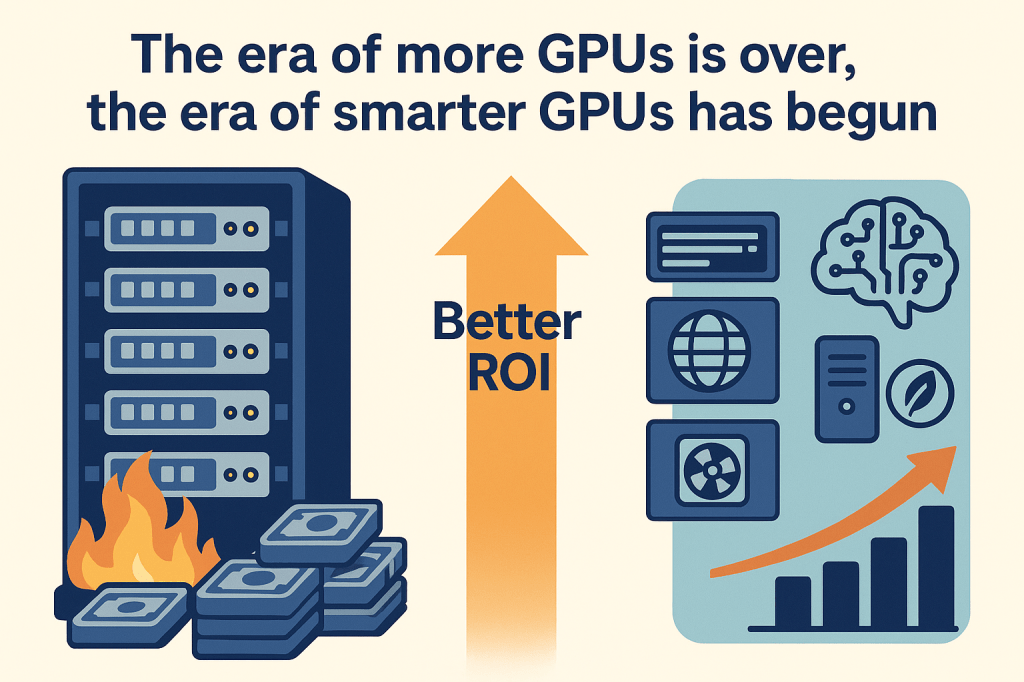
This illustration contrasts an old approach of endlessly adding more GPU servers, burning money for little gain, with a new era where AI-driven optimization of software, network, cooling and power delivers smarter GPUs and a much better ROI.
This image shows a CDU (Coolant Distribution Unit) Metrics & Control System diagram illustrating the overall structure. The system can be organized as follows:
System Structure
Upper Section: CDU Structure
First Loop: CPU with Coolant Distribution Unit
Second Main Loop: Row Manifold and Rack Manifold configuration
Process Chill Water Supply/Return: Process chilled water circulation system
Lower Section: Data Collection & Control Devices
Control Devices:
Pump (Pump RPM, Rate of max speed)
Valve (Valve Open %)
Sensor Configuration:
Temperature & Pressure Sensors on manifolds
Supply System:
Rack Water Supply/Return
Main Control Methods
1. Fixed Pressure Control (Fixed Pressure Drop)
Primary Method: Maintaining fixed pressure drop between rack supply-return
Primary Method: Maintaining constant approach temperature
Alternatives: Fixed open, fixed secondary supply temperature control
Summary
This CDU system provides precise cooling control for data centers through dual management of pressure and temperature. The system integrates sensor feedback from manifolds with pump and valve control to maintain optimal cooling conditions across server racks.
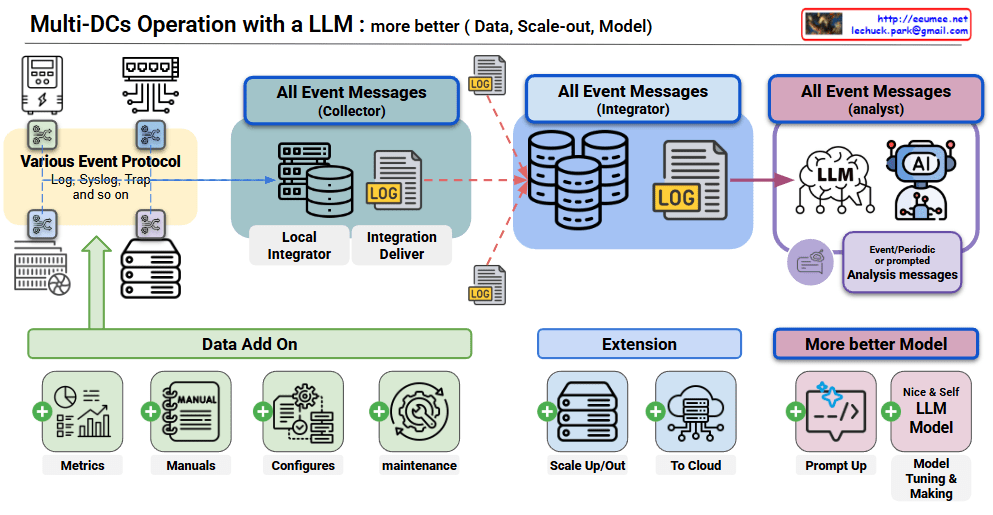
Final stage performs intelligent analysis using LLM and AI
3 Core Expansion Strategies
1️⃣ Data Expansion (Data Add On)
Integration of additional data sources beyond Event Messages:
Metrics: Performance indicators and metric data
Manuals: Operational manuals and documentation
Configures: System settings and configuration information
Maintenance: Maintenance history and procedural data
2️⃣ System Extension
Infrastructure scalability and flexibility enhancement:
Scale Up/Out: Vertical/horizontal scaling for increased processing capacity
To Cloud: Cloud environment expansion and hybrid operations
3️⃣ LLM Model Enhancement (More Better Model)
Evolution toward DC Operations Specialized LLM:
Prompt Up: Data center operations-specialized prompt engineering
Nice & Self LLM Model: In-house development of DC operations specialized LLM model construction and tuning
Strategic Significance
These 3 expansion strategies present a roadmap for evolving from a simple event log analysis system to an Intelligent Autonomous Operations Data Center. Particularly, through the development of in-house DC operations specialized LLM, the goal is to build an AI system that achieves domain expert-level capabilities specifically tailored for data center operations, rather than relying on generic AI tools.
This image illustrates the purpose and outcomes of temperature prediction approaches in data centers, showing how each method serves different operational needs.
Checking a Limitation: Validates whether proposed configurations are “OK or not”
Used for design validation and capacity planning
ML Approach – Operational Monitoring Purpose
Input:
Relation (Extended) Data: Real-time operational data starting from workload metrics
Continuous data streams: Power, CPU, Temperature, LPM/RPM
Process: Data-driven pattern learning and prediction
Results:
Operating Data: Real-time operational insights
Anomaly Detection: Identifies unusual patterns or potential issues
Used for real-time monitoring and predictive maintenance
Key Distinction in Purpose
CFD: “Can we do this?” – Validates design feasibility and limits before implementation
Answers hypothetical scenarios
Provides go/no-go decisions for infrastructure changes
Design-time tool
ML: “What’s happening now?” – Monitors current operations and predicts immediate future
Provides real-time operational intelligence
Enables proactive issue detection
Runtime operational tool
The diagram shows these are complementary approaches: CFD for design validation and ML for operational excellence, each serving distinct phases of data center lifecycle management.