AI With Probabilistic

This infographic visually explains the architectural paradigm shift in modern computing, illustrating how traditional systems and modern AI are merging. Here is a breakdown of the core concepts presented in the image:

1. The Deterministic Domain (Top Left)

The dark gray section represents traditional computing and engineering, grounded in strict logic.

  • Number & Rules: The icons of a number puzzle, math symbols, and a calculator symbolize environments governed by absolute rules—such as physical laws, hardcoded system logic, and strict operational manuals (like SOPs or EOPs).
  • Increase Certainty: In this realm, the primary objective is to maximize reliability. Given a specific input, the system will always produce the exact same output, ensuring complete control and certainty.

2. The Probabilistic Domain (Top Right)

The light blue section highlights the fundamental nature of modern artificial intelligence, particularly large language models (LLMs) and deep learning.

  • Rolling Dice: The dice in hand perfectly capture the statistical and inferential nature of AI. Instead of following hardcoded rules, these systems generate outcomes based on patterns and probabilities.
  • Reduce Probability: The phrase here signifies the process of machine learning itself—minimizing the margin of error and reducing uncertainty (or randomness) over time through continuous data training to reach the most optimal, highly probable answer.

3. Convergence: All Together at The AI Era (Bottom)

The bottom purple section demonstrates the ultimate goal of next-generation AI infrastructure.

  • It shows “Number,” “Rules,” and “Probability” converging into a single AI chip.
  • This illustrates that the future of autonomous systems isn’t just about letting probabilistic AI run wild. Instead, it is about Harness Engineering—using deterministic physical laws and strict expert rules as a protective scaffolding or “guardrail” around the probabilistic AI. By integrating concepts like Physics-Informed Machine Learning (PIML), AI agents can operate safely, reliably, and autonomously within the strict physical constraints of real-world environments like high-density data centers.

Summary

The image illustrates the evolution of computing from strictly deterministic systems (rules and absolute certainty) and purely probabilistic models (statistical inference) into a unified architecture for the AI era. It highlights the necessity of anchoring probabilistic AI within deterministic physical laws and operational guardrails to build reliable, autonomous systems.

#ArtificialIntelligence #HarnessEngineering #TechArchitecture #SystemDesign #FutureOfTech #TechnicalVisualization

With Gemini
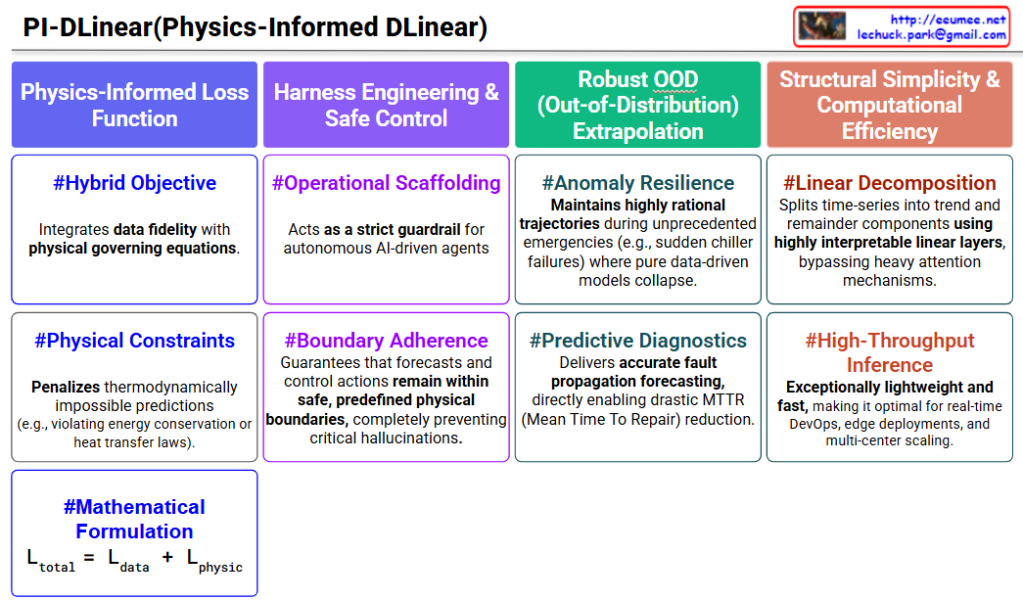
PI-DLinear(Physics-Informed DLinear)


PI-DLinear (Physics-Informed DLinear)

The provided image is a structured infographic slide titled “PI-DLinear (Physics-Informed DLinear).” It visually organizes the model’s core features into four distinct, color-coded columns:

1. Physics-Informed Loss Function (Blue Column)

This section focuses on how physical laws are integrated into the model’s learning process.

  • #Hybrid Objective: It explains that the model integrates data fidelity with physical governing equations.
  • #Physical Constraints: It states that the model penalizes thermodynamically impossible predictions (e.g., violating energy conservation or heat transfer laws).
  • #Mathematical Formulation: It provides the core equation for the loss function: Ltotal = Ldata + Lphysic.

2. Harness Engineering & Safe Control (Purple Column)

This column emphasizes the safety and control aspects for AI operations.

  • #Operational Scaffolding: It describes the model as acting as a strict guardrail for autonomous AI-driven agents.
  • #Boundary Adherence: It guarantees that forecasts and control actions remain within safe, predefined physical boundaries, completely preventing critical hallucinations.

3. Robust OOD (Out-of-Distribution) Extrapolation (Green Column)

This section highlights the model’s reliability during unexpected scenarios.

  • #Anomaly Resilience: It notes that the model maintains highly rational trajectories during unprecedented emergencies (like sudden chiller failures) where pure data-driven models would collapse.
  • #Predictive Diagnostics: It points out that the model delivers accurate fault propagation forecasting, which directly enables a drastic reduction in MTTR (Mean Time To Repair).

4. Structural Simplicity & Computational Efficiency (Red Column)

The final column outlines the architectural benefits of the model.

  • #Linear Decomposition: It explains that the model splits time-series into trend and remainder components using highly interpretable linear layers, bypassing heavy attention mechanisms.
  • #High-Throughput Inference: It emphasizes that the model is exceptionally lightweight and fast, making it optimal for real-time DevOps, edge deployments, and multi-center scaling.

Summary

The infographic effectively presents PI-DLinear as a powerful hybrid model for time-series forecasting. By combining the computational speed and simplicity of linear architectures with the strict mathematical boundaries of physical laws, it creates a highly reliable AI tool. It is specifically designed to handle unexpected anomalies safely and efficiently, making it ideal for critical infrastructure management where AI hallucinations cannot be tolerated.

#PIDLinear #PhysicsInformedAI #TimeSeriesForecasting #AIOps #MachineLearning #SafeAI #PredictiveMaintenance #HarnessEngineering

With Gemini

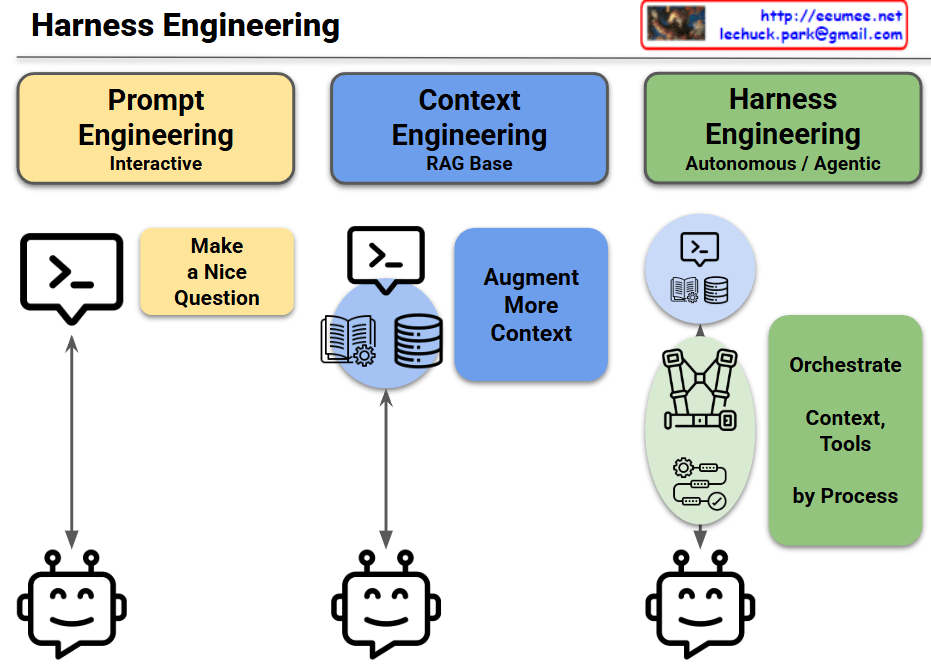
Harness Engineering


The Evolution of LLM Utilization: Toward Autonomous Agents

This slide illustrates the evolutionary roadmap of adopting Large Language Models (LLMs) within enterprise operations, transitioning from basic user inputs to fully automated, agentic workflows. The architecture is broken down into three distinct phases:

  • Phase 1: Prompt Engineering (Interactive)This represents the foundational stage of LLM interaction. At this level, the quality of the output depends entirely on human input—the ability to “Make a Nice Question.” It is a strictly interactive, 1:1 process that relies solely on the model’s pre-trained knowledge, which limits its capability to resolve complex, real-time operational issues.
  • Phase 2: Context Engineering (RAG Base)The second stage addresses the limitations of a standalone LLM by injecting trusted external data. Utilizing a Retrieval-Augmented Generation (RAG) base, the system actively retrieves specific domain knowledge—represented by the manual and database icons—to “Augment More Context.” This grounds the AI in reality, significantly reducing hallucinations and providing highly accurate, domain-specific insights.
  • Phase 3: Harness Engineering (Autonomous / Agentic)This is the ultimate target state. Moving beyond simply generating text, the AI evolves into a proactive agent. The “harness” icon symbolizes a secure, controlled framework where the AI can independently “Orchestrate Context, Tools by Process.” In this autonomous phase, the system not only understands the problem but also safely executes predefined workflows and controls physical or software tools to resolve issues with minimal human intervention.

#LLM #AIArchitecture #AIOps #AutonomousAgents #RAG #ContextEngineering #HarnessEngineering #AgenticAI #ITOperations #TechLeadership

With Gemini