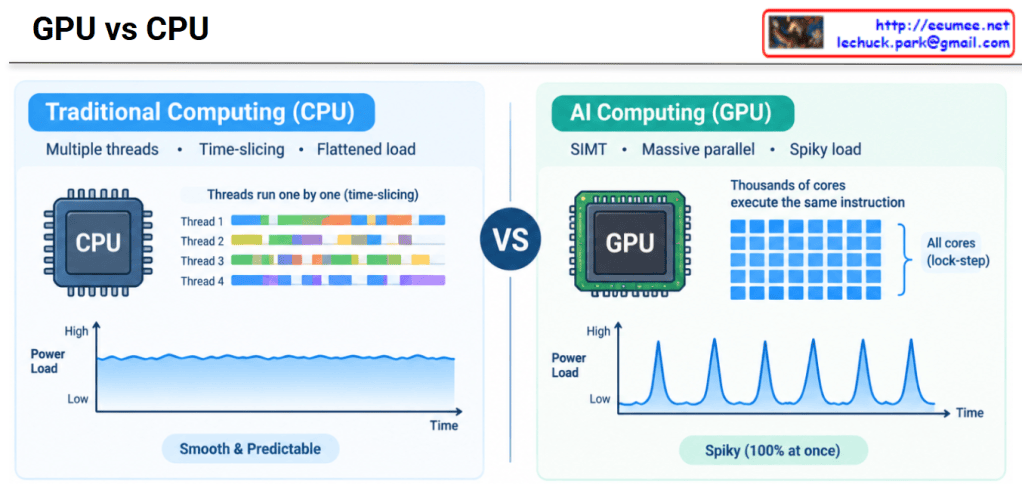
It presents ‘Multiple threads’, ‘Time-slicing’, and ‘Flattened load’ as its main features.
It shows a time-slicing method in the form of bar charts, where multiple threads (Thread 1 to 4) run one by one sequentially by dividing time.
The Power Load graph over time remains constant without large fluctuations, and this state is described as ‘Smooth & Predictable’.
AI Computing (GPU)
It presents ‘SIMT’, ‘Massive parallel’, and ‘Spiky load’ as its main features.
It depicts a massive parallel processing structure where thousands of cores execute the same instruction simultaneously (lock-step), represented by a grid of numerous blue squares.
The Power Load graph shows a ‘Spiky’ pattern, with power consumption sharply peaking at specific times because it performs operations at 100% at once.
Summary
A CPU processes multiple tasks sequentially by dividing time, resulting in stable and predictable power consumption. In contrast, a GPU utilizes thousands of cores to process massive calculations in parallel all at once, leading to a structural difference where the power load temporarily spikes.
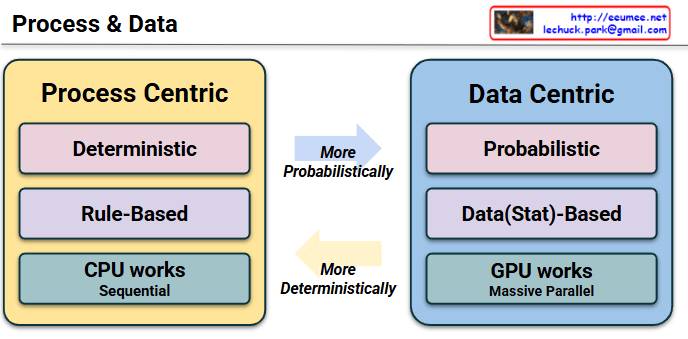
This slide, titled ‘Process & Data’, illustrates the technical differences between traditional computing environments and modern AI/data-centric environments, as well as the organic relationship between the two paradigms.
1. Left: Process Centric Paradigm
First, the yellow area labeled ‘Process Centric’ represents the realm of traditional software engineering that we have utilized for a long time.
Deterministic: It has a clear structure where identical inputs always yield 100% identical outputs.
Rule-Based: The system is controlled by algorithms and conditional statements (If-Then) defined in advance by developers.
CPU works / Sequential: All these processes rely on the sequential processing capabilities of a CPU, which executes instructions one by one in a step-by-step order.
2. Right: Data Centric Paradigm
On the other hand, the blue area labeled ‘Data Centric’ represents the paradigm pursued by modern machine learning, deep learning, and large-scale artificial intelligence (AI) systems.
Probabilistic: Rather than seeking a 100% perfect definitive answer, it infers the most likely ‘probability’ based on statistical evidence.
Data(Stat)-Based: Instead of fixed rules, it operates based on statistical patterns discovered by training on massive amounts of real-world data.
GPU works / Massive Parallel: It fundamentally requires a GPU architecture that performs massive parallel processing using thousands of cores to simultaneously train and infer enormous amounts of data.
3. Center: Paradigm Shift and Interaction (Arrows)
The most notable aspect is the two arrows located in the center. These systems are not isolated; they interact in a mutually complementary way.
Upward Arrow (More Probabilistically): This signifies the direction of evolving from a traditional rule-based system into a “more probabilistic and flexible” AI-based system (e.g., automation, predictive modeling) by integrating big data and high-performance GPU infrastructure.
Downward Arrow (More Deterministically): Conversely, this signifies the direction of securing system stability by converting complex and somewhat uncertain AI inference results or statistical data back into clear rules or formalized processes that humans can ultimately control (e.g., applying AI guardrails, cost optimization controls).
[Summary & Implications]
The core message of this slide is that the computing paradigm is expanding from traditional CPU-based, rule-centric computing (Process Centric) to GPU-based, massive data processing and probabilistic inference computing (Data Centric). To build a successful IT infrastructure, it is essential to understand the characteristics of both paradigms and properly connect them in both directions (More Probabilistically ↔ More Deterministically).
CPU Again for AI: The Evolution of Computing Paradigms
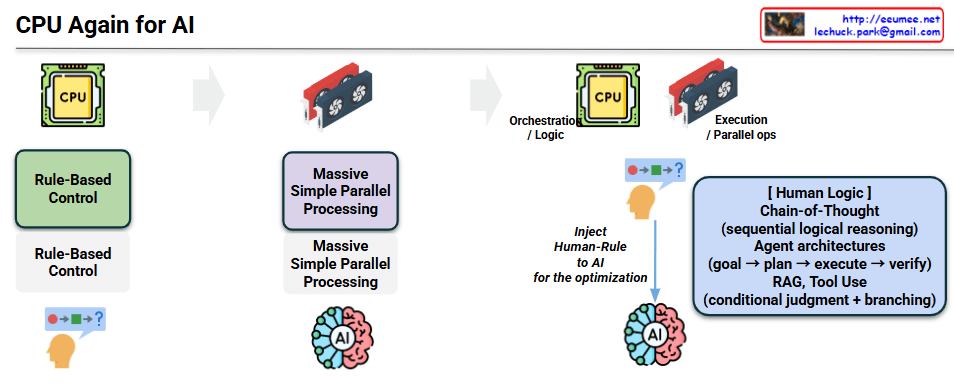
This diagram illustrates the evolutionary journey of computing architectures, highlighting why the CPU is reclaiming its pivotal role in the modern AI era. The flow is divided into three distinct phases:
1. The Era of Traditional Computing (CPU-Centric)
Core Concept: Rule-Based Control.
Mechanism: Historically, computing relied on explicit human logic. Developers hardcoded sequential rules and conditional branching (represented by the sequence 🔴 ➡️ 🟩 ➡️ ❓).
Role: The CPU was the undisputed core, designed specifically to handle complex control flows, logic execution, and sequential operations.
2. The Deep Learning Boom (GPU-Centric)
Core Concept: Massive Simple Parallel Processing.
Mechanism: With the rise of neural networks and deep learning, the focus shifted from complex branching logic to processing vast amounts of data simultaneously.
Role: The GPU took center stage. Its architecture, built for massive parallel operations, was perfectly suited for the mathematical matrix multiplications required by AI models, temporarily overshadowing the CPU’s control capabilities.
3. The Emergence of Agentic AI (CPU + GPU Synergy)
This represents the core message of the diagram. As AI systems become more sophisticated, they require more than just raw processing power; they need structured logic and control.
Division of Labor:
CPU (Orchestration / Logic): Reclaims its role as the system’s brain for control flow. It manages the overall pipeline, making conditional judgments and coordinating tasks.
GPU (Execution / Parallel Ops): Remains the workhorse for heavy computational lifting and model inference.
Injecting Human Logic: To optimize AI and make it capable of solving complex, real-world problems, we are injecting “Human-Rule” back into the system. This is achieved through advanced frameworks:
Chain-of-Thought: Enabling sequential, logical reasoning rather than instant, black-box outputs.
Agent Architectures: Implementing autonomous workflows that follow human-like cognitive steps (Goal ➡️ Plan ➡️ Execute ➡️ Verify).
RAG & Tool Use: Requiring conditional judgment and branching to fetch external data, trigger APIs, or utilize specific tools.
Summary
While the initial AI boom was heavily reliant on the sheer parallel processing power of GPUs, the current transition towards advanced AI Agents and RAG systems necessitates complex workflow management, conditional branching, and logical reasoning. Consequently, the CPU is once again becoming a critical component within AI architectures, serving as the essential orchestrator that guides, plans, and controls the raw execution power of the GPU.