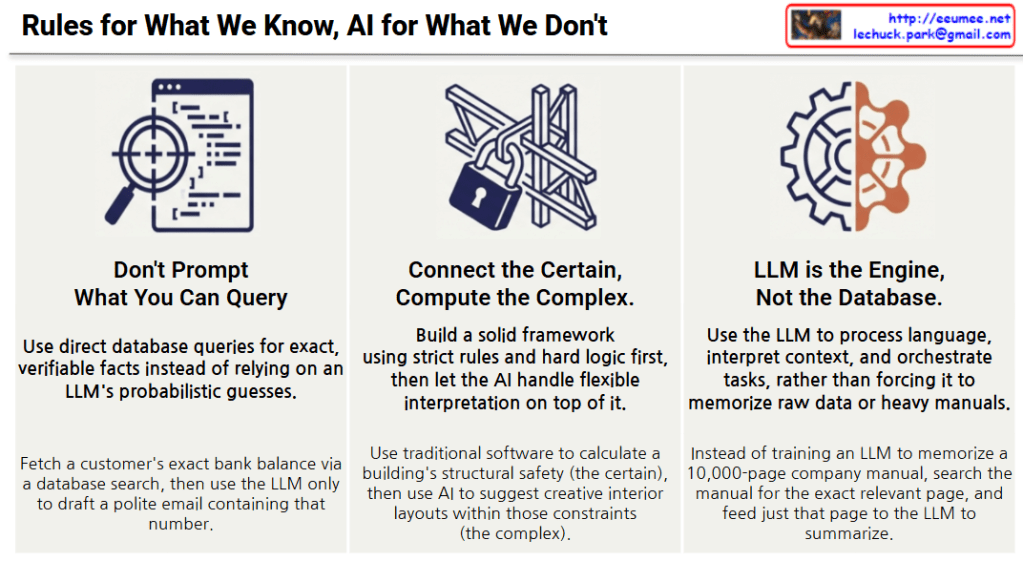
CPU Again

CPU Again for AI: The Evolution of Computing Paradigms

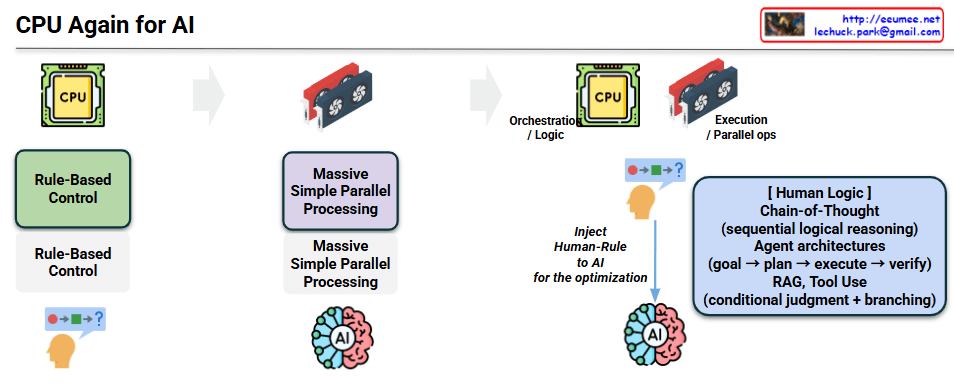
This diagram illustrates the evolutionary journey of computing architectures, highlighting why the CPU is reclaiming its pivotal role in the modern AI era. The flow is divided into three distinct phases:

1. The Era of Traditional Computing (CPU-Centric)

  • Core Concept: Rule-Based Control.
  • Mechanism: Historically, computing relied on explicit human logic. Developers hardcoded sequential rules and conditional branching (represented by the sequence 🔴 ➡️ 🟩 ➡️ ❓).
  • Role: The CPU was the undisputed core, designed specifically to handle complex control flows, logic execution, and sequential operations.

2. The Deep Learning Boom (GPU-Centric)

  • Core Concept: Massive Simple Parallel Processing.
  • Mechanism: With the rise of neural networks and deep learning, the focus shifted from complex branching logic to processing vast amounts of data simultaneously.
  • Role: The GPU took center stage. Its architecture, built for massive parallel operations, was perfectly suited for the mathematical matrix multiplications required by AI models, temporarily overshadowing the CPU’s control capabilities.

3. The Emergence of Agentic AI (CPU + GPU Synergy)

This represents the core message of the diagram. As AI systems become more sophisticated, they require more than just raw processing power; they need structured logic and control.

  • Division of Labor:
    • CPU (Orchestration / Logic): Reclaims its role as the system’s brain for control flow. It manages the overall pipeline, making conditional judgments and coordinating tasks.
    • GPU (Execution / Parallel Ops): Remains the workhorse for heavy computational lifting and model inference.
  • Injecting Human Logic: To optimize AI and make it capable of solving complex, real-world problems, we are injecting “Human-Rule” back into the system. This is achieved through advanced frameworks:
    • Chain-of-Thought: Enabling sequential, logical reasoning rather than instant, black-box outputs.
    • Agent Architectures: Implementing autonomous workflows that follow human-like cognitive steps (Goal ➡️ Plan ➡️ Execute ➡️ Verify).
    • RAG & Tool Use: Requiring conditional judgment and branching to fetch external data, trigger APIs, or utilize specific tools.

Summary

While the initial AI boom was heavily reliant on the sheer parallel processing power of GPUs, the current transition towards advanced AI Agents and RAG systems necessitates complex workflow management, conditional branching, and logical reasoning. Consequently, the CPU is once again becoming a critical component within AI architectures, serving as the essential orchestrator that guides, plans, and controls the raw execution power of the GPU.

#AIArchitecture #ComputingParadigm #AgenticAI #LLMOps #RAG #CPUvsGPU #SystemArchitecture #AIOrchestration #TechTrends

With Gemini

Harness Engineering


The Evolution of LLM Utilization: Toward Autonomous Agents

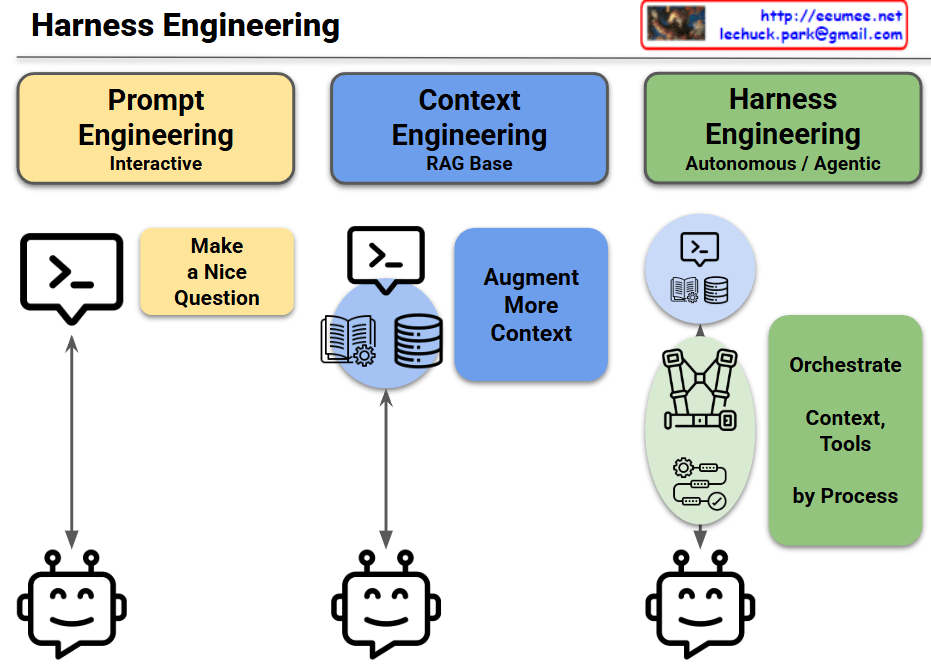
This slide illustrates the evolutionary roadmap of adopting Large Language Models (LLMs) within enterprise operations, transitioning from basic user inputs to fully automated, agentic workflows. The architecture is broken down into three distinct phases:

  • Phase 1: Prompt Engineering (Interactive)This represents the foundational stage of LLM interaction. At this level, the quality of the output depends entirely on human input—the ability to “Make a Nice Question.” It is a strictly interactive, 1:1 process that relies solely on the model’s pre-trained knowledge, which limits its capability to resolve complex, real-time operational issues.
  • Phase 2: Context Engineering (RAG Base)The second stage addresses the limitations of a standalone LLM by injecting trusted external data. Utilizing a Retrieval-Augmented Generation (RAG) base, the system actively retrieves specific domain knowledge—represented by the manual and database icons—to “Augment More Context.” This grounds the AI in reality, significantly reducing hallucinations and providing highly accurate, domain-specific insights.
  • Phase 3: Harness Engineering (Autonomous / Agentic)This is the ultimate target state. Moving beyond simply generating text, the AI evolves into a proactive agent. The “harness” icon symbolizes a secure, controlled framework where the AI can independently “Orchestrate Context, Tools by Process.” In this autonomous phase, the system not only understands the problem but also safely executes predefined workflows and controls physical or software tools to resolve issues with minimal human intervention.

#LLM #AIArchitecture #AIOps #AutonomousAgents #RAG #ContextEngineering #HarnessEngineering #AgenticAI #ITOperations #TechLeadership

With Gemini

RAG Works Pipeline

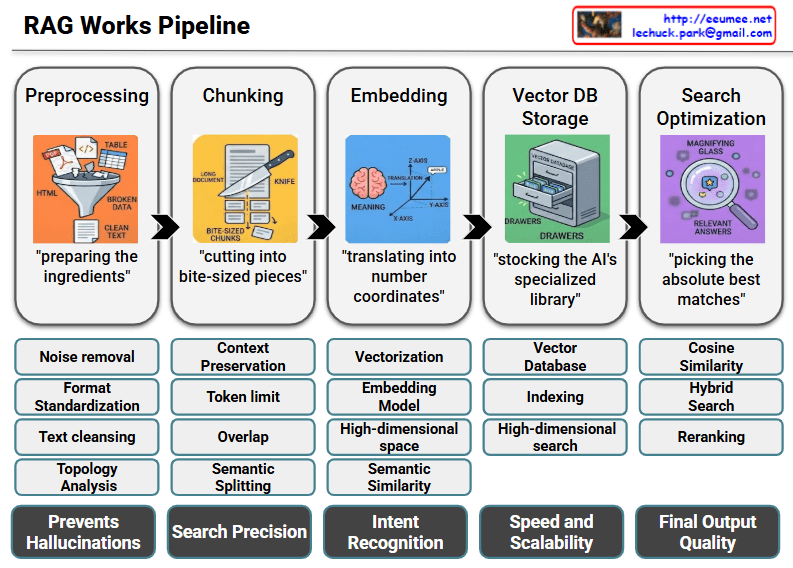
This image illustrates the RAG (Retrieval-Augmented Generation) Works Pipeline, breaking down the complex data processing workflow into five intuitive steps using relatable analogies like cooking and organizing.

Here is a step-by-step breakdown of the pipeline:

  • Step 1: Preprocessing (“preparing the ingredients”)
    Just like prepping ingredients for a meal, this step filters raw, unstructured data from various formats (PDFs, HTML, tables) through a funnel to extract clean text. By handling noise removal, format standardization, and text cleansing, it establishes a solid data foundation that ultimately prevents AI hallucinations.
  • Step 2: Chunking (“cutting into bite-sized pieces”)
    Long documents are sliced into smaller, manageable pieces that the AI model can easily process. Techniques like semantic splitting and overlapping ensure that the original context is preserved without exceeding the AI’s token limits. This careful division drastically improves the system’s overall search precision.
  • Step 3: Embedding (“translating into number coordinates”)
    Here, the text chunks are converted into mathematical vectors mapped in a high-dimensional space (X, Y, Z axes). This vectorization captures the underlying semantic meaning and context of the text, allowing the system to go beyond simple keyword matching and achieve true intent recognition.
  • Step 4: Vector DB Storage (“stocking the AI’s specialized library”)
    The embedded vectors are systematically stored and indexed in a Vector Database. Think of it as a highly organized, specialized filing cabinet designed specifically for AI. Efficient indexing allows for high-dimensional searches, ensuring optimal speed and scalability even as the dataset grows massively.
  • Step 5: Search Optimization (“picking the absolute best matches”)
    Acting as a magnifying glass, this final step identifies and retrieves the most relevant information to answer a user’s query. Using advanced methods like cosine similarity, hybrid search, and reranking, the system pinpoints the exact data needed. This precise retrieval guarantees the highest final output quality for the AI’s generated response.

#RAG #RetrievalAugmentedGeneration #GenerativeAI #LLM #VectorDatabase #DataPipeline #MachineLearning #AIArchitecture #TechExplanation #ArtificialIntelligence

With Gemini

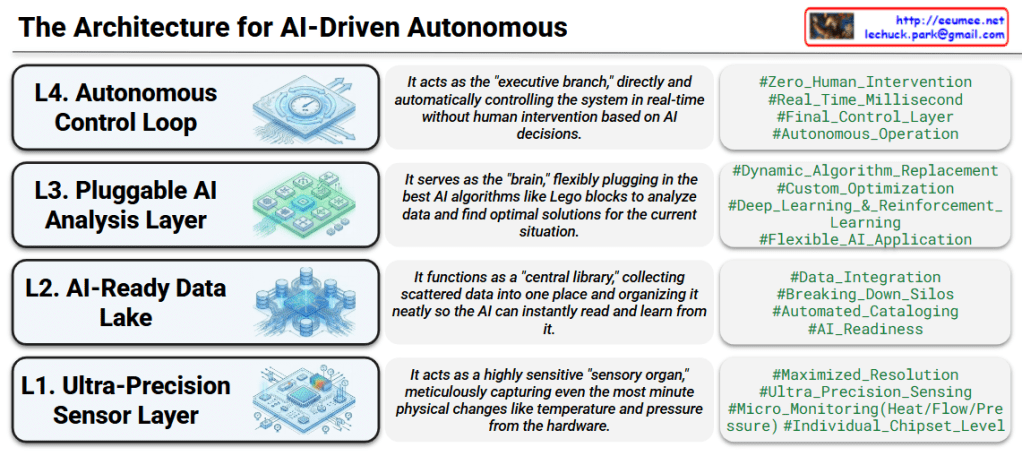
The Architecture for AI-Driven Autonomous

This slide effectively illustrates a complete, four-tier architecture required to build a fully autonomous AI system. Let’s walk through the framework from the foundation (data collection) to the top (autonomous execution):

  • L1. Ultra-Precision Sensor Layer (The “Sensory Organ”)This foundational layer is all about high-resolution data capture. Acting as the system’s highly sensitive sensory organs, it meticulously monitors minute physical changes—such as heat, flow, and pressure—right down to the individual chipset level.
  • L2. AI-Ready Data Lake (The “Central Library”)Once the data is captured, it flows into this layer to be consolidated. It breaks down data silos by collecting scattered facility data into one centralized library. It then automatically catalogs this information so that the AI can instantly access, read, and learn from it.
  • L3. Pluggable AI Analysis Layer (The “Brain”)This is where the cognitive processing happens. Acting as the brain of the system, it analyzes the organized data to find optimal solutions. Its “pluggable” nature means you can dynamically swap in the best AI algorithms—like Deep Learning or Reinforcement Learning—just like snapping Lego blocks together to fit the specific situation.
  • L4. Autonomous Control Loop (The “Executive Branch”)Finally, the insights from the brain are turned into action here. This layer operates in real-time (down to the millisecond) to send control signals back to the system. It executes decisions entirely on its own, achieving true autonomous operation with zero human intervention.

Summary

This architecture demonstrates a seamless, end-to-end operational flow: it starts by sensing microscopic hardware changes (L1), structures that raw data for immediate AI consumption (L2), applies dynamic and flexible algorithms to make smart decisions (L3), and ultimately executes those decisions autonomously in real-time (L4). It is a perfect blueprint for achieving a fully uncrewed, intelligent infrastructure.

#AIArchitecture #AutonomousSystems #EdgeComputing #DataLake #AIOps #SmartInfrastructure #MachineLearning #Automation

With Gemini

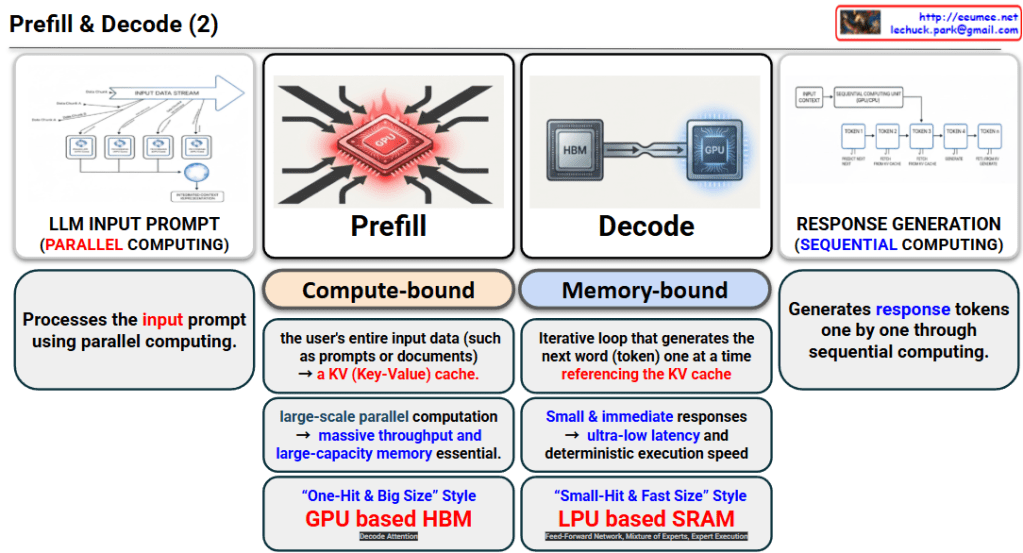
Prefill & Decode (2)

1. Prefill Phase (Input Analysis & Parallel Processing)

  • Processing Method: It processes the user’s lengthy prompts or documents all at once using Parallel Computing.
  • Bottleneck (Compute-bound): Since it needs to process a massive amount of data simultaneously, computational power is the most critical factor. This phase generates the KV (Key-Value) cache which is used in the next step.
  • Requirements: Because it requires large-scale parallel computation, massive throughput and large-capacity memory are essential.
  • Hardware Characteristics: The image describes this as a “One-Hit & Big Size” style, explaining that a GPU-based HBM (High Bandwidth Memory) architecture is highly suitable for handling such large datasets.

2. Decode Phase (Sequential Token Generation)

  • Processing Method: Using the KV cache generated during the Prefill phase, this is a Sequential Computing process that generates the response tokens one by one.
  • Bottleneck (Memory-bound): The computation itself is light, but the system must constantly access the memory (KV cache) to fetch and generate the next word. Therefore, memory access speed (bandwidth) becomes the limiting factor.
  • Requirements: Because it needs to provide small and immediate responses to the user, ultra-low latency and deterministic execution speed are crucial.
  • Hardware Characteristics: Described as a “Small-Hit & Fast Size” style, an LPU (Language Processing Unit)-based SRAM architecture is highly advantageous to minimize latency.

💡Summary

  1. Prefill is a compute-bound phase that processes user input in parallel all at once to create a KV cache, making GPU and HBM architectures highly suitable.
  2. Decode is a memory-bound phase that sequentially generates words one by one by referencing the KV cache, where LPU and SRAM architectures are advantageous for achieving ultra-low latency.
  3. Ultimately, an LLM operates by grasping the context through large-scale computation (Prefill) and then generating responses in real-time through fast memory access (Decode).

#LLM #Prefill #Decode #GPU_HBM #LPU_SRAM #AIArchitecture #ParallelComputing #UltraLowLatencyAI

With Gemini

vLLM Features

vLLM Features & Architecture Breakdown

This chart outlines the key components of vLLM (Virtual Large Language Model), a library designed to optimize the inference speed and memory efficiency of Large Language Models (LLMs).

1. Core Algorithm

  • PagedAttention
    • Concept: Applies the operating system’s (OS) virtual memory paging mechanism to the attention mechanism.
    • Benefit: It resolves memory fragmentation and enables the storage of the KV (Key-Value) cache in non-contiguous memory spaces, significantly reducing memory waste.

2. Data Unit

  • Block (Page)
    • Concept: The minimum KV cache unit with a fixed token size (e.g., 16 tokens).
    • Benefit: Increases management efficiency via fixed-size allocation and minimizes wasted space (internal fragmentation) within slots.
  • Block Table
    • Concept: A mapping table that connects Logical Blocks to Physical Blocks.
    • Benefit: Allows non-contiguous physical memory to be processed as if it were a continuous context.

3. Operation

  • Pre-allocation (Profiling)
    • Concept: Reserves the maximum required VRAM at startup by running a dummy simulation.
    • Benefit: Eliminates the overhead of runtime memory allocation/deallocation and prevents Out Of Memory (OOM) errors at the source.

4. Memory Handling

  • Swapping
    • Concept: Offloads data to CPU RAM when GPU memory becomes full.
    • Benefit: Handles traffic bursts without server downtime and preserves the context of suspended (waiting) requests.
  • Recomputation
    • Concept: Recalculates data instead of swapping it when recalculation is more cost-effective.
    • Benefit: Optimizes performance for short prompts or in environments with slow interconnects (e.g., PCIe limits).

5. Scheduling

  • Continuous Batching
    • Concept: Iteration-level scheduling that fills idle slots immediately without waiting for other requests to finish.
    • Benefit: Eliminates GPU idle time and maximizes overall throughput.

Summary

  1. vLLM adapts OS memory management techniques (like Paging and Swapping) to optimize LLM serving, solving critical memory fragmentation issues.
  2. Key technologies like PagedAttention and Continuous Batching minimize memory waste and eliminate GPU idle time to maximize throughput.
  3. This architecture ensures high performance and stability by preventing memory crashes (OOM) and efficiently handling traffic bursts.

#vLLM #LLMInference #PagedAttention #AIArchitecture #GPUOptimization #MachineLearning #SystemDesign #AIInfrastructure

With Gemini

Basic LLM Workflow

Basic LLM Workflow Interpretation

This diagram illustrates how data flows through various hardware components during the inference process of a Large Language Model (LLM).

Step-by-Step Breakdown

① Initialization Phase (Warm weights)

  • Model weights are loaded from SSD → DRAM → HBM (High Bandwidth Memory)
  • Weights are distributed and shared across multiple GPUs

② Input Processing (CPU tokenizes/batches)

  • CPU tokenizes input text and processes batches
  • Data is transferred through DRAM buffer to GPU

③ GPU Inference Execution

  • GPU performs Attention and FFN (Feed-Forward Network) computations from HBM
  • KV cache (Key-Value cache) is stored in HBM
  • If HBM is tight, KV cache can be offloaded to DRAM or SSD

④ Distributed Communication (NvLink/Infiniband)

  • Intra-node: High-speed communication between GPUs via NvLink (with NVSwitch if available)
  • Inter-node: Parallel communication through InfiniBand or NCCL

⑤ Post-processing (CPU decoding/post)

  • CPU decodes generated tokens and performs post-processing
  • Logs and caches are saved to SSD

Key Characteristics

This architecture leverages a memory hierarchy to efficiently execute large-scale models:

  • SSD: Long-term storage (slowest, largest capacity)
  • DRAM: Intermediate buffer
  • HBM: GPU-dedicated high-speed memory (fastest, limited capacity)

When model size exceeds GPU memory, strategies include distributing across multiple GPUs or offloading data to higher-level memory tiers.


Summary

This diagram shows how LLMs process data through a memory hierarchy (SSD→DRAM→HBM) across CPU and GPU components. The workflow involves loading model weights, tokenizing inputs on CPU, running inference on GPU with HBM, and using distributed communication (NvLink/InfiniBand) for multi-GPU setups. Memory management strategies like KV cache offloading enable efficient execution of large models that exceed single GPU capacity.

#LLM #DeepLearning #GPUComputing #MachineLearning #AIInfrastructure #NeuralNetworks #DistributedComputing #HPC #ModelOptimization #AIArchitecture #NvLink #Transformer #MLOps #AIEngineering #ComputerArchitecture

With Claude