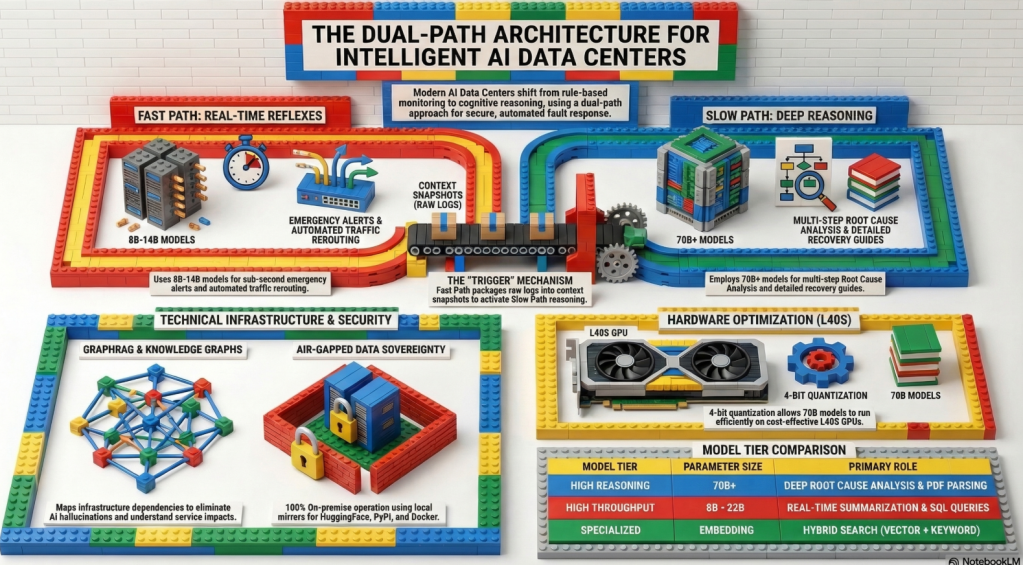
The proposed AI DC Intelligent Incident Response Platform upgrades traditional data center monitoring to an “Autonomous Operations” system within a secure, air-gapped on-premise environment. It features a Dual-Path architecture that utilizes lightweight LLMs for real-time automated alerts (Fast Path) and high-performance LLMs with GraphRAG for deep root-cause analysis (Slow Path). By structuring fragmented manuals and comprehensively mapping infrastructure dependencies, this system significantly reduces recovery time (MTTR) and provides a highly scalable, cost-effective solution for hyper-scale AI data centers
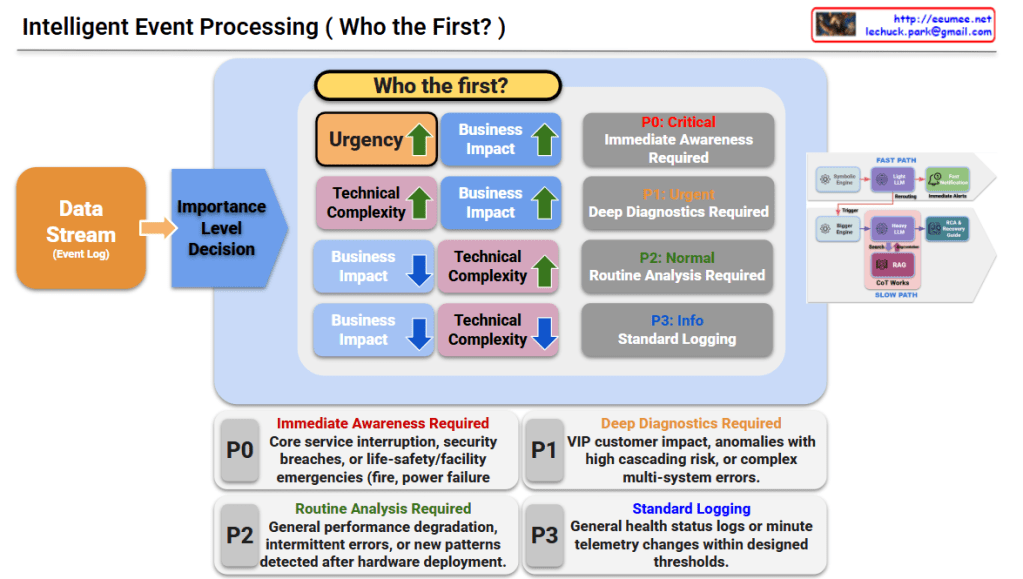
This architecture illustrates how a system intelligently prioritizes data streams (event logs) and selects the most efficient processing path—either for speed or for depth of analysis.
1. Importance Level Decision (Who the First?)
Events are categorized into four priority levels ($P0$ to $P3$) based on Urgency, Business Impact, and Technical Complexity.
P0: Critical (Immediate Awareness Required)
Criteria: High Urgency + High Business Impact.
Scope: Core service interruptions, security breaches, or life-safety/facility emergencies (e.g., fire, power failure).
P1: Urgent (Deep Diagnostics Required)
Criteria: High Technical Complexity + High Business Impact.
Scope: VIP customer impact, anomalies with high cascading risk, or complex multi-system errors.
P2: Normal (Routine Analysis Required)
Criteria: High Technical Complexity + Low Business Impact.
Scope: General performance degradation, intermittent errors, or new patterns detected after hardware deployment.
P3: Info (Standard Logging)
Criteria: Low Technical Complexity + Low Business Impact.
Scope: General health status logs or minute telemetry changes within designed thresholds.
2. Processing Paths: Fast Path vs. Slow Path
The system routes events through two different AI-driven pipelines to balance speed and accuracy.
A. Fast Path (Optimized for P0)
Workflow: Symbolic Engine → Light LLM → Fast Notification.
Goal: Minimizes latency to provide Immediate Alerts for critical issues where every second counts.
B. Slow Path (Optimized for P1 & P2)
Workflow: Bigger Engine → Heavy LLM + RAG (Retrieval-Augmented Generation) + CoT (Chain of Thought).
Goal: Delivers high-quality Root Cause Analysis (RCA) and detailed Recovery Guides for complex problems requiring deep reasoning.
Summary
The system automatically prioritizes event logs into four levels (P0–P3) based on their urgency, business impact, and technical complexity.
It bifurcates processing into a Fast Path using light models for instant alerting and a Slow Path using heavy LLMs/RAG for deep diagnostics.
This dual-track approach maximizes operational efficiency by ensuring critical failures are reported instantly while complex issues receive thorough AI-driven analysis.
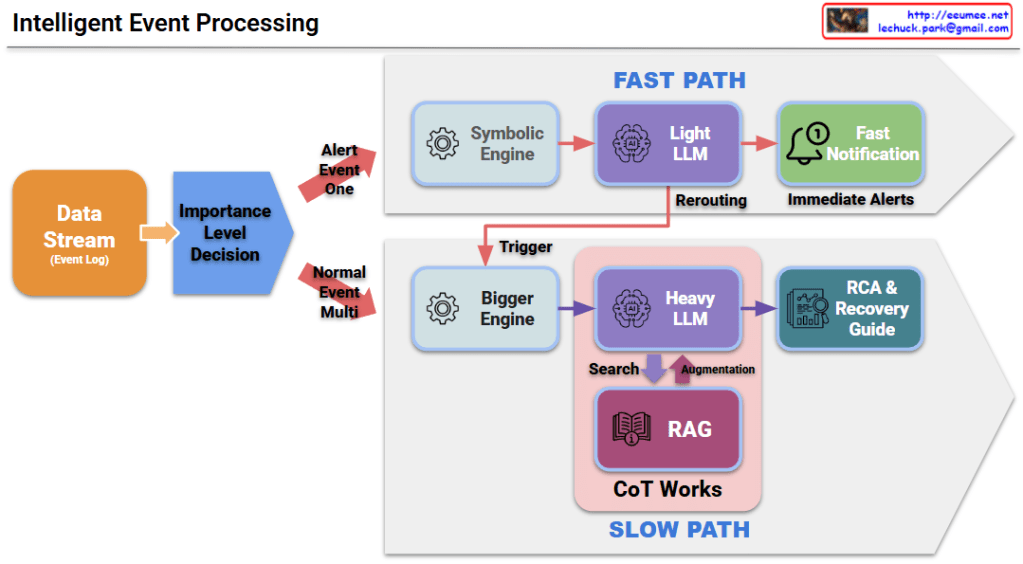
The provided diagrams, titled Event Level Flow and Intelligent Event Processing, illustrate a sophisticated dual-path framework designed to optimize incident response within data center environments. This architecture effectively balances the need for immediate awareness with the requirement for deep, evidence-based diagnostics.
1. Data Ingestion and Intelligent Triage
The process begins with a continuous Data Stream of event logs. An Importance Level Decision gate acts as a triage point, routing traffic based on urgency and complexity:
Critical, single-source issues are designated as Alert Event One and sent to the Fast Path.
Standard or bulk logs are labeled Normal Event Multi and directed to the Slow Path for batch or deeper processing.
2. Fast Path: The Low-Latency Response Track
This path minimizes the time between event detection and operator awareness.
A Symbolic Engine handles rapid, rule-based filtering.
A Light LLM (typically a smaller parameter model) summarizes the event for human readability.
The Fast Notification system delivers immediate alerts to operators.
Crucially, a Rerouting function triggers the Slow Path, ensuring that even rapidly reported issues receive full analytical scrutiny.
3. Slow Path: The Comprehensive Diagnostic Track
The Slow Path focuses on precision, using advanced reasoning to solve complex problems.
Upon receiving a Trigger, a Bigger Engine prepares the data for high-level inference.
The Heavy LLM executes Chain of Thought (CoT) Works, breaking down the incident into logical steps to avoid errors.
This is supported by a Retrieval-Augmented Generation (RAG) system that performs a Search across internal knowledge bases (like manuals) and performs an Augmentation to enrich the LLM prompt with specific context.
The final output is a comprehensive Root Cause Analysis (RCA) and an actionable Recovery Guide.
Summary
This architecture bifurcates incident response into a Fast Path for rapid awareness and a Slow Path for in-depth reasoning.
By combining lightweight LLMs for speed and heavyweight LLMs with RAG for accuracy, it ensures both rapid alerting and reliable recovery guidance.
The integration of symbolic rules and AI-driven Chain of Thought logic enhances both the operational efficiency and the technical reliability of the system.
History → Internet: All knowledge and information accumulated throughout human history is digitized through the internet and converted into AI training data. This consists of multimodal data including text, images, audio, and other formats.
Foundation Model: Large language models (LLMs) and multimodal models are pre-trained based on this vast accumulated data. Examples include GPT, BERT, CLIP, and similar architectures.
Human to AI: Applying Human Cognitive Patterns to AI
1. Chain of Thoughts
Implementation of human logical reasoning processes in the Reasoning stage
Mimicking human cognitive patterns that break down complex problems into step-by-step solutions
Replicating the human approach of “think → analyze → conclude” in AI systems
2. Mixture of Experts
AI implementation of human expert collaboration systems utilized in the Experts domain
Architecting the way human specialists collaborate on complex problems into model structures
Applying the human method of synthesizing multiple expert opinions for problem-solving into AI
3. Retrieval-Augmented Generation (RAG)
Implementing the human process of searching existing knowledge → generating new responses into AI systems
Systematizing the human approach of “reference material search → comprehensive judgment”
Personal/Enterprise/Sovereign Data Utilization
1. Personal Level
Utilizing individual documents, history, preferences, and private data in RAG systems
Providing personalized AI assistants and customized services
2. Enterprise Level
Integrating organizational internal documents, processes, and business data into RAG systems
Implementing enterprise-specific AI solutions and workflow automation
3. Sovereign Level
Connecting national or regional strategic data to RAG systems
Optimizing national security, policy decisions, and public services
Overall Significance: This architecture represents a Human-Centric AI system that transplants human cognitive abilities and thinking patterns into AI while utilizing multi-layered data from personal to national levels to evolve general-purpose AI (Foundation Models) into intelligent systems specialized for each level. It goes beyond simple data processing to implement human thinking methodologies themselves into next-generation AI systems.
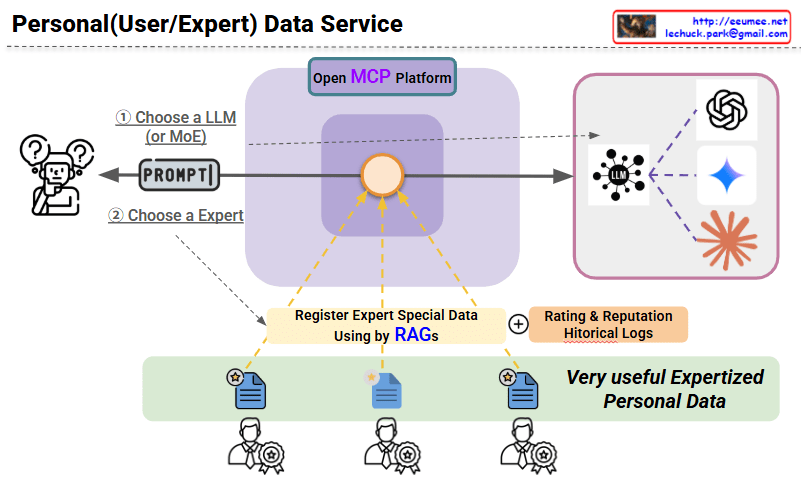
The Personal Data Service is an open expert RAG service platform based on MCP (Model Context Protocol). This system creates a bidirectional ecosystem where both users and experts can benefit mutually, enhancing accessibility to specialized knowledge and improving AI service quality.
Core Components
1. User Interface (Left Side)
LLM Model Selection: Users can choose their preferred language model or MoE (Mixture of Experts)
Expert Selection: Select domain-specific experts for customized responses
Prompt Input: Enter specific questions or requests
2. Open MCP Platform (Center)
Integrated Management Hub: Connects and coordinates all system components
Request Processing: Matches user requests with appropriate expert RAG systems
Service Orchestration: Manages and optimizes the entire workflow
3. LLM Service Layer (Right Side)
Multi-LLM Support: Integration with various AI model services
OAuth Authentication: Direct user selection of paid/free services
Vendor Neutrality: Open architecture independent of specific AI services
4. Expert RAG Ecosystem (Bottom)
Specialized Data Registration: Building expert-specific knowledge databases through RAG
Quality Management System: Ensuring reliability through evaluation and reputation management
Historical Logs: Continuous quality improvement through service usage records
Key Features
Bidirectional Ecosystem: Users obtain expert answers while experts monetize their knowledge
Open Architecture: Scalable platform based on MCP standards
Quality Assurance: Expert and answer quality management through evaluation systems
Flexible Integration: Compatibility with various LLM services
Autonomous Operation: Direct data management and updates by experts
This diagram titled “AI together!!” illustrates a comprehensive architecture for AI-powered question-answering systems, focusing on the integration of user data, tools, and AI models through standardized protocols.
Key Components:
Left Area (Blue) – User Side:
Prompt: The entry point for user queries, represented by a UI interface with chat elements
RAG (Retrieval Augmented Generation): A system that enhances AI responses by retrieving relevant information from user data sources
My Data: User’s personal data repositories shown as spreadsheets and databases
My Tool: Custom tools that can be integrated into the workflow
Right Area (Purple) – AI Model Side:
AI Model (foundation): The core AI foundation model represented by a robot icon
MOE (Mixture Of Experts): A system that combines multiple specialized AI models for improved performance
Domain Specific AI Model: Specialized AI models trained for particular domains or tasks
External or Internet: Connection to external knowledge sources and internet resources
Center Area (Green) – Connection Standard:
MCP (Model Context Protocol): A standardized protocol that facilitates communication between user-side components and AI models, labeled as “Standard of Connecting”
Information Flow:
Questions flow from the prompt interface on the left to the AI models on the right
Answers are generated by the AI models and returned to the user interface
The RAG system augments queries with relevant information from the user’s data
Semantic Search provides additional connections between components
All interactions are standardized through the MCP framework
This architecture demonstrates how personal data and custom tools can be seamlessly integrated with foundation and specialized AI models to create a more personalized, context-aware AI system that delivers more accurate and relevant responses to user queries.
This image shows a diagram titled “LLM RAG Agentic” that illustrates the components and relationships in an AI system architecture.
The diagram is organized in a grid-like layout with three rows and three columns. Each row appears to represent different functional aspects of the system:
Top row:
Left: “Text QnA” in a blue box
Middle: A question mark icon with what looks like document/chat symbols
Right: “LLM” (Large Language Model) in a blue box with a brain icon connected to various data sources/APIs in the middle
Middle row:
Left: “Domain Specific” in a blue box
Middle: A “Decision by AI” circle/node that serves as a central connection point
Right: “RAG” (Retrieval-Augmented Generation) in a blue box with database/server icons
Bottom row:
Left: “Agentic & Control Automation” in a blue box
Middle: A task management or workflow icon with checkmarks and a clock
Right: “Agentic AI” in a blue box with UI/interface icons
Arrows connect these components, showing how information and processes flow between them. The diagram appears to illustrate how a large language model integrates with retrieval-augmented generation capabilities and agentic (autonomous action-taking) functionality to form a complete AI system.



 Lechuck Park