Event Roll-Up by LLM

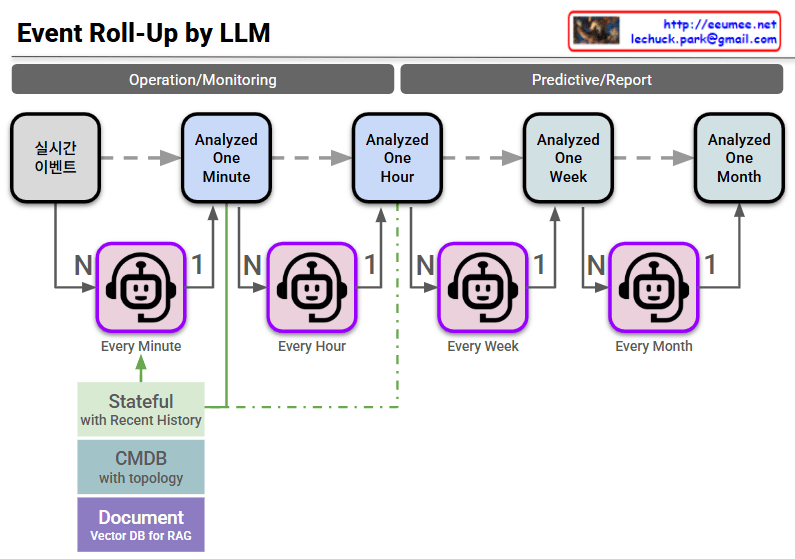
The provided image illustrates an AIOps-based event pipeline architecture. It demonstrates how Large Language Models (LLMs) hierarchically roll up and analyze the flood of real-time events occurring within a data center or large-scale IT infrastructure over time.

The core objective here is to compress countless simple alarms into meaningful insights, drastically reducing alert fatigue and minimizing Mean Time To Repair (MTTR). The architecture can be broken down into three main areas:

1. Separation by Purpose (Top Banner)

  • Operation/Monitoring: Encompasses the 1-minute and 1-hour analysis cycles. This zone is dedicated to immediate anomaly detection and real-time incident response.
  • Predictive/Report: Encompasses the 1-week and 1-month analysis cycles. By leveraging accumulated data, this zone focuses on identifying long-term failure trends, assisting with infrastructure capacity planning, and automatically generating weekly or monthly operational reports.

2. N:1 Hierarchical Roll-Up Mechanism (Center Pipeline)

The robot icons (LLM Agents) deployed at each time interval act as summarization engines, merging data from the lower tier and passing it up the chain.

  • Every Minute: The agent collects numerous real-time events (N) and compresses them into a summarized, 1-minute contextual block (1).
  • Every Hour / Week / Month: The agents aggregate multiple analytical outputs (N) from the preceding stage into a single, comprehensive analysis for the larger time window (1).
  • Through this mechanism, granular noise is progressively filtered out over time, leaving only the macroscopic health status and the most critical issues of the entire infrastructure.

3. Context & Knowledge Injection (Bottom Left)

For an LLM to go beyond simple text summarization and accurately assess the actual state of the infrastructure, it requires grounding. These elements provide that crucial context and are heavily injected during the initial (1-minute) analysis phase.

  • Stateful (with Recent History): Instead of treating events as isolated incidents, the system remembers recent context to track the continuity and transitions of system states.
  • CMDB (with topology): By integrating with the Configuration Management Database, the system understands the physical and logical relationships (e.g., power dependencies, network paths) between the alerting equipment and the rest of the infrastructure.
  • Document (Vector DB for RAG): This is a vectorized repository of operational manuals, past incident resolutions, and Standard Operating Procedures (SOPs). Utilizing Retrieval-Augmented Generation (RAG), it feeds specific domain knowledge to the LLM, enabling it to diagnose root causes and recommend highly accurate remediation steps.

In Summary:

This architecture represents a significant leap from traditional rule-based monitoring. It is a highly systematic blueprint designed to intelligently interpret real-time events by powering LLM agents with RAG and CMDB topology context. Ultimately, it paves the way for reducing manual operator intervention and achieving truly autonomous and proactive infrastructure management.


#AIOps #LLM #AgenticAI #RAG #EventRollUp #ITInfrastructure #AutonomousOperations #MTTR #Observability #TechArchitecture
Hybrid Analysis for Autonomous Operation (2)

Framework Overview

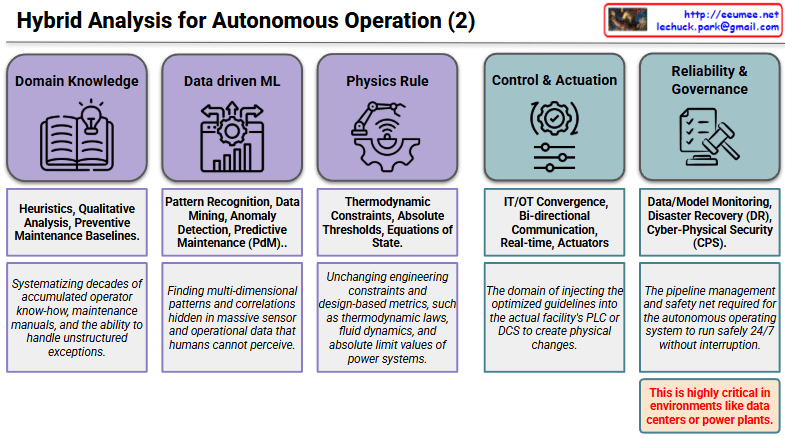
The image illustrates a “Hybrid Analysis” framework designed to achieve true Autonomous Operation. It outlines five core pillars required to build a reliable, self-driving system for high-stakes environments like AI data centers or power plants. The architecture combines three analytical foundations (purple) with two execution and safety layers (teal).


1. The Analytical Foundation (The Hybrid Triad)

This section forms the “brain” of the autonomous system, blending human expertise, artificial intelligence, and absolute scientific laws.

  • Domain Knowledge (Human Experience):
    • Core: Systematized heuristics, decades of operator know-how, and maintenance manuals.
    • Role: Provides qualitative analysis, establishes preventive maintenance baselines, and handles unstructured exceptions that algorithms might miss.
  • Data-driven ML (Artificial Intelligence):
    • Core: Pattern recognition, anomaly detection, and Predictive Maintenance (PdM).
    • Role: Analyzes massive volumes of multi-dimensional sensor and operational data to find hidden correlations and risks that are imperceptible to human operators.
  • Physics Rule (Engineering Guardrails):
    • Core: Thermodynamic constraints, equations of state, fluid dynamics, and absolute power limits.
    • Role: Acts as the ultimate boundary. It ensures that the operational commands generated by ML models are physically possible and safe, preventing the AI from violating unchanging engineering laws.

2. Execution and Safety Nets

This section translates the insights from the analytical triad into real-world, physical changes while guaranteeing system stability.

  • Control & Actuation (The Hands):
    • Core: IT/OT (Information Technology / Operational Technology) convergence and real-time bi-directional communication.
    • Role: The domain of injecting the optimized setpoints and guidelines directly into the facility’s PLC (Programmable Logic Controller) or DCS (Distributed Control System) to drive physical actuators.
  • Reliability & Governance (The Shield):
    • Core: Data/Model monitoring, Disaster Recovery (DR), and Cyber-Physical Security (CPS).
    • Role: The overarching safety net and pipeline management required to ensure the autonomous operating system runs securely and continuously, 24/7, without interruption.

💡 Key Takeaway

As emphasized by the red text at the bottom, this multi-layered approach is highly critical in environments like data centers or power plants. Relying solely on data-driven ML is too risky for high-density infrastructure; true autonomous stability is only achieved when AI is anchored by human domain expertise and strict physical laws.

#AutonomousOperations #AIOps #HybridAnalysis #PredictiveMaintenance #ITOTConvergence #CyberPhysicalSystems #MissionCritical #TechVisualization #EngineeringInfographic

With Gemini

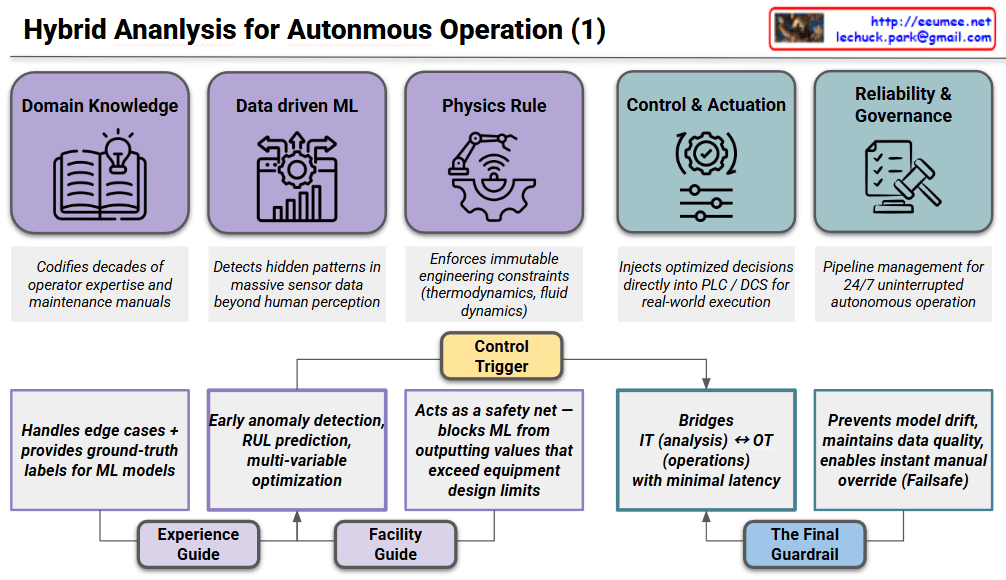
Hybrid Analysis for Autonomous Operation (1)


Hybrid Analysis for Autonomous Operation (1)

This framework illustrates a holistic approach to autonomous systems, integrating human expertise, physical laws, and AI to ensure safe and efficient real-world execution.

1. Five Core Modules (Top Layer)

  • Domain Knowledge: Codifies decades of operator expertise and maintenance manuals into digital logic.
  • Data-driven ML: Detects hidden patterns in massive sensor data that go beyond human perception.
  • Physics Rule: Enforces immutable engineering constraints (such as thermodynamics or fluid dynamics) to ground the AI in reality.
  • Control & Actuation: Injects optimized decisions directly into PLC / DCS (Distributed Control Systems) for real-world execution.
  • Reliability & Governance: Manages the entire pipeline to ensure 24/7 uninterrupted autonomous operation.

2. Integrated Value Drivers (Bottom Layer)

These modules work in synergy to create three essential “Guides” for the system:

  • Experience Guide: Combines domain expertise with ML to handle edge cases and provide high-quality ground-truth labels for model training.
  • Facility Guide: Acts as a safety net by combining ML predictions with physical rules. It predicts Remaining Useful Life (RUL) while blocking outputs that exceed equipment design limits.
  • The Final Guardrail: Bridges the gap between IT (Analysis) and OT (Operations). It prevents model drift and ensures an instant manual override (Failsafe) is always available.

3. Key Takeaways

The architecture centers on a “Control Trigger” that converts digital insights into physical action. By anchoring machine learning with physical laws and human experience, the system achieves a level of reliability required for mission-critical environments like data centers or industrial plants.

#AutonomousOperations #IndustrialAI #MachineLearning #SmartFactory #DataCenterManagement #PredictiveMaintenance #ControlSystems #OTSecurity #AIOps #HybridAI

With Gemini

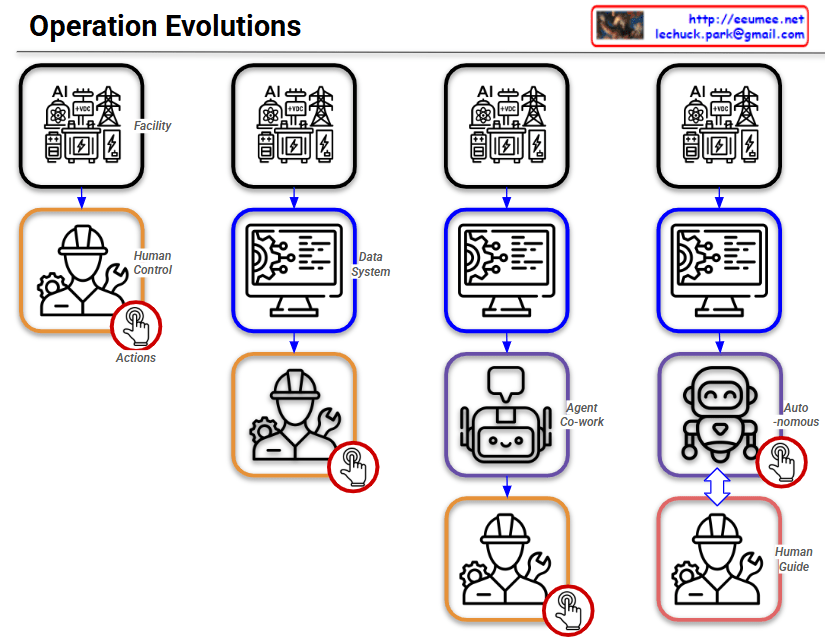
Operation Evolutions

By following the red circle with the ‘Actions’ (clicking hand) icon, you can easily track how the control and operational authority shift throughout the four stages.

Stage 1: Human Control

  • Structure: Facility ➡️ Human Control
  • Description: This represents the most traditional, manual approach. Without a centralized data system, human operators directly monitor the facility’s status and manually execute all Actions based on their physical observations and judgment.

Stage 2: Data System

  • Structure: Facility ➡️ Data System ➡️ Human Control
  • Description: A monitoring or data system (like a dashboard) is introduced. Humans now rely on the data collected by the system to understand the facility’s condition. However, the final Actions are still manually performed by humans.

Stage 3: Agent Co-work

  • Structure: Facility ➡️ Data System ➡️ Agent Co-work ➡️ Human Control
  • Description: An AI Agent is introduced as an intermediary between the data system and the human operator. The AI analyzes the data and provides insights, recommendations, or assistance. Even with this support, the final decision-making and physical Actions remain entirely the human’s responsibility.

Stage 4: Autonomous (Auto-nomous)

  • Structure: Facility ➡️ Data System ➡️ Auto-nomous ↔️ Human Guide
  • Description: This is the ultimate stage of operational evolution. The authority to execute Actions has shifted from the human to the AI. The AI analyzes data, makes independent decisions, and autonomously controls the facility. The human’s role transitions from a direct controller to a ‘Human Guide’, supervising the AI and providing high-level directives. The two-way arrow indicates a continuous, interactive feedback loop where the human and AI collaborate to refine and optimize the system.

Summary:

This slide intuitively illustrates a paradigm shift in infrastructure operations: progressing from Direct Human Intervention ➡️ System-Assisted Cognition ➡️ AI-Assisted Operations (Co-work) ➡️ Fully Autonomous AI Control with Human Supervision.

#AIOps #AutonomousOperations #TechEvolution #DigitalTransformation #DataCenter #FacilityManagement #InfrastructureAutomation #SmartFacilities #AIAgents #FutureOfWork #HumanAndAI #Automation

with Gemini

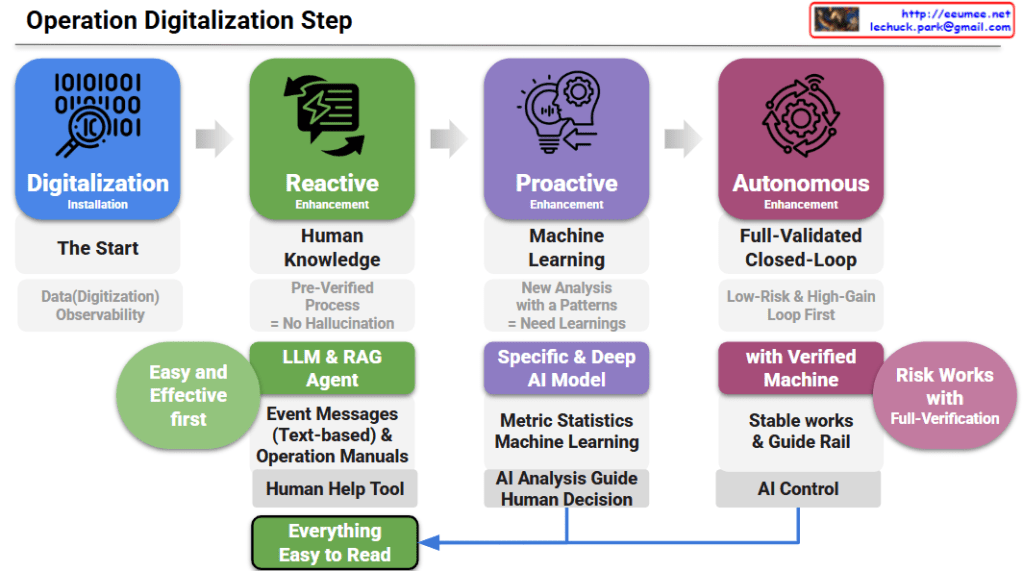
Operation Digitalization Step

Operation Digitalization Step: A 4-Step Roadmap

Step 1: Digitalization (The Start)

  • Goal: Securing data digitization and observability. It is the foundational phase of gathering and monitoring data before applying any advanced automation.

Step 2: Reactive Enhancement (Human Knowledge)

  • Goal: Applying LLM & RAG agents as a “Human Help Tool.”
  • Details: It relies on pre-verified processes to prevent AI hallucinations. By analyzing text-based event messages and operation manuals, it provides an “Easy and Effective first” approach to assist human operators.

Step 3: Proactive Enhancement (Machine Learning)

  • Goal: Deriving new insights through pattern analysis and machine learning.
  • Details: It utilizes specific and deep AI models based on metric statistics to provide an “AI Analysis Guide.” However, the final action still relies on a “Human Decision.”

Step 4: Autonomous Enhancement (Full-Validated Closed-Loop)

  • Goal: Achieving stable, AI-controlled operations.
  • Details: It prioritizes low-risk, high-gain loops. Through verified machines and strict guide rails, the system executes autonomous “AI Control” under full verification to manage risks.
  • Core Feedback Loop: The outcomes from both human decisions (Step 3) and AI control (Step 4) are ultimately designed to make “Everything Easy to Read,” ensuring transparency and intuitive understanding for operators.

  1. Progressive Evolution: The roadmap illustrates a strategic 4-step journey from basic data observability to fully autonomous, AI-controlled operations.
  2. Practical AI Adoption: It emphasizes a safe, low-risk strategy, starting with LLM/RAG as human-assist tools before advancing to predictive machine learning and closed-loop automation.
  3. Human-Centric Transparency: Regardless of the automation level, the ultimate design ensures all AI actions and system insights remain intuitive and “Easy to Read” for human operators.

#OperationDigitalization #AIOps #AutonomousOperations #DataCenterManagement #ITInfrastructure #LLM #RAG #MachineLearning #DigitalTransformation