AI DC, Speed Like F1 Race

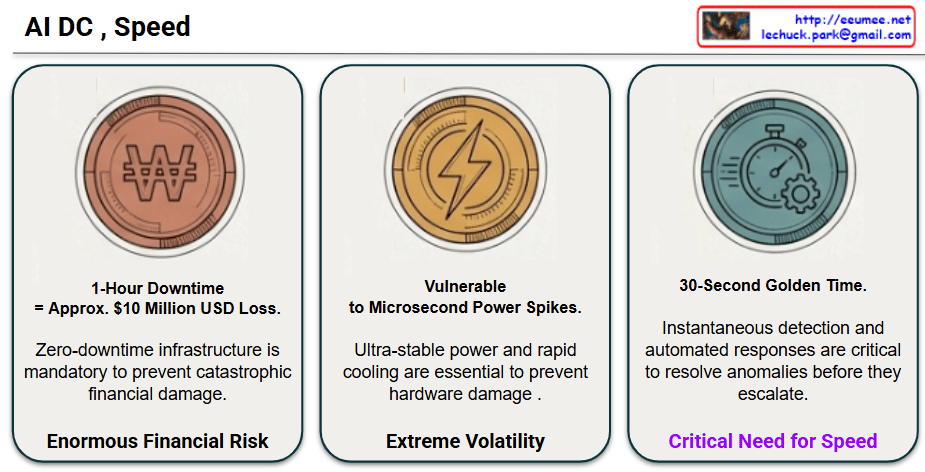
1. Enormous Financial Risk

The first section addresses the overwhelming costs associated with system failures. In an AI infrastructure environment handling intensive computing loads, just a single hour of downtime results in an astronomical financial loss of approximately $10 million USD. This indicates that system outages are not merely service delays but catastrophic blows to the business. Therefore, securing a zero-downtime infrastructure architecture is an absolute prerequisite under any circumstances.

2. Extreme Volatility

The second section warns about the unique vulnerabilities and extreme volatility of AI system hardware. High-density power systems are so sensitive that even microsecond-level power spikes can cause permanent hardware damage. To safely protect these systems, the image highlights that ultra-stable power management, combined with rapid precision or direct liquid cooling infrastructure to immediately control surging heat, is absolutely necessary.

3. Critical Need for Speed

The final section emphasizes “Speed” as the ultimate solution to control the massive financial and physical risks mentioned above. When minor anomalies occur in the system, the “golden time” to prevent them from escalating into irreversible, large-scale failures is a mere 30 seconds. Because human intervention is impossible within this short timeframe, the conclusion is that an AI-driven, fully automated, and ultra-fast response system must be deeply integrated into the infrastructure to instantly detect and autonomously resolve issues.

๐Ÿ’ก Executive Summary

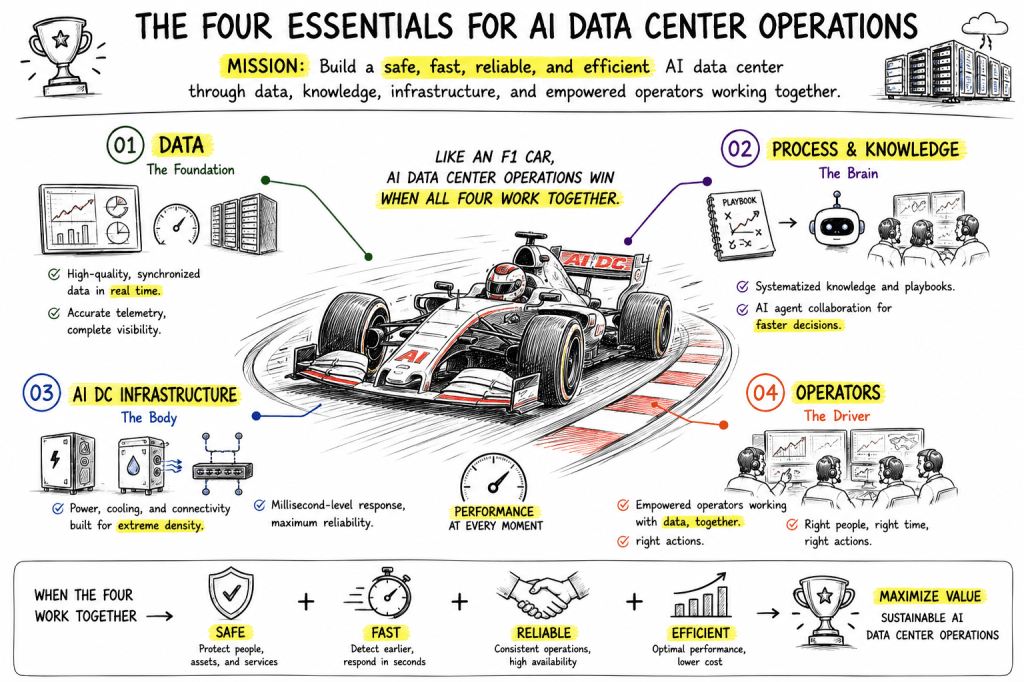
“The only effective strategy to defend against astronomical downtime costs and microsecond-level hardware damage in AI Data Centers is to build an ultra-fast, automated operational system that instantly detects anomalies and autonomously resolves them within the 30-second golden time.

#AIDC #ZeroDowntime #AI_Driven_Operations #AutomatedResponse #InfrastructureRisk #HighDensityPower #MTTR_Minimization
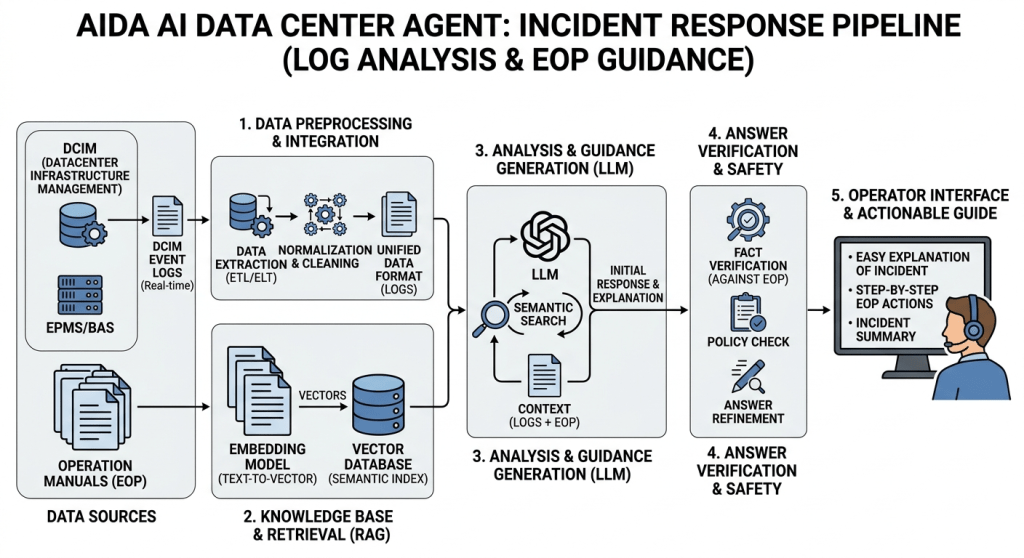
Current Works

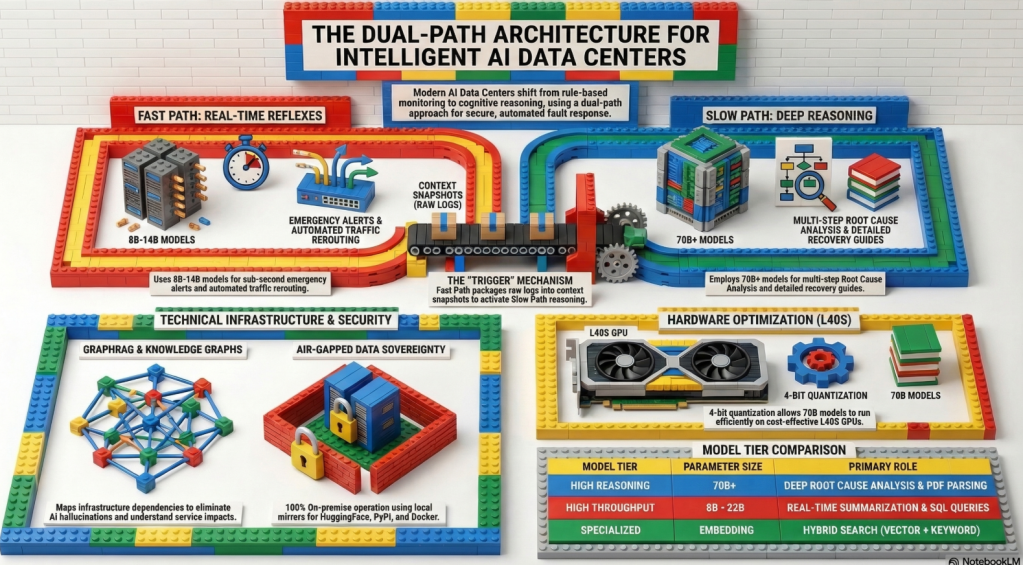
The proposed AI DC Intelligent Incident Response Platform upgrades traditional data center monitoring to an “Autonomous Operations” system within a secure, air-gapped on-premise environment. It features a Dual-Path architecture that utilizes lightweight LLMs for real-time automated alerts (Fast Path) and high-performance LLMs with GraphRAG for deep root-cause analysis (Slow Path). By structuring fragmented manuals and comprehensively mapping infrastructure dependencies, this system significantly reduces recovery time (MTTR) and provides a highly scalable, cost-effective solution for hyper-scale AI data centers

With NotebookLM

Multi-DCs Operation with a LLM (4)

LLM-Based Multi-Datacenter Operation System

System Architecture

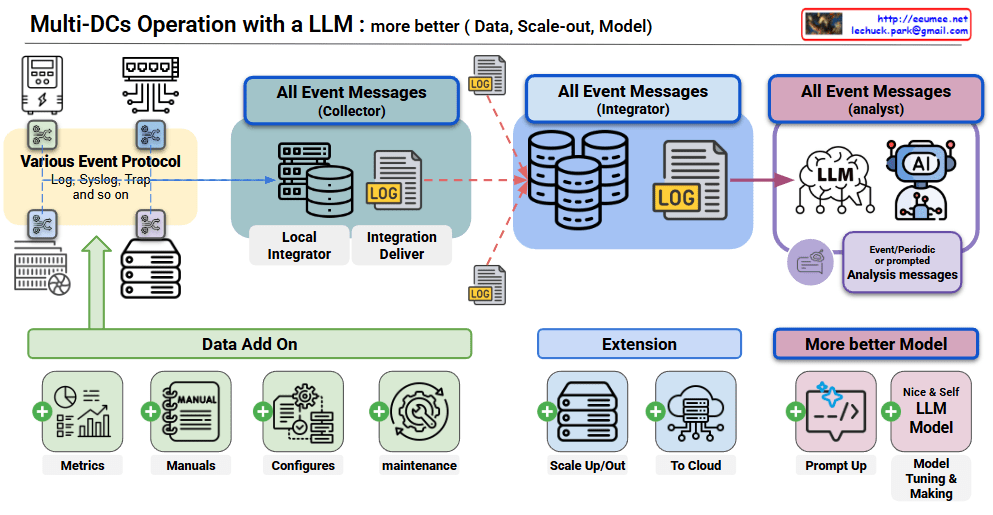
3-Stage Processing Pipeline: Collector โ†’ Integrator โ†’ Analyst

  • Event collection from various protocols
  • Data normalization through local integrators
  • Intelligent analysis via LLM/AI analyzers
  • RAG data expansion through bottom Data Add-On modules

Core Functions

1. Time-Based Event Aggregation Analysis

  • 60-second intervals (adjustable) for event bundling
  • Comprehensive situational analysis instead of individual alarms
  • LLM queries with predefined prompts

Effectiveness:

  • โœ… Resolves alarm fatigue and enables correlation analysis
  • โœ… Improves operational efficiency through periodic comprehensive reports
  • โš ๏ธ Potential delay in immediate response to critical issues ( -> Using a legacy/local monitoring system )

2. RAG-Based Data Enhancement

  • Extension data: Metrics, manuals, configurations, maintenance records
  • Reuse of past analysis results as learning data
  • Improved accuracy through domain-specific knowledge accumulation

Effectiveness:

  • โœ… Continuous improvement of analysis quality and increased automation
  • โœ… Systematization of operational knowledge and organizational capability enhancement

Innovative Value

  • Paradigm Shift: Reactive โ†’ Predictive/Contextual analysis
  • Operational Burden Reduction: Transform massive alarms into meaningful insights
  • Self-Evolution: Continuous learning system through RAG framework

Executive Summary: This system overcomes the limitations of traditional individual alarm approaches and represents an innovative solution that intelligentizes datacenter operations through time-based event aggregation and LLM analysis. As a self-evolving monitoring system that continuously learns and develops through RAG-based data enhancement, it is expected to dramatically improve operational efficiency and analysis accuracy.

With Claude

Multi-DCs Operation with a LLM(3)

This diagram presents the 3 Core Expansion Strategies for Event Message-based LLM Data Center Operations System.

System Architecture Overview

Basic Structure:

  • Collects event messages from various event protocols (Log, Syslog, Trap, etc.)
  • 3-stage processing pipeline: Collector โ†’ Integrator โ†’ Analyst
  • Final stage performs intelligent analysis using LLM and AI

3 Core Expansion Strategies

1๏ธโƒฃ Data Expansion (Data Add On)

Integration of additional data sources beyond Event Messages:

  • Metrics: Performance indicators and metric data
  • Manuals: Operational manuals and documentation
  • Configures: System settings and configuration information
  • Maintenance: Maintenance history and procedural data

2๏ธโƒฃ System Extension

Infrastructure scalability and flexibility enhancement:

  • Scale Up/Out: Vertical/horizontal scaling for increased processing capacity
  • To Cloud: Cloud environment expansion and hybrid operations

3๏ธโƒฃ LLM Model Enhancement (More Better Model)

Evolution toward DC Operations Specialized LLM:

  • Prompt Up: Data center operations-specialized prompt engineering
  • Nice & Self LLM Model: In-house development of DC operations specialized LLM model construction and tuning

Strategic Significance

These 3 expansion strategies present a roadmap for evolving from a simple event log analysis system to an Intelligent Autonomous Operations Data Center. Particularly, through the development of in-house DC operations specialized LLM, the goal is to build an AI system that achieves domain expert-level capabilities specifically tailored for data center operations, rather than relying on generic AI tools.

With Claude

go with : the best efficient

System Operations Strategy: Stabilize vs Optimize Analysis

Graph Components

Operational Performance Levels (Color-coded meanings):

  • Blue Line: Risk Zone – Abnormal operational state requiring urgent intervention
  • Green Line: Stable and efficient ideal operational range
  • Purple Line: Enhanced high-performance operational state
  • Dark Red Line: Fully optimized peak performance state
  • Gray Line: Conservative stable operation (high cost consumption)

Core Operating Philosophy

Phase 1: Stabilize

Objective: keep <Green> higher than <Blue>

  • Meaning: Build defense mechanisms to prevent system from falling below risk zone (blue)
  • Impact: Prevent failures, ensure service continuity
  • Approach: Proactive response through predictive-based prevention, prioritizing stability

Phase 2: Optimize

Objective: move <Green> to <Red>

  • Meaning: Gradual performance improvement on a stabilized foundation
  • Impact: Simultaneous improvement of cost efficiency and operational performance
  • Approach: Pursue optimization within limits that don’t compromise stability

Strategic Insights

1. Importance of Sequential Approach

  • The Stabilize โ†’ Optimize sequence is essential
  • Direct optimization without stabilization increases risk exposure

2. Cost Efficiency Paradox

  • Stable efficiency (green) is practically more valuable than full optimization (red)
  • Excessive optimization can result in diminishing returns on investment

3. Dynamic Equilibrium Maintenance

  • Green zone represents a dynamic benchmark continuously adjusted upward, not a fixed target
  • Balance point between stability and efficiency must be continuously recalibrated based on environmental changes

Practical Implications

This model visualizes the core principle of modern system operations: “Stability is the prerequisite for efficiency.” Rather than pursuing performance improvements alone, it presents strategic guidelines for achieving genuine operational efficiency through gradual and sustainable optimization built upon a solid foundation of stability.

The framework emphasizes that true operational excellence comes not from aggressive optimization, but from maintaining the optimal balance between risk mitigation and performance enhancement, ensuring long-term business value creation through sustainable operational practices.

With Claude

Multi-DCs Operation with a LLM (1)

This diagram illustrates a Multi-Data Center Operations Architecture leveraging LLM (Large Language Model) with Event Messages.

Key Components

1. Data Collection Layer (Left Side)

  • Collects data from various sources through multiple event protocols (Log, Syslog, Trap, etc.)
  • Gathers event data from diverse servers and network equipment

2. Event Message Processing (Center)

  • Collector: Comprises Local Integrator and Integration Deliver to process event messages
  • Integrator: Manages and consolidates event messages in a multi-database environment
  • Analyst: Utilizes AI/LLM to analyze collected event messages

3. Multi-Location Support

  • Other Location #1 and #2 maintain identical structures for event data collection and processing
  • All location data is consolidated for centralized analysis

4. AI-Powered Analysis (Right Side)

  • LLM: Intelligently analyzes all collected event messages
  • Event/Periodic or Prompted Analysis Messages: Generates automated alerts and reports based on analysis results

System Characteristics

This architecture represents a modern IT operations management solution that monitors and manages multi-data center environments using event messages. The system leverages LLM technology to intelligently analyze large volumes of log and event data, providing operational insights for enhanced data center management.

The key advantage is the unified approach to handling diverse event streams across multiple locations while utilizing AI capabilities for intelligent pattern recognition and automated response generation.

With Claude