RAG Works Pipeline

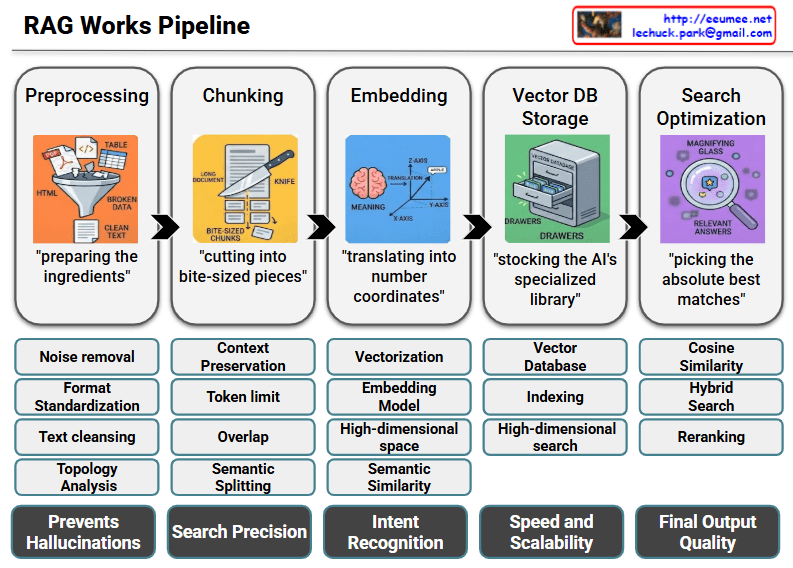
This image illustrates the RAG (Retrieval-Augmented Generation) Works Pipeline, breaking down the complex data processing workflow into five intuitive steps using relatable analogies like cooking and organizing.

Here is a step-by-step breakdown of the pipeline:

  • Step 1: Preprocessing (“preparing the ingredients”)
    Just like prepping ingredients for a meal, this step filters raw, unstructured data from various formats (PDFs, HTML, tables) through a funnel to extract clean text. By handling noise removal, format standardization, and text cleansing, it establishes a solid data foundation that ultimately prevents AI hallucinations.
  • Step 2: Chunking (“cutting into bite-sized pieces”)
    Long documents are sliced into smaller, manageable pieces that the AI model can easily process. Techniques like semantic splitting and overlapping ensure that the original context is preserved without exceeding the AI’s token limits. This careful division drastically improves the system’s overall search precision.
  • Step 3: Embedding (“translating into number coordinates”)
    Here, the text chunks are converted into mathematical vectors mapped in a high-dimensional space (X, Y, Z axes). This vectorization captures the underlying semantic meaning and context of the text, allowing the system to go beyond simple keyword matching and achieve true intent recognition.
  • Step 4: Vector DB Storage (“stocking the AI’s specialized library”)
    The embedded vectors are systematically stored and indexed in a Vector Database. Think of it as a highly organized, specialized filing cabinet designed specifically for AI. Efficient indexing allows for high-dimensional searches, ensuring optimal speed and scalability even as the dataset grows massively.
  • Step 5: Search Optimization (“picking the absolute best matches”)
    Acting as a magnifying glass, this final step identifies and retrieves the most relevant information to answer a user’s query. Using advanced methods like cosine similarity, hybrid search, and reranking, the system pinpoints the exact data needed. This precise retrieval guarantees the highest final output quality for the AI’s generated response.

#RAG #RetrievalAugmentedGeneration #GenerativeAI #LLM #VectorDatabase #DataPipeline #MachineLearning #AIArchitecture #TechExplanation #ArtificialIntelligence

With Gemini
Current Works

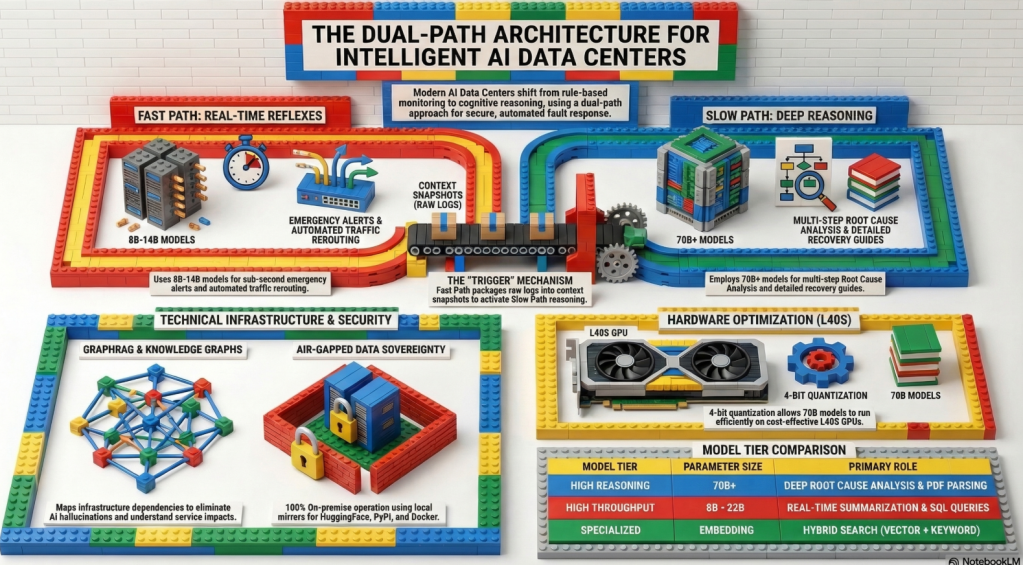
The proposed AI DC Intelligent Incident Response Platform upgrades traditional data center monitoring to an “Autonomous Operations” system within a secure, air-gapped on-premise environment. It features a Dual-Path architecture that utilizes lightweight LLMs for real-time automated alerts (Fast Path) and high-performance LLMs with GraphRAG for deep root-cause analysis (Slow Path). By structuring fragmented manuals and comprehensively mapping infrastructure dependencies, this system significantly reduces recovery time (MTTR) and provides a highly scalable, cost-effective solution for hyper-scale AI data centers

With NotebookLM

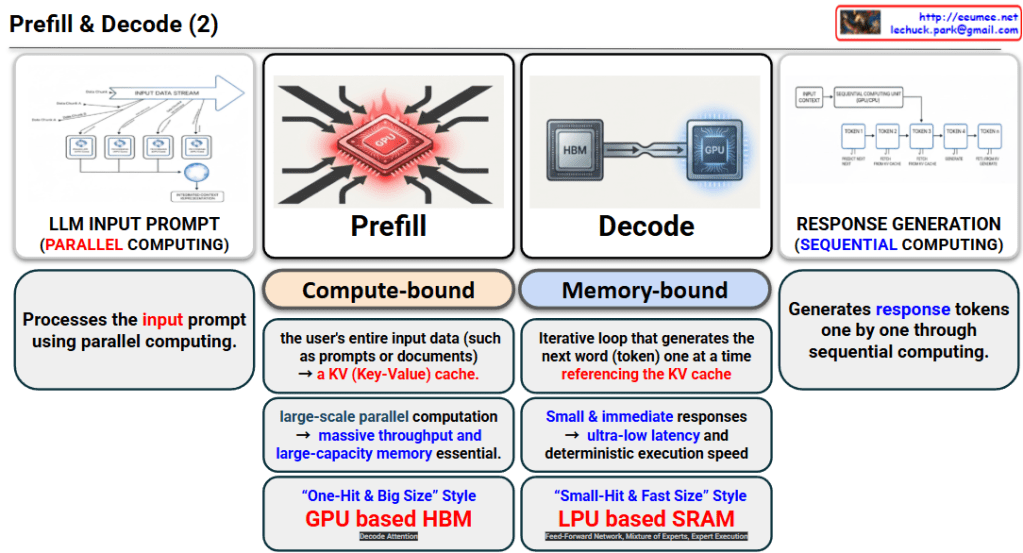
Prefill & Decode (2)

1. Prefill Phase (Input Analysis & Parallel Processing)

  • Processing Method: It processes the user’s lengthy prompts or documents all at once using Parallel Computing.
  • Bottleneck (Compute-bound): Since it needs to process a massive amount of data simultaneously, computational power is the most critical factor. This phase generates the KV (Key-Value) cache which is used in the next step.
  • Requirements: Because it requires large-scale parallel computation, massive throughput and large-capacity memory are essential.
  • Hardware Characteristics: The image describes this as a “One-Hit & Big Size” style, explaining that a GPU-based HBM (High Bandwidth Memory) architecture is highly suitable for handling such large datasets.

2. Decode Phase (Sequential Token Generation)

  • Processing Method: Using the KV cache generated during the Prefill phase, this is a Sequential Computing process that generates the response tokens one by one.
  • Bottleneck (Memory-bound): The computation itself is light, but the system must constantly access the memory (KV cache) to fetch and generate the next word. Therefore, memory access speed (bandwidth) becomes the limiting factor.
  • Requirements: Because it needs to provide small and immediate responses to the user, ultra-low latency and deterministic execution speed are crucial.
  • Hardware Characteristics: Described as a “Small-Hit & Fast Size” style, an LPU (Language Processing Unit)-based SRAM architecture is highly advantageous to minimize latency.

💡Summary

  1. Prefill is a compute-bound phase that processes user input in parallel all at once to create a KV cache, making GPU and HBM architectures highly suitable.
  2. Decode is a memory-bound phase that sequentially generates words one by one by referencing the KV cache, where LPU and SRAM architectures are advantageous for achieving ultra-low latency.
  3. Ultimately, an LLM operates by grasping the context through large-scale computation (Prefill) and then generating responses in real-time through fast memory access (Decode).

#LLM #Prefill #Decode #GPU_HBM #LPU_SRAM #AIArchitecture #ParallelComputing #UltraLowLatencyAI

With Gemini

DC Changes

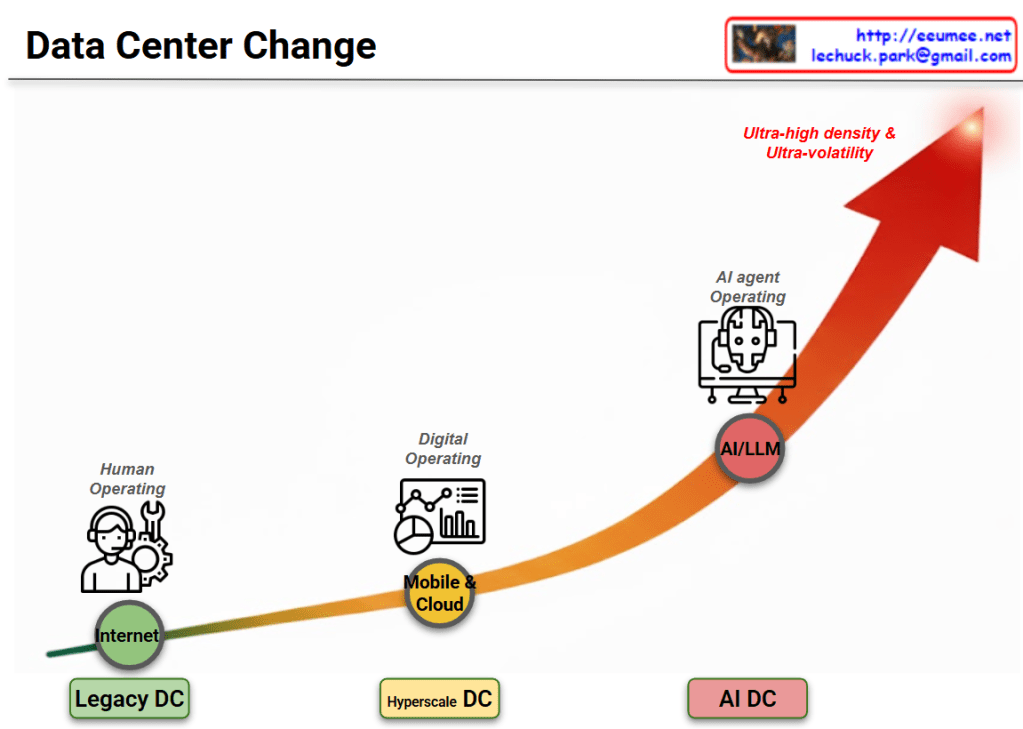
Image Analysis: The Evolution of Infrastructure

This diagram illustrates the evolutionary progression of infrastructure environments and operational methodologies over time. The upward-pointing arrow indicates the escalating complexity, density, and sophistication of these technologies.

  • Phase 1: Internet Era
    • Environment: Legacy Data Center
    • Core Technology: Internet
    • Operating Model: Human Operating
    • Characteristics: The foundational stage where human operators physically monitor and control the infrastructure, relying heavily on manual intervention and traditional toolsets.
  • Phase 2: Mobile & Cloud Era
    • Environment: Hyperscale Data Center
    • Core Technology: Mobile & Cloud
    • Operating Model: Digital Operating
    • Characteristics: A digital transformation phase designed to handle explosive data growth. This stage utilizes dashboards, analytics, and automated systems to significantly improve operational efficiency and scale.
  • Phase 3: Artificial Intelligence Era
    • Environment: AI Data Center
    • Core Technology: AI/LLM (Large Language Models)
    • Operating Model: AI Agent Operating
    • Characteristics: A highly advanced stage where an AI-driven agent takes over the integrated operations of the platform. It functions autonomously to manage and optimize the system, specifically to cope with the “Ultra-high density & Ultra-volatility” characteristic of modern AI workloads.

Summary

The diagram outlines a fundamental paradigm shift in infrastructure management. It traces the journey from early, manual-heavy environments to digitalized systems, ultimately culminating in an advanced era where an AI-driven agent autonomously manages operations for AI Data Centers, expertly handling environments defined by extreme density and volatility.

#DataCenter #AIAgent #LLM #Hyperscale #DigitalOperating #InfrastructureEvolution #UltraHighDensity #TechTrends


With Gemini

Easy LLM


🤖 Strategic Overview: The Most Accessible LLM Framework

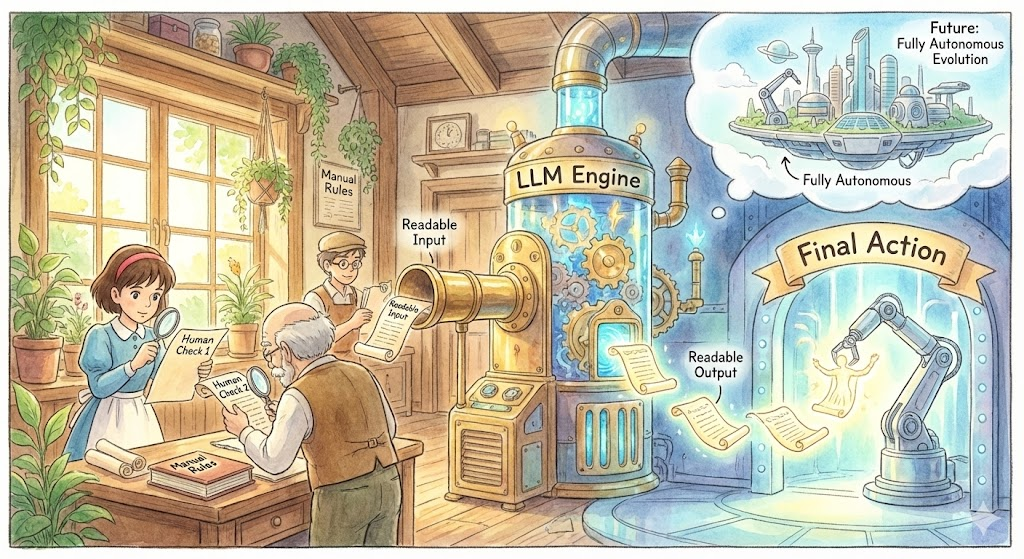
This framework is designed as a Human-in-the-loop architecture. It prioritizes immediate usability and safety while serving as a critical stepping stone toward Fully Autonomous AI.

1. Human-Guided Foundation (Input Phase)

  • Manual Rules & Structured Data: Instead of relying on raw, unpredictable data, humans define clear “Manual Rules.” This ensures the LLM Engine receives high-quality, “Readable Input.”
  • Initial Verification (Human Check 1 & 2): Every piece of information is scrutinized before it enters the AI core. This eliminates the risk of “garbage in, garbage out” and ensures the AI operates within a predefined ethical and logical boundary.

2. Transparent Processing (The Engine)

  • The LLM Engine: The AI performs the heavy lifting—reasoning, summarizing, and generating content—based on the verified input.
  • Readable Output: The system is designed to produce results that are easy for humans to interpret. This transparency removes the “Black Box” problem, making the AI’s logic visible and manageable.

3. Safety-First Execution (Output Phase)

  • The Final Gatekeeper (Human Check 3): Before any “Final Action” (like sending an email or updating a database) is taken, a human provides the final stamp of approval.
  • Reliability: This layer of human oversight ensures that the AI’s “hallucinations” or errors are caught before they have real-world consequences.

4. The Evolutionary Path (Future Vision)

  • Data as an Asset: Every human intervention and correction in this “easy” setup is recorded. This creates a high-quality feedback loop (RLHF – Reinforcement Learning from Human Feedback).
  • Transition to Autonomy: As the AI learns from these human corrections, the need for manual checks will gradually decrease. Eventually, the system will evolve into the “Fully Autonomous Evolution” shown in the illustration—a state where the AI operates independently with peak efficiency.

Key Takeaway: This approach is “easiest” because it builds trust and safety through human intuition today, while systematically building the data foundation needed for a fully automated tomorrow.

#LLM #AI_Strategy #HumanInTheLoop #AutonomousAI #FutureOfAI #AIOps #AI_Evolution #GenerativeAI #DataStrategy

With Gemini

Intelligent Event Analysis Framework ( Who the First? )


Intelligent Event Processing System Overview

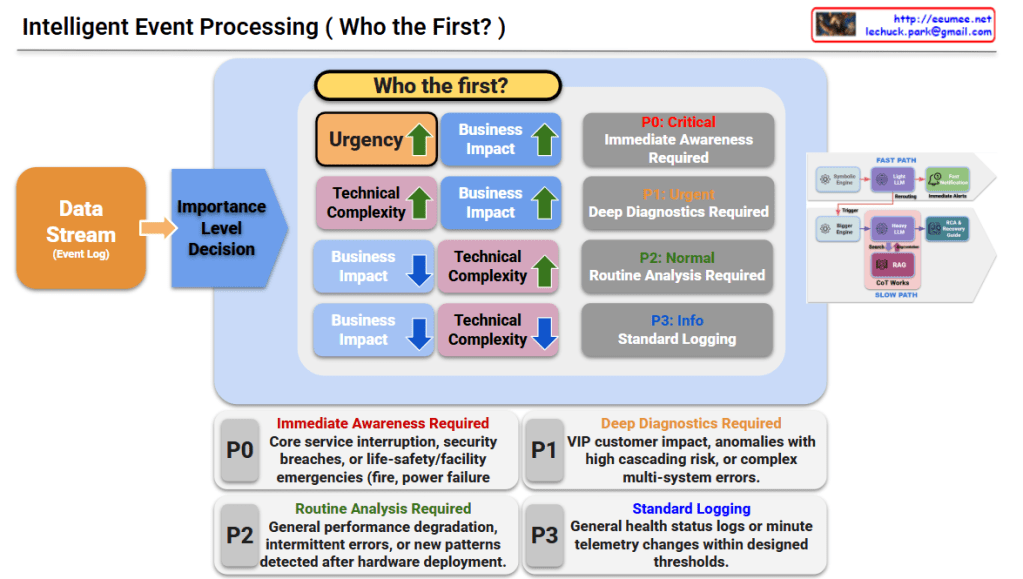
This architecture illustrates how a system intelligently prioritizes data streams (event logs) and selects the most efficient processing path—either for speed or for depth of analysis.

1. Importance Level Decision (Who the First?)

Events are categorized into four priority levels ($P0$ to $P3$) based on Urgency, Business Impact, and Technical Complexity.

  • P0: Critical (Immediate Awareness Required)
    • Criteria: High Urgency + High Business Impact.
    • Scope: Core service interruptions, security breaches, or life-safety/facility emergencies (e.g., fire, power failure).
  • P1: Urgent (Deep Diagnostics Required)
    • Criteria: High Technical Complexity + High Business Impact.
    • Scope: VIP customer impact, anomalies with high cascading risk, or complex multi-system errors.
  • P2: Normal (Routine Analysis Required)
    • Criteria: High Technical Complexity + Low Business Impact.
    • Scope: General performance degradation, intermittent errors, or new patterns detected after hardware deployment.
  • P3: Info (Standard Logging)
    • Criteria: Low Technical Complexity + Low Business Impact.
    • Scope: General health status logs or minute telemetry changes within designed thresholds.

2. Processing Paths: Fast Path vs. Slow Path

The system routes events through two different AI-driven pipelines to balance speed and accuracy.

A. Fast Path (Optimized for P0)

  • Workflow: Symbolic Engine → Light LLM → Fast Notification.
  • Goal: Minimizes latency to provide Immediate Alerts for critical issues where every second counts.

B. Slow Path (Optimized for P1 & P2)

  • Workflow: Bigger Engine → Heavy LLM + RAG (Retrieval-Augmented Generation) + CoT (Chain of Thought).
  • Goal: Delivers high-quality Root Cause Analysis (RCA) and detailed Recovery Guides for complex problems requiring deep reasoning.

Summary

  1. The system automatically prioritizes event logs into four levels (P0–P3) based on their urgency, business impact, and technical complexity.
  2. It bifurcates processing into a Fast Path using light models for instant alerting and a Slow Path using heavy LLMs/RAG for deep diagnostics.
  3. This dual-track approach maximizes operational efficiency by ensuring critical failures are reported instantly while complex issues receive thorough AI-driven analysis.

#AIOps #IntelligentEventProcessing #LLM #RAG #SystemMonitoring #IncidentResponse #ITAutomation #CloudOperations #RootCauseAnalysis

With Gemini

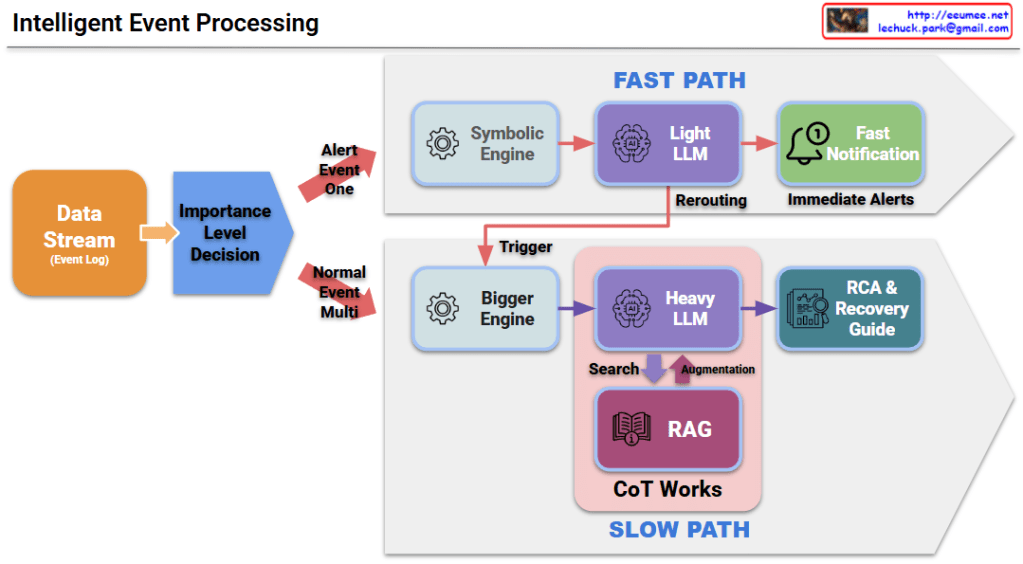
Intelligent Event Analysis Framework

Intelligent Event Processing Architecture Analysis

The provided diagrams, titled Event Level Flow and Intelligent Event Processing, illustrate a sophisticated dual-path framework designed to optimize incident response within data center environments. This architecture effectively balances the need for immediate awareness with the requirement for deep, evidence-based diagnostics.


1. Data Ingestion and Intelligent Triage

The process begins with a continuous Data Stream of event logs. An Importance Level Decision gate acts as a triage point, routing traffic based on urgency and complexity:

  • Critical, single-source issues are designated as Alert Event One and sent to the Fast Path.
  • Standard or bulk logs are labeled Normal Event Multi and directed to the Slow Path for batch or deeper processing.

2. Fast Path: The Low-Latency Response Track

This path minimizes the time between event detection and operator awareness.

  • A Symbolic Engine handles rapid, rule-based filtering.
  • A Light LLM (typically a smaller parameter model) summarizes the event for human readability.
  • The Fast Notification system delivers immediate alerts to operators.
  • Crucially, a Rerouting function triggers the Slow Path, ensuring that even rapidly reported issues receive full analytical scrutiny.

3. Slow Path: The Comprehensive Diagnostic Track

The Slow Path focuses on precision, using advanced reasoning to solve complex problems.

  • Upon receiving a Trigger, a Bigger Engine prepares the data for high-level inference.
  • The Heavy LLM executes Chain of Thought (CoT) Works, breaking down the incident into logical steps to avoid errors.
  • This is supported by a Retrieval-Augmented Generation (RAG) system that performs a Search across internal knowledge bases (like manuals) and performs an Augmentation to enrich the LLM prompt with specific context.
  • The final output is a comprehensive Root Cause Analysis (RCA) and an actionable Recovery Guide.

Summary

  1. This architecture bifurcates incident response into a Fast Path for rapid awareness and a Slow Path for in-depth reasoning.
  2. By combining lightweight LLMs for speed and heavyweight LLMs with RAG for accuracy, it ensures both rapid alerting and reliable recovery guidance.
  3. The integration of symbolic rules and AI-driven Chain of Thought logic enhances both the operational efficiency and the technical reliability of the system.

#AIOps #LLM #RAG #DataCenter #IncidentResponse #IntelligentMonitoring #AI_Operations #RCA #Automation

With Gemini