Co-Work

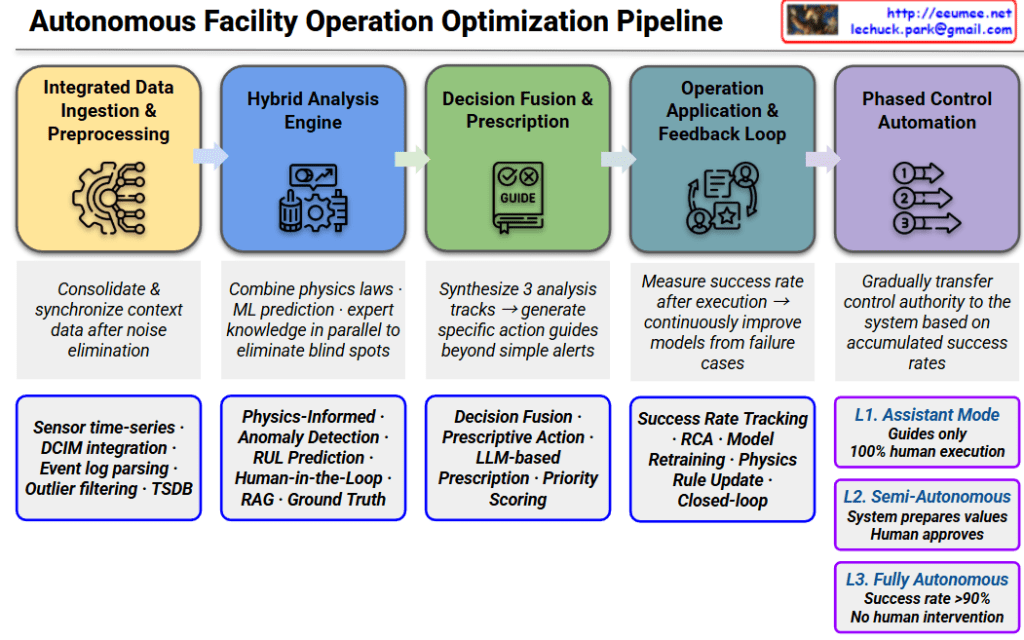
This image, titled “Co-Work,” illustrates a strategic framework for Event-Centric AIOps. It demonstrates how raw telemetry from physical infrastructure is transformed into structured, actionable intelligence for an AI Agent, fundamentally driven by human expertise.

1. Data Generation and Extraction

  • Device to Metric: Physical infrastructure (Device) generates raw operational data.
  • The Role of Configurations: This data is extracted into quantitative Metric (Number) formats. This extraction is guided by Configurations & Topology, which represents the structural configurations and network topology. This ensures the system understands the physical and logical layout of the devices.

2. Contextualization

  • Metric to Context: Raw numerical data lacks operational meaning on its own. It is transformed into readable Context (text), effectively converting raw telemetry into event logs suitable for LLM-based analysis.
  • The Role of System: This conversion is executed by the System, which acts as the Data Processing Operating System. It defines the rules and logic for how raw numbers are processed, correlated, and translated into meaningful operational states.

3. AI Agent Integration

  • Context to AI Agent: The structured, contextualized text is delivered to the AI Agent for analysis, root cause identification, or predictive tasks.
  • The Role of Manual: The AI Agent’s understanding is heavily enriched by the Manual, which encompasses text-based operating manuals, standard operating procedures (SOPs), and historical troubleshooting data. This provides the AI with established guidelines for how to interpret and react to specific scenarios.

4. The Foundation: Human Intent

The green foundational layer, Human Intent, is the most critical aspect of this architecture. Configurations, System, and Manual are the three core elements and systems that are actively built and managed by humans. They dictate the rules, structural layout, and historical knowledge that guide the AI. This ensures that the AI Agent does not operate in a vacuum, but rather functions safely and effectively within the strict boundaries of human operational intent.

Summary

The “Co-Work” architecture visualizes a collaborative AIOps framework where raw device metrics are systematically transformed into contextualized text. By leveraging three key human-managed components—Configurations (topology), Systems (data processing), and Manuals (historical/procedural text)—the architecture bridges the gap between physical hardware and AI. It ensures the AI Agent receives highly structured, context-rich event data to perform accurate and reliable infrastructure management.

#AIOps #EventCentricAIOps #AIDataCenter #HumanInTheLoop #Telemetry #LLM #ITOperations
Compression AI

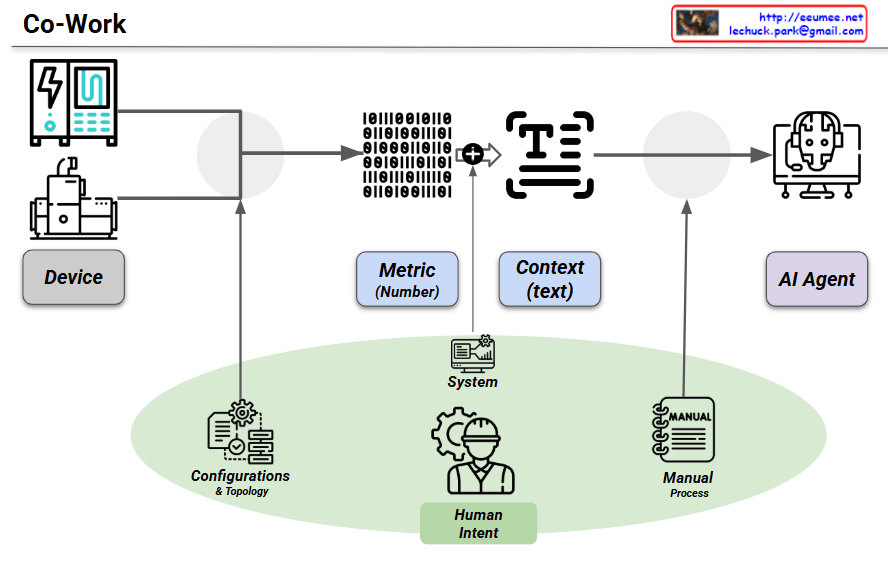
The provided image is an infographic titled “Compression AI”, which explains the underlying mechanisms and realities of modern artificial intelligence, such as Large Language Models (LLMs), through the lens of three types of “compression.” From left to right, it visually details the processes of compressing information, time, and energy.

1. Compression of Information

The first panel demonstrates how humanity’s vast text data is processed internally by the AI.

  • Countless amounts of knowledge, books, and language data pass through a funnel, undergoing a “lossy-compressed” process where some non-essential information is dropped.
  • This massive volume of text is not simply stored exactly as is in a database; instead, it is transformed into a neural network consisting of billions of mathematical parameters and weights.
  • Consequently, it explains that when the AI receives a prompt, it does not just search for and retrieve stored sentences. Rather, based on these compressed numerical values, it uses probabilistic calculations to ‘restore’ the most plausible answer (Probabilistic Restoration).

2. Compression of Time

The second panel illustrates the “compression of time” achieved through the incredible speed of AI’s training and inference.

  • It visualizes a vast stream of knowledge that would take humans hundreds of generations (lifetimes) to learn.
  • By utilizing massive parallel computing with numerous GPUs (GPU Parallel Training), the AI condenses hundreds of generations’ worth of human learning into a mere few weeks or months.
  • During the inference stage—when a user asks a question after the model is trained—the AI relies on these learned patterns to instantly derive an answer in a matter of milliseconds (ms).

3. Compression of Energy (Thermodynamic Cost)

The third panel addresses the immense physical toll exacted in the real world to run the AI’s invisible virtual logic.

  • It illustrates massive high-voltage power being continuously supplied to an ultra-high-density infrastructure (servers) in order to compress intangible information and time.
  • This process inevitably generates extreme heat, depicting servers practically on fire, which requires substantial physical labor, such as operating intensive cooling systems.
  • It emphasizes that the AI’s “Plausible Logic” we effortlessly view on our screens is actually the byproduct of massive energy consumption and hidden physical labor working behind the scenes.

📝 Summary

This image effectively highlights that AI (LLM) is not some virtual magic, but a strictly physical and mathematical process. It beautifully visualizes the core mechanism of AI as a massive “compression process”: using mathematical formulas to lossy-compress humanity’s vast information, accelerating hundreds of generations of learning time into a short period via GPU computation, and demanding an enormous amount of physical energy as the cost.

#ArtificialIntelligence #AI #LLM #CompressionAI #InformationCompression #TimeCompression #EnergyConsumption #AITrainingPrinciples #AIInfrastructure #DataCompression

With Gemini

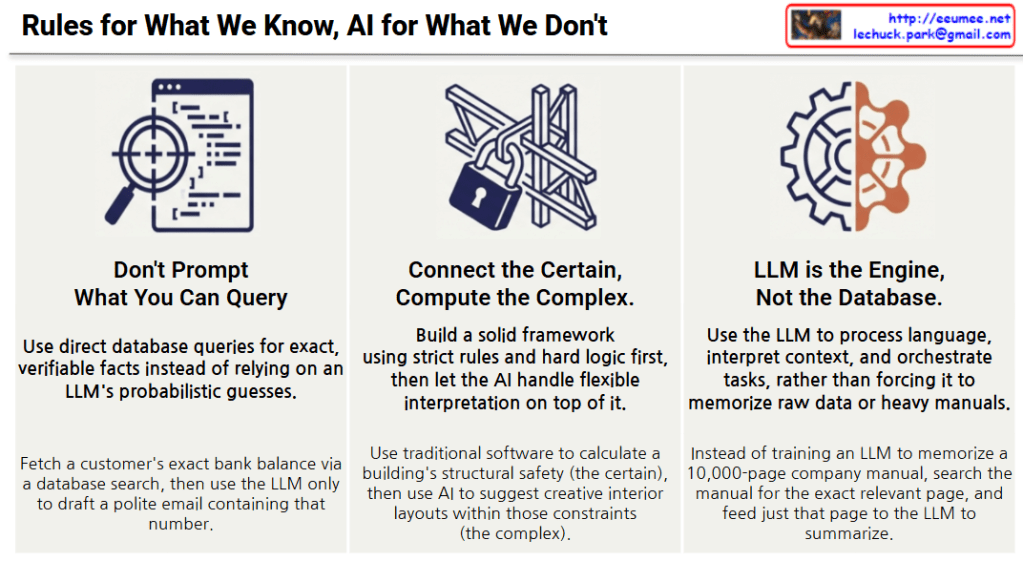
Rules for What We Know, AI for What We Don’t 

This image presents a practical guide on how to effectively integrate Artificial Intelligence, specifically Large Language Models (LLMs), into software systems. The overarching theme is “Rules for What We Know, AI for What We Don’t,” which emphasizes using reliable, traditional computing for hard facts and reserving AI for complex reasoning and interpretation.

1. Don’t Prompt What You Can Query

This principle warns against using AI to retrieve exact data. Because LLMs generate responses based on probabilities, they can sometimes guess incorrectly or hallucinate. If you need a verified fact—like a user’s bank balance—you should use a standard database search to fetch that exact number. Once you have the accurate data, you can then pass it to the AI to draft a natural, polite response.

2. Connect the Certain, Compute the Complex

This section suggests building a hybrid approach to problem-solving. You should establish a strict, rule-based foundation (the “certain”) using traditional logic, math, or physics. Once that solid framework is in place, you let the AI operate on top of it to handle creative or flexible tasks (the “complex”). For example, use traditional software to ensure a building is structurally safe, and then use AI to design creative interior layouts within those safe boundaries.

3. LLM is the Engine, Not the Database

This final point clarifies the true role of an LLM: it is a processor, not a storage drive. You shouldn’t try to force an AI to memorize massive amounts of raw data, like a 10,000-page company manual. Instead, use a search system to find the exact page you need, and then feed just that relevant text into the LLM. The AI acts as the “engine” to read, understand, and summarize that specific information for you.

Summary

To build reliable AI applications, rely on traditional databases and strict logic for factual retrieval and structural constraints. Use LLMs strictly as reasoning and processing engines to interpret context, draft text, and solve complex problems based on the hard facts you provide them.

#AIArchitecture #LLM #ArtificialIntelligence #SoftwareEngineering #DataScience #PromptEngineering #GenerativeAI

AI Agent : Bring Up


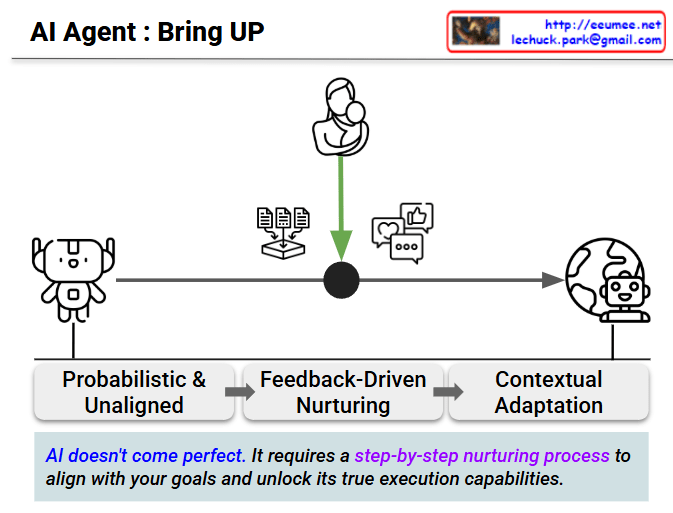
Visualizing the Evolution of an AI Agent: The “Bring UP” Process

This infographic, titled “AI Agent : Bring UP,” effectively illustrates the evolutionary journey of an Artificial Intelligence from a raw, untrained model to a fully functional, real-world agent. It uses a powerful “nurturing” metaphor to emphasize that building a reliable AI is not a plug-and-play event, but a continuous process of guidance.

Here is the step-by-step breakdown of the AI’s journey:

1. The Starting Point: Probabilistic & Unaligned

  • Visual: The basic, blank-faced robot on the far left.
  • Meaning: This represents the raw AI (such as a base LLM). At this initial stage, the AI is merely a probabilistic engine. It predicts outputs based on statistical likelihoods but fundamentally lacks an understanding of the user’s true intent, operational goals, or constraints. It is a powerful tool, but it is “unaligned.”

2. The Critical Phase: Feedback-Driven Nurturing

  • Visual: The central nexus featuring a parent holding a child, flanked by documents (data) and social interaction icons (likes/comments).
  • Meaning: This is the most crucial step—the “Human-in-the-Loop” process. The parent-child icon symbolizes that an AI must be nurtured. To bridge the gap between a raw model and a useful agent, it requires the injection of specific contextual data (documents) and continuous, iterative human feedback (represented by the interaction icons).

3. The Final Goal: Contextual Adaptation

  • Visual: The advanced, confident robot standing in front of a globe on the right.
  • Meaning: Having successfully passed through the nurturing phase, the AI is no longer just a text generator. It has adapted to complex, real-world contexts (the globe). It is now an aligned, goal-oriented “Agent” capable of understanding its environment and executing tasks accurately.

💡 The Key Takeaway

The most important message is captured in the footer: “AI doesn’t come perfect.”

Many people expect out-of-the-box perfection from AI, but this diagram clearly debunks that myth. To unlock an AI’s true execution capabilities, you cannot skip the middle step. It mandates a step-by-step nurturing process to align the technology with your specific objectives. Perfection is not the starting point; it is the result of continuous guidance.


#AIAgents #ArtificialIntelligence #AIAlignment #HumanInTheLoop #MachineLearning #TechVisualization #AIOps #LLM #TechLeadership #Innovation

With Gemini

Harness Engineering


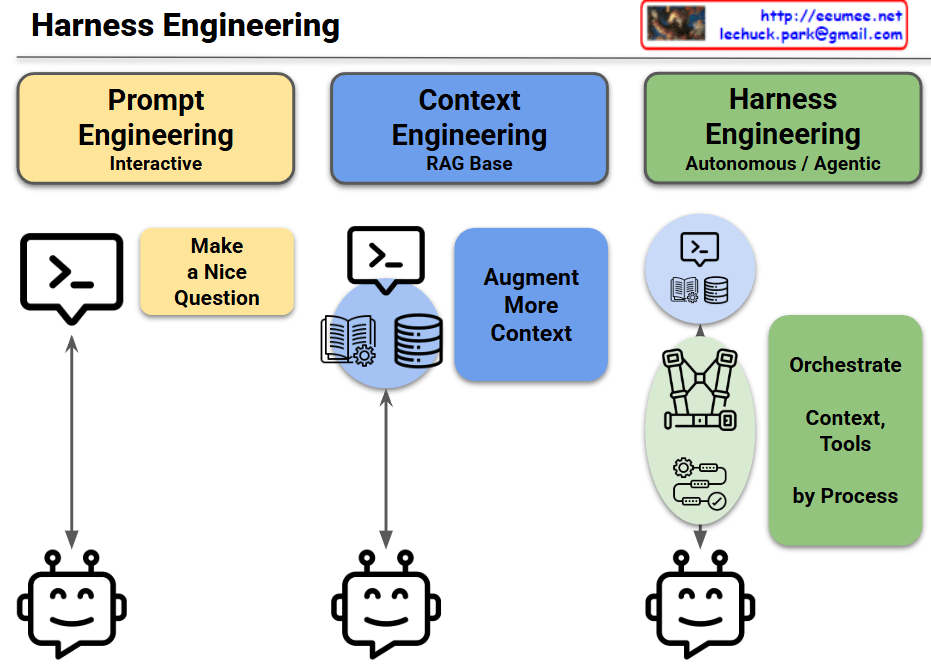
The Evolution of LLM Utilization: Toward Autonomous Agents

This slide illustrates the evolutionary roadmap of adopting Large Language Models (LLMs) within enterprise operations, transitioning from basic user inputs to fully automated, agentic workflows. The architecture is broken down into three distinct phases:

  • Phase 1: Prompt Engineering (Interactive)This represents the foundational stage of LLM interaction. At this level, the quality of the output depends entirely on human input—the ability to “Make a Nice Question.” It is a strictly interactive, 1:1 process that relies solely on the model’s pre-trained knowledge, which limits its capability to resolve complex, real-time operational issues.
  • Phase 2: Context Engineering (RAG Base)The second stage addresses the limitations of a standalone LLM by injecting trusted external data. Utilizing a Retrieval-Augmented Generation (RAG) base, the system actively retrieves specific domain knowledge—represented by the manual and database icons—to “Augment More Context.” This grounds the AI in reality, significantly reducing hallucinations and providing highly accurate, domain-specific insights.
  • Phase 3: Harness Engineering (Autonomous / Agentic)This is the ultimate target state. Moving beyond simply generating text, the AI evolves into a proactive agent. The “harness” icon symbolizes a secure, controlled framework where the AI can independently “Orchestrate Context, Tools by Process.” In this autonomous phase, the system not only understands the problem but also safely executes predefined workflows and controls physical or software tools to resolve issues with minimal human intervention.

#LLM #AIArchitecture #AIOps #AutonomousAgents #RAG #ContextEngineering #HarnessEngineering #AgenticAI #ITOperations #TechLeadership

With Gemini

Autonomous Facility Operation Optimization Pipeline


Autonomous Facility Operation Optimization Pipeline

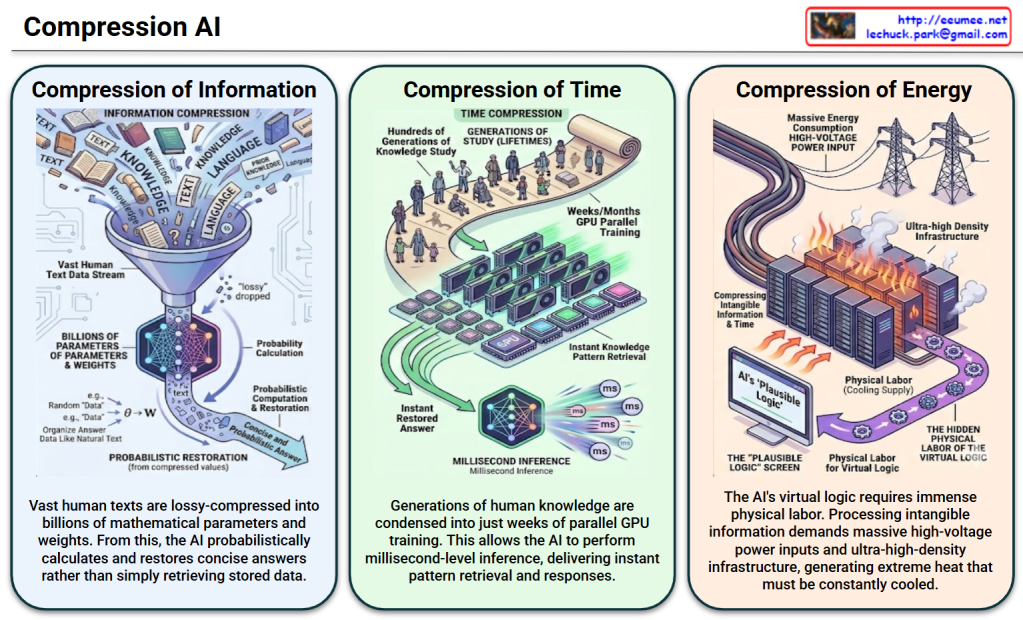
This pipeline represents a sophisticated 5-stage workflow designed to transition facility management from manual oversight to full AI-driven autonomy, ensuring reliability through hybrid modeling.

1. Integrated Data Ingestion & Preprocessing

  • Role: Consolidates diverse data streams into a synchronized, high-fidelity format by eliminating noise.
  • Key Components: Sensor time-series data, DCIM integration, Event log parsing, Outlier filtering, and TSDB (Time Series Database).

2. Hybrid Analysis Engine

  • Role: Eliminates analytical blind spots by running physical laws, machine learning predictions, and expert knowledge in parallel.
  • Key Components: Physics-Informed Machine Learning (PIML), Anomaly Detection, RUL (Remaining Useful Life) Prediction, and RAG-enhanced Ground Truth analysis.

3. Decision Fusion & Prescription

  • Role: Synthesizes multi-track analysis to move beyond simple alerts, generating specific, actionable “prescriptions.”
  • Key Components: Decision Fusion, Prescriptive Action, LLM-based Prescription, and Priority Scoring to rank urgency.

4. Operation Application & Feedback Loop

  • Role: Establishes a closed-loop system that measures success rates post-execution to continuously refine models.
  • Key Components: Success Rate Tracking, RCA (Root Cause Analysis), Model Retraining, and Physics/Rule updates based on real-world performance.

5. Phased Control Automation

  • Role: A risk-mitigated transition of control authority from humans to AI based on accumulated performance data.
  • Automation Levels:
    • L1. Assistant Mode: System provides guides only; 100% human execution.
    • L2. Semi-Autonomous: System prepares optimized values; human provides final approval.
    • L3. Fully Autonomous: System operates without human intervention (triggered when success rate >90%).

Strategic Insight

The hallmark of this architecture is the integration of Physics-Informed ML and LLM-based reasoning. By combining the rigid reliability of physical laws with the adaptive reasoning of Large Language Models, the pipeline solves the “black box” problem of traditional AI, making it suitable for mission-critical infrastructures like AI Data Centers.

#DataCenter #AIOps #AutonomousInfrastructure #PhysicsInformedML #DigitalTwin #LLM #PredictiveMaintenance #DataCenterOptimization #TechVisualization #SmartFacility #EngineeringExcellence