New Era of Digitals

This image presents a diagram titled “New Era of Digitals” that illustrates the evolution of computing paradigms.

Overall Structure:

The diagram shows a progression from left to right, transitioning from being “limited by Humans” to achieving “Everything by Digitals.”

Key Stages:

  1. Human Desire: The process begins with humans’ fundamental need to “wanna know it clearly,” representing our desire for understanding and knowledge.
  2. Rule-Based Era (1000s):
    • Deterministic approach
    • Using Logics and Rules
    • Automation with Specific Rules
    • Record with a human recognizable format
  3. Data-Driven Era:
    • Probabilistic approach (Not 100% But OK)
    • Massive Computing (Energy Resource)
    • Neural network-like structures represented by interconnected nodes

Core Message:

The diagram illustrates how computing has evolved from early systems that relied on human-defined explicit rules and logic to modern data-driven, probabilistic approaches. This represents the shift toward AI and machine learning, where we achieve “Not 100% But OK” results through massive computational resources rather than perfect deterministic rules.

The transition shows how we’ve moved from systems that required everything to be “human recognizable” to systems that can process and understand patterns beyond direct human comprehension, marking the current digital revolution where algorithms and data-driven approaches can handle complexity that exceeds traditional rule-based systems.

With Claude

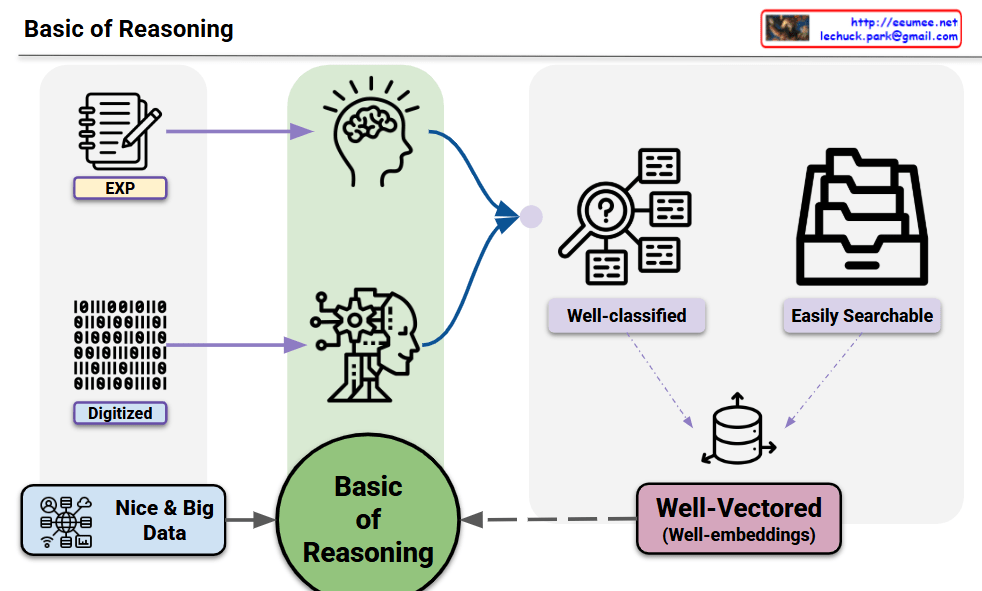
Basic of Reasoning

This diagram illustrates that human reasoning and AI reasoning share fundamentally identical structures.

Key Insights:

Common Structure Between Human and AI:

  • Human Experience (EXP) = Digitized Data: Human experiential knowledge and AI’s digital data are essentially the same information in different representations
  • Both rely on high-quality, large-scale data (Nice & Big Data) as their foundation

Shared Processing Pipeline:

  • Both human brain (intuitive thinking) and AI (systematic processing) go through the same Basic of Reasoning process
  • Information gets well-classified and structured to be easily searchable
  • Finally transformed into well-vectorized embeddings for storage

Essential Components for Reasoning:

  1. Quality Data: Whether experience or digital information, sufficient and high-quality data is crucial
  2. Structure: Systematic classification and organization of information
  3. Vectorization: Conversion into searchable and associative formats

Summary: This diagram demonstrates that effective reasoning – whether human or artificial – requires the same fundamental components: quality data and well-structured, vectorized representations. The core insight is that human experiential learning and AI data processing follow identical patterns, both culminating in structured knowledge storage that enables effective reasoning and retrieval.
Human-AI Collaborative Reasoning

This image illustrates the collaborative problem-solving process between humans and AI through reasoning, emphasizing their complementary relationship rather than a simple comparison.

Key Components and Interpretation

1. AI’s Operational Flow (Upper Section)

  • Big Data → Learning → AI Model: The process by which AI builds models through learning from vast amounts of data
  • Reasoning → Inferencing → Answer: The process by which AI receives questions and generates answers through reasoning

2. Human Role (Lower Section)

  • Experience: Knowledge and information acquired through direct experience
  • Logic: A logical thinking framework built upon experience
  • Reasoning: The cognitive process that combines experience and logic

3. Critical Interaction Mechanisms

Question:

  • Human reasoning results are input to AI in the form of sophisticated questions
  • These are not simple queries, but systematic and meaningful questions based on experience and logic

Answer:

  • AI’s responses are fed back into the human reasoning process
  • Humans verify AI’s answers and integrate them into new experiences and logic for deeper reasoning

4. Core Message

The red-highlighted phrase “humans must possess a strong, experience-based logical framework” represents the diagram’s central theme:

  • To collaborate effectively with AI, humans must also possess strong logical thinking frameworks based on experience
  • The ability to provide appropriate questions and properly verify and utilize AI’s responses is essential

Conclusion

This image demonstrates that human roles do not disappear in the AI era, but rather become more crucial. Human reasoning abilities based on experience and logic play a pivotal role in AI collaboration, and through this, humans and AI can create synergy for better problem-solving. The diagram presents a collaborative model where both entities work together to achieve superior results.

The key insight is that AI advancement doesn’t replace human thinking but rather requires humans to develop stronger reasoning capabilities to maximize the potential of human-AI collaboration.

With Claude, Gemini

The Evolution of Mainstream Data in Computing

This diagram illustrates the evolution of mainstream data types throughout computing history, showing how the complexity and volume of processed data has grown exponentially across different eras.

Evolution of Mainstream Data by Computing Era:

  1. Calculate (1940s-1950s)Numerical Data: Basic mathematical computations dominated
  2. Database (1960s-1970s)Structured Data: Tabular, organized data became central
  3. Internet (1980s-1990s)Text/Hypertext: Web pages, emails, and text-based information
  4. Video (2000s-2010s)Multimedia Data: Explosive growth of video, images, and audio content
  5. Machine Learning (2010s-Present)Big Data/Pattern Data: Large-scale, multi-dimensional datasets for training
  6. Human Perceptible/Everything (Future)Universal Cognitive Data: Digitization of all human senses, cognition, and experiences

The question marks on the right symbolize the fundamental uncertainty surrounding this final stage. Whether everything humans perceive – emotions, consciousness, intuition, creativity – can truly be fully converted into computational data remains an open question due to technical limitations, ethical concerns, and the inherent nature of human cognition.

Summary: This represents a data-centric view of computing evolution, progressing from simple numerical processing to potentially encompassing all aspects of human perception and experience, though the ultimate realization of this vision remains uncertain.

With Claude