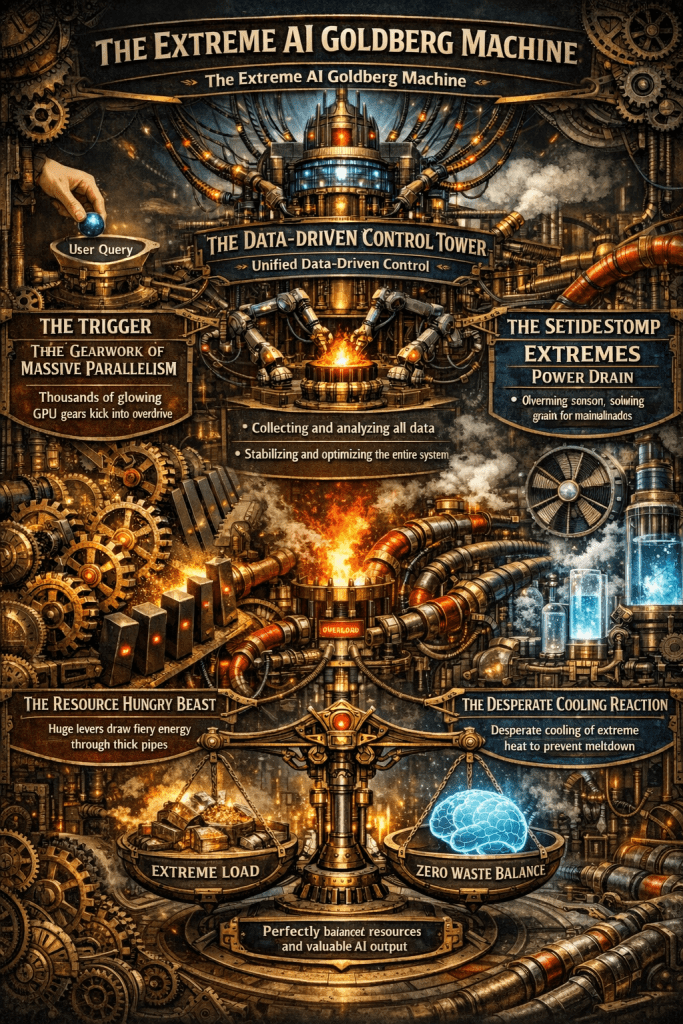
A single AI response triggers a massive chain reaction of compute, power, and cooling.
Only unified, data-driven control can stabilize this fragile system and eliminate waste.
The Computing for the Fair Human Life.
A single AI response triggers a massive chain reaction of compute, power, and cooling.
Only unified, data-driven control can stabilize this fragile system and eliminate waste.
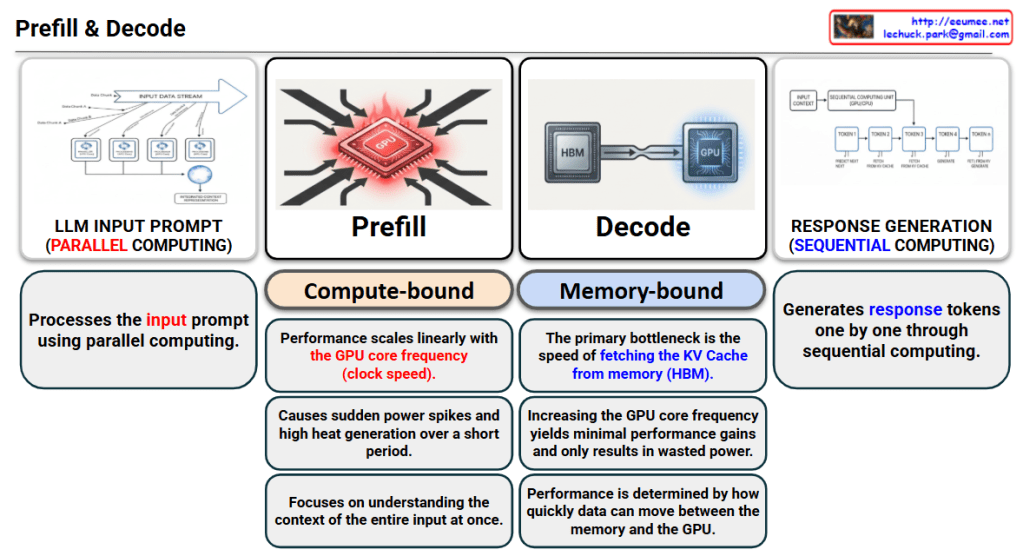
This image illustrates the dual nature of Large Language Model (LLM) inference, breaking it down into two fundamental stages: Prefill and Decode.
The Prefill stage is responsible for processing the initial input prompt provided by the user.
The Decode stage handles the actual generation of the response, producing one token at a time.
#LLM #Inference #GPU #PrefillVsDecode #AIInfrastructure #DeepLearning #ComputeBound #MemoryBandwidth
With Gemini
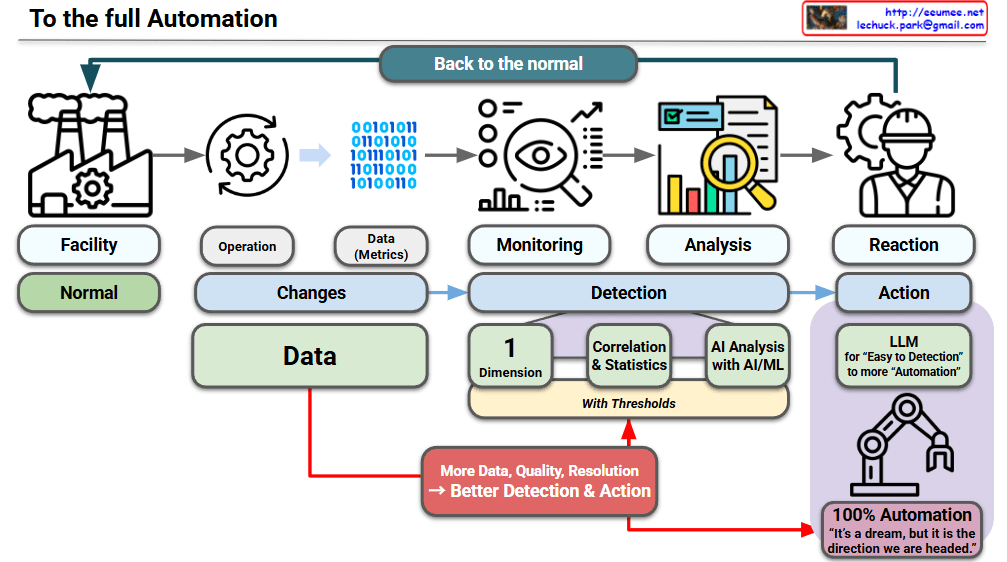
This visual emphasizes the critical role of high-quality data as the engine driving the transition from human-led reactions to fully autonomous operations. This roadmap illustrates how increasing data resolution directly enhances detection and automated actions.
The top flow describes the current state of industrial maintenance:
The most significant addition is the emphasized Data block and its impact on the automation cycle:
Detection matures through three distinct levels, all governed by specific thresholds:
The final stage replaces human “Reaction” with autonomous “Action”:
#HyperAutomation #DataQuality #IndustrialAI #SmartManufacturing #LLM #DigitalTwin #AutonomousOperations #AIOp
With Gemini
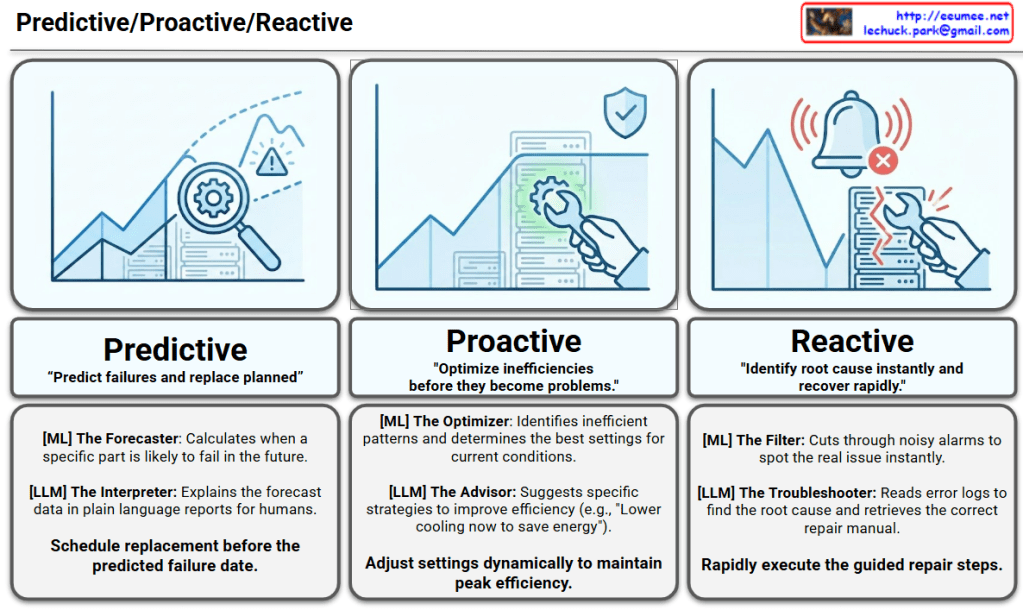
The infographic visualizes how AI technologies (Machine Learning and Large Language Models) are applied across Predictive, Proactive, and Reactive stages of facility management.
This is the most advanced stage, anticipating future issues before they occur.
This stage focuses on optimizing current conditions to prevent problems from developing.
This stage deals with responding rapidly and accurately to incidents that have already occurred.
#DataCenter #AIOps #PredictiveMaintenance #SmartInfrastructure #ArtificialIntelligence #MachineLearning #LLM #FacilityManagement #ITOps
with Gemini
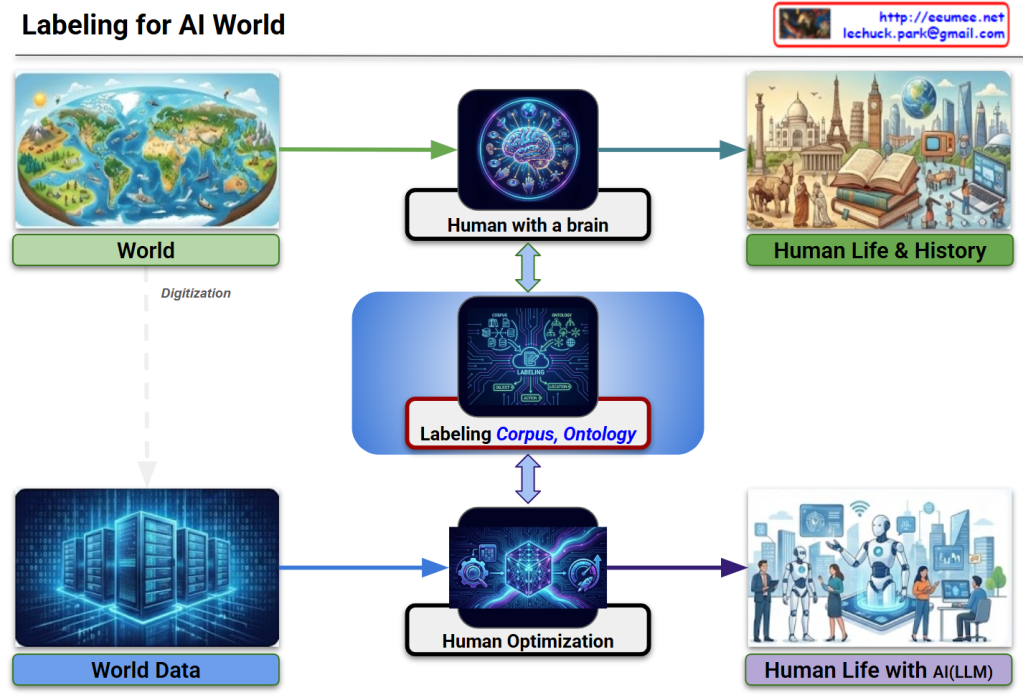
The image illustrates a logical framework titled “Labeling for AI World,” which maps how human cognitive processes are digitized and utilized to train Large Language Models (LLMs). It emphasizes the transition from natural human perception to optimized AI integration.
This track represents the traditional human experience:
This track represents the technical pipeline for AI development:
The most critical element of the diagram is the central blue box, which acts as a bridge between human logic and machine processing:
The diagram demonstrates that Data Labeling, guided by Corpus and Ontology, is the essential mechanism that translates human cognition into the digital realm. It ensures that LLMs are not just processing raw numbers, but are optimized to understand the world through a human-centric logical framework.
#AI #DataLabeling #LLM #Ontology #Corpus #CognitiveComputing #AIOptimization #DigitalTransformation
With Gemini
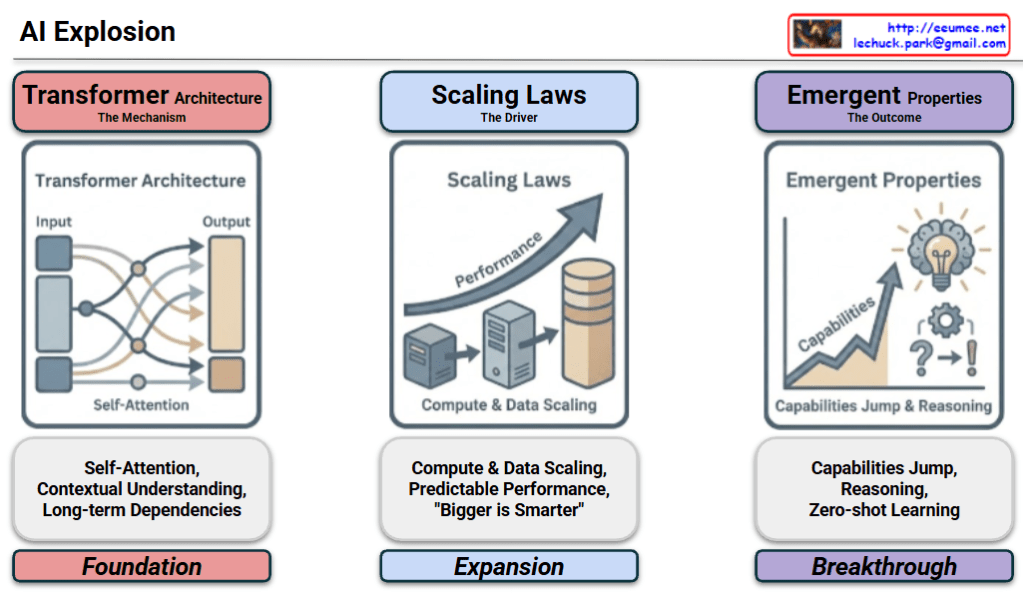
This diagram provides a structured visual narrative of how modern AI (LLM) achieved its rapid advancement, organized into a logical flow: Foundation → Expansion → Breakthrough.
1. The Foundation: Transformer Architecture
2. The Expansion: Scaling Laws
3. The Breakthrough: Emergent Properties
The diagram effectively illustrates the causal relationship of AI evolution: The Transformer provided the capability to learn, Scaling Laws amplified that capability through size, and Emergent Properties were the revolutionary outcome of that scale.
#AIExplosion #LLM #TransformerArchitecture #ScalingLaws #EmergentProperties #GenerativeAI #TechTrends
With Gemini

This image compares two major parallelization strategies used for training large language models (LLMs).
Structure:
Characteristics:
Structure:
Characteristics:
| Aspect | Data Parallelism | Expert Parallelism |
|---|---|---|
| Model Division | Full model replication | Model divided into experts |
| Data Division | Batch-wise | Layer/token-wise |
| Communication Pattern | Gradient All-Reduce | Token All-to-All |
| Scalability | Proportional to data size | Proportional to expert count |
| Efficiency | Dense computation | Sparse computation (conditional activation) |
These two approaches are often used together in practice, enabling ultra-large-scale model training through hybrid parallelization strategies.
Data Parallelism replicates the entire model across GPUs and divides the training data, synchronizing gradients after each step – simple but memory-limited. Expert Parallelism divides the model into specialized experts and routes tokens dynamically, enabling massive scale through sparse activation. Modern systems combine both strategies to train trillion-parameter models efficiently.
#MachineLearning #DeepLearning #LLM #Parallelism #DistributedTraining #DataParallelism #ExpertParallelism #MixtureOfExperts #MoE #GPU #ModelTraining #AIInfrastructure #ScalableAI #NeuralNetworks #HPC
 Lechuck Park