Why “Definition” Matters More

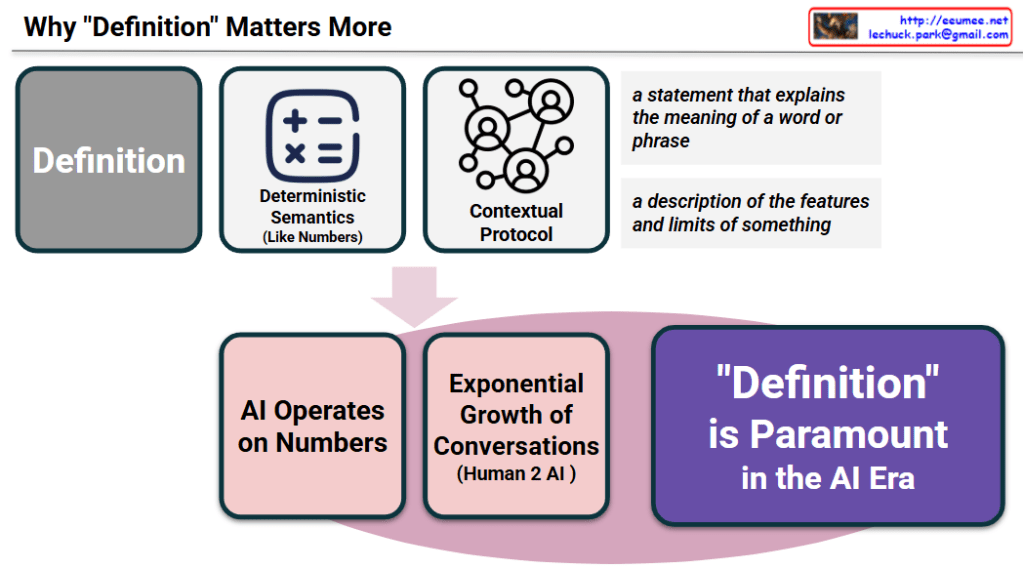
The revised slide visually and professionally conveys the technical philosophy we discussed through a clear visual narrative. Below is a structured breakdown of the slide, organized by its logical flow, which you can use directly as a presentation script or an executive summary.


Slide Overview: The Absolute Value of “Definition” in the AI Era

This slide illustrates why the traditional concept of a “definition” becomes critically important when applied to the new technological landscape of Artificial Intelligence. It follows a three-step logical progression: [The Nature of Concepts ➔ Characteristics of the AI Environment ➔ Final Conclusion].

1. Top Section: The Intrinsic Nature of a “Definition”

The upper half of the slide establishes the role of a “definition” from a system architecture perspective.

  • Deterministic Semantics (Like Numbers): As noted in the dictionary excerpts on the right, a definition explains meanings and boundaries. When applied to AI systems, this must function like mathematical symbols ($+, -, \times, =$). It requires an absolute, unchanging standard—a strict “deterministic semantic” that operates with the exactness of numbers.
  • Contextual Protocol: The network node icon signifies that definitions are no longer just dictionary entries. They act as fundamental “communication protocols” that govern, align, and regulate information exchange across complex networks and multiple AI agents.

2. Bottom-Left Section: The New Paradigm of the AI Environment

Moving through the central arrow, the slide transitions to the unique conditions of the current AI era where these definitions must be applied.

  • AI Operates on Numbers: AI does not comprehend text or context through human intuition; it processes information strictly as vectorized, numerical data.
  • Exponential Growth of Conversations (Human 2 AI): Concurrently, the frequency and volume of interactions—especially between humans and AI, and increasingly among AI agents themselves—are expanding at an explosive, unprecedented rate.

3. Bottom-Right Section: The Core Conclusion

  • “Definition” is Paramount in the AI Era: Ultimately, in an environment where machines process information numerically and the volume of communication is exponentially increasing, even a microscopic conceptual discrepancy can cascade into a catastrophic system failure or hallucination. Therefore, establishing “clear definitions” to structure data and strictly control meaning is the absolute, paramount requirement for maintaining a stable, reliable, and functional AI ecosystem.

Overall Summary

As AI exponentially scales the volume of our daily communications and processes them through rigid, mathematical vectors, linguistic ambiguity becomes the greatest systemic risk. A strictly defined semantic baseline—the “Definition”—is no longer just a linguistic tool, but the most essential engineering protocol required to prevent AI hallucinations and ensure precise, automated operations.

#ArtificialIntelligence #DataArchitecture #DeterministicSemantics #SemanticAnchor #DataGovernance #Definition

With Gemini

ALL & ChangeD DATA-Driven

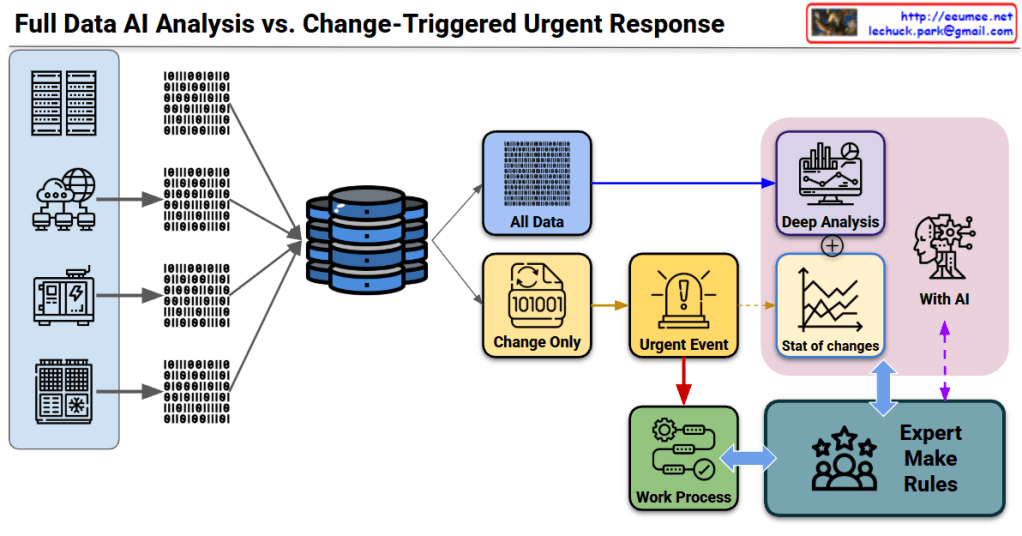
Image Analysis: Full Data AI Analysis vs. Change-Triggered Urgent Response

This diagram illustrates a system architecture comparing two core strategies for data processing.

🎯 Core 1: Two Data Processing Approaches

Approach A: Full Data Processing (Analysis)

  • All Data path (blue)
  • Collects and comprehensively analyzes all data
  • Performs in-depth analysis through Deep Analysis
  • AI-powered statistical change (Stat of changes) analysis
  • Characteristics: Identifies overall patterns, trends, and correlations

Approach B: Separate Change Detection Processing

  • Change Only path (yellow)
  • Selectively detects only changes
  • Extracts and processes only deltas (differences)
  • Characteristics: Fast response time, efficient resource utilization

🔥 Core 2: Analysis→Urgent Response→Expert Processing Flow

Stage 1: Analysis

  • Full Data Analysis: AI-based Deep Analysis
  • Change Detection: Change Only monitoring

Stage 2: Urgent Response (Urgent Event)

  • Immediate alert generation when changes detected (⚠️ Urgent Event)
  • Automated primary response process execution
  • Direct linkage to Work Process

Stage 3: Expert Processing (Expert Make Rules)

  • Human expert intervention
  • Integrated review of AI analysis results + urgent event information
  • Creation and modification of situation-appropriate rules
  • Work Process optimization

🔄 Integrated Process Flow

[Data Collection] 
    ↓
[Path Bifurcation]
    ├─→ [All Data] → [Deep Analysis] ─┐
    │                                  ├→ [AI Statistical Analysis]
    └─→ [Change Only] → [Urgent Event]─┘
                            ↓
                    [Work Process] ↔ [Expert Make Rules]
                            ↑_____________↓
                         (Feedback loop with AI)

💡 Core System Value

  1. Dual Processing Strategy: Stability (full analysis) + Agility (change detection)
  2. 3-Stage Response System: Automated analysis → Urgent process → Expert judgment
  3. AI + Human Collaboration: Combines AI analytical power with human expert judgment
  4. Continuous Improvement: Virtuous cycle where expert rules feed back into AI learning

This system is an architecture optimized for environments where real-time response is essential while expert judgment remains critical (manufacturing, infrastructure operations, security monitoring, etc.).


Summary

  1. Dual-path system: Comprehensive full data analysis (stability) + selective change detection (speed) working in parallel
  2. Three-tier response: AI automated analysis triggers urgent events, followed by work processes and expert rule refinement
  3. Human-AI synergy: Continuous improvement loop where expert knowledge enhances AI capabilities while AI insights inform expert decisions

#DataArchitecture #AIAnalysis #EventDrivenArchitecture #RealTimeMonitoring #HybridProcessing #ExpertSystems #ChangeDetection #UrgentResponse #IndustrialAI #SmartMonitoring #DataProcessing #AIHumanCollaboration #PredictiveMaintenance #IoTArchitecture #EnterpriseAI