LLM works ( Pure Digital Vs Digitized Analog )

How LLM Works: Pure Digital vs. Digitized Analog

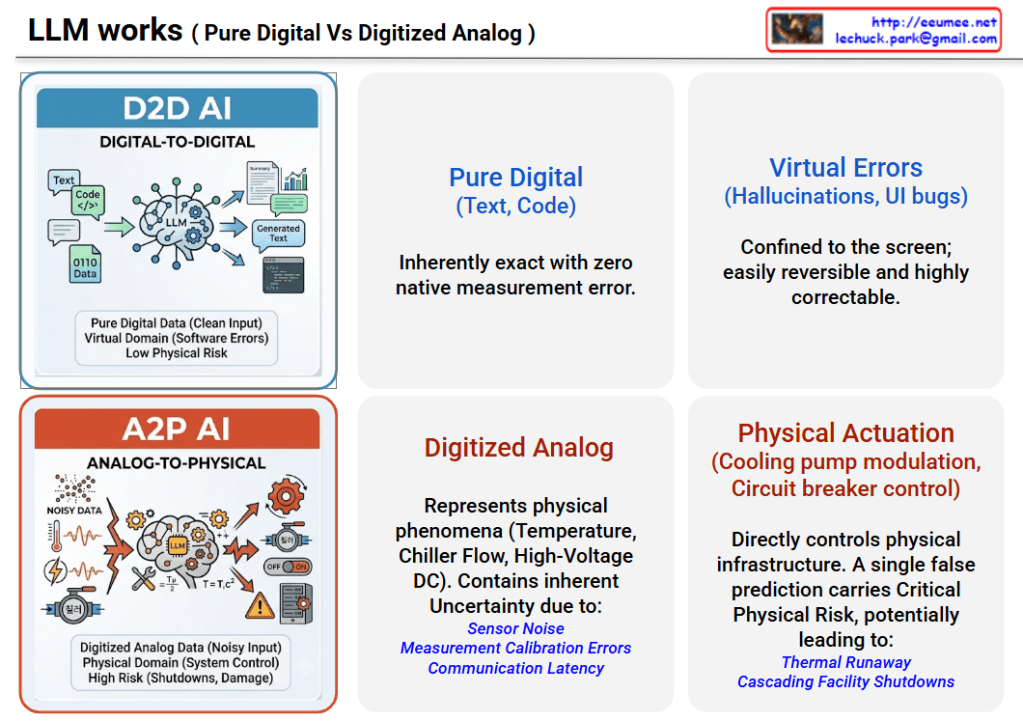
This infographic is titled “LLM works (Pure Digital Vs Digitized Analog)” at the top, with the creator’s source information (website and email) displayed in the top right corner. The image is horizontally divided to provide an intuitive comparison between general IT-environment AI (D2D AI) and industrial/data center AI (A2P AI).

1. Top Section: D2D AI (Digital-to-Digital AI) Designed with a blue theme, this section illustrates an AI operating within a virtual environment.

  • Input: Icons depict clean, “Pure Digital” data, such as text and code, being fed into a Large Language Model (LLM).
  • Characteristics: The text emphasizes that this pure digital input is “inherently exact with zero native measurement error.”
  • Output & Risk: The errors produced here are classified as “Virtual Errors” (e.g., hallucinations or UI bugs). Because these errors are confined strictly to the screen, they pose a low physical risk and are described as highly correctable and easily reversible.

2. Bottom Section: A2P AI (Analog-to-Physical AI) Designed with an orange theme, this section depicts an AI used for data center and industrial facility control.

  • Input: Graphics illustrate noisy data representing physical phenomena—such as temperature, chiller flow, and high-voltage DC—flowing into the LLM.
  • Characteristics: This data is defined as “Digitized Analog.” It contains inherent “Uncertainty” driven by physical realities such as sensor noise, measurement calibration errors, and communication latency.
  • Output & Risk: The AI’s output results in direct “Physical Actuation” (e.g., cooling pump modulation or circuit breaker control). The text strongly warns that a single false prediction carries “Critical Physical Risk,” potentially leading to catastrophic real-world consequences like “Thermal Runaway” and “Cascading Facility Shutdowns.”

💡 Summary This infographic perfectly contrasts the fundamental differences between D2D AI, which operates safely within software and is easily correctable, and A2P AI, which interprets uncertain digitized analog data to control physical infrastructure, thereby carrying significant and potentially destructive real-world risks.

#LLM #DataCenterAI #OperationalTechnology #D2DAI #A2PAI #CyberPhysicalSystems #AIGuardrails #IndustrialAI

With Gemini

Hybrid Analysis for Autonomous Operation (2)

Framework Overview

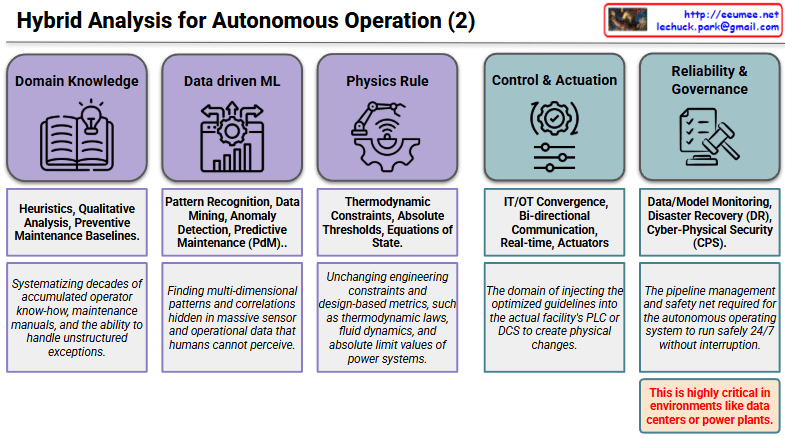
The image illustrates a “Hybrid Analysis” framework designed to achieve true Autonomous Operation. It outlines five core pillars required to build a reliable, self-driving system for high-stakes environments like AI data centers or power plants. The architecture combines three analytical foundations (purple) with two execution and safety layers (teal).


1. The Analytical Foundation (The Hybrid Triad)

This section forms the “brain” of the autonomous system, blending human expertise, artificial intelligence, and absolute scientific laws.

  • Domain Knowledge (Human Experience):
    • Core: Systematized heuristics, decades of operator know-how, and maintenance manuals.
    • Role: Provides qualitative analysis, establishes preventive maintenance baselines, and handles unstructured exceptions that algorithms might miss.
  • Data-driven ML (Artificial Intelligence):
    • Core: Pattern recognition, anomaly detection, and Predictive Maintenance (PdM).
    • Role: Analyzes massive volumes of multi-dimensional sensor and operational data to find hidden correlations and risks that are imperceptible to human operators.
  • Physics Rule (Engineering Guardrails):
    • Core: Thermodynamic constraints, equations of state, fluid dynamics, and absolute power limits.
    • Role: Acts as the ultimate boundary. It ensures that the operational commands generated by ML models are physically possible and safe, preventing the AI from violating unchanging engineering laws.

2. Execution and Safety Nets

This section translates the insights from the analytical triad into real-world, physical changes while guaranteeing system stability.

  • Control & Actuation (The Hands):
    • Core: IT/OT (Information Technology / Operational Technology) convergence and real-time bi-directional communication.
    • Role: The domain of injecting the optimized setpoints and guidelines directly into the facility’s PLC (Programmable Logic Controller) or DCS (Distributed Control System) to drive physical actuators.
  • Reliability & Governance (The Shield):
    • Core: Data/Model monitoring, Disaster Recovery (DR), and Cyber-Physical Security (CPS).
    • Role: The overarching safety net and pipeline management required to ensure the autonomous operating system runs securely and continuously, 24/7, without interruption.

💡 Key Takeaway

As emphasized by the red text at the bottom, this multi-layered approach is highly critical in environments like data centers or power plants. Relying solely on data-driven ML is too risky for high-density infrastructure; true autonomous stability is only achieved when AI is anchored by human domain expertise and strict physical laws.

#AutonomousOperations #AIOps #HybridAnalysis #PredictiveMaintenance #ITOTConvergence #CyberPhysicalSystems #MissionCritical #TechVisualization #EngineeringInfographic

With Gemini