Data & Knowledge Driven AI Agent for Data Center Operations
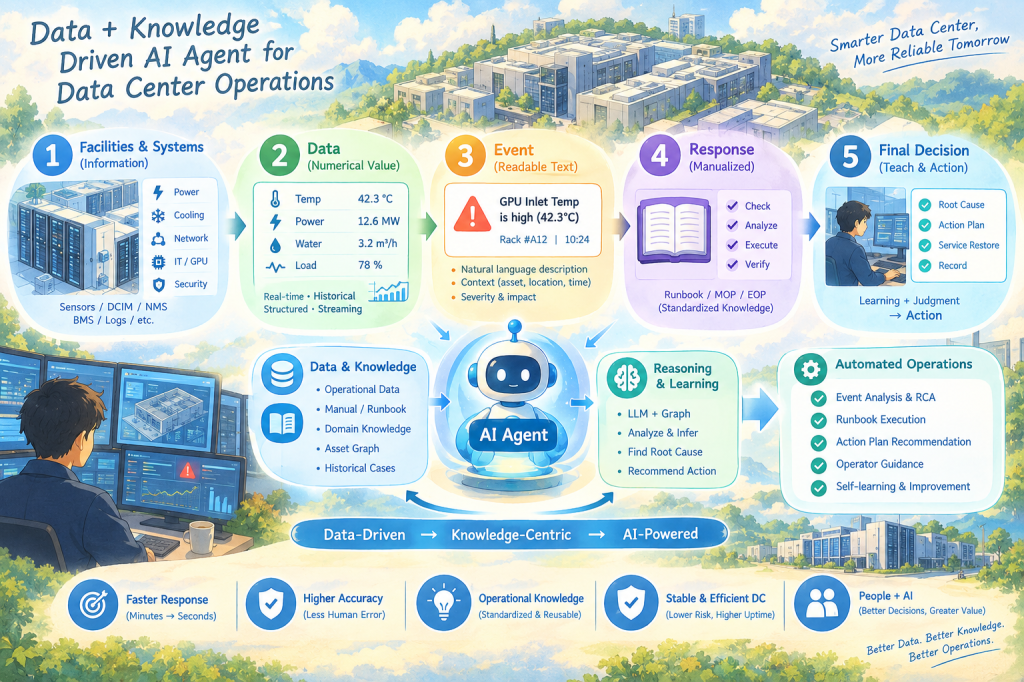
This illustration describes how data center operations can evolve from facility data → operational knowledge → AI Agent → automated operations.
The key message is not simply that AI controls data center equipment.
Rather, it shows how AI Agents can connect operational data with accumulated human knowledge, understand operational situations, reason about incidents, and support or automate operational actions.
1. Facilities & Systems
The process starts with the physical infrastructure and operational systems of the data center.
The illustration represents:
- Power
- Cooling
- Network
- IT / GPU
- Security
- Environment
Sensors and systems continuously generate operational information.
Systems such as DCIM, NMS, BMS, and log platforms collect this information.
In simple terms:
Facilities generate information, and systems collect it.
2. Data — From Information to Metrics
Facility information is transformed into measurable operational data.
For example:
- Temperature → 42.3°C
- Power Load → 12.6 MW
- Water Flow → 3.2 m³/h
- Utilization → 78%
The important point is that the AI Agent uses both:
Real-time Data + Historical Data
Real-time data tells the Agent what is happening now, while historical data provides the operational context and previous experience.
3. Event — Turning Numbers into Meaning
Raw numbers are not always meaningful to operators.
Therefore, data is transformed into understandable events.
For example:
GPU Inlet Temperature is high (42.3°C)
Now the numerical value has become a meaningful operational event.
The event also contains context such as:
What happened + Where + When + Severity + Impact
This is important because the AI Agent does not need to operate only on raw numbers. It can reason about meaningful operational situations.
4. Response — Operational Knowledge
When an event occurs, traditional operations rely on manuals and experienced operators.
The illustration represents this knowledge through:
- Runbook
- MOP
- EOP
- SOP
- Best Practices
A typical response process can be:
Check → Analyze → Execute → Verify
This represents the transformation of human experience into reusable operational knowledge.
Human Experience → Documentation → Operational Knowledge
This knowledge becomes one of the most important assets for the AI Agent.
5. Final Decision — Judgment & Action
The final stage goes beyond detecting an event.
The operational process becomes:
Root Cause → Action Plan → Service Restore → Record
Traditionally, experienced operators perform much of this reasoning manually.
With an AI Agent, operational data and knowledge can be combined to support:
- Root-cause analysis
- Action recommendations
- Runbook execution
- Operator guidance
- Controlled automation
In a real data center, however, autonomous action should be governed by policies, safety controls, and human approval where required.
The Center of the Illustration — AI Agent
The AI Agent sits at the center because it connects Data and Knowledge.
Data
- Operational Data
- Facility & Asset Data
- Event & Incident Data
- Historical Cases
- Asset / Relationship Data
Knowledge
- Manuals
- Runbooks
- SOP / MOP / EOP
- Domain Knowledge
- Best Practices
- Past Cases & Lessons
The Agent combines these two layers to perform:
Learn → Reason → Act
A simple way to express the concept is:
Data tells the Agent what is happening.
Knowledge tells the Agent what it means and what to do.
The Core Message
The most important point of the illustration is that the AI Agent itself is not the foundation.
The real foundation is:
Data → Knowledge → AI Agent → Operations
Without accurate data, the Agent cannot reliably understand the current state.
Without structured operational knowledge, the Agent cannot reliably determine what the situation means or what response is appropriate.
Therefore, the real objective of AI-enabled data center operations is not simply:
“Deploy AI.”
It is:
“Make operational data and knowledge usable by AI.”
The Transformation of Data Center Operations
The bottom of the illustration shows:
Data-Driven → Knowledge-Centric → AI-Powered
This represents the evolution of operational models.
Traditional Operations
Human → Data → Manual Analysis → Manual Action
AI Agent-Based Operations
Data + Knowledge → AI Agent → Reasoning → Recommended / Controlled Action
The role of people does not disappear.
Instead, it changes.
AI handles repetitive monitoring, analysis, and operational assistance, while people focus more on judgment, decision-making, exception handling, and continuous improvement.
This is why the final concept is:
People + AI
rather than simply AI replaces People.
One-Sentence Summary
By connecting data generated from data center facilities with operational knowledge, an AI Agent can understand, reason, and support or automate operational actions—transforming human-centered operations into data- and knowledge-driven intelligent operations.
#AIDC #DataCenter #AIDataCenter #AIAgent #DataDriven #KnowledgeDriven #AIOps #DCIM #DataCenterOperations #OperationalAutomation #DigitalTransformation #DataAndKnowledge #IntelligentOperations #HumanAndAI
With ChatGPT