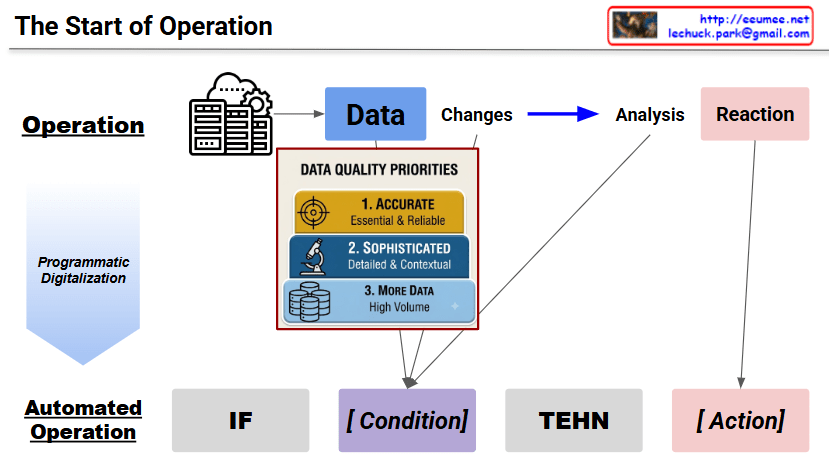
This image, titled “The Start of Operation,” visually maps out the “Programmatic Digitalization” process. It illustrates how a standard, manual “Operation” transitions into an “Automated Operation.”
Detailed Description:
- Top Layer – Operation Phase:
- The workflow begins with “Data” sourced from servers and cloud infrastructure (represented by the icons on the left).
- This data flows through “Changes,” follows a blue arrow into “Analysis,” and finally results in a “Reaction.”
- Data Quality Priorities:
- An embedded box under “Data” highlights a specific hierarchy of data importance.
- Priority 1: ACCURATE – Emphasizes that data must be essential and reliable (Target icon).
- Priority 2: SOPHISTICATED – Data should be detailed and contextual (Microscope icon).
- Priority 3: MORE DATA – Refers to a high volume of data (Database icon).
- Bottom Layer – Automated Operation Phase:
- The upper processes are translated into a foundational programming logic: “IF-THEN” (Note: “THEN” is slightly misspelled as “TEHN” in the image).
- Arrows pointing down from “Data” (including the priority box), “Changes,” and “Analysis” all converge into the “[Condition]” box. This shows that quality data and its subsequent analysis form the “IF” criteria.
- An arrow from the top layer’s “Reaction” points directly down to the “[Action]” box. This indicates that once the condition is met (THEN), an automated response is executed.
Summary: This diagram outlines the architectural logic behind automating business or system operations through digitalization. It demonstrates that defining a precise “IF Condition” relies entirely on high-quality data (prioritizing accuracy, sophistication, and volume) and thorough analysis. Once these conditions are met, they seamlessly trigger a pre-determined, automated “THEN Action.”
#DataAutomation #DigitalTransformation #DataQuality #ConditionalLogic #ProgrammaticDigitalization
WIth Gemini

