PIML(Physics-Informed Machine Learning)

PIML (Physics-Informed Machine Learning) Explained

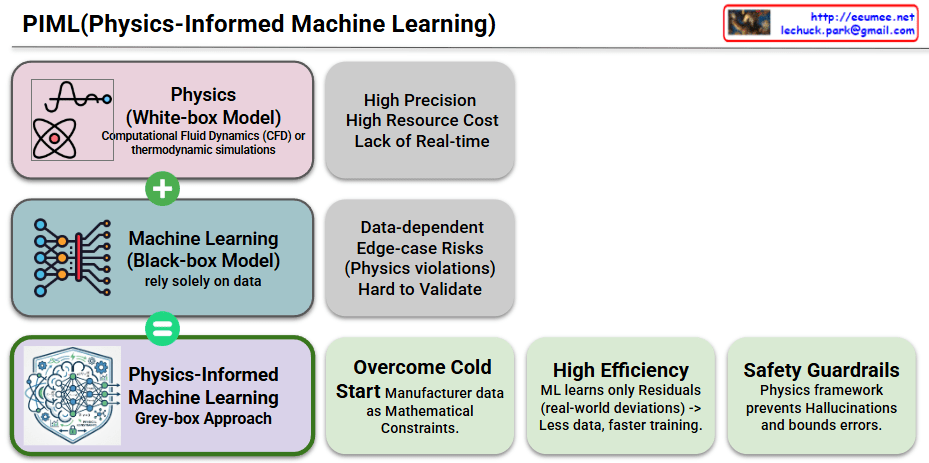
This diagram illustrates how PIML (Physics-Informed Machine Learning) combines the strengths of physics-based models and data-driven machine learning to create a more powerful and reliable approach.


1. Top: Physics (White-box Model)

  • Definition: These are models where the underlying principles are fully explained by mathematical equations, such as Computational Fluid Dynamics (CFD) or thermodynamic simulations.
  • Characteristics:
    • High Precision: They are very accurate because they are based on fundamental physical laws.
    • High Resource Cost: They are computationally intensive, requiring significant processing power and time.
    • Lack of Real-time Processing: Complex simulations are difficult to use for real-time prediction or control.

2. Middle: Machine Learning (Black-box Model)

  • Definition: These models rely solely on large amounts of training data to find correlations and make predictions, without using underlying physical principles.
  • Characteristics:
    • Data-dependent: Their performance depends heavily on the quality and quantity of the data they are trained on.
    • Edge-case Risks: In situations not covered by the data (edge cases), they can make illogical predictions that violate physical laws.
    • Hard to Validate: It is difficult to understand their internal workings, making it challenging to verify the reliability of their results.

3. Bottom: Physics-Informed Machine Learning (Grey-box Approach)

  • Definition: This approach integrates the knowledge of physical laws (equations) into a machine learning model as mathematical constraints, combining the best of both worlds.
  • Benefits:
    • Overcome Cold Start Problem: By using existing knowledge like mathematical constraints, PIML can function even when training data is scarce, effectively addressing the initial (“Cold Start”) state.
    • High Efficiency: Instead of learning physics from scratch, the ML model focuses on learning only the residuals (real-world deviations) between the physics-based model and actual data. This makes learning faster and more efficient with less data.
    • Safety Guardrails: The integrated physics framework acts as a set of safety guardrails, providing constraints that prevent the model from making physically impossible predictions (“Hallucinations”) and bounding errors to ensure safety.

#AI #PIML #MachineLearning #Physics #HybridAI #DataScience #ExplainableAI #XAI #ComputationalPhysics #Simulation

with Gemini
Hybrid Analysis for Autonomous Operation (1)


Hybrid Analysis for Autonomous Operation (1)

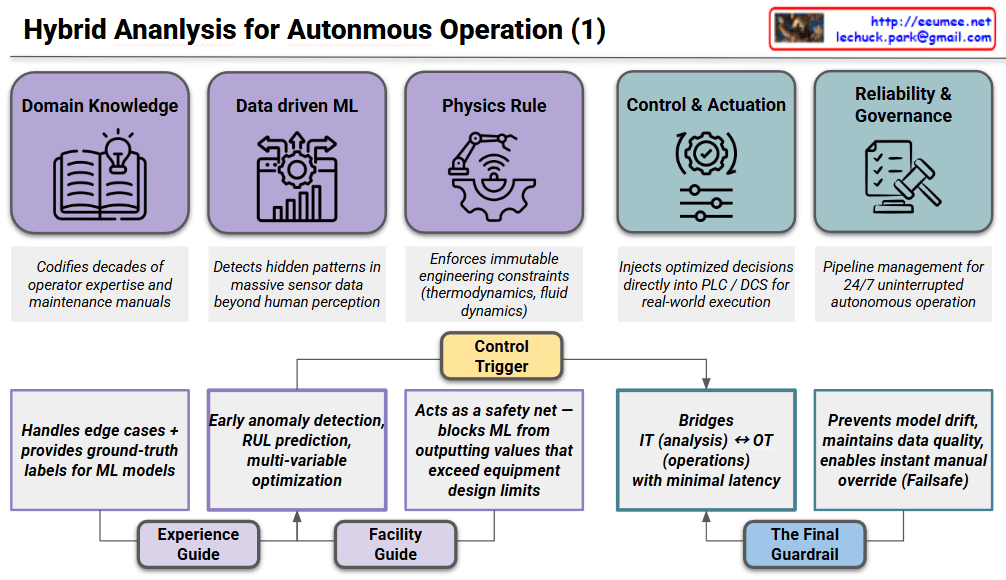
This framework illustrates a holistic approach to autonomous systems, integrating human expertise, physical laws, and AI to ensure safe and efficient real-world execution.

1. Five Core Modules (Top Layer)

  • Domain Knowledge: Codifies decades of operator expertise and maintenance manuals into digital logic.
  • Data-driven ML: Detects hidden patterns in massive sensor data that go beyond human perception.
  • Physics Rule: Enforces immutable engineering constraints (such as thermodynamics or fluid dynamics) to ground the AI in reality.
  • Control & Actuation: Injects optimized decisions directly into PLC / DCS (Distributed Control Systems) for real-world execution.
  • Reliability & Governance: Manages the entire pipeline to ensure 24/7 uninterrupted autonomous operation.

2. Integrated Value Drivers (Bottom Layer)

These modules work in synergy to create three essential “Guides” for the system:

  • Experience Guide: Combines domain expertise with ML to handle edge cases and provide high-quality ground-truth labels for model training.
  • Facility Guide: Acts as a safety net by combining ML predictions with physical rules. It predicts Remaining Useful Life (RUL) while blocking outputs that exceed equipment design limits.
  • The Final Guardrail: Bridges the gap between IT (Analysis) and OT (Operations). It prevents model drift and ensures an instant manual override (Failsafe) is always available.

3. Key Takeaways

The architecture centers on a “Control Trigger” that converts digital insights into physical action. By anchoring machine learning with physical laws and human experience, the system achieves a level of reliability required for mission-critical environments like data centers or industrial plants.

#AutonomousOperations #IndustrialAI #MachineLearning #SmartFactory #DataCenterManagement #PredictiveMaintenance #ControlSystems #OTSecurity #AIOps #HybridAI

With Gemini

Human Rules Always


The Evolutionary Roadmap to Human-Optimized AI

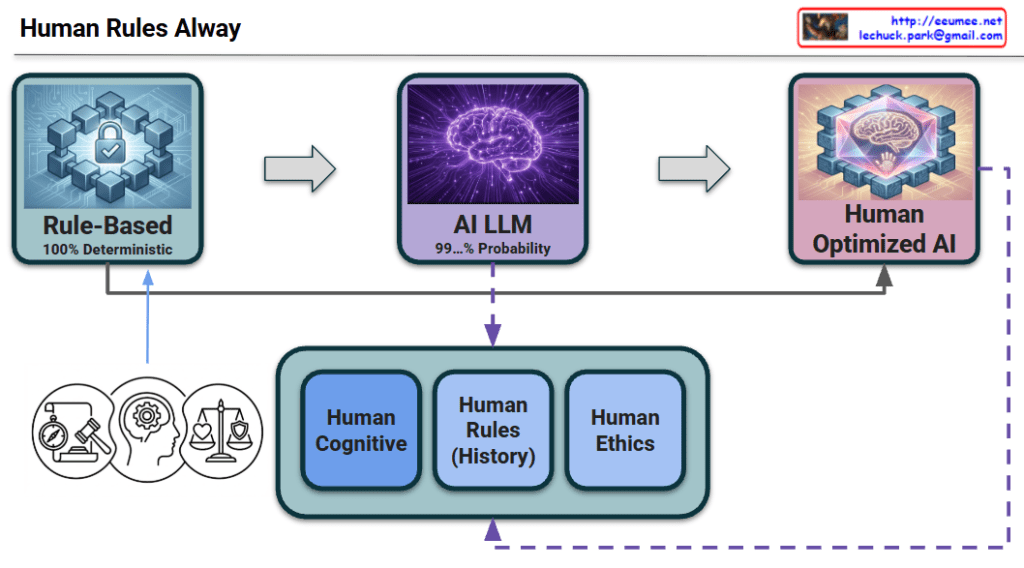
This diagram visualizes the history and future direction of intelligent systems. It illustrates the evolution from the era of manual programming to the current age of generative AI, and finally to the ultimate goal where human standards perfect the technology.

1. The 3 Stages of Technological Evolution (Top Flow)

  • Stage 1: Rule-Based (The Foundation / Past)
    • Concept: “The Era of Human-Defined Logic”
    • Context: This represents the starting point of computing where humans explicitly created formulas and coded every rule.
    • Characteristics: It is 100% Deterministic. While accurate within its scope, it cannot handle the complexity of the real world beyond what humans have manually programmed.
  • Stage 2: AI LLM (The Transition / Present)
    • Concept: “The Era of Probabilistic Scale”
    • Context: We have evolved into the age of massive parallel processing and Large Language Models.
    • Characteristics: It operates on 99…% Probability. It offers immense scalability and creativity that rule-based systems could never achieve, but it lacks the absolute certainty of the past, occasionally leading to inefficiencies or hallucinations.
  • Stage 3: Human Optimized AI (The Final Goal / Future)
    • Concept: “The Era of Reliability & Efficiency”
    • Context: This is the destination we must reach. It is not just about using AI, but about integrating the massive power of the “Present” (AI LLM) with the precision of the “Past” (Rule-Based).
    • Characteristics: By applying human standards to control the AI’s massive parallel processing, we achieve a system that is both computationally efficient and strictly reliable.

2. The Engine of Evolution: Human Standards (Bottom Box)

This section represents the mechanism that drives the evolution from Stage 2 to Stage 3.

  • The Problem: Raw AI (Stage 2) consumes vast energy and can be unpredictable.
  • The Solution: We must re-introduce the “Human Rules” (History, Logic, Ethics) established in Stage 1 into the AI’s workflow.
  • The Process:
    • Constraint & Optimization: Human Cognition and Rules act as a pruning mechanism, cutting off wasteful parallel computations in the LLM.
    • Safety: Ethics ensure the output aligns with human values.
  • Result: This filtering process transforms the raw, probabilistic energy of the LLM into the polished, “Human Optimized” state.

3. The Feedback Loop (Continuous Evolution)

  • Dashed Line: The journey doesn’t end at Stage 3. The output from the optimized AI is reviewed by humans, which in turn updates our rules and ethical standards. This circular structure ensures that the AI continues to evolve alongside human civilization.

This diagram declares that the future of AI lies not in discarding the old “Rule-Based” ways, but in fusing that deterministic precision with modern probabilistic power to create a truly optimized intelligence.


#AIEvolution #FutureOfAI #HybridAI #DeterministicVsProbabilistic #HumanInTheLoop #TechRoadmap #AIArchitecture #Optimization #ResponsibleAI