AI Agent : Bring Up


Visualizing the Evolution of an AI Agent: The “Bring UP” Process

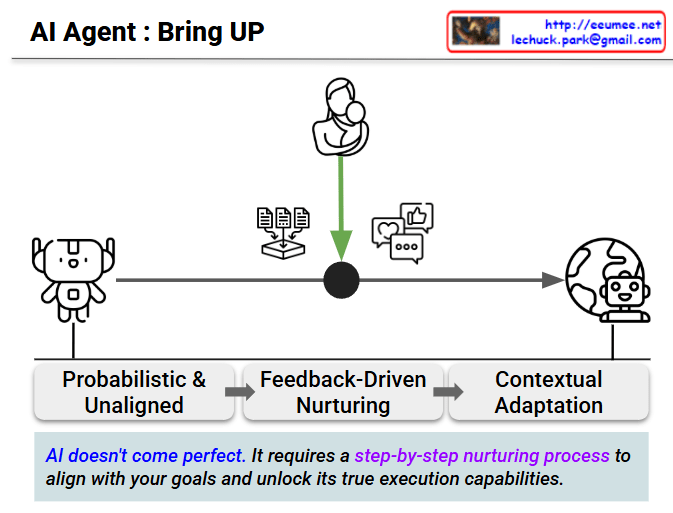
This infographic, titled “AI Agent : Bring UP,” effectively illustrates the evolutionary journey of an Artificial Intelligence from a raw, untrained model to a fully functional, real-world agent. It uses a powerful “nurturing” metaphor to emphasize that building a reliable AI is not a plug-and-play event, but a continuous process of guidance.

Here is the step-by-step breakdown of the AI’s journey:

1. The Starting Point: Probabilistic & Unaligned

  • Visual: The basic, blank-faced robot on the far left.
  • Meaning: This represents the raw AI (such as a base LLM). At this initial stage, the AI is merely a probabilistic engine. It predicts outputs based on statistical likelihoods but fundamentally lacks an understanding of the user’s true intent, operational goals, or constraints. It is a powerful tool, but it is “unaligned.”

2. The Critical Phase: Feedback-Driven Nurturing

  • Visual: The central nexus featuring a parent holding a child, flanked by documents (data) and social interaction icons (likes/comments).
  • Meaning: This is the most crucial step—the “Human-in-the-Loop” process. The parent-child icon symbolizes that an AI must be nurtured. To bridge the gap between a raw model and a useful agent, it requires the injection of specific contextual data (documents) and continuous, iterative human feedback (represented by the interaction icons).

3. The Final Goal: Contextual Adaptation

  • Visual: The advanced, confident robot standing in front of a globe on the right.
  • Meaning: Having successfully passed through the nurturing phase, the AI is no longer just a text generator. It has adapted to complex, real-world contexts (the globe). It is now an aligned, goal-oriented “Agent” capable of understanding its environment and executing tasks accurately.

💡 The Key Takeaway

The most important message is captured in the footer: “AI doesn’t come perfect.”

Many people expect out-of-the-box perfection from AI, but this diagram clearly debunks that myth. To unlock an AI’s true execution capabilities, you cannot skip the middle step. It mandates a step-by-step nurturing process to align the technology with your specific objectives. Perfection is not the starting point; it is the result of continuous guidance.


#AIAgents #ArtificialIntelligence #AIAlignment #HumanInTheLoop #MachineLearning #TechVisualization #AIOps #LLM #TechLeadership #Innovation

With Gemini
Groq_LPU

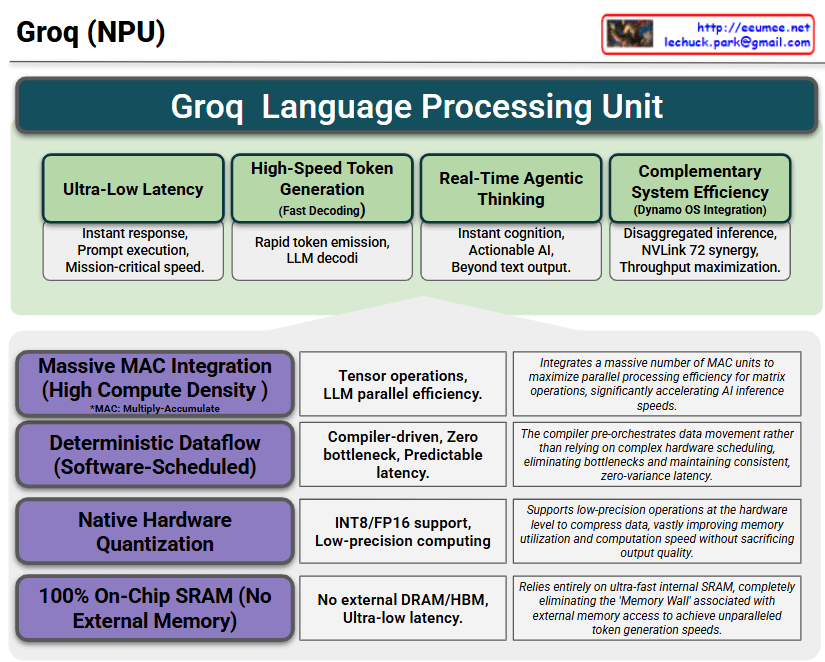
The core strength of this slide is how it connects the Capabilities/Benefits (The “What”) at the top with the Core Technologies (The “How”) at the bottom.

1. Top Section (Green): The Capabilities & Benefits of LPU

This section highlights the immediate, tangible values achieved by deploying the Groq architecture.

  • Ultra-Low Latency & High-Speed Token Gen: Emphasizes the crucial need for instant response times and rapid LLM decoding for real-time services. (Note: There is a minor typo in the second box—”decodi” should be “decoding”.)
  • Real-Time Agentic Thinking: Shows that this speed elevates the AI from a simple text generator to an actionable agent capable of instant cognition.
  • Complementary System Efficiency: Highlights the strategic advantage of “Disaggregated Inference,” where the LPU handles fast generation while partnering with high-throughput systems (like NVLink 72) to maximize the overall data center throughput.

2. Bottom Section (Grey): The 4 Core Technologies

This section details the specific engineering choices that make the top section’s performance possible.

  • Massive MAC Integration: The sheer density of compute units required for parallel tensor operations.
  • Deterministic Dataflow: The software/compiler-driven approach that eliminates hardware scheduling bottlenecks, ensuring predictable, zero-variance latency.
  • Native Hardware Quantization: The built-in support for low-precision formats (INT8/FP16) to speed up math and save memory.
  • 100% On-Chip SRAM: The most critical differentiator—completely bypassing external memory (DRAM/HBM) to shatter the “Memory Wall.”

Summary

  • Logical Architecture: The slide perfectly visualizes how four radical hardware design choices directly enable four critical performance benefits for AI inference.
  • The Speed Secret: It highlights that Groq’s unprecedented speed and predictable latency come from eliminating external memory (100% SRAM) and relying on software-scheduled dataflow.
  • System Synergy: It effectively positions the LPU not as a standalone replacement, but as a specialized engine for real-time agentic thinking that complements high-throughput data center systems.

#Groq #LPU #AIHardware #DataCenter #AIInference #NPU #AIAgents #DisaggregatedInference

With Gemini

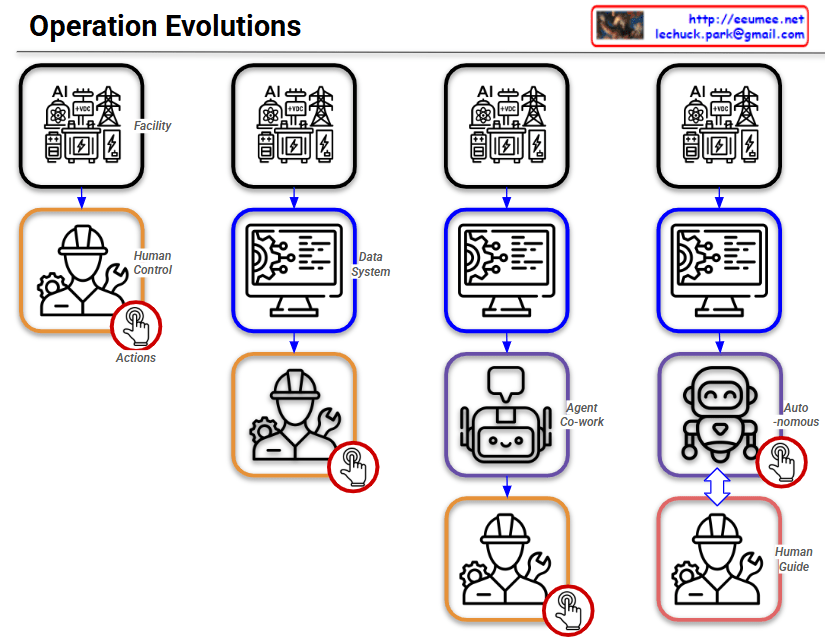
Operation Evolutions

By following the red circle with the ‘Actions’ (clicking hand) icon, you can easily track how the control and operational authority shift throughout the four stages.

Stage 1: Human Control

  • Structure: Facility ➡️ Human Control
  • Description: This represents the most traditional, manual approach. Without a centralized data system, human operators directly monitor the facility’s status and manually execute all Actions based on their physical observations and judgment.

Stage 2: Data System

  • Structure: Facility ➡️ Data System ➡️ Human Control
  • Description: A monitoring or data system (like a dashboard) is introduced. Humans now rely on the data collected by the system to understand the facility’s condition. However, the final Actions are still manually performed by humans.

Stage 3: Agent Co-work

  • Structure: Facility ➡️ Data System ➡️ Agent Co-work ➡️ Human Control
  • Description: An AI Agent is introduced as an intermediary between the data system and the human operator. The AI analyzes the data and provides insights, recommendations, or assistance. Even with this support, the final decision-making and physical Actions remain entirely the human’s responsibility.

Stage 4: Autonomous (Auto-nomous)

  • Structure: Facility ➡️ Data System ➡️ Auto-nomous ↔️ Human Guide
  • Description: This is the ultimate stage of operational evolution. The authority to execute Actions has shifted from the human to the AI. The AI analyzes data, makes independent decisions, and autonomously controls the facility. The human’s role transitions from a direct controller to a ‘Human Guide’, supervising the AI and providing high-level directives. The two-way arrow indicates a continuous, interactive feedback loop where the human and AI collaborate to refine and optimize the system.

Summary:

This slide intuitively illustrates a paradigm shift in infrastructure operations: progressing from Direct Human Intervention ➡️ System-Assisted Cognition ➡️ AI-Assisted Operations (Co-work) ➡️ Fully Autonomous AI Control with Human Supervision.

#AIOps #AutonomousOperations #TechEvolution #DigitalTransformation #DataCenter #FacilityManagement #InfrastructureAutomation #SmartFacilities #AIAgents #FutureOfWork #HumanAndAI #Automation

with Gemini