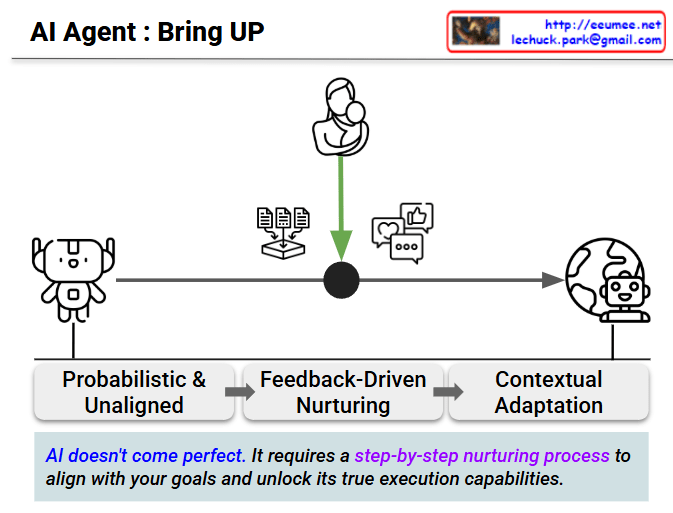
AI Agent : Bring Up


Visualizing the Evolution of an AI Agent: The “Bring UP” Process

This infographic, titled “AI Agent : Bring UP,” effectively illustrates the evolutionary journey of an Artificial Intelligence from a raw, untrained model to a fully functional, real-world agent. It uses a powerful “nurturing” metaphor to emphasize that building a reliable AI is not a plug-and-play event, but a continuous process of guidance.

Here is the step-by-step breakdown of the AI’s journey:

1. The Starting Point: Probabilistic & Unaligned

  • Visual: The basic, blank-faced robot on the far left.
  • Meaning: This represents the raw AI (such as a base LLM). At this initial stage, the AI is merely a probabilistic engine. It predicts outputs based on statistical likelihoods but fundamentally lacks an understanding of the user’s true intent, operational goals, or constraints. It is a powerful tool, but it is “unaligned.”

2. The Critical Phase: Feedback-Driven Nurturing

  • Visual: The central nexus featuring a parent holding a child, flanked by documents (data) and social interaction icons (likes/comments).
  • Meaning: This is the most crucial step—the “Human-in-the-Loop” process. The parent-child icon symbolizes that an AI must be nurtured. To bridge the gap between a raw model and a useful agent, it requires the injection of specific contextual data (documents) and continuous, iterative human feedback (represented by the interaction icons).

3. The Final Goal: Contextual Adaptation

  • Visual: The advanced, confident robot standing in front of a globe on the right.
  • Meaning: Having successfully passed through the nurturing phase, the AI is no longer just a text generator. It has adapted to complex, real-world contexts (the globe). It is now an aligned, goal-oriented “Agent” capable of understanding its environment and executing tasks accurately.

💡 The Key Takeaway

The most important message is captured in the footer: “AI doesn’t come perfect.”

Many people expect out-of-the-box perfection from AI, but this diagram clearly debunks that myth. To unlock an AI’s true execution capabilities, you cannot skip the middle step. It mandates a step-by-step nurturing process to align the technology with your specific objectives. Perfection is not the starting point; it is the result of continuous guidance.


#AIAgents #ArtificialIntelligence #AIAlignment #HumanInTheLoop #MachineLearning #TechVisualization #AIOps #LLM #TechLeadership #Innovation

With Gemini
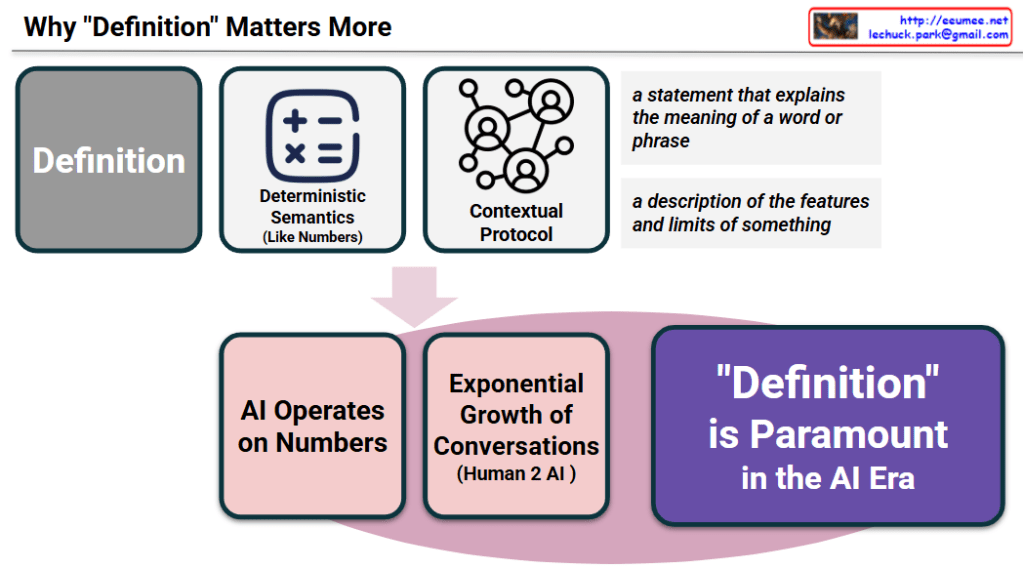
Why “Definition” Matters More

The revised slide visually and professionally conveys the technical philosophy we discussed through a clear visual narrative. Below is a structured breakdown of the slide, organized by its logical flow, which you can use directly as a presentation script or an executive summary.


Slide Overview: The Absolute Value of “Definition” in the AI Era

This slide illustrates why the traditional concept of a “definition” becomes critically important when applied to the new technological landscape of Artificial Intelligence. It follows a three-step logical progression: [The Nature of Concepts ➔ Characteristics of the AI Environment ➔ Final Conclusion].

1. Top Section: The Intrinsic Nature of a “Definition”

The upper half of the slide establishes the role of a “definition” from a system architecture perspective.

  • Deterministic Semantics (Like Numbers): As noted in the dictionary excerpts on the right, a definition explains meanings and boundaries. When applied to AI systems, this must function like mathematical symbols ($+, -, \times, =$). It requires an absolute, unchanging standard—a strict “deterministic semantic” that operates with the exactness of numbers.
  • Contextual Protocol: The network node icon signifies that definitions are no longer just dictionary entries. They act as fundamental “communication protocols” that govern, align, and regulate information exchange across complex networks and multiple AI agents.

2. Bottom-Left Section: The New Paradigm of the AI Environment

Moving through the central arrow, the slide transitions to the unique conditions of the current AI era where these definitions must be applied.

  • AI Operates on Numbers: AI does not comprehend text or context through human intuition; it processes information strictly as vectorized, numerical data.
  • Exponential Growth of Conversations (Human 2 AI): Concurrently, the frequency and volume of interactions—especially between humans and AI, and increasingly among AI agents themselves—are expanding at an explosive, unprecedented rate.

3. Bottom-Right Section: The Core Conclusion

  • “Definition” is Paramount in the AI Era: Ultimately, in an environment where machines process information numerically and the volume of communication is exponentially increasing, even a microscopic conceptual discrepancy can cascade into a catastrophic system failure or hallucination. Therefore, establishing “clear definitions” to structure data and strictly control meaning is the absolute, paramount requirement for maintaining a stable, reliable, and functional AI ecosystem.

Overall Summary

As AI exponentially scales the volume of our daily communications and processes them through rigid, mathematical vectors, linguistic ambiguity becomes the greatest systemic risk. A strictly defined semantic baseline—the “Definition”—is no longer just a linguistic tool, but the most essential engineering protocol required to prevent AI hallucinations and ensure precise, automated operations.

#ArtificialIntelligence #DataArchitecture #DeterministicSemantics #SemanticAnchor #DataGovernance #Definition

With Gemini

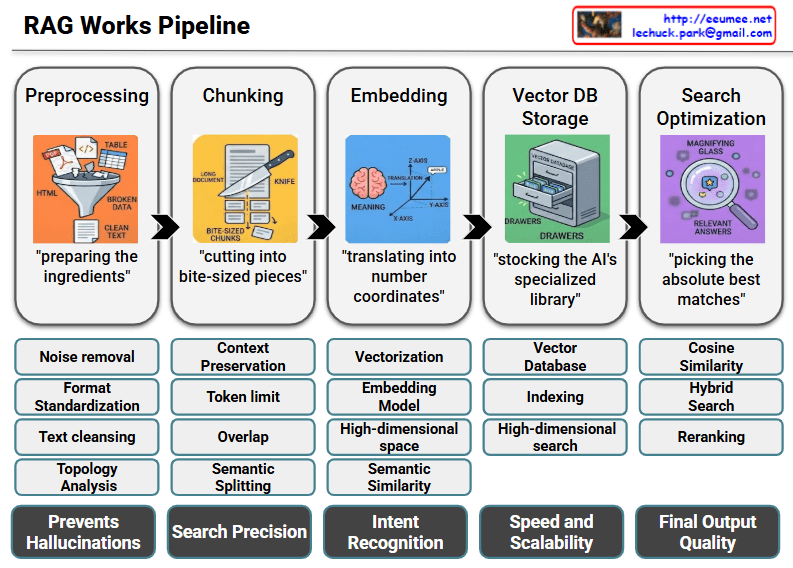
RAG Works Pipeline

This image illustrates the RAG (Retrieval-Augmented Generation) Works Pipeline, breaking down the complex data processing workflow into five intuitive steps using relatable analogies like cooking and organizing.

Here is a step-by-step breakdown of the pipeline:

  • Step 1: Preprocessing (“preparing the ingredients”)
    Just like prepping ingredients for a meal, this step filters raw, unstructured data from various formats (PDFs, HTML, tables) through a funnel to extract clean text. By handling noise removal, format standardization, and text cleansing, it establishes a solid data foundation that ultimately prevents AI hallucinations.
  • Step 2: Chunking (“cutting into bite-sized pieces”)
    Long documents are sliced into smaller, manageable pieces that the AI model can easily process. Techniques like semantic splitting and overlapping ensure that the original context is preserved without exceeding the AI’s token limits. This careful division drastically improves the system’s overall search precision.
  • Step 3: Embedding (“translating into number coordinates”)
    Here, the text chunks are converted into mathematical vectors mapped in a high-dimensional space (X, Y, Z axes). This vectorization captures the underlying semantic meaning and context of the text, allowing the system to go beyond simple keyword matching and achieve true intent recognition.
  • Step 4: Vector DB Storage (“stocking the AI’s specialized library”)
    The embedded vectors are systematically stored and indexed in a Vector Database. Think of it as a highly organized, specialized filing cabinet designed specifically for AI. Efficient indexing allows for high-dimensional searches, ensuring optimal speed and scalability even as the dataset grows massively.
  • Step 5: Search Optimization (“picking the absolute best matches”)
    Acting as a magnifying glass, this final step identifies and retrieves the most relevant information to answer a user’s query. Using advanced methods like cosine similarity, hybrid search, and reranking, the system pinpoints the exact data needed. This precise retrieval guarantees the highest final output quality for the AI’s generated response.

#RAG #RetrievalAugmentedGeneration #GenerativeAI #LLM #VectorDatabase #DataPipeline #MachineLearning #AIArchitecture #TechExplanation #ArtificialIntelligence

With Gemini

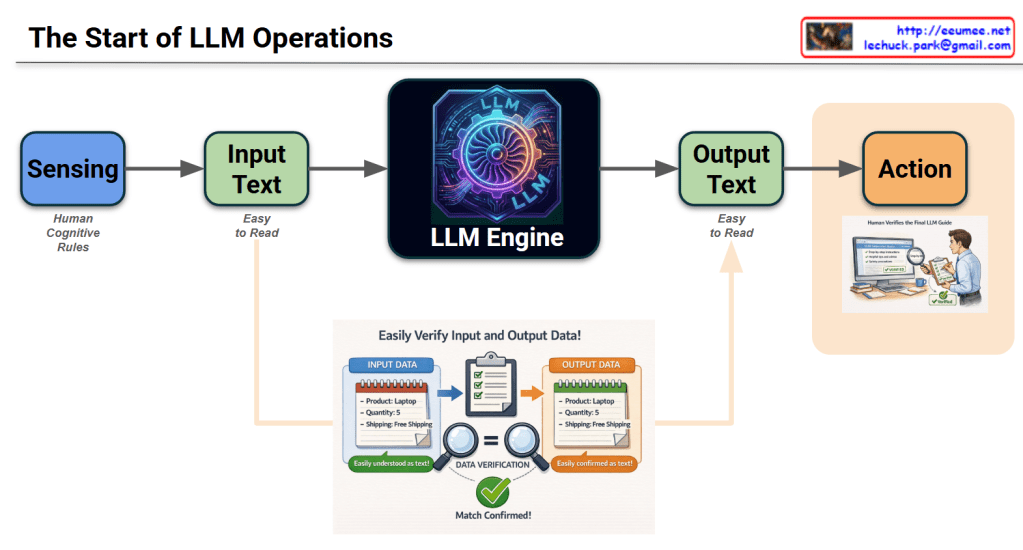
The Start of LLM Operations

This infographic, titled “The Start of LLM Operations,” illustrates the end-to-end workflow of how a Large Language Model (LLM) processes information to drive real-world outcomes.


Detailed Breakdown of the Workflow

1. Core Process Flow (Horizontal Axis)

  • Sensing: The initial stage where data is gathered based on Human Cognitive Rules. It represents the system “perceiving” the environment or requirements.
  • Input Text: Data is converted into a format that is “Easy to Read” for humans, ensuring the prompt or command is transparent.
  • LLM Engine: The central processing unit (symbolized by a high-tech gear) that analyzes the input and generates a response.
  • Output Text: The engine produces a result, again in a human-readable format, to ensure clarity before execution.
  • Action: The final stage where the output is translated into a functional task or operation.

2. Data Verification (Bottom Inset)

This section highlights the critical “Check & Balance” mechanism:

  • Input Data vs. Output Data: It shows a specific example (Product: Laptop, Quantity: 5, Shipping: Free).
  • Validation: The use of magnifying glasses and a green checkmark (Match Confirmed!) emphasizes that the output must strictly align with the input requirements to prevent hallucinations or errors.

3. Human-in-the-Loop (Right Section)

  • The image of the person reviewing a checklist (“Human Verifies the Final LLM Guide”) signifies that human oversight is the final gatekeeper. Before the “Action” is taken, a person ensures the AI’s logic and results are safe and accurate.

Summary & Insight

The diagram suggests that successful LLM operations are not just about the model’s intelligence, but about transparency and verification. By keeping data “Easy to Read” and involving “Human Verification,” the system ensures that AI-driven actions are reliable and grounded in human-defined rules.


Hashtags

#LLMOps #GenerativeAI #AIWorkflow #DataVerification #HumanInTheLoop #ArtificialIntelligence #TechInfographic #AIOperations #MachineLearning #PromptEngineering

With Gemini

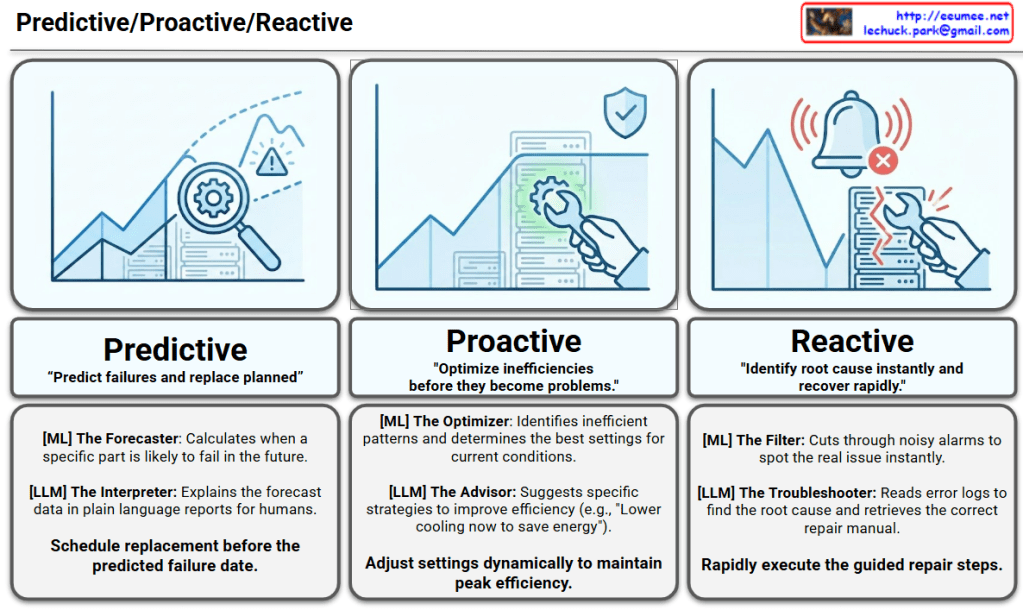
Predictive/Proactive/Reactive

The infographic visualizes how AI technologies (Machine Learning and Large Language Models) are applied across Predictive, Proactive, and Reactive stages of facility management.


1. Predictive Stage

This is the most advanced stage, anticipating future issues before they occur.

  • Core Goal: “Predict failures and replace planned.”
  • Icon Interpretation: A magnifying glass is used to examine a future point on a rising graph, identifying potential risks (peaks and warnings) ahead of time.
  • Role of AI:
    • [ML] The Forecaster: Analyzes historical data to calculate precisely when a specific component is likely to fail in the future.
    • [LLM] The Interpreter: Translates complex forecast data and probabilities into plain language reports that are easy for human operators to understand.
  • Key Activity: Scheduling parts replacement and maintenance windows well before the predicted failure date.

2. Proactive Stage

This stage focuses on optimizing current conditions to prevent problems from developing.

  • Core Goal: “Optimize inefficiencies before they become problems.”
  • Icon Interpretation: On a stable graph, a wrench is shown gently fine-tuning the system for optimization, protected by a shield icon representing preventative measures.
  • Role of AI:
    • [ML] The Optimizer: Identifies inefficient operational patterns and determines the optimal configurations for current environmental conditions.
    • [LLM] The Advisor: Suggests specific, actionable strategies to improve efficiency (e.g., “Lower cooling now to save energy”).
  • Key Activity: Dynamically adjusting system settings in real-time to maintain peak efficiency.

3. Reactive Stage

This stage deals with responding rapidly and accurately to incidents that have already occurred.

  • Core Goal: “Identify root cause instantly and recover rapidly.”
  • Icon Interpretation: A sharp drop in the graph accompanied by emergency alarms, showing an urgent repair being performed on a broken server rack.
  • Role of AI:
    • [ML] The Filter: Cuts through the noise of massive alarm volumes to instantly isolate the true, critical issue.
    • [LLM] The Troubleshooter: Reads and analyzes complex error logs to determine the root cause and retrieves the correct Standard Operating Procedure (SOP) or manual.
  • Key Activity: Rapidly executing the guided repair steps provided by the system.

Summary

  • The image illustrates the evolution of data center operations from traditional Reactive responses to intelligent Proactive optimization and Predictive maintenance.
  • It clearly delineates the roles of AI, where Machine Learning (ML) handles data analysis and forecasting, while Large Language Models (LLMs) interpret these insights and provide actionable guidance.
  • Ultimately, this integrated AI approach aims to maximize uptime, enhance energy efficiency, and accelerate incident recovery in critical infrastructure.

#DataCenter #AIOps #PredictiveMaintenance #SmartInfrastructure #ArtificialIntelligence #MachineLearning #LLM #FacilityManagement #ITOps

with Gemini

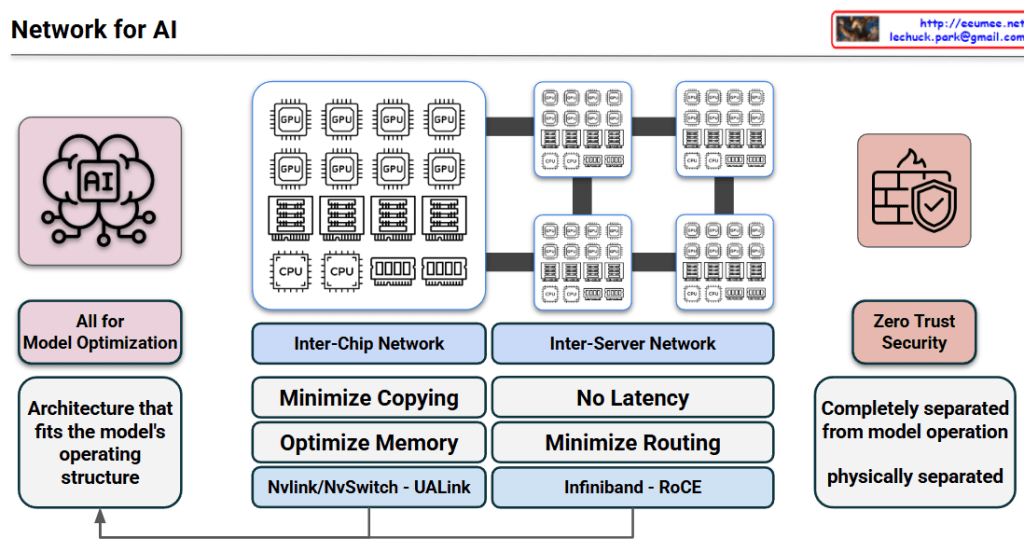
Network for AI

1. Core Philosophy: All for Model Optimization

The primary goal is to create an “Architecture that fits the model’s operating structure.” Unlike traditional general-purpose data centers, AI infrastructure is specialized to handle the massive data throughput and synchronized computations required by LLMs (Large Language Models).

2. Hierarchical Network Design

The architecture is divided into two critical layers to handle different levels of data exchange:

A. Inter-Chip Network (Scale-Up)

This layer focuses on the communication between individual GPUs/Accelerators within a single server or node.

  • Key Goals: Minimize data copying and optimize memory utilization (Shared Memory/Memory Pooling).
  • Technologies: * NVLink / NVSwitch: NVIDIA’s proprietary high-speed interconnect.
  • UALink (Ultra Accelerator Link): The new open standard designed for scale-up AI clusters.

B. Inter-Server Network (Scale-Out)

This layer connects multiple server nodes to form a massive AI cluster.

  • Key Goals: Achieve “No Latency” (Ultra-low latency) and minimize routing overhead to prevent bottlenecks during collective communications (e.g., All-Reduce).
  • Technologies: * InfiniBand: A lossless, high-bandwidth fabric preferred for its low CPU overhead.
  • RoCE (RDMA over Converged Ethernet): High-speed Ethernet that allows direct memory access between servers.

3. Zero Trust Security & Physical Separation

A unique aspect of this architecture is the treatment of security.

  • Operational Isolation: The security and management plane is completely separated from the model operation plane.
  • Performance Integrity: By being physically separated, security protocols (like firewalls or encryption inspection) do not introduce latency into the high-speed compute fabric where the model runs. This ensures that a “Zero Trust” posture does not degrade training or inference speed.

4. Architectural Feedback Loop

The arrow at the bottom indicates a feedback loop: the performance metrics and requirements of the inter-chip and inter-server networks directly inform the ongoing optimization of the overall architecture. This ensures the platform evolves alongside advancing AI model structures.


The architecture prioritizes model-centric optimization, ensuring infrastructure is purpose-built to match the specific operating requirements of large-scale AI workloads.

It employs a dual-tier network strategy using Inter-chip (NVLink/UALink) for memory efficiency and Inter-server (InfiniBand/RoCE) for ultra-low latency cluster scaling.

Zero Trust security is integrated through complete physical separation from the compute fabric, allowing for robust protection without causing any performance bottlenecks.

#AIDC #ArtificialIntelligence #GPU #Networking #NVLink #UALink #InfiniBand #RoCEv2 #ZeroTrust #DataCenterArchitecture #MachineLearningOps #ScaleOut

Mixture-of-Experts (MoE) DeepSeek-v3

Image Interpretation: DeepSeek-v3 Mixture-of-Experts (MoE)

This image outlines the key technologies and performance efficiency of the DeepSeek-v3 model, which utilizes the Mixture-of-Experts (MoE) architecture. It is divided into the architecture diagram/cost table on the left and four key technical features on the right.

1. DeepSeekMoE Architecture (Left Diagram)

The diagram illustrates how the model processes data:

  • Separation of Experts: Unlike traditional MoEs, it distinguishes between Shared Experts (Green) and Routed Experts (Blue).
    • Shared Experts: Always active to handle common knowledge.
    • Routed Experts: Selectively activated by the Router to handle specific, specialized features.
  • Workflow: When an input (ut) arrives, the Router selects the top-$K$ experts (Top-Kr). The system processes the input through both shared and selected routed experts in parallel and combines the results.

2. Four Key Technical Features (Right Panel)

This section explains how DeepSeek-v3 overcomes the limitations of existing MoE models:

  • Load Balancing without Auxiliary Loss:
    • Problem: Standard MoEs often use “auxiliary loss” to balance expert usage, which can degrade performance.
    • Solution: It uses learnable bias terms in the router to ensure balance. This bias only affects “dispatching” (where data goes) and not the actual “weights” (calculation values), preserving model quality.
  • Shared Expert Design:
    • Concept: Keeping one or a few experts always active for general tasks allows the routed experts to focus purely on complex, specialized tasks.
    • Benefit: Reduces redundancy and improves the capacity utilization of experts.
  • Hardware-Aware Dual-Pipe Parallelism:
    • Efficiency: It fully overlaps All-to-All communication with computation, minimizing idle time.
    • Optimization: “Node-local expert routing” is used to minimize slow data transfers between different nodes.
  • FP8 Mixed-Precision Training:
    • Speed & Cost: Utilizes the tensor cores of modern GPUs (Hopper/Blackwell) for full FP8 (8-bit floating point) training. This drastically lowers both training and inference costs.

3. Cost Efficiency Comparison (Table 2)

The comparison highlights the massive efficiency gain over dense models:

  • DeepSeek-V3 MoE (671B parameters): Despite having the largest parameter count, its training cost is extremely low at 250 GFLOPS/Token.
  • LLaMa-405B Dense (405B parameters): Although smaller in size, it requires ~10x higher cost (2448 GFLOPS/Token) compared to DeepSeek-v3.
  • Conclusion: DeepSeek-v3 achieves “high performance at low cost” by massively scaling the model size (671B) while keeping the actual computation equivalent to a much smaller model.

Summary

  1. Hybrid Structure: DeepSeek-v3 separates “Shared Experts” for general knowledge and “Routed Experts” for specialized tasks to maximize efficiency.
  2. Optimized Training: It achieves high speed and balance using “Load Balancing without Auxiliary Loss” and “FP8 Mixed-Precision Training.”
  3. Extreme Efficiency: Despite a massive 671B parameter size, it offers roughly 10x lower training costs per token compared to similar dense models (like LLaMa-405B).

#DeepSeek #AI #MachineLearning #MoE #MixtureOfExperts #LLM #DeepLearning #TechTrends #ArtificialIntelligence #ModelArchitecture

With Gemini