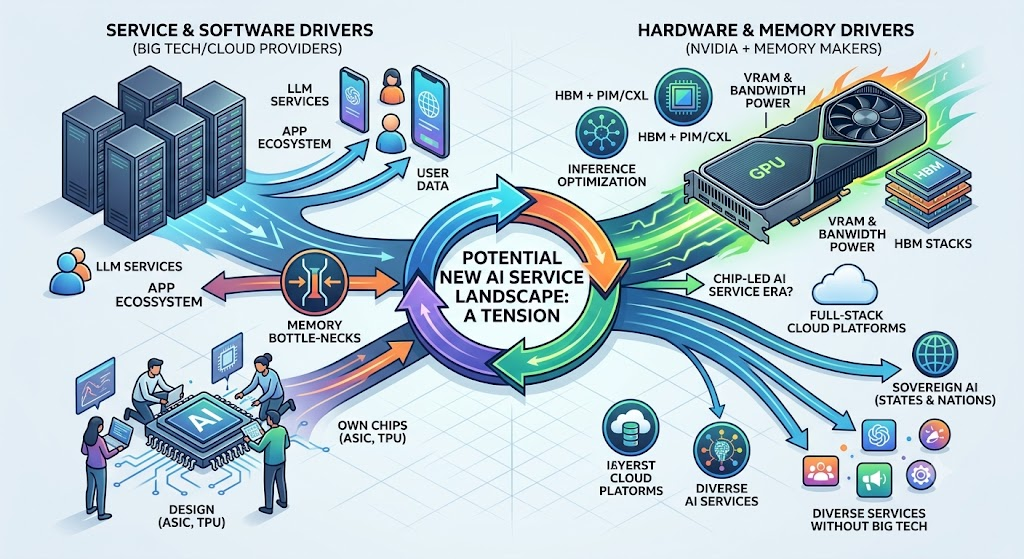
This infographic illustrates the potential future dynamic and tension within the AI industry, pitting Big Tech Service & Software Drivers against Hardware & Memory Drivers (NVIDIA and memory manufacturers).
On the left, cloud providers focus on LLM services and developing their own chips (ASIC, TPU) to overcome a central memory bottleneck.
On the right, hardware makers emphasize the raw power of GPUs, high-bandwidth memory (HBM), and in-memory processing to optimize inference.
A central loop describes this interaction as a “tension” that could lead to various outcomes, from a chip-led AI service era to a diverse range of cloud platforms and independent AI services, including sovereign AI initiatives.
The provided diagram, titled “AI Optimization,” illustrates the process of AI learning and inference in relation to data flow, along with the physical hardware infrastructure optimization (power and thermal management) required to sustain it. It goes beyond simple software algorithms to provide architectural insights into AI infrastructure and system design.
1. Data Acquisition and Preprocessing (Left Section)
Infinite World Data (Green Arrow): Represents the vast, unstructured, and infinite source data existing in the real world.
For All World Data & RAM: Shows the process of loading this infinite real-world data into RAM (a finite computing resource) so that the AI can process it. This represents the beginning of the data pipeline, where massive amounts of data are ingested, compressed, and refined for the system.
2. AI Computation & Infrastructure Optimization (Center Section)
This is the core of the diagram, showing how software-driven data optimization and hardware-driven power/cooling optimization intersect around the central AI processor (such as a GPU or NPU).
Algorithm & Model Optimization (Horizontal Flow):
Learning: The process where the AI trains on and optimizes data based on human-built statistical frameworks (Human Statistics).
Inference: The process of executing the trained model to run computations on new inputs and derive actionable results.
Physical Infrastructure Optimization (Vertical Flow): Represents the data center-level physical management required to sustain high-performance AI workloads.
Fit Optimization For Computing (Top): The lightning bolt icon signifies the optimization of high-density power supply systems and computing efficiency necessary for heavy AI workloads.
Fit Optimization For Heat (Bottom): The snowflake and circulation icon represents thermal management and cooling system optimization (such as liquid immersion cooling or advanced HVAC) to control the massive heat generated by the chips during intense computation.
3. Generation of Meaningful Information (Right Section)
For All Human Data & RAM: Shows the final output derived from the AI’s inference process being loaded back into the memory (RAM).
Unlike the large, single bar of raw source data on the left, the data on the right is fragmented into multiple smaller blocks. This symbolizes that massive, unrefined data has been successfully processed by the AI into structured, meaningful, and digestible information that humans can immediately consume and utilize for specific purposes.
Summary
This diagram emphasizes that AI value creation is not merely a software algorithm that takes data in and spits results out. It conveys a system engineering philosophy: true AI Optimization can only be achieved when software models are perfectly synchronized with the physical architecture—specifically high-density power delivery (Computing) and efficient thermal management (Heat)—that supports the hardware at its core.
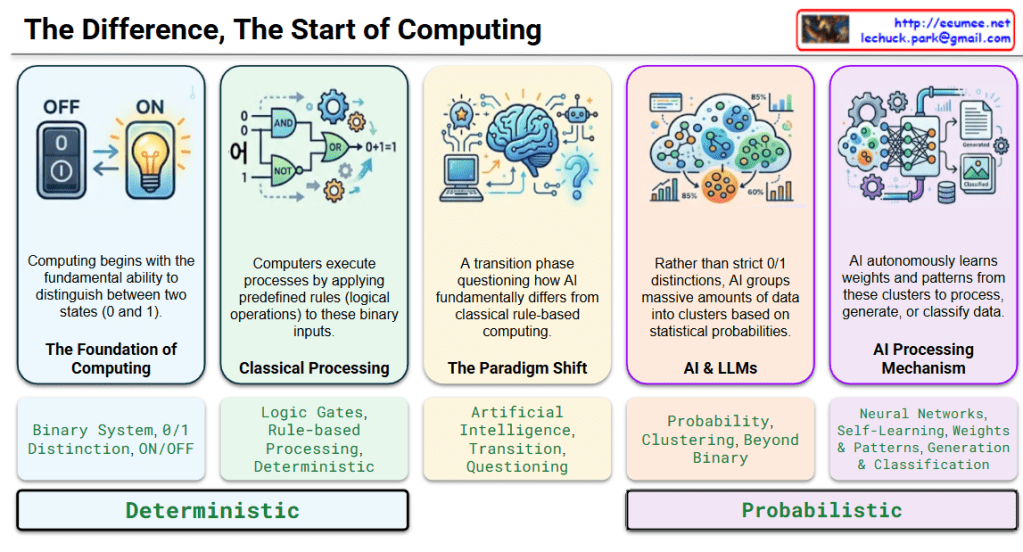
The provided image is an infographic that visually compares the operational mechanisms of traditional computing and modern Artificial Intelligence (AI). The addition of the keywords “Deterministic” and “Probabilistic” at the bottom perfectly summarizes the core difference between these two paradigms.
1. The World of Deterministic Computing
This section explains the traditional computer mechanism, which consistently produces the same output based on predefined, rigid rules.
Step 1: The Foundation of Computing
Visuals: An intuitive ON/OFF power switch and an illuminated lightbulb.
Meaning: Computing begins with the fundamental Binary System, which distinguishes between two clear states: 0 (OFF) and 1 (ON).
Step 2: Classical Processing
Visuals: Logic gate symbols (AND, OR, NOT) interlocked with gears.
Meaning: It illustrates how conventional computers process binary inputs mechanically by applying predefined human rules and logical operations (Rule-based Processing).
2. The Paradigm Shift
Step 3: Questioning and Transition
Visuals: A brain integrated with electronic circuits, a computer, a robot icon, and a large question mark in the center.
Meaning: This represents a technological leap, asking the core question: “How does AI fundamentally differ from classical rule-based computing?”
3. The World of Probabilistic Computing
This section explains AI’s mechanism, which relies on data statistics and probabilities to self-learn and generate flexible outcomes.
Step 4: AI & LLMs (Large Language Models)
Visuals: A cloud containing clustered data nodes of various colors and statistical charts showing probabilities like 85% and 60%.
Meaning: Instead of making strict 0/1 distinctions, AI groups massive amounts of data into Clusters based on statistical Probabilities.
Step 5: AI Processing Mechanism
Visuals: A complex Artificial Neural Network structure combined with processing gears, leading to output files labeled “Generated” (images) and “Classified” (documents).
Meaning: Without relying on explicit human programming, AI autonomously learns weights and internal patterns (Self-Learning) from these probabilistic clusters to create new content or classify data.
📌 Summary
This infographic acts as a visual map showcasing the evolution of computing history from the era of “Deterministic Rules” to the era of “Probabilistic Self-Learning.”
It intuitively conveys the core difference: while early computers relied on clear 0/1 distinctions and explicit human-written code, modern AI (like LLMs) groups vast amounts of data by probability and autonomously learns internal patterns and weights to deliver flexible, creative, and highly advanced results.
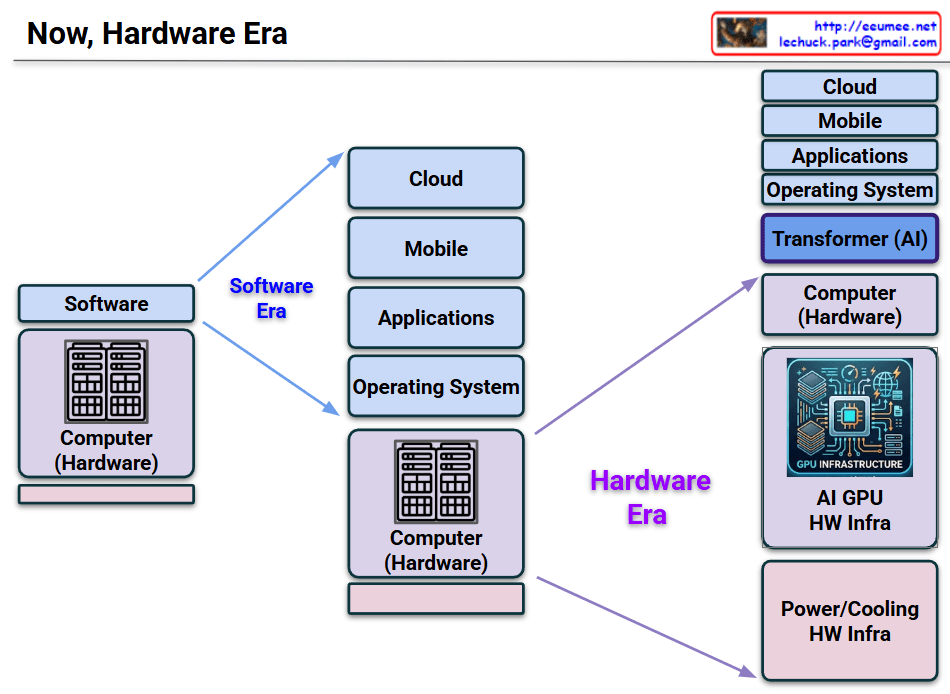
This image is an insightful architectural diagram illustrating the major paradigm shift in the IT industry, transitioning from the past “Software Era” to the current “Hardware Era.”
On the left side, representing the Software Era, the structure is heavily focused on software expansion. A single, traditional “Computer (Hardware)” block serves as a basic foundation to support a growing stack of software components: Operating System, Applications, Mobile, and Cloud. During this time, hardware was largely viewed as a standardized commodity to run software.
On the right side, representing the current Hardware Era, the diagram shows a significant architectural transformation driven by Artificial Intelligence.
Here are the key changes:
The Insertion of AI: A new, prominent purple block labeled “Transformer (AI)” is inserted right beneath the traditional software stack. This signifies that AI models have become the core engine and an indispensable layer for modern IT services.
Expansion of Hardware Infrastructure: To support the massive computational demands of the AI layer, the hardware section at the bottom has expanded dramatically into three distinct pillars:
Computer (Hardware): The traditional CPU-based computing servers.
AI GPU HW Infra: A large, specialized block featuring a detailed microchip icon. This highlights the absolute necessity of high-performance GPU clusters, high-bandwidth memory (HBM), and high-speed networking to process AI workloads.
Power/Cooling HW Infra: This is perhaps the most critical new addition. It visually emphasizes that running massive AI GPU clusters requires enormous energy and generates immense heat. Consequently, power supply and advanced cooling systems are no longer just facility management issues, but a core component of the IT infrastructure itself.
The diagram visualizes how the advent of AI has shifted the industry’s bottleneck and focus back to building robust, highly specialized hardware and the physical power/cooling infrastructure required to sustain it.
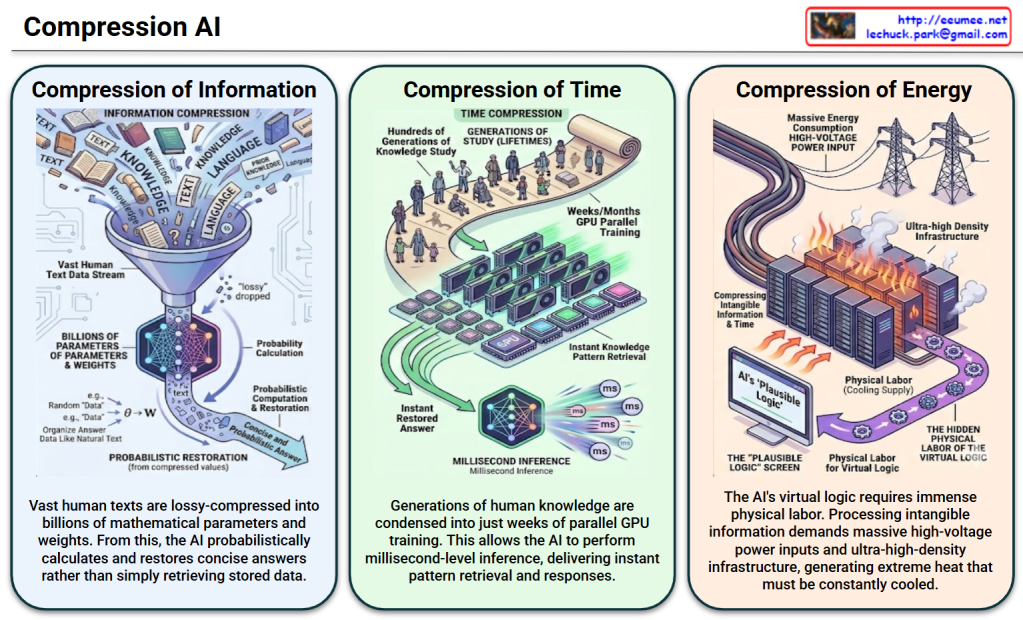
The provided image is an infographic titled “Compression AI”, which explains the underlying mechanisms and realities of modern artificial intelligence, such as Large Language Models (LLMs), through the lens of three types of “compression.” From left to right, it visually details the processes of compressing information, time, and energy.
1. Compression of Information
The first panel demonstrates how humanity’s vast text data is processed internally by the AI.
Countless amounts of knowledge, books, and language data pass through a funnel, undergoing a “lossy-compressed” process where some non-essential information is dropped.
This massive volume of text is not simply stored exactly as is in a database; instead, it is transformed into a neural network consisting of billions of mathematical parameters and weights.
Consequently, it explains that when the AI receives a prompt, it does not just search for and retrieve stored sentences. Rather, based on these compressed numerical values, it uses probabilistic calculations to ‘restore’ the most plausible answer (Probabilistic Restoration).
2. Compression of Time
The second panel illustrates the “compression of time” achieved through the incredible speed of AI’s training and inference.
It visualizes a vast stream of knowledge that would take humans hundreds of generations (lifetimes) to learn.
By utilizing massive parallel computing with numerous GPUs (GPU Parallel Training), the AI condenses hundreds of generations’ worth of human learning into a mere few weeks or months.
During the inference stage—when a user asks a question after the model is trained—the AI relies on these learned patterns to instantly derive an answer in a matter of milliseconds (ms).
3. Compression of Energy (Thermodynamic Cost)
The third panel addresses the immense physical toll exacted in the real world to run the AI’s invisible virtual logic.
It illustrates massive high-voltage power being continuously supplied to an ultra-high-density infrastructure (servers) in order to compress intangible information and time.
This process inevitably generates extreme heat, depicting servers practically on fire, which requires substantial physical labor, such as operating intensive cooling systems.
It emphasizes that the AI’s “Plausible Logic” we effortlessly view on our screens is actually the byproduct of massive energy consumption and hidden physical labor working behind the scenes.
📝 Summary
This image effectively highlights that AI (LLM) is not some virtual magic, but a strictly physical and mathematical process. It beautifully visualizes the core mechanism of AI as a massive “compression process”: using mathematical formulas to lossy-compress humanity’s vast information, accelerating hundreds of generations of learning time into a short period via GPU computation, and demanding an enormous amount of physical energy as the cost.
This infographic visually explains the architectural paradigm shift in modern computing, illustrating how traditional systems and modern AI are merging. Here is a breakdown of the core concepts presented in the image:
1. The Deterministic Domain (Top Left)
The dark gray section represents traditional computing and engineering, grounded in strict logic.
Number & Rules: The icons of a number puzzle, math symbols, and a calculator symbolize environments governed by absolute rules—such as physical laws, hardcoded system logic, and strict operational manuals (like SOPs or EOPs).
Increase Certainty: In this realm, the primary objective is to maximize reliability. Given a specific input, the system will always produce the exact same output, ensuring complete control and certainty.
2. The Probabilistic Domain (Top Right)
The light blue section highlights the fundamental nature of modern artificial intelligence, particularly large language models (LLMs) and deep learning.
Rolling Dice: The dice in hand perfectly capture the statistical and inferential nature of AI. Instead of following hardcoded rules, these systems generate outcomes based on patterns and probabilities.
Reduce Probability: The phrase here signifies the process of machine learning itself—minimizing the margin of error and reducing uncertainty (or randomness) over time through continuous data training to reach the most optimal, highly probable answer.
3. Convergence: All Together at The AI Era (Bottom)
The bottom purple section demonstrates the ultimate goal of next-generation AI infrastructure.
It shows “Number,” “Rules,” and “Probability” converging into a single AI chip.
This illustrates that the future of autonomous systems isn’t just about letting probabilistic AI run wild. Instead, it is about Harness Engineering—using deterministic physical laws and strict expert rules as a protective scaffolding or “guardrail” around the probabilistic AI. By integrating concepts like Physics-Informed Machine Learning (PIML), AI agents can operate safely, reliably, and autonomously within the strict physical constraints of real-world environments like high-density data centers.
Summary
The image illustrates the evolution of computing from strictly deterministic systems (rules and absolute certainty) and purely probabilistic models (statistical inference) into a unified architecture for the AI era. It highlights the necessity of anchoring probabilistic AI within deterministic physical laws and operational guardrails to build reliable, autonomous systems.
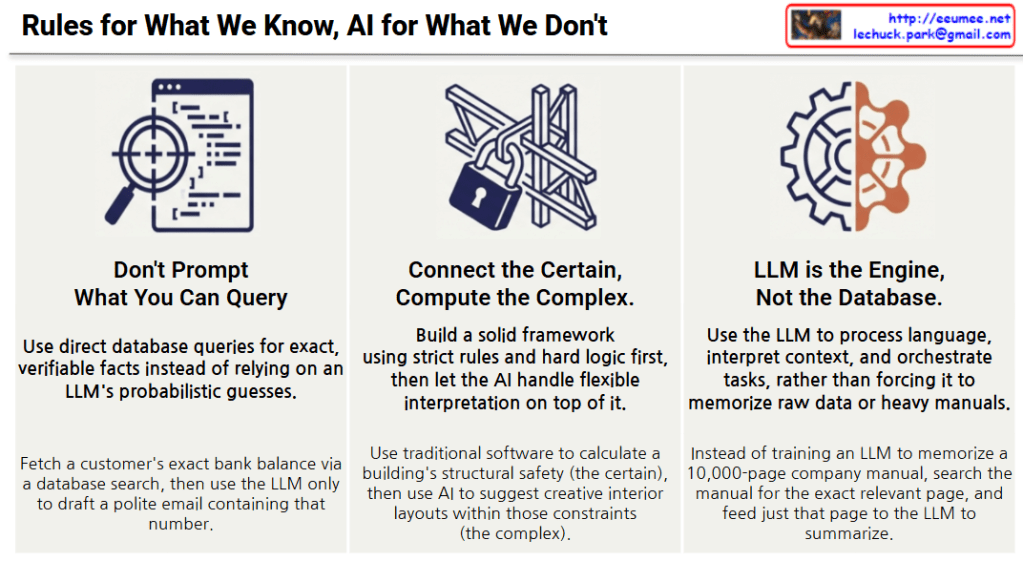
This image presents a practical guide on how to effectively integrate Artificial Intelligence, specifically Large Language Models (LLMs), into software systems. The overarching theme is “Rules for What We Know, AI for What We Don’t,” which emphasizes using reliable, traditional computing for hard facts and reserving AI for complex reasoning and interpretation.
1. Don’t Prompt What You Can Query
This principle warns against using AI to retrieve exact data. Because LLMs generate responses based on probabilities, they can sometimes guess incorrectly or hallucinate. If you need a verified fact—like a user’s bank balance—you should use a standard database search to fetch that exact number. Once you have the accurate data, you can then pass it to the AI to draft a natural, polite response.
2. Connect the Certain, Compute the Complex
This section suggests building a hybrid approach to problem-solving. You should establish a strict, rule-based foundation (the “certain”) using traditional logic, math, or physics. Once that solid framework is in place, you let the AI operate on top of it to handle creative or flexible tasks (the “complex”). For example, use traditional software to ensure a building is structurally safe, and then use AI to design creative interior layouts within those safe boundaries.
3. LLM is the Engine, Not the Database
This final point clarifies the true role of an LLM: it is a processor, not a storage drive. You shouldn’t try to force an AI to memorize massive amounts of raw data, like a 10,000-page company manual. Instead, use a search system to find the exact page you need, and then feed just that relevant text into the LLM. The AI acts as the “engine” to read, understand, and summarize that specific information for you.
Summary
To build reliable AI applications, rely on traditional databases and strict logic for factual retrieval and structural constraints. Use LLMs strictly as reasoning and processing engines to interpret context, draft text, and solve complex problems based on the hard facts you provide them.


 Lechuck Park