(OCP) Third Party Integration, Telemetry & APIs

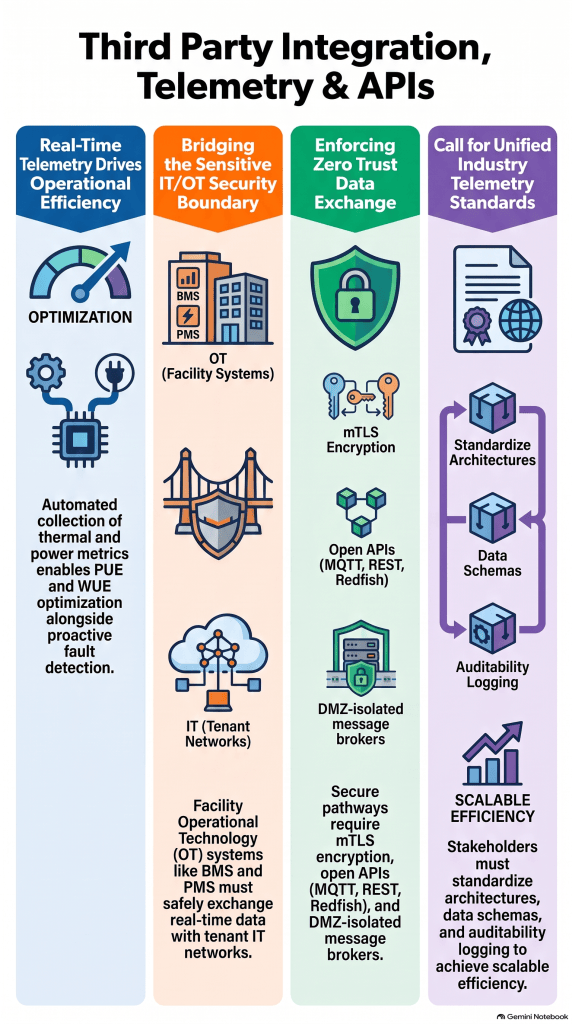
This infographic, titled “Third Party Integration, Telemetry & APIs,” outlines a four-pillar framework for establishing secure, efficient, and standardized real-time data integration between IT and OT systems in facility and data center environments.

https://www.opencompute.org/documents/third-party-integration-telemetry-apis-final-pdf/

Detailed Image Breakdown

  1. Real-Time Telemetry Drives Operational Efficiency
    • Visuals: Speedometer gauge labeled “OPTIMIZATION” and a microchip connected to a gear and power plug.
    • Description: Automated collection of thermal and power metrics enables optimization of PUE (Power Usage Effectiveness) and WUE (Water Usage Effectiveness), along with proactive fault detection.
  2. Bridging the Sensitive IT/OT Security Boundary
    • Visuals: OT facility buildings (BMS/PMS), a central bridge structure, and tenant IT cloud networks.
    • Description: Facility Operational Technology (OT) systems—such as BMS and PMS—must safely exchange real-time telemetry with tenant IT networks without compromising perimeter security.
  3. Enforcing Zero Trust Data Exchange
    • Visuals: A secure shield lock, mTLS encryption keys, Open API connectors, and DMZ-isolated server brokers.
    • Description: Secure communication channels require mutual TLS (mTLS) encryption, open standard APIs (MQTT, REST, Redfish), and DMZ-isolated message brokers.
  4. Call for Unified Industry Telemetry Standards
    • Visuals: Standardized documentation with a global seal, a continuous lifecycle loop (Standardize Architectures $\rightarrow$ Data Schemas $\rightarrow$ Auditability Logging), and an upward trend chart labeled “SCALABLE EFFICIENCY”.
    • Description: To achieve scalable efficiency, stakeholders across the industry must unify architectures, data schemas, and auditability logging standards.

Summary

Integrating real-time telemetry across the IT/OT divide is critical for optimizing facility resource efficiency (PUE/WUE). Doing so at scale requires implementing strict Zero Trust controls (mTLS, DMZ brokers, open APIs) alongside unified industry standards for data schemas, system architectures, and audit logging.

#DataCenter #Telemetry #ZeroTrust #OTSecurity #ITOTConvergence #BMS #PUE #OpenAPI #DataCenterInfrastructure #Cybersecurity #IndustrialIoT

With Gemini
Network for AI

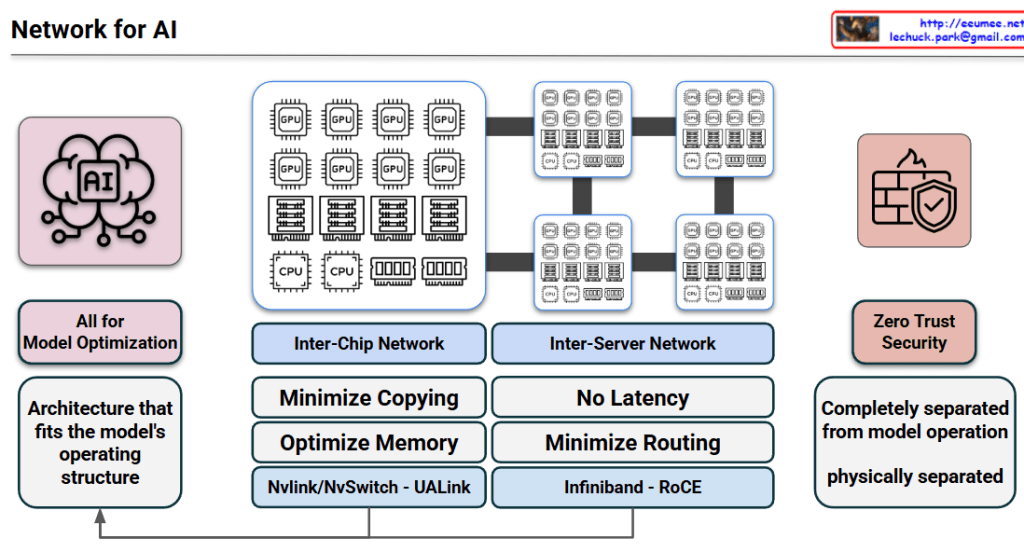
1. Core Philosophy: All for Model Optimization

The primary goal is to create an “Architecture that fits the model’s operating structure.” Unlike traditional general-purpose data centers, AI infrastructure is specialized to handle the massive data throughput and synchronized computations required by LLMs (Large Language Models).

2. Hierarchical Network Design

The architecture is divided into two critical layers to handle different levels of data exchange:

A. Inter-Chip Network (Scale-Up)

This layer focuses on the communication between individual GPUs/Accelerators within a single server or node.

  • Key Goals: Minimize data copying and optimize memory utilization (Shared Memory/Memory Pooling).
  • Technologies: * NVLink / NVSwitch: NVIDIA’s proprietary high-speed interconnect.
  • UALink (Ultra Accelerator Link): The new open standard designed for scale-up AI clusters.

B. Inter-Server Network (Scale-Out)

This layer connects multiple server nodes to form a massive AI cluster.

  • Key Goals: Achieve “No Latency” (Ultra-low latency) and minimize routing overhead to prevent bottlenecks during collective communications (e.g., All-Reduce).
  • Technologies: * InfiniBand: A lossless, high-bandwidth fabric preferred for its low CPU overhead.
  • RoCE (RDMA over Converged Ethernet): High-speed Ethernet that allows direct memory access between servers.

3. Zero Trust Security & Physical Separation

A unique aspect of this architecture is the treatment of security.

  • Operational Isolation: The security and management plane is completely separated from the model operation plane.
  • Performance Integrity: By being physically separated, security protocols (like firewalls or encryption inspection) do not introduce latency into the high-speed compute fabric where the model runs. This ensures that a “Zero Trust” posture does not degrade training or inference speed.

4. Architectural Feedback Loop

The arrow at the bottom indicates a feedback loop: the performance metrics and requirements of the inter-chip and inter-server networks directly inform the ongoing optimization of the overall architecture. This ensures the platform evolves alongside advancing AI model structures.


The architecture prioritizes model-centric optimization, ensuring infrastructure is purpose-built to match the specific operating requirements of large-scale AI workloads.

It employs a dual-tier network strategy using Inter-chip (NVLink/UALink) for memory efficiency and Inter-server (InfiniBand/RoCE) for ultra-low latency cluster scaling.

Zero Trust security is integrated through complete physical separation from the compute fabric, allowing for robust protection without causing any performance bottlenecks.

#AIDC #ArtificialIntelligence #GPU #Networking #NVLink #UALink #InfiniBand #RoCEv2 #ZeroTrust #DataCenterArchitecture #MachineLearningOps #ScaleOut