Data Center Shift with AI

Data Center Shift with AI

This diagram illustrates how data centers are transforming as they enter the AI era.

📅 Timeline of Technological Evolution

The top section shows major technology revolutions and their timelines:

  • Internet ’95 (Internet era)
  • Mobile ’07 (Mobile era)
  • Cloud ’10 (Cloud era)
  • Blockchain
  • AI(LLM) ’22 (Large Language Model-based AI era)

🏢 Traditional Data Center Components

Conventional data centers consisted of the following core components:

  • Software
  • Server
  • Network
  • Power
  • Cooling

These were designed as relatively independent layers.

🚀 New Requirements in the AI Era

With the introduction of AI (especially LLMs), data centers require specialized infrastructure:

  1. LLM Model – Operating large language models
  2. GPU – High-performance graphics processing units (essential for AI computations)
  3. High B/W – High-bandwidth networks (for processing large volumes of data)
  4. SMR/HVDC – Switched-Mode Rectifier/High-Voltage Direct Current power systems
  5. Liquid/CDU – Liquid cooling/Cooling Distribution Units (for cooling high-heat GPUs)

🔗 Key Characteristic of AI Data Centers: Integrated Design

The circular connection in the center of the diagram represents the most critical feature of AI data centers:

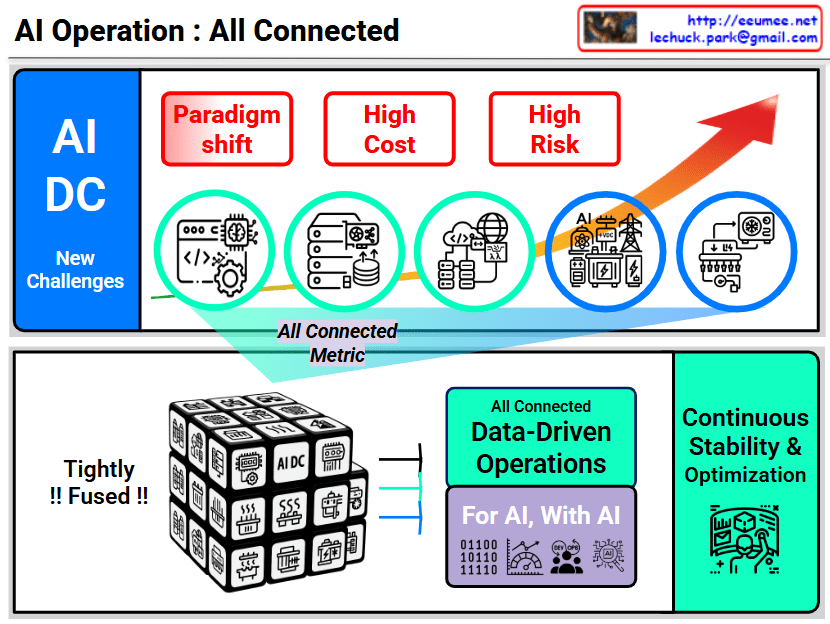
Tight Interdependency between SW/Computing/Network ↔ Power/Cooling

Unlike traditional data centers, in AI data centers:

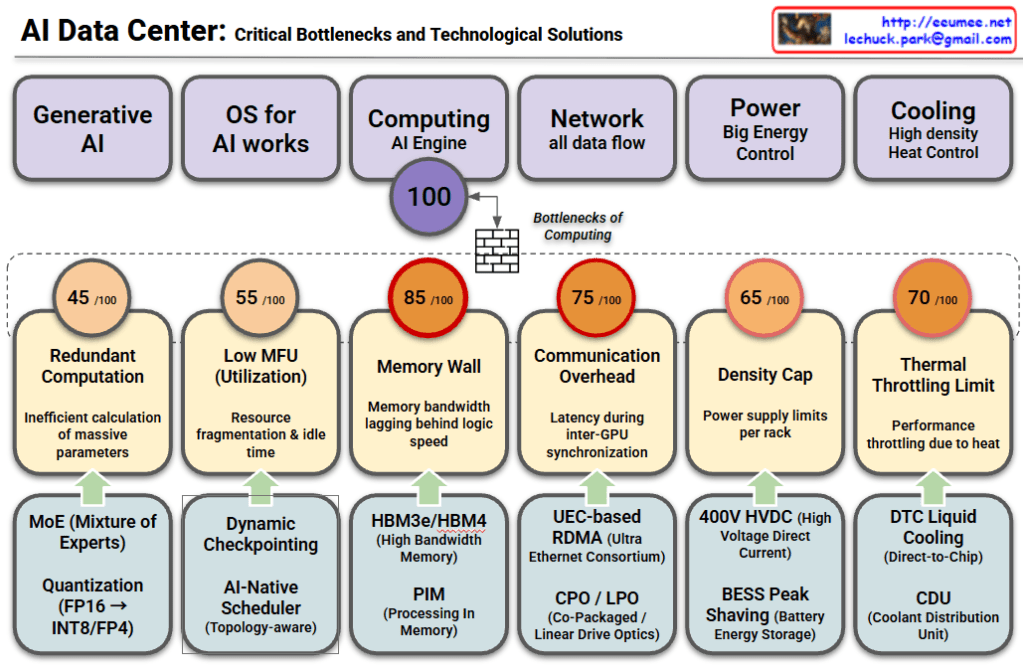
  • GPU-based computing consumes enormous power and generates significant heat
  • High B/W networks consume additional power during massive data transfers between GPUs
  • Power systems (SMR/HVDC) must stably supply high power density
  • Liquid cooling (Liquid/CDU) must handle high-density GPU heat in real-time

These elements must be closely integrated in design, and optimizing just one element cannot guarantee overall system performance.

💡 Key Message

AI workloads require moving beyond the traditional layer-by-layer independent design approach of conventional data centers, demanding that computing-network-power-cooling be designed as one integrated system. This demonstrates that a holistic approach is essential when building AI data centers.


📝 Summary

AI data centers fundamentally differ from traditional data centers through the tight integration of computing, networking, power, and cooling systems. GPU-based AI workloads create unprecedented power density and heat generation, requiring liquid cooling and HVDC power systems. Success in AI infrastructure demands holistic design where all components are co-optimized rather than independently engineered.

#AIDataCenter #DataCenterEvolution #GPUInfrastructure #LiquidCooling #AIComputing #LLM #DataCenterDesign #HighPerformanceComputing #AIInfrastructure #HVDC #HolisticDesign #CloudComputing #DataCenterCooling #AIWorkloads #FutureOfDataCenters

With Claude

New For AI

Analysis of “New For AI” Diagram

This image, titled “New For AI,” systematically organizes the essential components required for building AI systems.

Structure Overview

Top Section: Fundamental Technical Requirements for AI (Two Pillars)

Left Domain – Computing Axis (Turquoise)

  1. Massive Data
    • Processing vast amounts of data that form the foundation for AI training and operations
  2. Immense Computing
    • Powerful computational capacity to process data and run AI models

Right Domain – Infrastructure Axis (Light Blue)

3. Enormous Energy
Large-scale power supply to drive AI computing

  1. High-Density Cooling
    • Effective heat removal from high-performance computing operations

Central Link 🔗

Meaning of the Chain Link Icon:

  • For AI to achieve its performance, Computing (Data/Chips) and Infrastructure (Power/Cooling) don’t simply exist in parallel
  • They must be tightly integrated and optimized to work together
  • Symbolizes the interdependent relationship where strengthening only one side cannot unlock the full system’s potential

Bottom Section: Implementation Technologies (Stability & Optimization)

Learning & Inference/Reasoning (Learning and Inference Optimization)

Technologies to enhance AI model performance and efficiency:

  • Evals/Golden Set: Model evaluation and benchmarking
  • Safety Guardrails, RLHF-DPO: Safety assurance and human feedback-based learning
  • FlashAttention: Memory-efficient attention mechanism
  • Quant(INT8/FP8): Computational optimization through model quantization
  • Speculative/MTP Decoding: Inference speed enhancement techniques

Massive Parallel Computing (Large-Scale Parallel Computing)

Hardware and network technologies enabling massive computation:

  • GB200/GB300 NVL72: NVIDIA’s latest GPU systems
  • HBM: High Bandwidth Memory
  • InfiniBand, NVlink: Ultra-high-speed interconnect technologies
  • AI factory: AI-dedicated data centers
  • TPU, MI3xx, NPU, DPU: Various AI-specialized chips
  • PIM, CxL, UvLink: Memory-compute integration and next-gen interfaces
  • Silicon Photonics, UEC: Optical communication technologies

More Energy, Energy Efficiency (Energy Supply and Efficiency)

Technologies for stable and efficient power supply:

  • Smart Grid: Intelligent power grid
  • SMR: Small Modular Reactor (stable large-scale power source)
  • Renewable Energy: Renewable energy integration
  • ESS: Energy Storage System (power stabilization)
  • 800V HVDC: High-voltage direct current transmission (loss minimization)
  • Direct DC Supply: Direct DC supply (eliminating conversion losses)
  • Power Forecasting: AI-based power demand prediction and optimization

High Heat Exchange & PUE (Heat Exchange and Power Efficiency)

Securing cooling system efficiency and stability:

  • Liquid Cooling: Liquid cooling (higher efficiency than air cooling)
  • CDU: Coolant Distribution Unit
  • D2C: Direct-to-Chip cooling
  • Immersing: Immersion cooling (complete liquid immersion)
  • 100% Free Cooling: Utilizing external air (energy saving)
  • AI-Driven Cooling Optimization: AI-based cooling optimization
  • PUE Improvement: Power Usage Effectiveness (overall power efficiency metric)

Key Message

This diagram emphasizes that for successful AI implementation:

  1. Technical Foundation: Both Data/Chips (Computing) and Power/Cooling (Infrastructure) are necessary
  2. Tight Integration: These two axes are not separate but must be firmly connected like a chain and optimized simultaneously
  3. Implementation Technologies: Specific advanced technologies for stability and optimization in each domain must provide support

The central link particularly visualizes the interdependent relationship where “increasing computing power requires strengthening energy and cooling in tandem, and computing performance cannot be realized without infrastructure support.”


Summary

AI systems require two inseparable pillars: Computing (Data/Chips) and Infrastructure (Power/Cooling), which must be tightly integrated and optimized together like links in a chain. Each pillar is supported by advanced technologies spanning from AI model optimization (FlashAttention, Quantization) to next-gen hardware (GB200, TPU) and sustainable infrastructure (SMR, Liquid Cooling, AI-driven optimization). The key insight is that scaling AI performance demands simultaneous advancement across all layers—more computing power is meaningless without proportional energy supply and cooling capacity.


#AI #AIInfrastructure #AIComputing #DataCenter #AIChips #EnergyEfficiency #LiquidCooling #MachineLearning #AIOptimization #HighPerformanceComputing #HPC #GPUComputing #AIFactory #GreenAI #SustainableAI #AIHardware #DeepLearning #AIEnergy #DataCenterCooling #AITechnology #FutureOfAI #AIStack #MLOps #AIScale #ComputeInfrastructure

With Claude

Cooling for AI (heavy heater)

AI Data Center Cooling System Architecture Analysis

This diagram illustrates the evolution of data center cooling systems designed for high-heat AI workloads.

Traditional Cooling System (Top Section)

Three-Stage Cooling Process:

  1. Cooling Tower – Uses ambient air to cool water
  2. Chiller – Further refrigerates the cooled water
  3. CRAH (Computer Room Air Handler) – Distributes cold air to the server room

Free Cooling option is shown, which reduces chiller operation by leveraging low outside temperatures for energy savings.

New Approach for AI DC: Liquid Cooling System (Bottom Section)

To address extreme heat generation from high-density AI chips, a CDU (Coolant Distribution Unit) based liquid cooling system has been introduced.

Key Components:

① Coolant Circulation and Distribution

  • Direct coolant circulation system to servers

② Heat Exchanges (Two Methods)

  • Direct-to-Chip (D2C) Liquid Cooling: Cold plate with manifold distribution system directly contacting chips
  • Rear-Door Heat Exchanger (RDHx): Heat exchanger mounted on rack rear door (immersion cooling)

③ Pumping and Flow Control

  • Pumps and flow control for coolant circulation

④ Filtration and Coolant Quality Management

  • Maintains coolant quality and removes contaminants

⑤ Monitoring and Control

  • Real-time monitoring and cooling performance control

Critical Differences

Traditional Method: Air cooling → Indirect, suitable for low-density workloads

AI DC Method: Liquid cooling → Direct, high-efficiency, capable of handling high TDP (Thermal Design Power) of AI chips

Liquid has approximately 25x better heat transfer efficiency than air, making it effective for cooling AI accelerators (GPUs, TPUs) that generate hundreds of watts to kilowatt-level heat.


Summary:

  1. Traditional data centers use air-based cooling (Cooling Tower → Chiller → CRAH), suitable for standard workloads.
  2. AI data centers require liquid cooling with CDU systems due to extreme heat from high-density AI chips.
  3. Liquid cooling offers direct-to-chip heat removal with 25x better thermal efficiency than air, supporting kW-level heat dissipation.

#AIDataCenter #LiquidCooling #DataCenterInfrastructure #CDU #ThermalManagement #DirectToChip #AIInfrastructure #GreenDataCenter #HeatDissipation #HyperscaleComputing #AIWorkload #DataCenterCooling #ImmersionCooling #EnergyEfficiency #NextGenDataCenter

With Claude

Power/Cooling impacts to AI Work

Power/Cooling Impacts on AI Work – Analysis

This slide summarizes research findings on how AI workloads impact power grids and cooling systems.

Key Findings:

📊 Reliability & Failure Studies

  • Large-Scale ML Cluster Reliability (Meta, 2024/25)
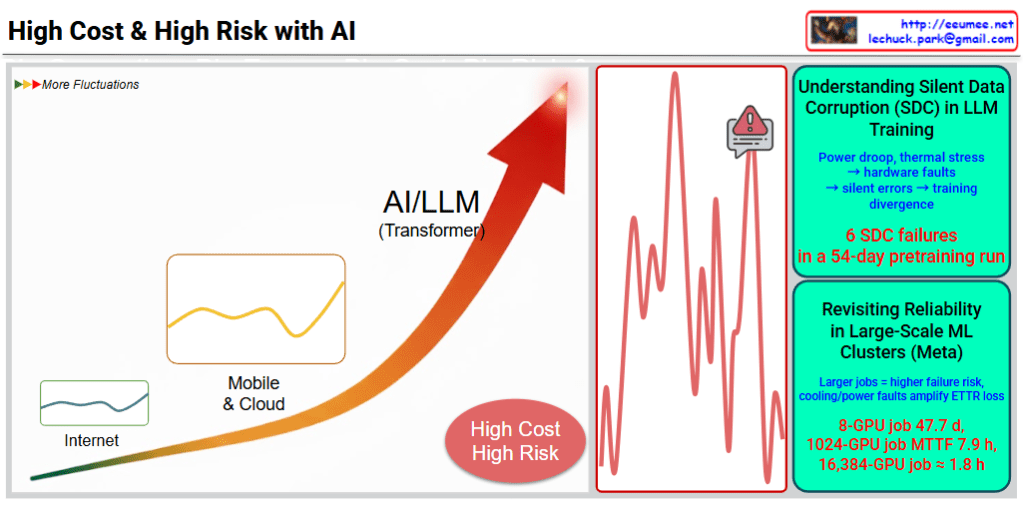
    • 1024-GPU job MTTF (Mean Time To Failure): 7.9 hours
    • 8-GPU job: 47.7 days
    • 16,384-GPU job: 1.8 hours
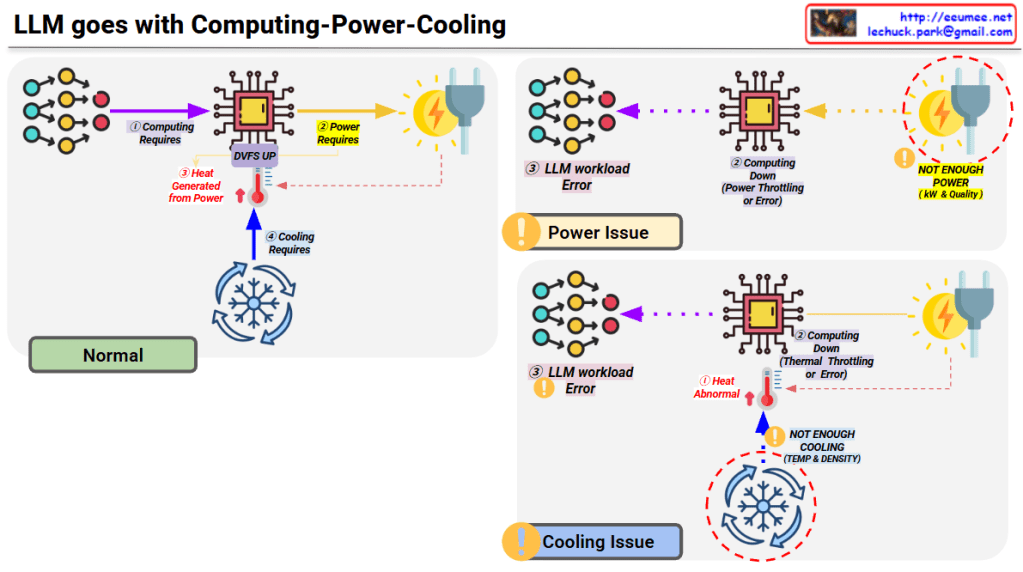
    • → Larger jobs = higher failure risk due to cooling/power faults amplifying errors

🔌 Silent Data Corruption (SDC)

  • SDC in LLM Training (2025)
    • Meta report: 6 SDC failures in 54-day pretraining run
    • Power droop, thermal stress → hardware faults → silent errors → training divergence

Inference Energy Efficiency

  • LLM Inference Energy Consumption (2025)
    • GPT-4o query benchmarks:
      • Short: 0.43 Wh
      • Medium: ~3.71 Wh
    • Batch 4→8: ~43% savings
    • Batch 8→16: ~43% savings per prompt
    • → PUE & infrastructure efficiency significantly impact inference cost, delay, and carbon footprint

🏭 Grid-Level Instability

  • AI-Induced Power Grid Disruptions (2024)
    • Model training causes power transients
    • Dropouts → hardware resets
    • Grid-level instability → node-level errors (SDC, restarts) → LLM job failures

🎯 Summary:

  1. Large-scale AI workloads face exponentially higher failure rates – bigger jobs are increasingly vulnerable to power/cooling system issues, with 16K-GPU jobs failing every 1.8 hours.
  2. Silent data corruption from thermal/power stress causes undetected training failures, while inference efficiency can be dramatically improved through batch optimization (43% energy reduction).
  3. AI training creates a vicious cycle of grid instability – power transients trigger hardware faults that cascade into training failures, requiring robust infrastructure design for power stability and fault tolerance.

#AIInfrastructure #MLOps #DataCenterEfficiency #PowerManagement #AIReliability #LLMTraining #SilentDataCorruption #EnergyEfficiency #GridStability #AIatScale #HPC #CoolingSystem #AIFailures #SustainableAI #InferenceOptimization

With Claude

Power for AI

AI Data Center Power Infrastructure: 3 Key Transformations

Traditional Data Center Power Structure (Baseline)

Power Grid → Transformer → UPS → Server (220V AC)

  • Single power grid connection
  • Standard UPS backup (10-15 minutes)
  • AC power distribution
  • 200-300W per server

3 Critical Changes for AI Data Centers

🔴 1. More Power (Massive Power Supply)

Key Changes:

  • Diversified power sources:
    • SMR (Small Modular Reactor) – Stable baseload power
    • Renewable energy integration
    • Natural gas turbines
    • Long-term backup generators + large fuel tanks

Why: AI chips (GPU/TPU) consume kW to tens of kW per server

  • Traditional server: 200-300W
  • AI server: 5-10 kW (25-50x increase)
  • Total data center power demand: Hundreds of MW scale

🔴 2. Stable Power (Power Quality & Conditioning)

Key Changes:

  • 800V HVDC system – High-voltage DC transmission
  • ESS (Energy Storage System) – Large-scale battery storage
  • Peak Shaving – Peak load control and leveling
  • UPS + Battery/Flywheel – Instantaneous outage protection
  • Power conditioning equipment – Voltage/frequency stabilization

Why: AI workload characteristics

  • Instantaneous power surges (during inference/training startup)
  • High power density (30-100 kW per rack)
  • Power fluctuation sensitivity – Training interruption = days of work lost
  • 24/7 uptime requirements

🔴 3. Server Power (High-Efficiency Direct DC Delivery)

Key Changes:

  • Direct-to-Chip DC power delivery
  • Rack-level battery systems (Lithium/Supercapacitor)
  • High-density power distribution

Why: Maximize efficiency

  • Eliminate AC→DC conversion losses (5-15% efficiency gain)
  • Direct chip-level power supply – Minimize conversion stages
  • Ultra-high rack density support (100+ kW/rack)
  • Even minor voltage fluctuations are critical – Chip-level stabilization needed

Key Differences Summary

CategoryTraditional DCAI Data Center
Power ScaleFew MWHundreds of MW
Rack Density5-10 kW/rack30-100+ kW/rack
Power MethodAC-centricHVDC + Direct DC
Backup PowerUPS (10-15 min)Multi-tier (Generator+ESS+UPS)
Power StabilityStandardExtremely high reliability
Energy SourcesSingle gridMultiple sources (Nuclear+Renewable)

Summary

AI data centers require 25-50x more power per server, demanding massive power infrastructure with diversified sources including SMRs and renewables

Extreme workload stability needs drive multi-tier backup systems (ESS+UPS+Generator) and advanced power conditioning with 800V HVDC

Direct-to-chip DC power delivery eliminates conversion losses, achieving 5-15% efficiency gains critical for 100+ kW/rack densities

#AIDataCenter #DataCenterPower #HVDC #DirectDC #EnergyStorageSystem #PeakShaving #SMR #PowerInfrastructure #HighDensityComputing #GPUPower #DataCenterDesign #EnergyEfficiency #UPS #BackupPower #AIInfrastructure #HyperscaleDataCenter #PowerConditioning #DCPower #GreenDataCenter #FutureOfComputing

With Claude

AI goes exponentially with ..

This infographic illustrates how AI’s exponential growth triggers a cascading exponential expansion across all interconnected domains.

Core Concept: Exponential Chain Reaction

Top Process Chain: AI’s exponential growth creates proportionally exponential demands at each stage:

  • AI (LLM)DataComputingPowerCooling

The “≈” symbol indicates that each element grows exponentially in proportion to the others. When AI doubles, the required data, computing, power, and cooling all scale proportionally.

Evidence of Exponential Growth Across Domains

1. AI Networking & Global Data Generation (Top Left)

  • Exponential increase beginning in the 2010s
  • Vertical surge post-2020

2. Data Center Electricity Demand (Center Left)

  • Sharp increase projected between 2026-2030
  • Orange (AI workloads) overwhelms blue (traditional workloads)
  • AI is the primary driver of total power demand growth

3. Power Production Capacity (Center Right)

  • 2005-2030 trends across various energy sources
  • Power generation must scale alongside AI demand

4. AI Computing Usage (Right)

  • Most dramatic exponential growth
  • Modern AI era begins in 2012
  • Doubling every 6 months (extremely rapid exponential growth)
  • Over 300,000x increase since 2012
  • Three exponential growth phases shown (1e+0, 1e+2, 1e+4, 1e+6)

Key Message

This infographic demonstrates that AI development is not an isolated phenomenon but triggers exponential evolution across the entire ecosystem:

  • As AI models advance → Data requirements grow exponentially
  • As data increases → Computing power needs scale exponentially
  • As computing expands → Power consumption rises exponentially
  • As power consumption grows → Cooling systems must expand exponentially

All elements are tightly interconnected, creating a ‘cascading exponential effect’ where exponential growth in one domain simultaneously triggers exponential development and demand across all other domains.


#ArtificialIntelligence #ExponentialGrowth #AIInfrastructure #DataCenters #ComputingPower #EnergyDemand #TechScaling #AIRevolution #DigitalTransformation #Sustainability #TechInfrastructure #MachineLearning #LLM #DataScience #FutureOfAI #TechTrends #TechnologyEvolution

With Claude

AI Stabilization & Optimization

This diagram illustrates the AI Stabilization & Optimization framework addressing the reality where AI’s explosive development encounters critical physical and technological barriers.

Core Concept: Explosive Change Meets Reality Walls

The AI → Explosion → Wall (Limit) pathway shows how rapid AI advancement inevitably hits real-world constraints, requiring immediate strategic responses.

Four Critical Walls (Real-World Limitations)

  • Data Wall: Training data depletion
  • Computing Wall: Processing power and memory constraints
  • Power Wall: Energy consumption explosion (highlighted in red)
  • Cooling Wall: Thermal management limits

Dual Response Strategy

Stabilization – Managing Change

Stable management of rapid changes:

  • LM SW: Fine-tuning, RAG, Guardrails for system stability
  • Computing: Heterogeneous, efficient, modular architecture
  • Power: UPS, dual path, renewable mix for power stability
  • Cooling: CRAC control, monitoring for thermal stability

Optimization – Breaking Through/Approaching Walls

Breaking limits or maximizing utilization:

  • LM SW: MoE, lightweight solutions for efficiency maximization
  • Computing: Near-memory, neuromorphic, quantum for breakthrough
  • Power: AI forecasting, demand response for power optimization
  • Cooling: Immersion cooling, heat reuse for thermal innovation

Summary

This framework demonstrates that AI’s explosive innovation requires a dual strategy: stabilization to manage rapid changes and optimization to overcome physical limits, both happening simultaneously in response to real-world constraints.

#AIOptimization #AIStabilization #ComputingLimits #PowerWall #AIInfrastructure #TechBottlenecks #AIScaling #DataCenterEvolution #QuantumComputing #GreenAI #AIHardware #ThermalManagement #EnergyEfficiency #AIGovernance #TechInnovation

With Claude