Modular Data Center

Modular Data Center Architecture Analysis

This image illustrates a comprehensive Modular Data Center architecture designed specifically for modern AI/ML workloads, showcasing integrated systems and their key capabilities.

Core Components

1. Management Layer

  • Integrated Visibility: DCIM & Digital Twin for real-time monitoring
  • Autonomous Operations: AI-Driven Analytics (AIOps) for predictive maintenance
  • Physical Security: Biometric Access Control for enhanced protection

2. Computing Infrastructure

  • High Density AI Accelerators: GPU/NPU optimized for AI workloads
  • Scalability: OCP (Open Compute Project) Racks for standardized deployment
  • Standardization: High-Speed Interconnects (InfiniBand) for low-latency communication

3. Power Systems

  • Power Continuity: Modular UPS with Li-ion Battery for reliable uptime
  • Distribution Efficiency: Smart Busway/Busduct for optimized power delivery
  • Space Optimization: High-Voltage DC (HVDC) for reduced footprint

4. Cooling Solutions

  • Hot Spot Elimination: In-Row/Rear Door Cooling for targeted heat removal
  • PUE Optimization: Liquid/Immersion Cooling for maximum efficiency
  • High Heat Flux Handling: Containment Systems (Hot/Cold Aisle) for AI density

5. Safety & Environmental

  • Early Detection: VESDA (Very Early Smoke Detection Apparatus)
  • Non-Destructive Suppression: Clean Agents (Novec 1230/FM-200)
  • Environmental Monitoring: Leak Detection System (LDS)

Why Modular DC is Critical for AI Data Centers

Speed & Agility

Traditional data centers take 18-24 months to build, but AI demands are exploding NOW. Modular DCs deploy in 3-6 months, allowing organizations to capture market opportunities and respond to rapidly evolving AI compute requirements without lengthy construction cycles.

AI-Specific Thermal Challenges

AI workloads generate 3-5x more heat per rack (30-100kW) compared to traditional servers (5-10kW). Modular designs integrate advanced liquid cooling and containment systems from day one, purpose-built to handle GPU/NPU thermal density that would overwhelm conventional infrastructure.

Elastic Scalability

AI projects often start experimental but can scale exponentially. The “pay-as-you-grow” model lets organizations deploy one block initially, then add capacity incrementally as models grow—avoiding massive upfront capital while maintaining consistent architecture and avoiding stranded capacity.

Edge AI Deployment

AI inference increasingly happens at the edge for latency-sensitive applications (autonomous vehicles, smart manufacturing). Modular DCs’ compact, self-contained design enables AI deployment anywhere—from remote locations to urban centers—with full data center capabilities in a standardized package.

Operational Efficiency

AI workloads demand maximum PUE efficiency to manage operational costs. Modular DCs achieve PUE of 1.1-1.3 through integrated cooling optimization, HVDC power distribution, and AI-driven management—versus 1.5-2.0 in traditional facilities—critical when GPU clusters consume megawatts.

Key Advantages

📦 “All pack to one Block” – Complete infrastructure in pre-integrated modules 🧩 “Scale out with more blocks” – Linear, predictable expansion without redesign

  • ⏱️ Time-to-Market: 4-6x faster deployment vs traditional builds
  • 💰 Pay-as-you-Grow: CapEx aligned with revenue/demand curves
  • 🌍 Anywhere & Edge: Containerized deployment for any location

Summary

Modular Data Centers are essential for AI infrastructure because they deliver pre-integrated, high-density compute, power, and cooling blocks that deploy 4-6x faster than traditional builds, enabling organizations to rapidly scale GPU clusters from prototype to production while maintaining optimal PUE efficiency and avoiding massive upfront capital investment in uncertain AI workload trajectories.

The modular approach specifically addresses AI’s unique challenges: extreme thermal density (30-100kW/rack), explosive demand growth, edge deployment requirements, and the need for liquid cooling integration—all packaged in standardized blocks that can be deployed anywhere in months rather than years.

This architecture transforms data center infrastructure from a multi-year construction project into an agile, scalable platform that matches the speed of AI innovation, allowing organizations to compete in the AI economy without betting the company on fixed infrastructure that may be obsolete before completion.


#ModularDataCenter #AIInfrastructure #DataCenterDesign #EdgeComputing #LiquidCooling #GPUComputing #HyperscaleAI #DataCenterModernization #AIWorkloads #GreenDataCenter #DCInfrastructure #SmartDataCenter #PUEOptimization #AIops #DigitalTwin #EdgeAI #DataCenterInnovation #CloudInfrastructure #EnterpriseAI #SustainableTech

With Claude

AI Data Center: Critical Bottlenecks and Technological Solutions


AI Data Center: Critical Bottlenecks and Technological Solutions

This chart analyzes the major challenges facing modern AI Data Centers across six key domains. It outlines the [Domain] → [Bottleneck/Problem] → [Solution] flow, indicating the severity of each bottleneck with a score out of 100.

1. Generative AI

  • Bottleneck (45/100): Redundant Computation
    • Inefficiencies occur when calculating massive parameters for large models.
  • Solutions:
    • MoE (Mixture of Experts): Uses only relevant sub-models (experts) for specific tasks to reduce computation.
    • Quantization (FP16 → INT8/FP4): Reduces data precision to speed up processing and save memory.

2. OS for AI Works

  • Bottleneck (55/100): Low MFU (Model Flops Utilization)
    • Issues with resource fragmentation and idle time result in underutilization of hardware.
  • Solutions:
    • Dynamic Checkpointing: Efficiently saves model states during training.
    • AI-Native Scheduler: Optimizes task distribution based on network topology.

3. Computing / AI Engine (Most Critical)

  • Bottleneck (85/100): Memory Wall
    • Marked as the most severe bottleneck, where memory bandwidth cannot keep up with the speed of logic processors.
  • Solutions:
    • HBM3e/HBM4: Next-generation High Bandwidth Memory.
    • PIM (Processing In Memory): Performs calculations directly within memory to reduce data movement.

4. Network

  • Bottleneck (75/100): Communication Overhead
    • Latency issues arise during synchronization between multiple GPUs.
  • Solutions:
    • UEC-based RDMA: Ultra Ethernet Consortium standards for faster direct memory access.
    • CPO / LPO: Advanced optics (Co-Packaged/Linear Drive) to improve data transmission efficiency.

5. Power

  • Bottleneck (65/100): Density Cap
    • Physical limits on how much power can be supplied per server rack.
  • Solutions:
    • 400V HVDC: High Voltage Direct Current for efficient power delivery.
    • BESS Peak Shaving: Using Battery Energy Storage Systems to manage peak power loads.

6. Cooling

  • Bottleneck (70/100): Thermal Throttling Limit
    • Performance drops (throttling) caused by excessive heat in high-density racks.
  • Solutions:
    • DTC Liquid Cooling: Direct-to-Chip liquid cooling technologies.
    • CDU: Coolant Distribution Units for effective heat management.

Summary

  1. The “Memory Wall” (85/100) is identified as the most critical bottleneck in AI Data Centers, meaning memory bandwidth is the primary constraint on performance.
  2. To overcome these limits, the industry is adopting advanced hardware like HBM and Liquid Cooling, alongside software optimizations like MoE and Quantization.
  3. Scaling AI infrastructure requires a holistic approach that addresses computing, networking, power efficiency, and thermal management simultaneously.

#AIDataCenter #ArtificialIntelligence #MemoryWall #HBM #LiquidCooling #GenerativeAI #TechTrends #AIInfrastructure #Semiconductor #CloudComputing

With Gemini

LLM goes with Computing-Power-Cooling

LLM’s Computing-Power-Cooling Relationship

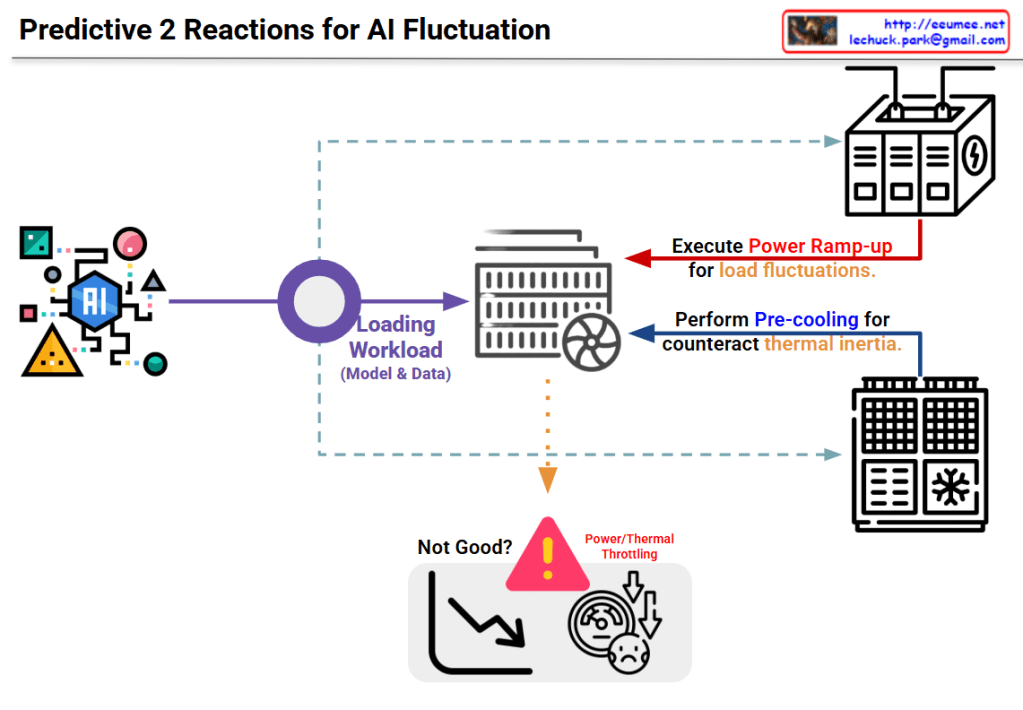
This diagram illustrates the technical architecture and potential issues that can occur when operating LLMs (Large Language Models).

Normal Operation (Top Left)

  1. Computing Requires – LLM workload is delivered to the processor
  2. Power Requires – Power supplied via DVFS (Dynamic Voltage and Frequency Scaling)
  3. Heat Generated – Heat is produced during computing processes
  4. Cooling Requires – Temperature management through proper cooling systems

Problem Scenarios

Power Issue (Top Right)

  • Symptom: Insufficient power (kW & Quality)
  • Results:
    • Computing performance degradation
    • Power throttling or errors
    • LLM workload errors

Cooling Issue (Bottom Right)

  • Symptom: Insufficient cooling (Temperature & Density)
  • Results:
    • Abnormal heat generation
    • Thermal throttling or errors
    • Computing performance degradation
    • LLM workload errors

Key Message

For stable LLM operations, the three elements of Computing-Power-Cooling must be balanced. If any one element is insufficient, it leads to system-wide performance degradation or errors. This emphasizes that AI infrastructure design must consider not only computing power but also adequate power supply and cooling systems together.


Summary

  • LLM operation requires a critical balance between computing, power supply, and cooling infrastructure.
  • Insufficient power causes power throttling, while inadequate cooling leads to thermal throttling, both resulting in workload errors.
  • Successful AI infrastructure design must holistically address all three components rather than focusing solely on computational capacity.

#LLM #AIInfrastructure #DataCenter #ThermalManagement #PowerManagement #AIOperations #MachineLearning #HPC #DataCenterCooling #AIHardware #ComputeOptimization #MLOps #TechInfrastructure #AIatScale #GreenAI

WIth Claude

AI Operation : All Connected

AI Operation: All Connected – Image Analysis

This diagram explains the operational paradigm shift in AI Data Centers (AI DC).

Top Section: New Challenges

AI DC Characteristics:

  • Paradigm shift: Fundamental change in operations for the AI era
  • High Cost: Massive investment required for GPUs, infrastructure, etc.
  • High Risk: Greater impact during outages and increased complexity

Five Core Components of AI DC (left→right):

  1. Software: AI models, application development
  2. Computing: GPUs, servers, and computational resources
  3. Network: Data transmission and communication infrastructure
  4. Power: High-density power supply and management (highlighted in orange)
  5. Cooling: Heat management and cooling systems

→ These five elements are interconnected through the “All Connected Metric”

Bottom Section: Integrated Operations Solution

Core Concept:

📦 Tightly Fused Rubik’s Cube

  • The five core components (Software, Computing, Network, Power, Cooling) are intricately intertwined like a Rubik’s cube
  • Changes or issues in one element affect all other elements due to tight coupling

🎯 All Connected Data-Driven Operations

  • Data-driven integrated operations: Collecting and analyzing data from all connected elements
  • “For AI, With AI”: Operating the data center itself using AI technology for AI workloads

Continuous Stability & Optimization

  • Ensuring continuous stability
  • Real-time monitoring and optimization

Key Message

AI data centers have five core components—Software, Computing, Network, Power, and Cooling—that are tightly fused together. To effectively manage this complex system, a data-centric approach that integrates and analyzes data from all components is essential, enabling continuous stability and optimization.


Summary

AI data centers are characterized by tightly coupled components (software, computing, network, power, cooling) that create high complexity, cost, and risk. This interconnected system requires data-driven operations that leverage AI to monitor and optimize all elements simultaneously. The goal is achieving continuous stability and optimization through integrated, real-time management of all connected metrics.

#AIDataCenter #DataDrivenOps #AIInfrastructure #DataCenterOptimization #TightlyFused #AIOperations #HybridInfrastructure #IntelligentOps #AIforAI #DataCenterManagement #MLOps #AIOps #PowerManagement #CoolingOptimization #NetworkInfrastructure

High Cost & High Risk with AI

This image illustrates the high cost and high risk of AI/LLM (Large Language Model) training.

Key Analysis

Left: AI/LLM Growth Path

  • Evolution from Internet → Mobile & Cloud → AI/LLM (Transformer)
  • Each stage shows increasing fluctuations in the graph
  • Emphasizes “High Cost, High Risk” message

Center: Real Problem Visualization

The red graph shows dramatic performance spikes that occurred during actual training processes.

Top Right: Silent Data Corruption (SDC) Issues

Silent data corruption from hardware failures:

  • Power drops, thermal stress → hardware faults
  • Silent errors → training divergence
  • 6 SDC failures in a 54-day pretraining run

Bottom Right: Reliability Issues in Large-Scale ML Clusters (Meta Case)

Real failure cases:

  • 8-GPU job: average 47.7 days
  • 1024-GPU job: MTTF (Mean Time To Failure) 7.9 hours
  • 16,384-GPU job: failure in approximately 1.8 hours

Summary

  1. As GPU scale increases, failure probability rises exponentially, making large-scale AI training extremely costly and technically risky.
  2. Hardware-induced silent data corruption causes training divergence, with 6 failures recorded in just 54 days of pretraining.
  3. Meta’s experience shows massive GPU clusters can fail in under 2 hours, highlighting infrastructure reliability as a critical challenge.

#AITraining #LLM #MachineLearning #DataCorruption #GPUCluster #MLOps #AIInfrastructure #HardwareReliability #TransformerModels #HighPerformanceComputing #AIRisk #MLEngineering #DeepLearning

Large Scale Network Driven Design ( Deepseek V3)

Deepseek v3 Large-Scale Network Architecture Analysis

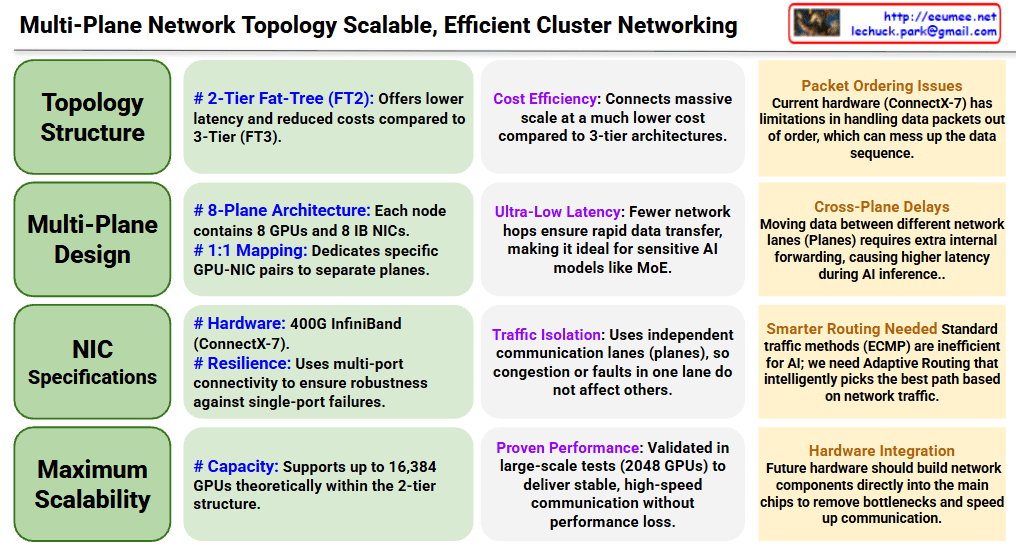
This image explains the Multi-Plane Fat-Tree network structure of Deepseek v3.

Core Architecture

1. 8-Plane Architecture

  • Consists of eight independent network channels (highways)
  • Maximizes network bandwidth and distributes traffic for enhanced scalability

2. Fat-Tree Topology

  • Two-layer switch structure:
    • Leaf SW (Leaf Switches): Directly connected to GPUs
    • Spine SW (Spine Switches): Interconnect leaf switches
  • Enables high-speed communication among all nodes (GPUs) while minimizing switch contention

3. GPU/IB NIC Pair

  • Each GPU is paired with a dedicated Network Interface Card (NIC)
  • Each pair is exclusively assigned to one of the eight planes to initiate communication

Communication Methods

NVLink

  • Ultra-high-speed connection between GPUs within the same node
  • Fast data transfer path used for intra-node communication

Cross-plane Traffic

  • Occurs when communication happens between different planes
  • Requires intra-node forwarding through another NIC, PCIe, or NVLink
  • Primary factor that increases latency

Network Optimization Process

The workflow below minimizes latency and prevents network congestion:

  1. Workload Analysis
  2. All to All (analyzing all-to-all communication patterns)
  3. Plane & Layer Set (plane and layer assignment)
  4. Profiling (Hot-path opt K) (hot-path optimization)
  5. Static Routing (Hybrid) (hybrid static routing approach)

Goal: Low latency & no jamming

Scalability

This design is a scale-out network for large-scale distributed training supporting 16,384+ GPUs. Each plane operates independently to maximize overall system throughput.


3-Line Summary

Deepseek v3 uses an 8-plane fat-tree network architecture that connects 16,384+ GPUs through independent communication channels, minimizing contention and maximizing bandwidth. The two-layer switch topology (Spine and Leaf) combined with dedicated GPU-NIC pairs enables efficient traffic distribution across planes. Cross-plane traffic management and hot-path optimization ensure low-latency, high-throughput communication for large-scale AI training.

#DeepseekV3 #FatTreeNetwork #MultiPlane #NetworkArchitecture #ScaleOut #DistributedTraining #AIInfrastructure #GPUCluster #HighPerformanceComputing #NVLink #DataCenterNetworking #LargeScaleAI

With Claude

Optimize LLM

LLM Optimization: Integration of Traditional Methods and New Paradigms

Core Message

LLM (Transformer) optimization requires more than just traditional optimization methodologies – new perspectives must be added.


1. Traditional Optimization Methodology (Left Side)

SW (Software) Optimization

  • Data Optimization
    • Structure: Data structure design
    • Copy: Data movement optimization
  • Logics Optimization
    • Algorithm: Efficient algorithm selection
    • Profiling: Performance analysis and bottleneck identification

Characteristics: Deterministic, logical approach

HW (Hardware) Optimization

  • Functions & Speed (B/W): Function and speed/bandwidth optimization
  • Fit For HW: Optimization for existing hardware
  • New HW implementation: New hardware design and implementation

Characteristics: Physical performance improvement focus


2. New Perspectives Required for LLM (Right Side)

SW Aspect: Human-Centric Probabilistic Approach

  • Human Language View / Human’s View
    • Human language understanding methods
    • Human thinking perspective
  • Human Learning
    • Mimicking human learning processes

Key Point: Statistical and Probabilistic Methodology

  • Different from traditional deterministic optimization
  • Language patterns, probability distributions, and context understanding are crucial

HW Aspect: Massive Parallel Processing

  • Massive Simple Parallel
    • Parallel processing of large-scale simple computations
    • Hardware architecture capable of parallel processing (GPU/TPU) is essential

Key Point: Efficient parallel processing of large-scale matrix operations


3. Integrated Perspective

LLM Optimization = Traditional Optimization + New Paradigm

DomainTraditional MethodLLM Additional Elements
SWAlgorithm, data structure optimization+ Probabilistic/statistical approach (human language/learning perspective)
HWFunction/speed optimization+ Massive parallel processing architecture

Conclusion

For effective LLM optimization:

  1. Traditional optimization techniques (data, algorithms, hardware) as foundation
  2. Probabilistic approach reflecting human language and learning methods
  3. Hardware perspective supporting massive parallel processing

These three elements must be organically combined – this is the core message of the diagram.


Summary

LLM optimization requires integrating traditional deterministic SW/HW optimization with new paradigms: probabilistic/statistical approaches that mirror human language understanding and learning, plus hardware architectures designed for massive parallel processing. This represents a fundamental shift from conventional optimization, where human-centric probabilistic thinking and large-scale parallelism are not optional but essential dimensions.


#LLMOptimization #TransformerArchitecture #MachineLearningOptimization #ParallelProcessing #ProbabilisticAI #HumanLanguageView #GPUComputing #DeepLearningHardware #StatisticalML #AIInfrastructure #ModelOptimization #ScalableAI #NeuralNetworkOptimization #AIPerformance #ComputationalEfficiency