New Power(s) in AI DC

Overview: New Power Architecture in AI DC

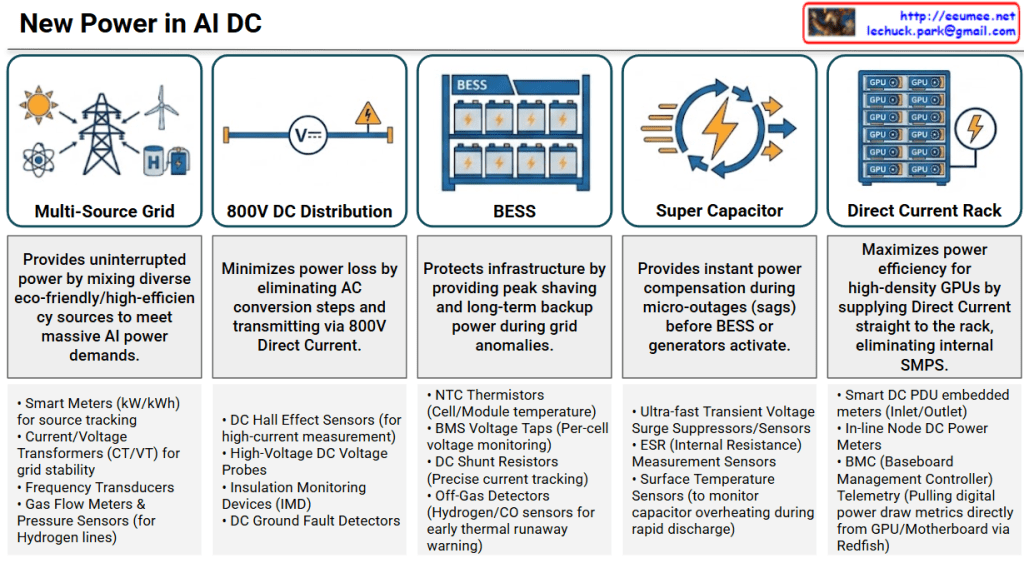
This infographic outlines a multi-layered, hybrid power infrastructure designed to meet the colossal, dynamic power demands of modern AI factories. The system progresses from varied facility-level power sources down to logic-level components, integrated into a unified direct-current environment. The primary objectives are to minimize conversion losses, ensure uninterrupted operation, and provide granular, digital telemetry for proactive management.

The Five Stages of Power Flow

1. Multi-Source Grid (Grid Receiving)

  • Icon: A convergence of diverse sources, including power transmission towers (Grid), solar, wind turbines, atom/SMR, and hydrogen lines.
  • Role: Provides uninterrupted mixed power from green and high-efficiency sources to meet massive AI power demands.
  • Key Metrics: Supply volume/dependency per source (Grid vs. Microgrid), grid frequency and voltage stability, SMR/Hydrogen fuel status, and facility-level carbon footprint (PUE/CUE).

2. 800V DC Distribution (Direct Current Busbar)

  • Icon: A straight high-voltage DC busbar with the “V—” DC symbol and a high-voltage warning indicator.
  • Role: Minimizes power conversion loss by eliminating several AC conversion steps and transmitting power at 800V High-Voltage Direct Current (HVDC).
  • Key Metrics: Main Busbar DC voltage/current, voltage drop and line loss rate, and insulation resistance/ground fault detection.

3. BESS (Battery Energy Storage System) (Modular Storage Racks)

  • Icon: Multiple modular industrial battery storage racks.
  • Role: Protects infrastructure via peak shaving (reducing peak grid load) and provides long-term backup power during grid anomalies or outages.
  • Key Metrics: State of Charge (SoC) & State of Health (SoH), cell/module-level temperature and thermal runaway detection, real-time C-rate, and available capacity.

4. Super Capacitor (Ultra-short Power Compensation) (Rapid Compensation Loop)

  • Icon: A dynamic lightning bolt with rapid response arrows in a circular flow.
  • Role: Provides instant power compensation during micro-outages (voltage sags/sags) to bridge the millisecond gap before BESS or generators can activate.
  • Key Metrics: Voltage sag detection response time (ms), ride-through time, equivalent series resistance (ESR), and cycle life.

5. Direct Current Rack (DC-Powered GPU Rack) (DC Rack Inlet)

  • Icon: A high-density server rack populated with GPU nodes. A distinct DC power input is connected, and the rack does not require a bulky internal AC/DC power supply unit.
  • Role: Maximizes power efficiency for high-density GPUs by supplying direct current straight to the rack, completely eliminating the internal SMPS conversion stage.
  • Key Metrics: Total rack power consumption (kW), DC PDU voltage/current and top/bottom balance, and GPU node-level power draw.

Summary

This infographic describes a multi-layered hybrid power architecture designed for AI data centers. The architecture progresses from a diverse array of power sources—including a 1. Multi-Source Grid (renewable, hydrogen, SMR)—through to a central 2. 800V DC Distribution busbar, all integrated into a unified hybrid direct-current environment. The system balances hybrid loads by combining the immediate, millisecond response of the 4. Super Capacitor (ride-through) with the long-term backup and peak-shaving capabilities of the 3. BESS (modular battery storage). This facility-level infrastructure ultimately provides direct, conversion-free power to the 5. Direct Current Rack (DC-powered GPU rack). A critical innovation of this architecture is the facility-to-IT handshake, where digital telemetry (PDU, node meters, Redfish telemetry from GPUs) enables granular Root Cause Analysis (RCA) to instantly separate facility faults (flow/voltage anomalies) from IT server faults (component degradation/thermal throttling).

#AIDC #PowerInfrastructure #800VDC #DirectCurrent #BESS #SuperCapacitor #GreenEnergy #Hydrogen #SMR #GPUDensity #PowerTelemetry

With Gemini
Data Center Power

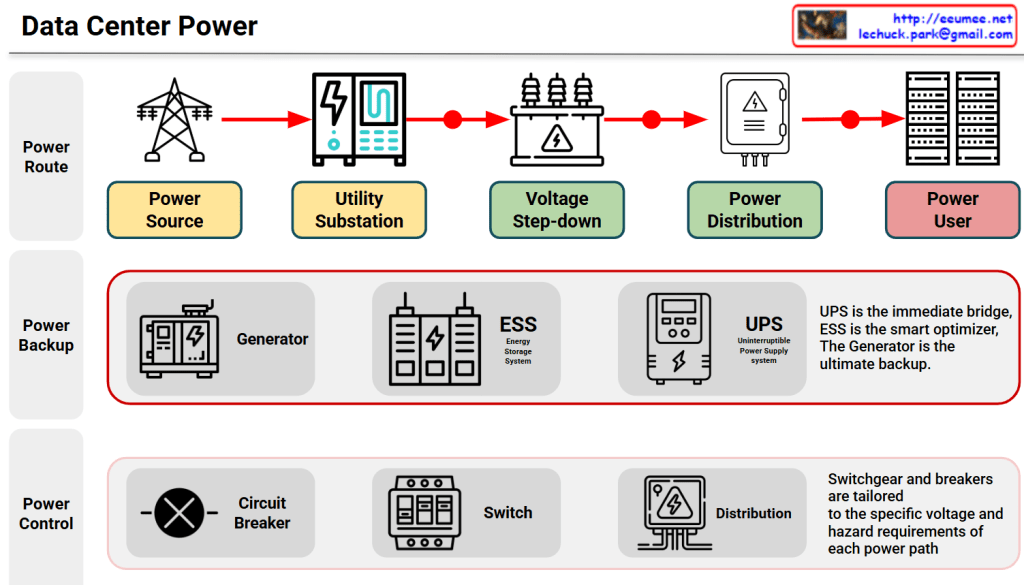
This diagram, provides a comprehensive and easy-to-understand overview of a Data Center Power Architecture. It breaks down the complex electrical infrastructure into three main functional layers: Power Route, Power Backup, and Power Control.

1. Power Route (The Main Flow of Electricity)

This top layer illustrates the journey of electricity from the grid all the way to the servers.

  • Power Source: This is the starting point where high-voltage electricity is delivered from the external power grid or power plants.
  • Utility Substation: The high-voltage power first enters the data center’s dedicated substation to be safely received and managed.
  • Voltage Step-down: Because grid voltage is way too high for servers, heavy-duty transformers step down the voltage to a lower, safer operating level.
  • Power Distribution: The stepped-down electricity is split and routed into various distribution switchboards and panels.
  • Power User: The final destination. Clean, stable power is delivered directly to the high-density IT racks and servers.

2. Power Backup (The Safety Net)

This layer ensures the data center remains fully operational even during severe grid failures or blackouts. It highlights three critical components:

  • Generator: The ultimate powerhouse for long-term survival. It takes a few seconds to start up but can supply continuous power for days during extended outages.
  • ESS (Energy Storage System): The smart optimizer. It strategically saves energy when power is cheap and discharges it during peak demand to cut costs and improve efficiency.
  • UPS (Uninterruptible Power Supply): The zero-second shield. It provides instant battery power the exact millisecond a blackout occurs so that servers never drop a single packet.

Key Concept: “UPS is the immediate bridge, ESS is the smart optimizer, and the Generator is the ultimate backup.”

3. Power Control (The Guard and Router)

The bottom layer focuses on the safety and granular control of the electricity flowing through the system.

  • Circuit Breaker: Automatically cuts off the electrical flow instantly if a short circuit or overload is detected, protecting expensive equipment from catching fire.
  • Switch: Allows operators to manually or automatically redirect power paths for maintenance or load balancing.
  • Distribution: Fine-tunes and splits the power safely down to the individual hardware level.

Key Concept: “Switchgear and breakers are tailored to the specific voltage and hazard requirements of each power path.”

📝 In Summary

The architecture shown how a modern data center achieves maximum uptime. Power Route brings the electricity in, Power Backup ensures it never goes dark, and Power Control guarantees that the entire flow remains safe, stable, and highly optimized.

#DataCenter #AIDC #PowerInfrastructure #UPS #ESS #BackupGenerator #ElectricalEngineering #Switchgear #DataCenterDesign

Power for AI

AI Data Center Power Infrastructure: 3 Key Transformations

Traditional Data Center Power Structure (Baseline)

Power Grid → Transformer → UPS → Server (220V AC)

  • Single power grid connection
  • Standard UPS backup (10-15 minutes)
  • AC power distribution
  • 200-300W per server

3 Critical Changes for AI Data Centers

🔴 1. More Power (Massive Power Supply)

Key Changes:

  • Diversified power sources:
    • SMR (Small Modular Reactor) – Stable baseload power
    • Renewable energy integration
    • Natural gas turbines
    • Long-term backup generators + large fuel tanks

Why: AI chips (GPU/TPU) consume kW to tens of kW per server

  • Traditional server: 200-300W
  • AI server: 5-10 kW (25-50x increase)
  • Total data center power demand: Hundreds of MW scale

🔴 2. Stable Power (Power Quality & Conditioning)

Key Changes:

  • 800V HVDC system – High-voltage DC transmission
  • ESS (Energy Storage System) – Large-scale battery storage
  • Peak Shaving – Peak load control and leveling
  • UPS + Battery/Flywheel – Instantaneous outage protection
  • Power conditioning equipment – Voltage/frequency stabilization

Why: AI workload characteristics

  • Instantaneous power surges (during inference/training startup)
  • High power density (30-100 kW per rack)
  • Power fluctuation sensitivity – Training interruption = days of work lost
  • 24/7 uptime requirements

🔴 3. Server Power (High-Efficiency Direct DC Delivery)

Key Changes:

  • Direct-to-Chip DC power delivery
  • Rack-level battery systems (Lithium/Supercapacitor)
  • High-density power distribution

Why: Maximize efficiency

  • Eliminate AC→DC conversion losses (5-15% efficiency gain)
  • Direct chip-level power supply – Minimize conversion stages
  • Ultra-high rack density support (100+ kW/rack)
  • Even minor voltage fluctuations are critical – Chip-level stabilization needed

Key Differences Summary

CategoryTraditional DCAI Data Center
Power ScaleFew MWHundreds of MW
Rack Density5-10 kW/rack30-100+ kW/rack
Power MethodAC-centricHVDC + Direct DC
Backup PowerUPS (10-15 min)Multi-tier (Generator+ESS+UPS)
Power StabilityStandardExtremely high reliability
Energy SourcesSingle gridMultiple sources (Nuclear+Renewable)

Summary

AI data centers require 25-50x more power per server, demanding massive power infrastructure with diversified sources including SMRs and renewables

Extreme workload stability needs drive multi-tier backup systems (ESS+UPS+Generator) and advanced power conditioning with 800V HVDC

Direct-to-chip DC power delivery eliminates conversion losses, achieving 5-15% efficiency gains critical for 100+ kW/rack densities

#AIDataCenter #DataCenterPower #HVDC #DirectDC #EnergyStorageSystem #PeakShaving #SMR #PowerInfrastructure #HighDensityComputing #GPUPower #DataCenterDesign #EnergyEfficiency #UPS #BackupPower #AIInfrastructure #HyperscaleDataCenter #PowerConditioning #DCPower #GreenDataCenter #FutureOfComputing

With Claude