The Paradigm Shift: From Brute Force to Efficiency

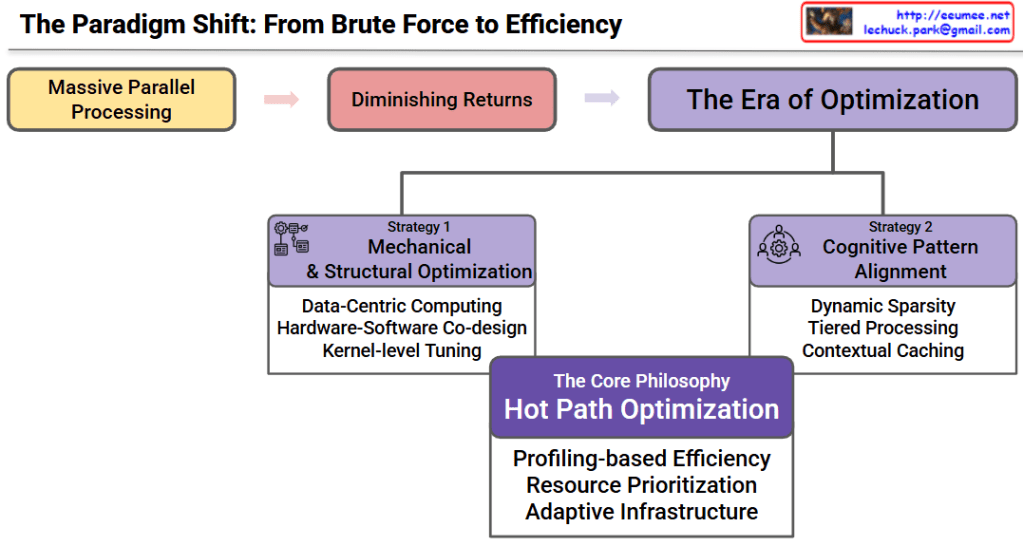
This diagram illustrates the critical paradigm shift currently happening in AI development: the transition from a “brute-force” approach—heavily reliant on massive infrastructure scaling and immense energy consumption—to a highly targeted, efficiency-first optimization perspective.

1. The Evolutionary Path in AI Infrastructure

The top flow outlines the historical and current trajectory of AI computing:

  • Massive Parallel Processing: This represents the “Brute Force” era of AI. Progress was historically driven by simply throwing massive GPU clusters and enormous amounts of electrical power at models to achieve scale.
  • Diminishing Returns: We are hitting a physical and energetic wall. Pumping more hardware and megawatts of power into data centers is yielding progressively smaller performance gains due to power density limits, cooling challenges, and silicon constraints.
  • The Era of Optimization: The new frontier of AI development. Since we can no longer rely purely on adding more servers and power, the focus has entirely shifted to extracting maximum compute-per-watt and maximizing the utilization of existing infrastructure.

2. The Dual-Pillar Strategy for Efficiency

To navigate away from energy-heavy brute force, the diagram proposes two distinct but complementary optimization approaches:

Strategy 1: Mechanical & Structural Optimization

This focuses on the physical and foundational software layers to prevent energy and computational waste.

  • Data-Centric Computing: Keeping data close to the processing units to reduce the massive energy cost of moving data across networks.
  • Hardware-Software Co-design: Building AI software that is perfectly aligned with the underlying silicon to maximize throughput without drawing excess power.
  • Kernel-level Tuning: Fine-tuning the operating system at the lowest level to remove overhead and latency.

Strategy 2: Cognitive Pattern Alignment

This focuses on algorithmic and logical efficiency, ensuring the AI models themselves are running “smarter.”

  • Dynamic Sparsity: Skipping unnecessary calculations in AI models (like ignoring zero-values in neural networks), drastically reducing the required compute power.
  • Tiered Processing: Assigning tasks to the right level of hardware based on complexity, so high-power GPUs are only used when absolutely necessary.
  • Contextual Caching: Intelligently predicting and storing data to speed up AI inference without repeatedly fetching it from main memory.

3. The Core Philosophy: Hot Path Optimization

At the foundation of this new era is Hot Path Optimization, the ultimate answer to the energy and infrastructure bottleneck.

Instead of keeping the entire AI data center running at maximum power, this philosophy dictates:

  • Profiling-based Efficiency: Identifying the exact “Hot Paths” (the most frequent and critical computational bottlenecks in the AI workload).
  • Resource Prioritization: Funneling the best hardware and power strictly into those critical paths, rather than wasting energy on idle or low-priority tasks.
  • Adaptive Infrastructure: Creating an environment that dynamically scales power and resources in real-time to match the exact needs of the AI model, achieving peak efficiency.

#AIInfrastructure #EnergyEfficiency #SustainableAI #OptimizationEra #GreenDataCenter #HotPathOptimization #ComputePerWatt #TechVisualization

New For AI

Analysis of “New For AI” Diagram

This image, titled “New For AI,” systematically organizes the essential components required for building AI systems.

Structure Overview

Top Section: Fundamental Technical Requirements for AI (Two Pillars)

Left Domain – Computing Axis (Turquoise)

  1. Massive Data
    • Processing vast amounts of data that form the foundation for AI training and operations
  2. Immense Computing
    • Powerful computational capacity to process data and run AI models

Right Domain – Infrastructure Axis (Light Blue)

3. Enormous Energy
Large-scale power supply to drive AI computing

  1. High-Density Cooling
    • Effective heat removal from high-performance computing operations

Central Link 🔗

Meaning of the Chain Link Icon:

  • For AI to achieve its performance, Computing (Data/Chips) and Infrastructure (Power/Cooling) don’t simply exist in parallel
  • They must be tightly integrated and optimized to work together
  • Symbolizes the interdependent relationship where strengthening only one side cannot unlock the full system’s potential

Bottom Section: Implementation Technologies (Stability & Optimization)

Learning & Inference/Reasoning (Learning and Inference Optimization)

Technologies to enhance AI model performance and efficiency:

  • Evals/Golden Set: Model evaluation and benchmarking
  • Safety Guardrails, RLHF-DPO: Safety assurance and human feedback-based learning
  • FlashAttention: Memory-efficient attention mechanism
  • Quant(INT8/FP8): Computational optimization through model quantization
  • Speculative/MTP Decoding: Inference speed enhancement techniques

Massive Parallel Computing (Large-Scale Parallel Computing)

Hardware and network technologies enabling massive computation:

  • GB200/GB300 NVL72: NVIDIA’s latest GPU systems
  • HBM: High Bandwidth Memory
  • InfiniBand, NVlink: Ultra-high-speed interconnect technologies
  • AI factory: AI-dedicated data centers
  • TPU, MI3xx, NPU, DPU: Various AI-specialized chips
  • PIM, CxL, UvLink: Memory-compute integration and next-gen interfaces
  • Silicon Photonics, UEC: Optical communication technologies

More Energy, Energy Efficiency (Energy Supply and Efficiency)

Technologies for stable and efficient power supply:

  • Smart Grid: Intelligent power grid
  • SMR: Small Modular Reactor (stable large-scale power source)
  • Renewable Energy: Renewable energy integration
  • ESS: Energy Storage System (power stabilization)
  • 800V HVDC: High-voltage direct current transmission (loss minimization)
  • Direct DC Supply: Direct DC supply (eliminating conversion losses)
  • Power Forecasting: AI-based power demand prediction and optimization

High Heat Exchange & PUE (Heat Exchange and Power Efficiency)

Securing cooling system efficiency and stability:

  • Liquid Cooling: Liquid cooling (higher efficiency than air cooling)
  • CDU: Coolant Distribution Unit
  • D2C: Direct-to-Chip cooling
  • Immersing: Immersion cooling (complete liquid immersion)
  • 100% Free Cooling: Utilizing external air (energy saving)
  • AI-Driven Cooling Optimization: AI-based cooling optimization
  • PUE Improvement: Power Usage Effectiveness (overall power efficiency metric)

Key Message

This diagram emphasizes that for successful AI implementation:

  1. Technical Foundation: Both Data/Chips (Computing) and Power/Cooling (Infrastructure) are necessary
  2. Tight Integration: These two axes are not separate but must be firmly connected like a chain and optimized simultaneously
  3. Implementation Technologies: Specific advanced technologies for stability and optimization in each domain must provide support

The central link particularly visualizes the interdependent relationship where “increasing computing power requires strengthening energy and cooling in tandem, and computing performance cannot be realized without infrastructure support.”


Summary

AI systems require two inseparable pillars: Computing (Data/Chips) and Infrastructure (Power/Cooling), which must be tightly integrated and optimized together like links in a chain. Each pillar is supported by advanced technologies spanning from AI model optimization (FlashAttention, Quantization) to next-gen hardware (GB200, TPU) and sustainable infrastructure (SMR, Liquid Cooling, AI-driven optimization). The key insight is that scaling AI performance demands simultaneous advancement across all layers—more computing power is meaningless without proportional energy supply and cooling capacity.


#AI #AIInfrastructure #AIComputing #DataCenter #AIChips #EnergyEfficiency #LiquidCooling #MachineLearning #AIOptimization #HighPerformanceComputing #HPC #GPUComputing #AIFactory #GreenAI #SustainableAI #AIHardware #DeepLearning #AIEnergy #DataCenterCooling #AITechnology #FutureOfAI #AIStack #MLOps #AIScale #ComputeInfrastructure

With Claude