Sensors for AI DC Rack

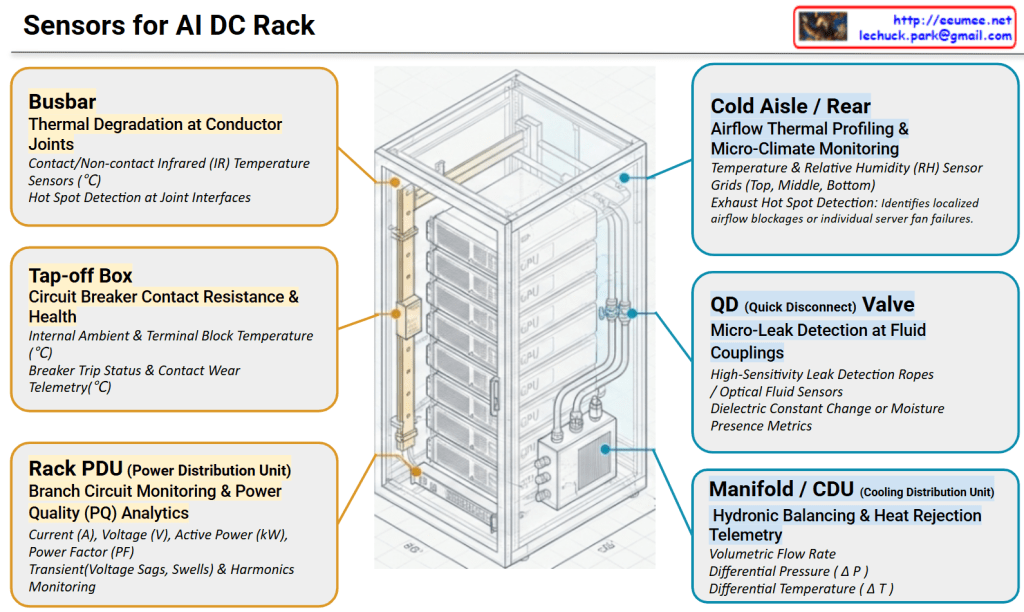
Architecture Walkthrough: High-Density AI Rack Monitoring Topology

This diagram illustrates a comprehensive monitoring framework tailored for next-generation, high-density AI Data Centers. As rack power densities scale upward of 40kW to over 100kW, the integration of high-density power delivery and advanced liquid cooling demands a unified telemetry layer. The architecture symmetrically bifurcates these critical operations into two primary domains: Power Distribution & Electrical Infrastructure (left, in yellow) and Liquid Cooling & Thermal Management (right, in blue).

1. Power Infrastructure Telemetry (Left Domain)

  • Busbar (Top Left): Focuses on tracking surface temperatures at copper/aluminum busway joints using contact or non-contact infrared (IR) sensors. This mitigates the risk of thermal runaway caused by mechanical loosening or joint degradation.
  • Tap-off Box (Middle Left): Monitors the critical junction where power is tapped from the main busway to individual racks. Telemetry captures internal ambient temperatures and circuit breaker contact wear to prevent nuisance tripping under heavy GPU loads.
  • Rack PDU (Bottom Left): Delivers granular power quality (PQ) analytics. Beyond basic billing metrics, it utilizes high-speed sampling to capture transient events—such as voltage sags, swells, and total harmonic distortion (THD)—triggered by sudden LLM training state transitions.

2. Liquid Cooling & Thermal Management (Right Domain)

  • Cold Aisle / Rear (Top Right): Provides 3D micro-climate profiling of the rack enclosure. Using sensor grids (top, middle, bottom), it tracks cold air intake and maps exhaust air behavior to instantaneously flag localized hot spots or individual server fan failures.
  • QD (Quick Disconnect) Valve (Middle Right): Positions high-sensitivity leak detection ropes or optical fluid sensors directly at the fluid mating interfaces of individual GPU server blades. This safeguards expensive IT assets against coolant escape.
  • Manifold / CDU (Bottom Right): Serves as the central hydronic balancing hub. By cross-referencing volumetric flow rate (LPM), differential pressure (Delta P), and differential temperature ($\Delta T$) across supply and return lines, the system continuously calculates the exact real-time heat rejection load in kW.

Executive Summary: The Imperative of High-Fidelity Infrastructure Telemetry

In a modern AI Data Center, the sheer density of accelerated computing clusters renders traditional, coarse facility monitoring completely obsolete. To ensure maximum uptime and operational efficiency, telemetry must undergo a paradigm shift governed by two critical vectors:

1. High Precision & High Resolution

Because GPU workloads scale from idle to maximum power in microseconds, sensors must feature ultra-high sampling rates (millisecond-level resolution for electrical transients) and high precision (milli-degree sensitivity for liquid thermal loops). Coarse, averaged data masks dangerous micro-spikes that degrade hardware components over time. High-resolution telemetry is the baseline requirement for capturing the true, unvarnished physical state of the infrastructure.

2. From Phenomena to Precursors (Omens)

Traditional data center monitoring is reactive—it alerts operators to a phenomenon (e.g., “Rack temperature has exceeded $85^\circ\text{C}$”), which usually means the failure has already occurred.

Conversely, high-fidelity, continuous data allows an AIOps engine to identify precursors or omens—the microscopic anomalies that precede a disaster. For instance:

  • A fractional, steady rise in busbar temperature relative to a static workload implies micro-vibration joint loosening (Thermal Degradation Precursor).
  • A subtle drift in the dielectric constant near a fluid coupling signals a microscopic weep before it transforms into a catastrophic spray (Leak Precursor).
  • A minor, localized spike in differential pressure (Delta P) combined with a micro-drop in flow rate alerts the system to initial strainer clogging before fluid starvation throttles the GPUs.

By capturing these subtle “signs” rather than waiting for the “symptom,” data centers can transition from reactive firefighting to fully automated, self-healing predictive maintenance.

#AIDataCenter #LiquidCooling #DirectToChip #AIOps #InfrastructureTelemetry #HighDensityComputing #PredictiveMaintenance #DataCenterArchitecture #TechnicalVisualization #SmartInfrastructure

With Gemini
Sensing Point

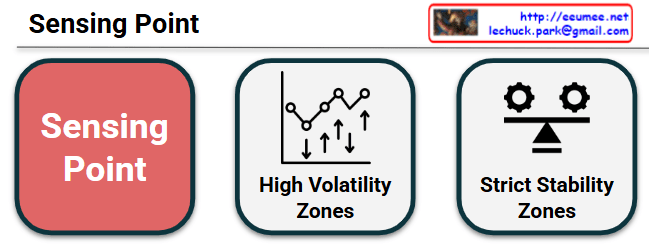
This mage is a diagram that visually contrasts two core characteristics of “Sensing Points,” which are locations where data is collected and status is monitored within a system or infrastructure environment.

Here is a breakdown of each component:

  • Sensing Point (Red Block): The central theme of this diagram. It represents the measurement points where physical and logical sensors are deployed to collect data for system monitoring and autonomous operations.
  • High Volatility Zones: Represented by a fluctuating line graph and up/down arrows. This indicates areas that are highly dynamic with large and rapid fluctuations in state—such as sudden surges in GPU power consumption or localized thermal changes driven by heavy AI workloads. The primary goal of sensing in these zones is to minimize data collection latency (Time Constant) to instantly capture rapid changes and respond with agility.
  • Strict Stability Zones: Represented by interlocking gears and a balanced scale. This refers to the foundational areas of the system where balance must be strictly maintained, such as the baseline temperature of a cooling system or the main power distribution network. Because volatility must be tightly controlled here, the purpose of sensing is focused on ensuring the overall integrity of the infrastructure by detecting subtle imbalances or early signs of anomalies.

Comprehensive Analysis:

Ultimately, this infographic illustrates a monitoring strategy for efficiently managing high-density environments, such as AI Data Centers. By bifurcating the monitoring targets into “areas requiring immediate tracking due to high volatility” and “areas requiring homeostasis through strict control,” it provides a highly intuitive, architecturally structured visualization. It emphasizes the need to establish tailored measurement and operational standards (like AIOps) for each specific domain.


#DataCenter#InfrastructureArchitecture #SensingPoint #Telemetry #SystemMonitoring #AutonomousOperations #HighDensityComputing #TechVisualized

With Gemini

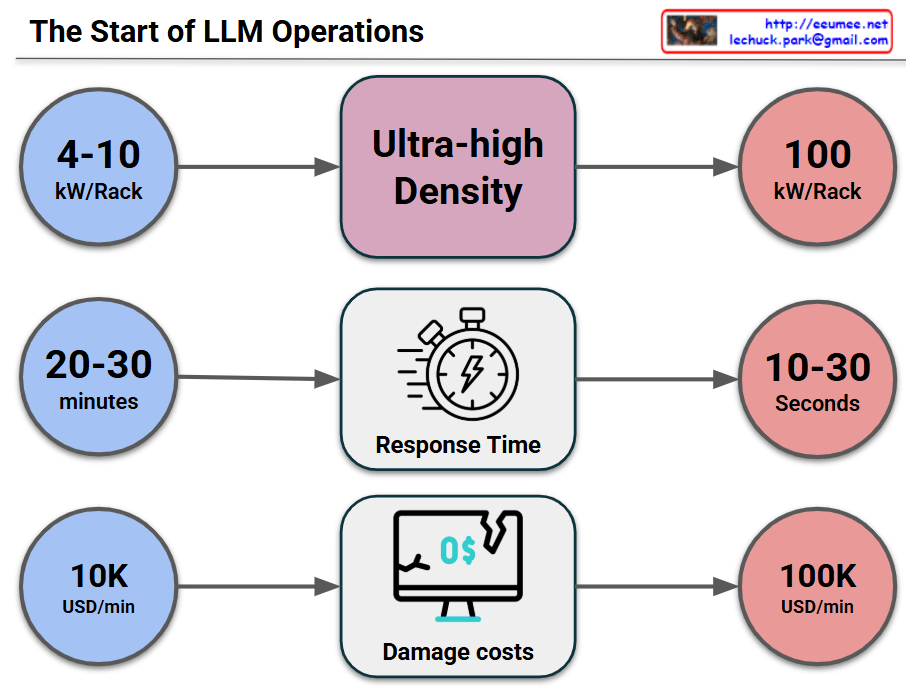
The High Stakes of Ultra-High Density: Seconds to React, Massive Costs

This image visually compares the critical changes and risks that occur when a data center or IT infrastructure transitions to an “Ultra-high Density” environment across three key metrics.

1. Surge in Power Density (Top Row)

  • Past/Standard Environment (Blue): Racks typically operated at a power density of 4-10 kW per Rack.
  • Transition (Middle): The shift toward Ultra-high Density infrastructure (driven by AI, High-Performance Computing, etc.).
  • Current/Ultra-high Density (Red): Power density explodes to 100 kW per Rack, which is a 10-fold increase.

2. Drastic Drop in Response Time (Middle Row)

  • Past/Standard Environment: In the event of a cooling failure or system issue, operators had a comfortable golden window of 20-30 minutes to react before systems went down.
  • Transition: Focusing on the change in Response Time.
  • Current/Ultra-high Density: Due to the massive, instantaneous heat generation, the reaction window plummets to a mere 10-30 seconds. This makes manual human intervention practically impossible.

3. Explosion of Damage Costs (Bottom Row)

  • Past/Standard Environment: The financial loss caused by system downtime was around $10,000 (10K USD) per minute.
  • Transition: Focusing on the change in Damage costs.
  • Current/Ultra-high Density: Because of the high value of the equipment and the critical nature of the data being processed, the cost of downtime skyrockets to $100,000 (100K USD) per minute—a 10x increase.

💡 Overall Summary

The core message of this infographic is a strong warning: “In ultra-high density environments reaching 100kW per rack, the window for disaster response shrinks from minutes to mere seconds, while the financial loss per minute multiplies tenfold.” This perfectly illustrates why immediate, automated cooling and response systems (such as liquid cooling or AI-driven automation) are no longer optional, but mandatory for modern data centers.


#DataCenter #UltraHighDensity #HighDensityComputing #ITInfrastructure #Downtime #CostOfDowntime #RiskManagement

With Gemini

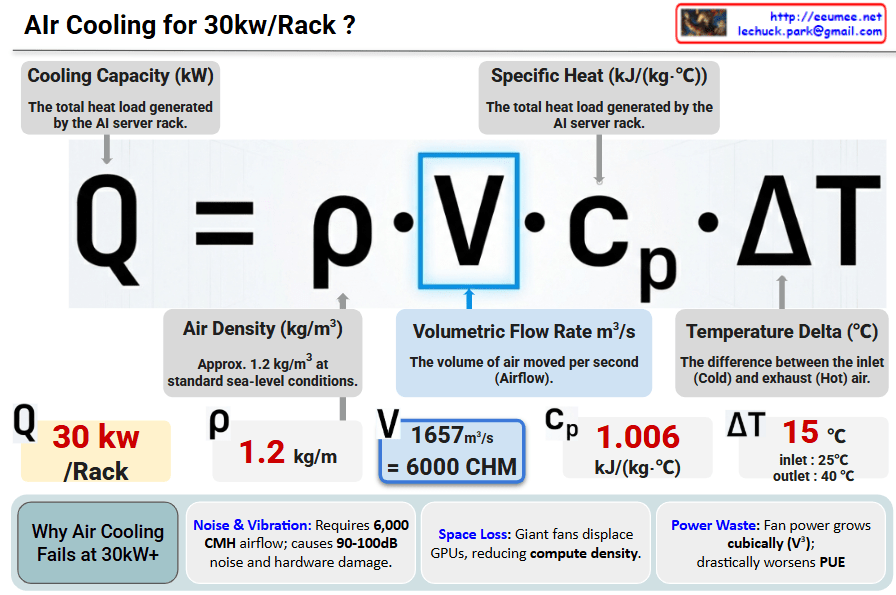
Air Cooling For 30kw/Rack

Why Air Cooling Fails at 30kW+

  • Noise & Vibration: Achieving 6,000 CMH airflow generates 90-100dB noise and vibrations that damage hardware.
  • Space Loss: Massive cooling fans displace GPUs/CPUs, drastically reducing compute density.
  • Power Waste: Fan power consumption grows cubically (V^3), causing a significant spike in PUE (Power Usage Effectiveness).

Conclusion: At 30kW/Rack, air cooling hits a physical and economic “wall”. Transitioning to Liquid Cooling is mandatory for next-generation AI Data Centers.


#AIDataCenter #LiquidCooling #ThermalManagement #30kWRack #DataCenterEfficiency #PUE #HighDensityComputing #GPUCooling

Power for AI

AI Data Center Power Infrastructure: 3 Key Transformations

Traditional Data Center Power Structure (Baseline)

Power Grid → Transformer → UPS → Server (220V AC)

  • Single power grid connection
  • Standard UPS backup (10-15 minutes)
  • AC power distribution
  • 200-300W per server

3 Critical Changes for AI Data Centers

🔴 1. More Power (Massive Power Supply)

Key Changes:

  • Diversified power sources:
    • SMR (Small Modular Reactor) – Stable baseload power
    • Renewable energy integration
    • Natural gas turbines
    • Long-term backup generators + large fuel tanks

Why: AI chips (GPU/TPU) consume kW to tens of kW per server

  • Traditional server: 200-300W
  • AI server: 5-10 kW (25-50x increase)
  • Total data center power demand: Hundreds of MW scale

🔴 2. Stable Power (Power Quality & Conditioning)

Key Changes:

  • 800V HVDC system – High-voltage DC transmission
  • ESS (Energy Storage System) – Large-scale battery storage
  • Peak Shaving – Peak load control and leveling
  • UPS + Battery/Flywheel – Instantaneous outage protection
  • Power conditioning equipment – Voltage/frequency stabilization

Why: AI workload characteristics

  • Instantaneous power surges (during inference/training startup)
  • High power density (30-100 kW per rack)
  • Power fluctuation sensitivity – Training interruption = days of work lost
  • 24/7 uptime requirements

🔴 3. Server Power (High-Efficiency Direct DC Delivery)

Key Changes:

  • Direct-to-Chip DC power delivery
  • Rack-level battery systems (Lithium/Supercapacitor)
  • High-density power distribution

Why: Maximize efficiency

  • Eliminate AC→DC conversion losses (5-15% efficiency gain)
  • Direct chip-level power supply – Minimize conversion stages
  • Ultra-high rack density support (100+ kW/rack)
  • Even minor voltage fluctuations are critical – Chip-level stabilization needed

Key Differences Summary

CategoryTraditional DCAI Data Center
Power ScaleFew MWHundreds of MW
Rack Density5-10 kW/rack30-100+ kW/rack
Power MethodAC-centricHVDC + Direct DC
Backup PowerUPS (10-15 min)Multi-tier (Generator+ESS+UPS)
Power StabilityStandardExtremely high reliability
Energy SourcesSingle gridMultiple sources (Nuclear+Renewable)

Summary

AI data centers require 25-50x more power per server, demanding massive power infrastructure with diversified sources including SMRs and renewables

Extreme workload stability needs drive multi-tier backup systems (ESS+UPS+Generator) and advanced power conditioning with 800V HVDC

Direct-to-chip DC power delivery eliminates conversion losses, achieving 5-15% efficiency gains critical for 100+ kW/rack densities

#AIDataCenter #DataCenterPower #HVDC #DirectDC #EnergyStorageSystem #PeakShaving #SMR #PowerInfrastructure #HighDensityComputing #GPUPower #DataCenterDesign #EnergyEfficiency #UPS #BackupPower #AIInfrastructure #HyperscaleDataCenter #PowerConditioning #DCPower #GreenDataCenter #FutureOfComputing

With Claude