Data Center Changes

The Evolution of Data Centers

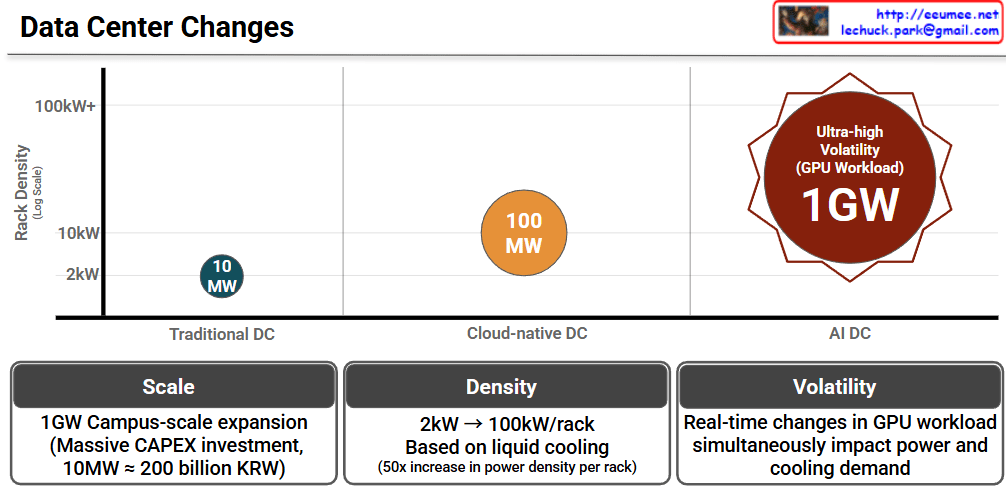
This infographic, titled “Data Center Changes,” visually explains how data center requirements are skyrocketing due to the shift from traditional computing to AI-driven workloads.

The chart compares three stages of data centers across two main metrics: Rack Density (how much power a single server rack consumes, shown on the vertical axis) and the overall Total Power Capacity (represented by the size and labels of the circles).

  • Traditional DC (Data Center): In the past, data centers ran at a very low rack density of around 2kW. The total power capacity required for a facility was relatively small, at around 10 MW.
  • Cloud-native DC: As cloud computing took over, the demands increased. Rack densities jumped to about 10kW, and the overall facility size grew to require around 100 MW of power.
  • AI DC: This is where we see a massive leap. Driven by heavy GPU workloads, AI data centers push rack densities beyond 100kW+. The scale of these facilities is enormous, demanding up to 1GW of power. The red starburst shape also highlights a new challenge: “Ultra-high Volatility,” meaning the power draw isn’t stable; it spikes violently depending on what the AI is processing.

The Three Core Challenges (Bottom Panels)

The bottom three panels summarize the key takeaways of transitioning to AI Data Centers:

  1. Scale (Massive Investment): Building a 1GW “Campus-scale” AI data center requires astronomical capital expenditure (CAPEX). To put this into perspective, the chart notes that just 10MW costs roughly 200 billion KRW (South Korean Won). Scaling that to 1GW is a colossal financial undertaking.
  2. Density (The Need for Liquid Cooling): Power density per rack is jumping from 2kW to 100kW—a 50x increase. Traditional air-conditioning cannot cool servers running this hot, meaning the industry must transition to advanced liquid cooling technologies.
  3. Volatility (Unpredictable Demands): Unlike traditional servers that run at a steady hum, AI GPU workloads change in real-time. A sudden surge in computing tasks instantly spikes both the electricity needed to run the GPUs and the cooling power needed to keep them from melting.

Summary

  • Data centers are undergoing a massive transformation from Traditional (10MW) and Cloud (100MW) models to gigantic AI Data Centers requiring up to 1 Gigawatt (1GW) of power.
  • Because AI servers use powerful GPUs, power density per rack is increasing 50-fold (up to 100kW+), forcing a shift from traditional air cooling to advanced liquid cooling.
  • This AI infrastructure requires staggering financial investments (CAPEX) and must be designed to handle extreme, real-time volatility in both power and cooling demands.

#DataCenter #AIDataCenter #LiquidCooling #GPU #CloudComputing #TechTrends #TechInfrastructure #CAPEX

With Gemini

DynamoLLM

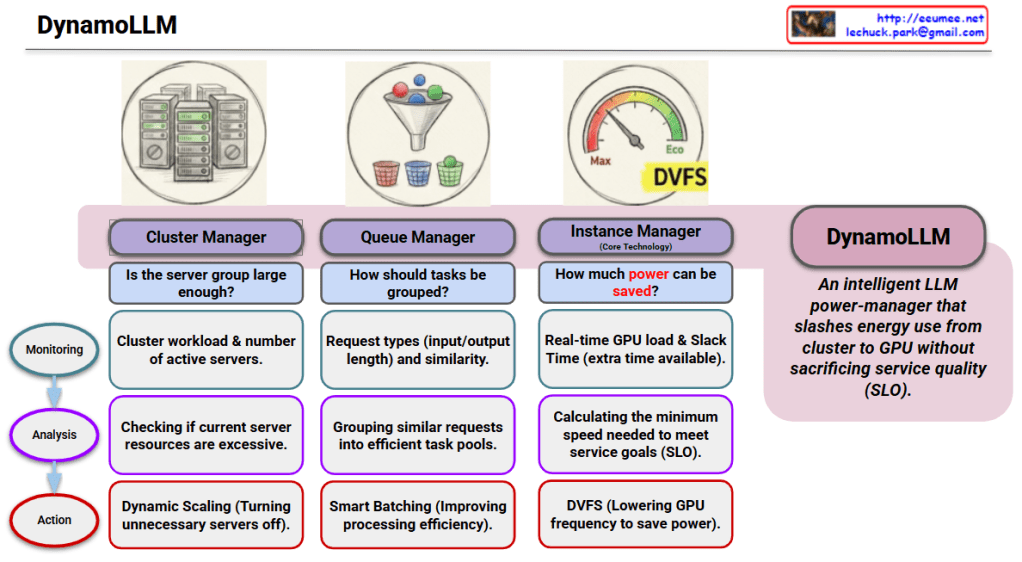
The provided infographic illustrates DynamoLLM, an intelligent power-saving framework specifically designed for operating Large Language Models (LLMs). Its primary mission is to minimize energy consumption across the entire infrastructure—from the global cluster down to individual GPU nodes—while strictly maintaining Service Level Objectives (SLO).


## 3-Step Intelligent Power Saving

1. Cluster Manager (Infrastructure Level)

This stage ensures that the overall server resources match the actual demand to prevent idle waste.

  • Monitoring: Tracks the total cluster workload and the number of currently active servers.
  • Analysis: Evaluates if the current server group is too large or if resources are excessive.
  • Action: Executes Dynamic Scaling by turning off unnecessary servers to save power at the fleet level.

2. Queue Manager (Workload Level)

This stage organizes incoming requests to maximize the efficiency of the processing phase.

  • Monitoring: Identifies request types (input/output token lengths) and their similarities.
  • Analysis: Groups similar requests into efficient “task pools” to streamline computation.
  • Action: Implements Smart Batching to improve processing efficiency and reduce operational overhead.

3. Instance Manager (GPU Level)

As the core technology, this stage manages real-time power at the hardware level.

  • Monitoring: Observes real-time GPU load and Slack Time (the extra time available before a deadline).
  • Analysis: Calculates the minimum processing speed required to meet the service goals (SLO) without over-performing.
  • Action: Utilizes DVFS (Dynamic Voltage and Frequency Scaling) to lower GPU frequency and minimize power draw.

# Summary

  1. DynamoLLM is an intelligent framework that minimizes LLM energy use across three layers: Cluster, Queue, and Instance.
  2. It maintains strict service quality (SLO) by calculating the exact performance needed to meet deadlines without wasting power.
  3. The system uses advanced techniques like Dynamic Scaling and DVFS to ensure GPUs only consume as much energy as a task truly requires.

#DynamoLLM #GreenAI #LLMOps #EnergyEfficiency #GPUOptimization #SustainableAI #CloudComputing

With Gemini

Big Changes with AI

This image illustrates the dramatic growth in computing performance and data throughput from the Internet era to the AI/LLM era.

Key Development Stages

1. Internet Era

  • 10 TWh (terawatt-hours) power consumption
  • 2 PB/day (petabytes/day) data processing
  • 1K DC (1,000 data centers)
  • PUE 3.0 (Power Usage Effectiveness)

2. Mobile & Cloud Era

  • 200 TWh (20x increase)
  • 20,000 PB/day (10,000x increase)
  • 4K DC (4x increase)
  • PUE 1.8 (improved efficiency)

3. AI/LLM (Transformer) Era – “Now Here?” point

  • 400+ TWh (40x additional increase)
  • 1,000,000,000 PB/day = 1 billion PB/day (500,000x increase)
  • 12K DC (12x increase)
  • PUE 1.4 (further improved efficiency)

Summary

The chart demonstrates unprecedented exponential growth in data processing and power consumption driven by AI and Large Language Models. While data center efficiency (PUE) has improved significantly, the sheer scale of computational demands has skyrocketed. This visualization emphasizes the massive infrastructure requirements that modern AI systems necessitate.

#AI #LLM #DataCenter #CloudComputing #MachineLearning #ArtificialIntelligence #BigData #Transformer #DeepLearning #AIInfrastructure #TechTrends #DigitalTransformation #ComputingPower #DataProcessing #EnergyEfficiency