The Difference, The Start of Computing

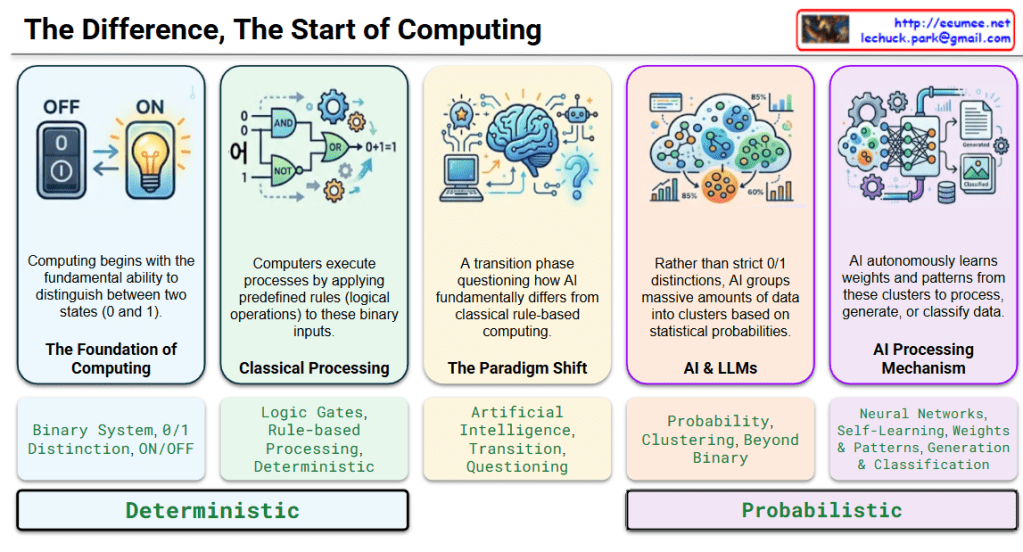
The provided image is an infographic that visually compares the operational mechanisms of traditional computing and modern Artificial Intelligence (AI). The addition of the keywords “Deterministic” and “Probabilistic” at the bottom perfectly summarizes the core difference between these two paradigms.

1. The World of Deterministic Computing

This section explains the traditional computer mechanism, which consistently produces the same output based on predefined, rigid rules.

  • Step 1: The Foundation of Computing
    • Visuals: An intuitive ON/OFF power switch and an illuminated lightbulb.
    • Meaning: Computing begins with the fundamental Binary System, which distinguishes between two clear states: 0 (OFF) and 1 (ON).
  • Step 2: Classical Processing
    • Visuals: Logic gate symbols (AND, OR, NOT) interlocked with gears.
    • Meaning: It illustrates how conventional computers process binary inputs mechanically by applying predefined human rules and logical operations (Rule-based Processing).

2. The Paradigm Shift

  • Step 3: Questioning and Transition
    • Visuals: A brain integrated with electronic circuits, a computer, a robot icon, and a large question mark in the center.
    • Meaning: This represents a technological leap, asking the core question: “How does AI fundamentally differ from classical rule-based computing?”

3. The World of Probabilistic Computing

This section explains AI’s mechanism, which relies on data statistics and probabilities to self-learn and generate flexible outcomes.

  • Step 4: AI & LLMs (Large Language Models)
    • Visuals: A cloud containing clustered data nodes of various colors and statistical charts showing probabilities like 85% and 60%.
    • Meaning: Instead of making strict 0/1 distinctions, AI groups massive amounts of data into Clusters based on statistical Probabilities.
  • Step 5: AI Processing Mechanism
    • Visuals: A complex Artificial Neural Network structure combined with processing gears, leading to output files labeled “Generated” (images) and “Classified” (documents).
    • Meaning: Without relying on explicit human programming, AI autonomously learns weights and internal patterns (Self-Learning) from these probabilistic clusters to create new content or classify data.

📌 Summary

This infographic acts as a visual map showcasing the evolution of computing history from the era of “Deterministic Rules” to the era of “Probabilistic Self-Learning.”

It intuitively conveys the core difference: while early computers relied on clear 0/1 distinctions and explicit human-written code, modern AI (like LLMs) groups vast amounts of data by probability and autonomously learns internal patterns and weights to deliver flexible, creative, and highly advanced results.

#ArtificialIntelligence #AIComputing #HistoryOfComputing #Deterministic #Probabilistic #LLM #MachineLearning #TechInfographic #TechTrends #TechExplanation

With Gemini

Human data

This updated image titled “Data?” presents a deeper philosophical perspective on data and AI.

Core Concept:

Human Perception is Limited

  • Compared to the infinite complexity of the real world, the scope that humans can perceive and define is constrained
  • The gray area labeled “Human perception is limited” visualizes this boundary of recognition

Two Dimensions of AI Application:

  1. Deterministic Data
    • Data domains that humans have already defined and structured
    • Contains clear rules and patterns that AI can process in predictable ways
    • Represents traditional AI problem-solving approaches
  2. Non-deterministic Data
    • Data from domains that humans haven’t fully defined
    • Raw data from the real world with high uncertainty and complexity
    • Areas where AI must discover and utilize patterns without prior human definitions

Key Insight: This diagram illustrates that AI’s true potential extends beyond simply solving pre-defined human problems. While AI can serve as a tool that opens new possibilities by transcending human cognitive boundaries and discovering complex patterns from the real world that we haven’t yet defined or understood, there remains a crucial human element in this process. Even as AI ventures into unexplored territories of reality beyond human-defined problem spaces, humans still play an essential role in determining how to interpret, validate, and responsibly apply these AI-discovered insights. The diagram suggests a collaborative relationship where AI expands our perceptual capabilities, but human judgment and decision-making remain fundamental in guiding how these expanded possibilities are understood and utilized.

With Claude

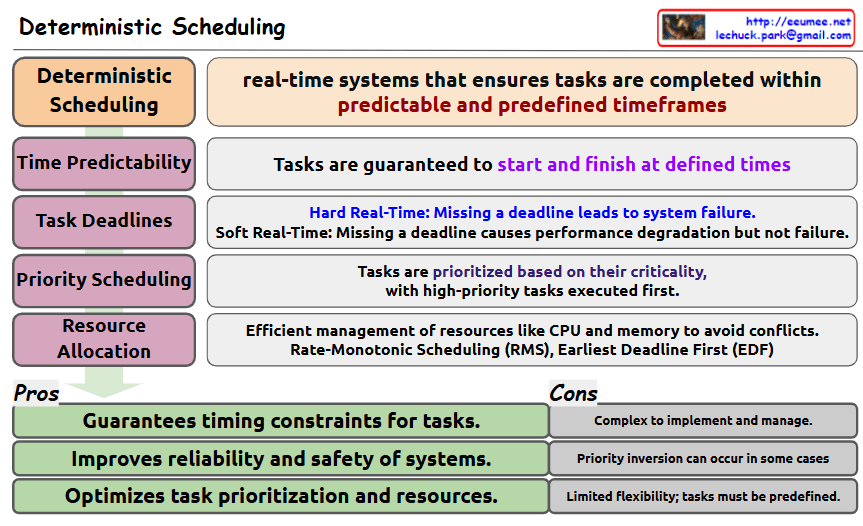
Deterministic Scheduling

With Claude
Definition: Deterministic Scheduling is a real-time systems approach that ensures tasks are completed within predictable and predefined timeframes.

Key Components:

  1. Time Predictability
  • Tasks are guaranteed to start and finish at defined times
  1. Task Deadlines
  • Hard Real-Time: Missing a deadline leads to system failure
  • Soft Real-Time: Missing a deadline causes performance degradation but not failure
  1. Priority Scheduling
  • Tasks are prioritized based on their criticality
  • High-priority tasks are executed first
  1. Resource Allocation
  • Efficient management of resources like CPU and memory to avoid conflicts
  • Uses Rate-Monotonic Scheduling (RMS) and Earliest Deadline First (EDF)

Advantages (Pros):

  • Guarantees timing constraints for tasks
  • Improves reliability and safety of systems
  • Optimizes task prioritization and resources

Disadvantages (Cons):

  • Complex to implement and manage
  • Priority inversion can occur in some cases
  • Limited flexibility; tasks must be predefined

The system is particularly important in real-time applications where timing and predictability are crucial for system operation. It provides a structured approach to managing tasks while ensuring they meet their specified time constraints and resource requirements.