Silence Data Corruption

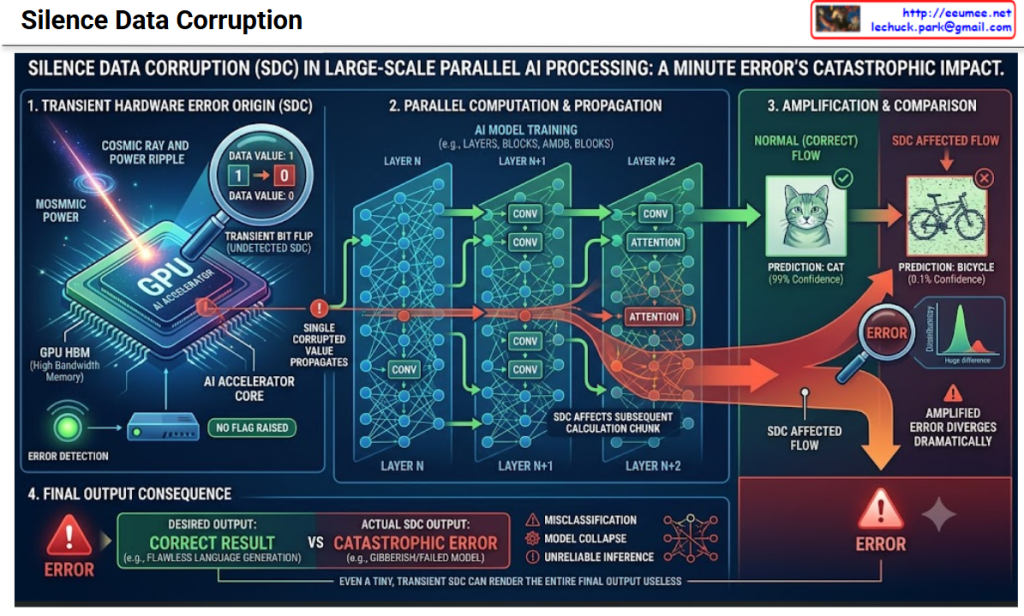
This infographic diagram illustrates the lifecycle of a single, minute, and transient error, showing how it goes undetected and exponentially amplifies through the layers of an AI model to cause a catastrophic final failure.

Step-by-Step Breakdown of the Diagram

The diagram is organized horizontally into four sequential stages, moving from the physical hardware level to the final AI application output.

Step 1: Transient Hardware Error Origin (SDC)

The leftmost section focuses on the physical cause of the error.

  • Context: We see a stylized GPU AI Accelerator and GPU HBM (High Bandwidth Memory), which represent the hardware infrastructure.
  • The Cause: An external physical event strikes the chip.
    • COSMIC RAY AND POWER RIPPLE: This represents high-energy particles from space or a minor voltage instability in the power supply. These events can deliver a tiny electrical charge to a critical component.
  • The Immediate Effect (Zoom in): This tiny charge hits a memory cell. As seen in the magnified view, it causes a TRANSIENT BIT FLIP (UNDETECTED SDC), instantly changing a data bit from 1 to 0.
  • The Essence of SDC (Red ‘!’): Crucially, the ERROR DETECTION sensor incorrectly assesses the situation, showing a green light and labeling it ‘NO FLAG RAISED.’ The system continues, unaware that the data has been corrupted. This is the ‘Silent’ aspect of SDC.

Step 2: Parallel Computation & Propagation

The central section illustrates how the corrupted value enters the AI model.

  • Structure: We see an AI MODEL TRAINING flow, distributed across massive parallel blocks (e.g., LAYERS, BLOCKS, AMDB, CONV, ATTENTION) like LAYER N, LAYER N+1, and LAYER N+2.
  • The Propagation Path:
    • Green Arrows (Normal Flow): Most of the data processed across the millions of nodes is correct.
    • Orange Arrows (SDC Affected Flow): The single flipped bit affects a small chunk of calculation in LAYER N. The diagram shows how this corruption (SDC AFFECTS SUBSEQUENT CALCULATION CHUNK) is passed on to LAYER N+1 and LAYER N+2, infecting and merging with a growing number of subsequent nodes as it progresses.

Step 3: Amplification & Comparison

The third section provides a striking side-by-side comparison of the final processed state.

  • Comparison:
    • Normal Flow: Had the error not occurred, the model would have made a PREDICTION: CAT (99% Confidence) with a high degree of accuracy and certainty.
    • SDC Affected Flow: The minute error, after cascading through thousands of parallel nodes and multiple layers, has been dramatically amplified. The model now makes a complete misclassification, with a non-sensical and low-confidence PREDICTION: BICYCLE (0.1% Confidence).
  • Graph (Error Divergence): The small SDC input (seen earlier as the single bit flip) has caused the entire output distribution to AMPLIFIED ERROR DIVERGES DRAMATICALLY.

Step 4: Final Output Consequence

The final, largest section at the bottom summarizes the real-world impact.

  • The Contrast:
    • Desired Output: The perfect outcome, like a flawless language generation or a critical diagnostic result (DESIRED OUTPUT: CORRECT RESULT).
    • Actual SDC Output: What actually occurs due to the SDC (ACTUAL SDC OUTPUT: CATASTROPHIC ERROR). This is not just a slightly wrong answer; it can be complete gibberish, a crashed model, or a dangerously incorrect real-world action.
  • Summary of Impact: The diagram lists the core failures: MISCLASSIFICATION, MODEL COLLAPSE, and UNRELIABLE INFERENCE, rendering the entire output useless.

Conclusion: Why SDC is a Catastrophic Danger

The ultimate takeaway, as stated in the title and the final caption, is that EVEN A TINY, TRANSIENT SDC CAN RENDER THE ENTIRE FINAL OUTPUT USELESS. In large-scale, massive parallel AI processing, a single, undetectable bit flip can cascade and multiply, causing a model that looks perfect to fail catastrophically.

#SilentDataCorruption #SDC #AI #MachineLearning #DeepLearning #LargeScaleAI #DistributedComputing #ParallelProcessing #HighPerformanceComputing #HPC

With Gemini (inc. infographic)

Optimize LLM

LLM Optimization: Integration of Traditional Methods and New Paradigms

Core Message

LLM (Transformer) optimization requires more than just traditional optimization methodologies – new perspectives must be added.


1. Traditional Optimization Methodology (Left Side)

SW (Software) Optimization

  • Data Optimization
    • Structure: Data structure design
    • Copy: Data movement optimization
  • Logics Optimization
    • Algorithm: Efficient algorithm selection
    • Profiling: Performance analysis and bottleneck identification

Characteristics: Deterministic, logical approach

HW (Hardware) Optimization

  • Functions & Speed (B/W): Function and speed/bandwidth optimization
  • Fit For HW: Optimization for existing hardware
  • New HW implementation: New hardware design and implementation

Characteristics: Physical performance improvement focus


2. New Perspectives Required for LLM (Right Side)

SW Aspect: Human-Centric Probabilistic Approach

  • Human Language View / Human’s View
    • Human language understanding methods
    • Human thinking perspective
  • Human Learning
    • Mimicking human learning processes

Key Point: Statistical and Probabilistic Methodology

  • Different from traditional deterministic optimization
  • Language patterns, probability distributions, and context understanding are crucial

HW Aspect: Massive Parallel Processing

  • Massive Simple Parallel
    • Parallel processing of large-scale simple computations
    • Hardware architecture capable of parallel processing (GPU/TPU) is essential

Key Point: Efficient parallel processing of large-scale matrix operations


3. Integrated Perspective

LLM Optimization = Traditional Optimization + New Paradigm

DomainTraditional MethodLLM Additional Elements
SWAlgorithm, data structure optimization+ Probabilistic/statistical approach (human language/learning perspective)
HWFunction/speed optimization+ Massive parallel processing architecture

Conclusion

For effective LLM optimization:

  1. Traditional optimization techniques (data, algorithms, hardware) as foundation
  2. Probabilistic approach reflecting human language and learning methods
  3. Hardware perspective supporting massive parallel processing

These three elements must be organically combined – this is the core message of the diagram.


Summary

LLM optimization requires integrating traditional deterministic SW/HW optimization with new paradigms: probabilistic/statistical approaches that mirror human language understanding and learning, plus hardware architectures designed for massive parallel processing. This represents a fundamental shift from conventional optimization, where human-centric probabilistic thinking and large-scale parallelism are not optional but essential dimensions.


#LLMOptimization #TransformerArchitecture #MachineLearningOptimization #ParallelProcessing #ProbabilisticAI #HumanLanguageView #GPUComputing #DeepLearningHardware #StatisticalML #AIInfrastructure #ModelOptimization #ScalableAI #NeuralNetworkOptimization #AIPerformance #ComputationalEfficiency