Event Processing

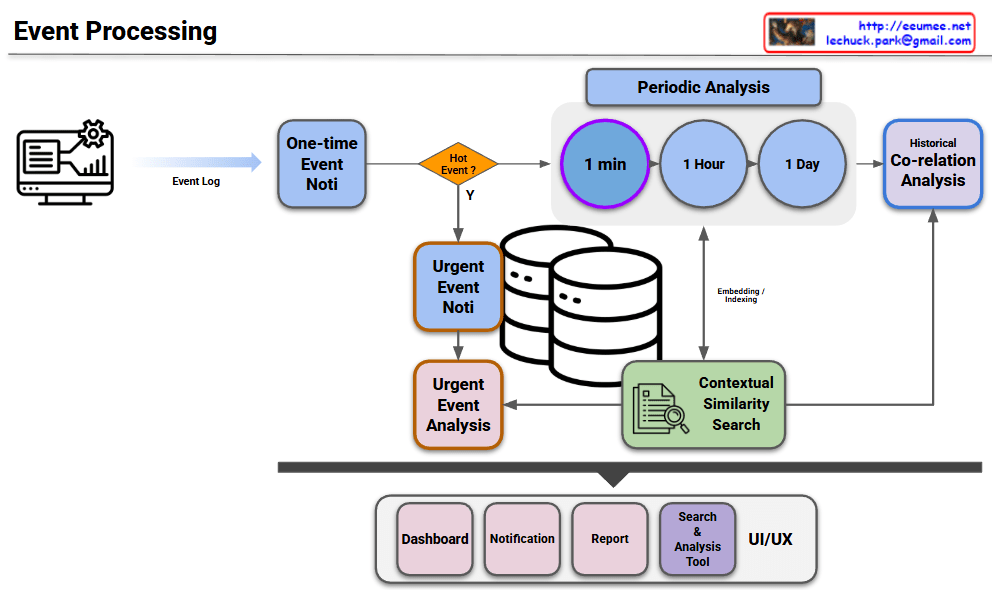
This diagram illustrates a workflow that handles system logs/events by dividing them into real-time urgent responses and periodic deep analysis.

1. Data Ingestion & Filtering

  • Event Log → One-time Event Noti: The process begins with incoming event logs triggering an initial, single-instance notification.
  • Hot Event Decision: A decision node determines if the event is critical (“Hot Event?”). This splits the workflow into two distinct paths: a Hot Path for emergencies and an Analytical Path for deeper insights.

2. Hot Path (Real-time Response)

  • Urgent Event Noti & Analysis: If identified as a “Hot Event,” the system immediately issues an urgent notification and performs an urgent analysis while persisting the data to the database. This path appears designed to minimize MTTD (Mean Time To Detect) for critical failures.

3. Periodic & Contextual Analysis (AIOps Layer)

This section indicates a shift from simple monitoring to intelligent AIOps.

  • Periodic Analysis: Events are aggregated and analyzed over fixed time windows (1 min, 1 Hour, 1 Day). The purple highlight on “1 min” suggests the current focus is on short-term trend analysis.
  • Contextual Similarity Search: This is a critical advanced feature. By explicitly mentioning “Embedding / Indexing,” the architecture suggests the use of Vector Search (likely via a Vector DB). It implies the system doesn’t just match keywords but understands the semantic context of an error to find similar past cases.
  • Historical Co-relation Analysis: This module synthesizes the periodic trends and similarity search results to correlate the current event with historical patterns, aiding in Root Cause Analysis (RCA).

4. User Interface (UI/UX)

The processed insights are delivered to the user through four channels:

  • Dashboard: High-level status visualization.
  • Notification: Alerts for urgent issues.
  • Report: Summarized periodic findings.
  • Search & Analysis Tool: A tool for granular log investigation.

Summary

  1. Hybrid Architecture: Efficiently separates critical “Hot Event” handling (Real-time) from deep “Periodic Analysis” (Batch) to balance speed and insight.
  2. Semantic Intelligence: Incorporates “Contextual Similarity Search” using Embeddings, enabling the system to identify issues based on meaning rather than just keywords.
  3. Holistic Observability: interconnected modules (Urgent, Periodic, Historical) feed into a comprehensive UI/UX to support rapid decision-making and post-mortem analysis.

#EventProcessing #SystemArchitecture #VectorSearch #Observability #RCA

Labeling for AI World

The image illustrates a logical framework titled “Labeling for AI World,” which maps how human cognitive processes are digitized and utilized to train Large Language Models (LLMs). It emphasizes the transition from natural human perception to optimized AI integration.


1. The Natural Cognition Path (Top)

This track represents the traditional human experience:

  • World to Human with a Brain: Humans sense the physical world through biological organs, which the brain then analyzes and processes into information.
  • Human Life & History: This cognitive processing results in the collective knowledge, culture, and documented history of humanity.

2. The Digital Optimization Path (Bottom)

This track represents the technical pipeline for AI development:

  • World Data: Through Digitization, the physical world is converted into raw data stored in environments like AI Data Centers.
  • Human Optimization: This raw data is refined through processes like RLHF (Reinforcement Learning from Human Feedback) or fine-tuning to align AI behavior with human intent.
  • Human Life with AI (LLM): The end goal is a lifestyle where humans and LLMs coexist, with the AI acting as a sophisticated partner in daily life.

3. The Central Bridge: Labeling (Corpus & Ontology)

The most critical element of the diagram is the central blue box, which acts as a bridge between human logic and machine processing:

  • Corpus: Large-scale structured text data necessary for training.
  • Ontology: The formal representation of categories, properties, and relationships between concepts that define the human “worldview.”
  • The Link: High-quality Labeling ensures that AI optimization is grounded in human-defined logic (Ontology) and comprehensive language data (Corpus), ensuring both Quality and Optimization.

Summary

The diagram demonstrates that Data Labeling, guided by Corpus and Ontology, is the essential mechanism that translates human cognition into the digital realm. It ensures that LLMs are not just processing raw numbers, but are optimized to understand the world through a human-centric logical framework.

#AI #DataLabeling #LLM #Ontology #Corpus #CognitiveComputing #AIOptimization #DigitalTransformation

With Gemini

Numeric Data Processing


Architecture Overview

The diagram illustrates a tiered approach to Numeric Data Processing, moving from simple monitoring to advanced predictive analytics:

  • 1-D Processing (Real-time Detection): This layer focuses on individual metrics. It emphasizes high-resolution data acquisition with precise time-stamping to ensure data quality. It uses immediate threshold detection to recognize critical changes as they happen.
  • Static Processing (Statistical & ML Analysis): This stage introduces historical context. It applies statistical functions (like averages and deviations) to identify trends and uses Machine Learning (ML) models to detect anomalies that simple thresholds might miss.
  • n-D Processing (Correlative Intelligence): This is the most sophisticated layer. It groups multiple metrics to find correlations, creating “New Numeric Data” (synthetic metrics). By analyzing the relationship between different data points, it can identify complex root causes in highly interleaved systems.

Summary

  1. The framework transitions from reactive 1-D monitoring to proactive n-D correlation, enhancing the depth of system observability.
  2. It integrates statistical functions and machine learning to filter noise and identify true anomalies based on historical patterns rather than just fixed limits.
  3. The ultimate goal is to achieve high-fidelity data processing that enables automated severity detection and complex pattern recognition across multi-dimensional datasets.

#DataProcessing #AIOps #MachineLearning #Observability #Telemetry #SystemArchitecture #AnomalyDetection #DigitalTwin #DataCenterOps #InfrastructureMonitoring

With Gemini

“End-to-End AI Factory Optimization: From Infrastructure to SLA


End-to-End AI Factory Optimization: Bridging Infrastructure and Business Value

This diagram outlines a comprehensive framework for optimizing an “AI Factory”—a modern data center dedicated to AI workloads. The core message is that optimizing AI performance and cost requires a holistic view that connects physical infrastructure realities directly to high-level business Service Level Agreements (SLAs).

Here is a breakdown of the three main pillars of this framework:

1. The AI Factory (Infrastructure Foundation)

On the far left, we see the AI Factory itself. This represents the converged physical infrastructure required to run massive AI models (indicated by the neural network icons).

It emphasizes that the critical hardware components—GPUs (Compute), Networking, Power, and Cooling—cannot be managed in silos. They are marked as “ULTRA CONNECTED,” meaning the behavior of one directly impacts the others (e.g., intense GPU activity spikes power demand and generates immediate heat, requiring instant cooling response).

2. Ultra Data Quality (The Intelligence Layer)

In the center, the diagram highlights the necessity of Ultra Data Quality. To optimize such a complex, interconnected system, standard logging isn’t enough. The telemetry data collected from the infrastructure must meet three critical criteria:

  • Ultra Precision & Resolution: Capturing minute details of operations.
  • Ultra Time-Sync: The ability to perfectly synchronize timestamps across different hardware types (e.g., nanosecond-level GPU events vs. millisecond-level cooling events) to understand cause-and-effect relationships accurately.

3. Cost & SLA vs. Usage+Performance (The Value Realization)

The right section is the most critical, showing the direct mapping between physical operational metrics (Usage+Performance) and business outcomes (Cost & SLA). It argues that physical stability directly dictates business success:

  • TOKEN (Output/Revenue) ↔ Clock Consistency: To maintain a steady stream of AI output (tokens), the GPU clock speeds must remain consistent and stable without fluctuating.
  • FLOPS (Peak Compute Power) ↔ Zero Throttling Events: Achieving maximum floating-point operations per second requires eliminating “throttling”—performance downgrades caused by overheating or power constraints.
  • Watt (Operational Cost) ↔ Power Draw vs TDP: Managing operational expenses (electricity bills) requires optimizing the actual power draw relative to the hardware’s Thermal Design Power (TDP) limits.
  • PUE (Data Center Efficiency) ↔ Thermal Headroom: The overall Power Usage Effectiveness of the facility depends on optimizing “thermal headroom”—managing how close the cooling systems run to their limits without wasting energy.

This diagram illustrates that optimizing an AI business isn’t just about better code or faster chips; it requires an end-to-end approach where the physical realities of power, cooling, and hardware are tightly integrated with data analytics to ensure performance promises (SLAs) are met cost-effectively.


#AIFactory #DataCenterOptimization #AIInfrastructure #GPUComputing #SLAmanagement #EnergyEfficiency #PUE #Operations #TechInnovation #ArtificialIntelligence

AI GPU Cost

AI GPU Service Cost Proof

This image outlines a framework for justifying the cost of AI GPU services (such as cloud or bare-metal leasing) by strictly proving performance quality. The core theme is “Transparency with Metrics,” demonstrating Stability and Efficiency through data rather than empty promises.

Here is a breakdown of the four key quadrants:

1. Clock Speed Consistency (Top Left)

  • Metric: Stable SM (Streaming Multiprocessor) Clock.
  • Meaning: This tracks the operating frequency of the GPU’s core compute units over time.
  • Significance: The graph should ideally be a flat line. Fluctuations indicate “clock jitter,” which leads to unpredictable training times and inconsistent performance. A stable clock proves the power delivery is clean and the workload is steady.

2. Zero Throttling Events (Top Right)

  • Metric: Count of ‘SW Power Cap’ and ‘Thermal Slowdown’ events.
  • Meaning: It verifies whether the GPU had to forcibly lower its performance (throttle) due to overheating or hitting power limits.
  • Significance: The goal is Zero (0). Any positive number means the infrastructure failed to support the GPU’s maximum potential, wasting the customer’s money and time.

3. Thermal Headroom (Bottom Left)

  • Metric: Temperature Margin (vs. $T_{limit}$).
    • (Note: The text box in the image incorrectly repeats “Streaming Multiprocessor Clock Changes,” likely a copy-paste error, but the gauge clearly indicates Temperature).
  • Meaning: It displays the gap between the current operating temperature and the GPU’s thermal limit.
  • Significance: Operating with a safe margin (headroom) prevents thermal throttling and ensures hardware longevity during long-running AI workloads.

4. Power Draw vs TDP (Bottom Right)

  • Metric: Max Power Utilization vs. Thermal Design Power (TDP).
    • (Note: The text box here also appears to be a copy-paste error from the top right, but the gauge represents Power/Watts).
  • Meaning: It measures how close the actual power consumption is to the GPU’s rated maximum (TDP).
  • Significance: If the power draw is consistently close to the TDP (e.g., 700W), it proves the GPU is being fully utilized. If it’s low despite a heavy workload, it suggests a bottleneck elsewhere (network, CPU, or power delivery issues).

Summary

  1. Objective: To validate service fees by providing transparent, data-driven proof of infrastructure quality.
  2. Key Metrics: Focuses on maintaining Stable Clocks, ensuring Zero Throttling, securing Thermal Headroom, and maximizing Power Utilization.
  3. Value: It acts as a technical SLA (Service Level Agreement), assuring users that the environment allows the GPUs to perform at 100% capacity without degradation.

#AIDataCenter #GPUOptimization #ServiceLevelAgreement #CloudInfrastructure #Nvidia #HighPerformanceComputing #DataCenterOps #GreenComputing #TechTransparency #AIInfrastructure

With Gemini

Time Constant(Delay of the sensor)

Image Interpretation: System Problems Due to Sensor Delay

This diagram explains system performance issues caused by the Time Constant (delay) of temperature sensors.

Top Section: Two Workload Scenarios

LLM Workload (AI Tasks)

  • Runs at 100% workload
  • Almost no delay (No Delay almost)
  • Result: Performance Down and Workload Cost waste

GPU Workload

  • Operating at 80°C
  • Thermal Throttling occurs
  • Transport Delay exists
  • Performance degradation starts at 60°C → Step down

Bottom Section: Core of the Sensor Delay Problem

Timeline:

  1. Sensor UP start (Temperature Sensor activation)
    • Big Delay due to Time Constant
  2. TC63 (After 10-20 seconds)
    • Sensor detects 63% temperature rise
    • Actual temperature is already higher
  3. After 30-40 seconds
    • Sensor detects 86% rise
    • Temperature Divergence, Late Cooling problem occurs

Key Issues

Due to the sensor’s Time Constant delay:

  • Takes too long to detect actual temperature rise
  • Cooling system activates too late
  • GPU already overheated, causing thermal throttling
  • Results in workload cost waste and performance degradation

Summary

Sensor delays create a critical gap between actual temperature and detected temperature, causing cooling systems to react too late. This results in GPU thermal throttling, performance degradation, and wasted computational resources. Real-time monitoring with fast-response sensors is essential for optimal system performance.


#ThermalManagement #SensorDelay #TimeConstant #GPUThrottling #DataCenter #PerformanceOptimization #CoolingSystem #AIWorkload #SystemMonitoring #HardwareEngineering #ThermalThrottling #LatencyChallenges #ComputeEfficiency #ITInfrastructure #TemperatureSensing

With Claude

2 Key Points For Digitalizations

2 Key Points For Digitalizations

This diagram illustrates two essential elements for successful digital transformation.

1️⃣ Data Quality

“High Precision & High Resolution”

The left section shows the data collection and quality management phase:

  • Facility/Device: Physical infrastructure including servers, networks, power systems, and cooling equipment
  • Data Generator: Generates data from various sources
  • 3T Process:
    • Performance: Data collection and measurement
    • Transform: Data processing and standardization
    • Transfer: Data movement and delivery

The key is to secure high-quality data with high precision and resolution.

2️⃣ Fast & Accurate Data Correlation

“Rapid Data Correlation Analysis with AI”

The right section represents the data utilization phase:

  • Data Storing: Systematic storage in various types of databases
  • Monitoring: Real-time system surveillance and alerts
  • Analysis: In-depth data analysis and insight extraction

The ultimate goal is to quickly and accurately identify correlations between data using AI.

Core Message

The keys to successful digitalization are:

  1. Input Stage: Accurate and detailed data collection
  2. Output Stage: Fast and precise AI-based analysis

True digital transformation becomes possible when these two elements work in harmony.


Summary

✅ Successful digitalization requires two pillars: high-quality data input (high precision & resolution) and intelligent output (AI-driven analysis).

✅ The process flows from facility infrastructure through data generation, the 3T transformation (Performance-Transform-Transfer), to storage, monitoring, and analysis.

✅ When quality data collection meets fast AI correlation analysis, organizations achieve meaningful digital transformation and actionable insights.

#DigitalTransformation #DataQuality #AIAnalysis #DataCorrelation #HighPrecisionData #BigData #DataDriven #Industry40 #SmartFactory #DataInfrastructure #DigitalStrategy #AIInsights #DataManagement #TechInnovation #EnterpriseIT

With Claude