AI DC AGENT

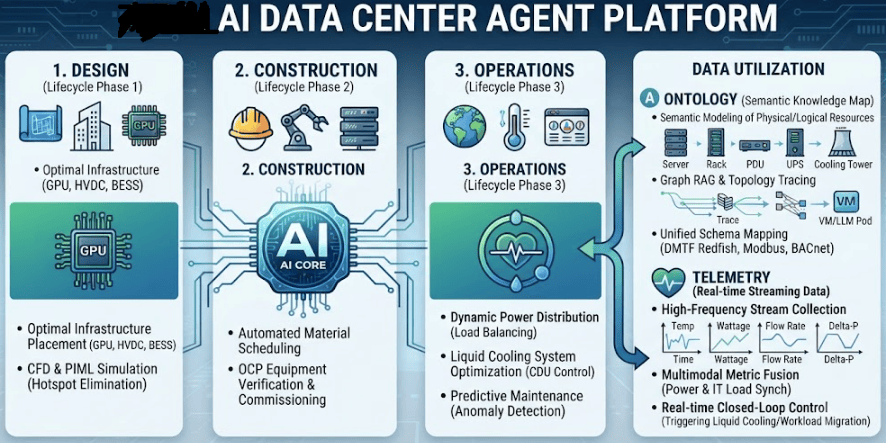
At the top of the image is the title “AI DATA CENTER AGENT PLATFORM”, outlining a system structured around three lifecycle phases and a Data Utilization sector, all orchestrated by the central ‘AI CORE’.

1. DESIGN (Lifecycle Phase 1)

  • Key Role: Determines optimal infrastructure layouts for high-density GPU clusters, 800V HVDC, and BESS.
  • Core Technology: Uses CFD and PIML simulations to preemptively eliminate thermal hotspots.

2. CONSTRUCTION (Lifecycle Phase 2)

  • Key Role: Automates material procurement scheduling and verifies installation compliance for OCP standard equipment.
  • Core Technology: Streamlines the commissioning process to eliminate human errors and enhance deployment efficiency.

3. OPERATIONS (Lifecycle Phase 3)

  • Key Role: Executes dynamic power distribution (load balancing) for real-time load fluctuations and optimizes liquid cooling via CDU control.
  • Core Technology: Performs predictive maintenance with anomaly detection to preemptively prevent failures.

4. DATA UTILIZATION

  • A. ONTOLOGY (Semantic Knowledge Map)
    • Defines hierarchical relationships among physical and logical resources (Servers, Racks, PDUs, UPS, Cooling Towers) using semantic modeling.
    • Utilizes Graph RAG and topology mapping to trace affected VMs or LLM serving Pods within milliseconds during a failure.
    • Integrates heterogeneous equipment data through standardized schemas (DMTF Redfish, Modbus, BACnet).
  • B. TELEMETRY (Real-time Streaming Data)
    • Collects high-frequency time-series streaming data including temperature, wattage, flow rate, and delta-P.
    • Fuses power infrastructure metrics with IT workload metrics to predict thermal and power peaks proactively.

#AIDataCenter #DataCenterLifecycle #Ontology #Telemetry #ClosedLoopControl #LiquidCooling #GraphRAG #AIInfrastructure

With Gemini
Ontology+Telemetry

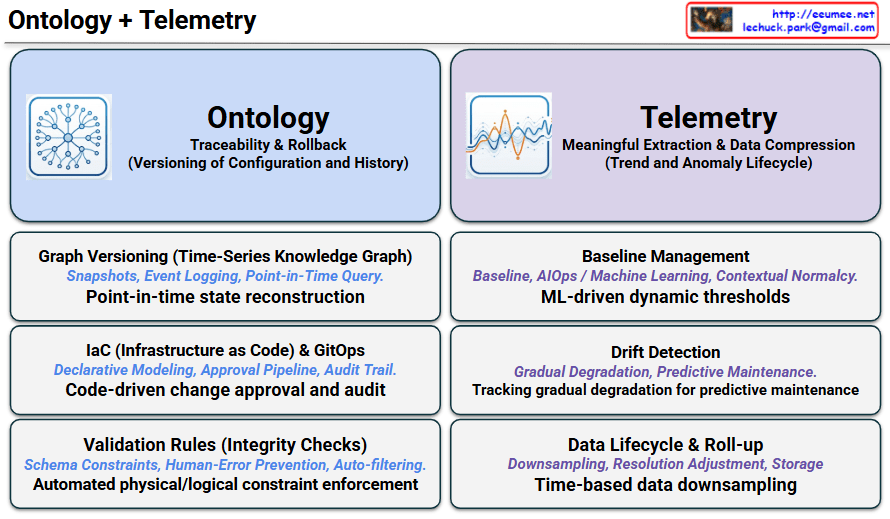
The image is titled “Ontology + Telemetry” at the top and is divided into two main columns: a blue-themed section for “Ontology” on the left, and a purple-themed section for “Telemetry” on the right.

1. Left Section: Ontology At the top left, there is an icon of a network graph with connected nodes. The primary focus of this section is “Traceability & Rollback,” which involves the versioning of configuration and history. It details three key components:

  • Graph Versioning (Time-Series Knowledge Graph): Associated with snapshots, event logging, and point-in-time queries. Its main function is “Point-in-time state reconstruction.”
  • IaC (Infrastructure as Code) & GitOps: Focuses on declarative modeling, approval pipelines, and audit trails to enable “Code-driven change approval and audit.”
  • Validation Rules (Integrity Checks): Utilizes schema constraints and auto-filtering to prevent human error, leading to “Automated physical/logical constraint enforcement.”

2. Right Section: Telemetry At the top right, there is an icon depicting line graphs and fluctuating data waves. The primary focus here is “Meaningful Extraction & Data Compression,” managing the lifecycle of trends and anomalies. It also lists three key components:

  • Baseline Management: Uses AIOps and machine learning for contextual normalcy, establishing “ML-driven dynamic thresholds.”
  • Drift Detection: Involves monitoring gradual degradation and enables “Tracking gradual degradation for predictive maintenance.”
  • Data Lifecycle & Roll-up: Deals with downsampling, resolution adjustment, and storage optimization through “Time-based data downsampling.”

๐Ÿ’ก Summary
This infographic outlines a comprehensive framework for managing modern IT infrastructure and data centers. It contrasts and combines two essential pillars: “Ontology,” which handles the static configuration, tracing structural changes and rollbacks, and “Telemetry,” which processes dynamic operational metrics to extract meaningful trends and predict anomalies.

#Ontology #Telemetry #ITInfrastructure #DataCenterManagement #AIOps #ConfigurationManagement #PredictiveMaintenance #GitOps

Labeling for AI World

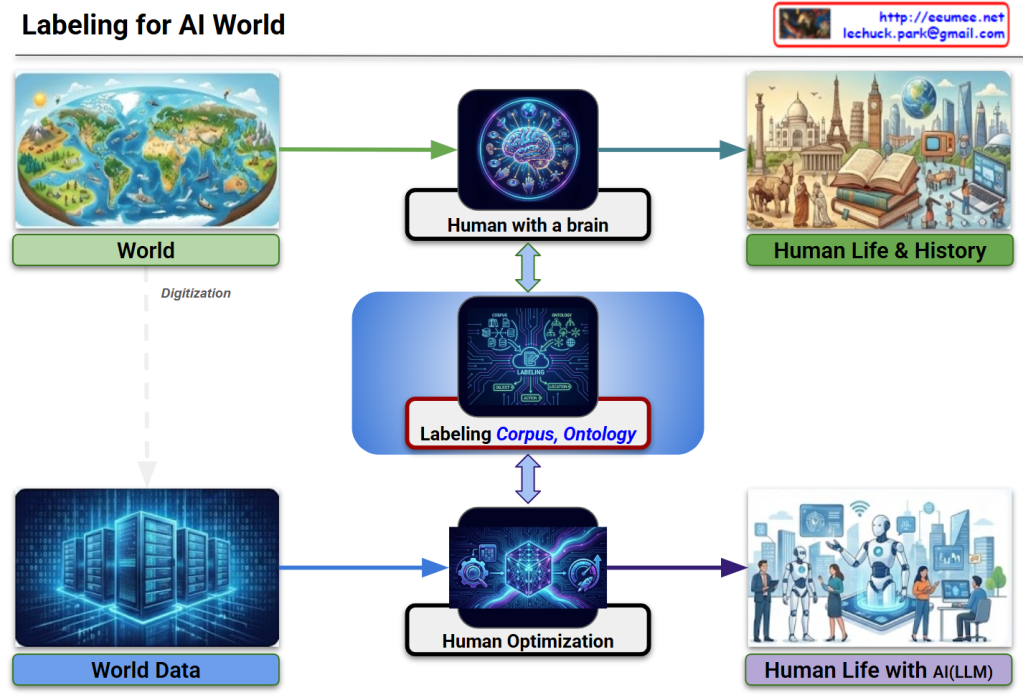
The image illustrates a logical framework titled “Labeling for AI World,” which maps how human cognitive processes are digitized and utilized to train Large Language Models (LLMs). It emphasizes the transition from natural human perception to optimized AI integration.


1. The Natural Cognition Path (Top)

This track represents the traditional human experience:

  • World to Human with a Brain: Humans sense the physical world through biological organs, which the brain then analyzes and processes into information.
  • Human Life & History: This cognitive processing results in the collective knowledge, culture, and documented history of humanity.

2. The Digital Optimization Path (Bottom)

This track represents the technical pipeline for AI development:

  • World Data: Through Digitization, the physical world is converted into raw data stored in environments like AI Data Centers.
  • Human Optimization: This raw data is refined through processes like RLHF (Reinforcement Learning from Human Feedback) or fine-tuning to align AI behavior with human intent.
  • Human Life with AI (LLM): The end goal is a lifestyle where humans and LLMs coexist, with the AI acting as a sophisticated partner in daily life.

3. The Central Bridge: Labeling (Corpus & Ontology)

The most critical element of the diagram is the central blue box, which acts as a bridge between human logic and machine processing:

  • Corpus: Large-scale structured text data necessary for training.
  • Ontology: The formal representation of categories, properties, and relationships between concepts that define the human “worldview.”
  • The Link: High-quality Labeling ensures that AI optimization is grounded in human-defined logic (Ontology) and comprehensive language data (Corpus), ensuring both Quality and Optimization.

Summary

The diagram demonstrates that Data Labeling, guided by Corpus and Ontology, is the essential mechanism that translates human cognition into the digital realm. It ensures that LLMs are not just processing raw numbers, but are optimized to understand the world through a human-centric logical framework.

#AI #DataLabeling #LLM #Ontology #Corpus #CognitiveComputing #AIOptimization #DigitalTransformation

With Gemini

Corpus, Ontology and LLM

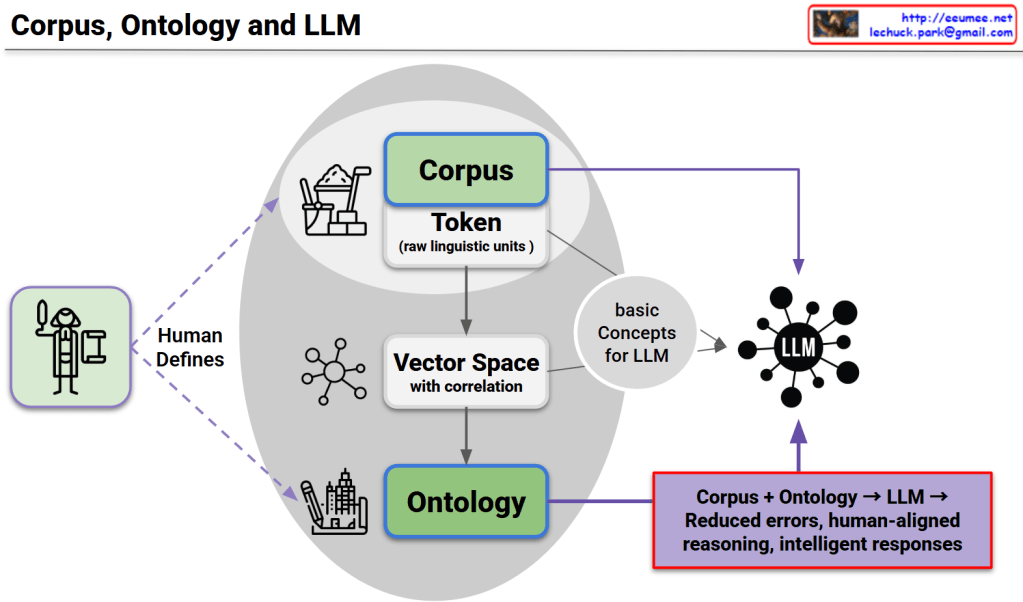
This diagram presents a unified framework consisting of three core structures, their interconnected relationships, and complementary utilization as the foundation for LLM advancement.

Three Core Structures

1. Corpus Structure

  • Token-based raw linguistic data
  • Provides statistical language patterns and usage frequency information

2. Ontology Structure

  • Systematically human-defined conceptual knowledge structure
  • Provides logical relationships and semantic hierarchies

3. LLM Structure

  • Neural network-based language processing model
  • Possesses pattern learning and generation capabilities

Interconnected Relationships and Interactions

  • Corpus โ†’ Vector Space: Numerical representation transformation of linguistic data
  • Ontology โ†’ Basic Concepts: Conceptual abstraction of structured knowledge
  • Vector Space โ†” Ontology: Mutual validation between statistical patterns and logical structures
  • Integrated Concepts โ†’ LLM: Multi-layered knowledge input

LLM Development Foundation through Complementary Relationships

Each structure compensates for the limitations of others:

  • Corpus’s statistical accuracy + Ontology’s logical consistency โ†’ Balanced knowledge foundation
  • Ontology’s explicit rules + LLM’s pattern learning โ†’ Flexible yet systematic reasoning
  • Corpus’s real-usage data + LLM’s generative capability โ†’ Natural and accurate language generation

Final Achievement

This triangular complementary structure overcomes the limitations of single approaches to achieve:

  • Error minimization
  • Human-centered reasoning capabilities
  • Intelligent and reliable response generation

This represents the core foundation for next-generation LLM development.

With Claude