AI Data Center: Critical Bottlenecks and Technological Solutions


AI Data Center: Critical Bottlenecks and Technological Solutions

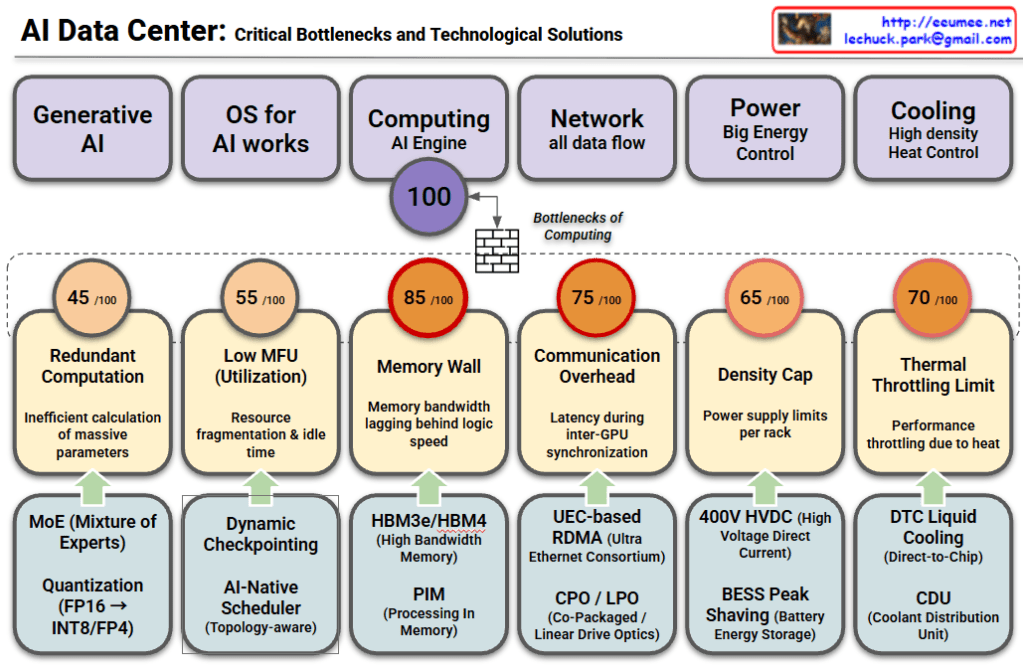
This chart analyzes the major challenges facing modern AI Data Centers across six key domains. It outlines the [Domain] → [Bottleneck/Problem] → [Solution] flow, indicating the severity of each bottleneck with a score out of 100.

1. Generative AI

  • Bottleneck (45/100): Redundant Computation
    • Inefficiencies occur when calculating massive parameters for large models.
  • Solutions:
    • MoE (Mixture of Experts): Uses only relevant sub-models (experts) for specific tasks to reduce computation.
    • Quantization (FP16 → INT8/FP4): Reduces data precision to speed up processing and save memory.

2. OS for AI Works

  • Bottleneck (55/100): Low MFU (Model Flops Utilization)
    • Issues with resource fragmentation and idle time result in underutilization of hardware.
  • Solutions:
    • Dynamic Checkpointing: Efficiently saves model states during training.
    • AI-Native Scheduler: Optimizes task distribution based on network topology.

3. Computing / AI Engine (Most Critical)

  • Bottleneck (85/100): Memory Wall
    • Marked as the most severe bottleneck, where memory bandwidth cannot keep up with the speed of logic processors.
  • Solutions:
    • HBM3e/HBM4: Next-generation High Bandwidth Memory.
    • PIM (Processing In Memory): Performs calculations directly within memory to reduce data movement.

4. Network

  • Bottleneck (75/100): Communication Overhead
    • Latency issues arise during synchronization between multiple GPUs.
  • Solutions:
    • UEC-based RDMA: Ultra Ethernet Consortium standards for faster direct memory access.
    • CPO / LPO: Advanced optics (Co-Packaged/Linear Drive) to improve data transmission efficiency.

5. Power

  • Bottleneck (65/100): Density Cap
    • Physical limits on how much power can be supplied per server rack.
  • Solutions:
    • 400V HVDC: High Voltage Direct Current for efficient power delivery.
    • BESS Peak Shaving: Using Battery Energy Storage Systems to manage peak power loads.

6. Cooling

  • Bottleneck (70/100): Thermal Throttling Limit
    • Performance drops (throttling) caused by excessive heat in high-density racks.
  • Solutions:
    • DTC Liquid Cooling: Direct-to-Chip liquid cooling technologies.
    • CDU: Coolant Distribution Units for effective heat management.

Summary

  1. The “Memory Wall” (85/100) is identified as the most critical bottleneck in AI Data Centers, meaning memory bandwidth is the primary constraint on performance.
  2. To overcome these limits, the industry is adopting advanced hardware like HBM and Liquid Cooling, alongside software optimizations like MoE and Quantization.
  3. Scaling AI infrastructure requires a holistic approach that addresses computing, networking, power efficiency, and thermal management simultaneously.

#AIDataCenter #ArtificialIntelligence #MemoryWall #HBM #LiquidCooling #GenerativeAI #TechTrends #AIInfrastructure #Semiconductor #CloudComputing

With Gemini

AI Operation : All Connected

AI Operation: All Connected – Image Analysis

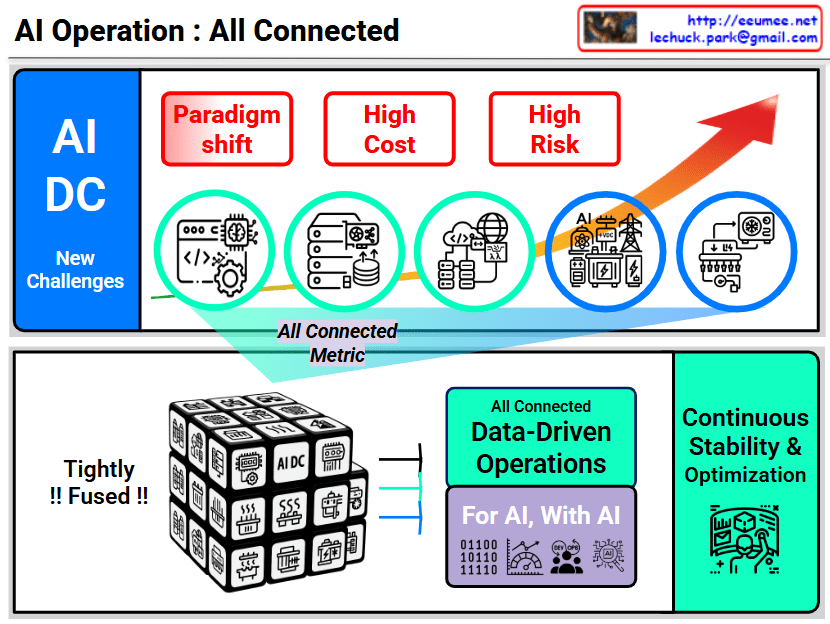
This diagram explains the operational paradigm shift in AI Data Centers (AI DC).

Top Section: New Challenges

AI DC Characteristics:

  • Paradigm shift: Fundamental change in operations for the AI era
  • High Cost: Massive investment required for GPUs, infrastructure, etc.
  • High Risk: Greater impact during outages and increased complexity

Five Core Components of AI DC (left→right):

  1. Software: AI models, application development
  2. Computing: GPUs, servers, and computational resources
  3. Network: Data transmission and communication infrastructure
  4. Power: High-density power supply and management (highlighted in orange)
  5. Cooling: Heat management and cooling systems

→ These five elements are interconnected through the “All Connected Metric”

Bottom Section: Integrated Operations Solution

Core Concept:

📦 Tightly Fused Rubik’s Cube

  • The five core components (Software, Computing, Network, Power, Cooling) are intricately intertwined like a Rubik’s cube
  • Changes or issues in one element affect all other elements due to tight coupling

🎯 All Connected Data-Driven Operations

  • Data-driven integrated operations: Collecting and analyzing data from all connected elements
  • “For AI, With AI”: Operating the data center itself using AI technology for AI workloads

Continuous Stability & Optimization

  • Ensuring continuous stability
  • Real-time monitoring and optimization

Key Message

AI data centers have five core components—Software, Computing, Network, Power, and Cooling—that are tightly fused together. To effectively manage this complex system, a data-centric approach that integrates and analyzes data from all components is essential, enabling continuous stability and optimization.


Summary

AI data centers are characterized by tightly coupled components (software, computing, network, power, cooling) that create high complexity, cost, and risk. This interconnected system requires data-driven operations that leverage AI to monitor and optimize all elements simultaneously. The goal is achieving continuous stability and optimization through integrated, real-time management of all connected metrics.

#AIDataCenter #DataDrivenOps #AIInfrastructure #DataCenterOptimization #TightlyFused #AIOperations #HybridInfrastructure #IntelligentOps #AIforAI #DataCenterManagement #MLOps #AIOps #PowerManagement #CoolingOptimization #NetworkInfrastructure

Data Center Shift with AI

Data Center Shift with AI

This diagram illustrates how data centers are transforming as they enter the AI era.

📅 Timeline of Technological Evolution

The top section shows major technology revolutions and their timelines:

  • Internet ’95 (Internet era)
  • Mobile ’07 (Mobile era)
  • Cloud ’10 (Cloud era)
  • Blockchain
  • AI(LLM) ’22 (Large Language Model-based AI era)

🏢 Traditional Data Center Components

Conventional data centers consisted of the following core components:

  • Software
  • Server
  • Network
  • Power
  • Cooling

These were designed as relatively independent layers.

🚀 New Requirements in the AI Era

With the introduction of AI (especially LLMs), data centers require specialized infrastructure:

  1. LLM Model – Operating large language models
  2. GPU – High-performance graphics processing units (essential for AI computations)
  3. High B/W – High-bandwidth networks (for processing large volumes of data)
  4. SMR/HVDC – Switched-Mode Rectifier/High-Voltage Direct Current power systems
  5. Liquid/CDU – Liquid cooling/Cooling Distribution Units (for cooling high-heat GPUs)

🔗 Key Characteristic of AI Data Centers: Integrated Design

The circular connection in the center of the diagram represents the most critical feature of AI data centers:

Tight Interdependency between SW/Computing/Network ↔ Power/Cooling

Unlike traditional data centers, in AI data centers:

  • GPU-based computing consumes enormous power and generates significant heat
  • High B/W networks consume additional power during massive data transfers between GPUs
  • Power systems (SMR/HVDC) must stably supply high power density
  • Liquid cooling (Liquid/CDU) must handle high-density GPU heat in real-time

These elements must be closely integrated in design, and optimizing just one element cannot guarantee overall system performance.

💡 Key Message

AI workloads require moving beyond the traditional layer-by-layer independent design approach of conventional data centers, demanding that computing-network-power-cooling be designed as one integrated system. This demonstrates that a holistic approach is essential when building AI data centers.


📝 Summary

AI data centers fundamentally differ from traditional data centers through the tight integration of computing, networking, power, and cooling systems. GPU-based AI workloads create unprecedented power density and heat generation, requiring liquid cooling and HVDC power systems. Success in AI infrastructure demands holistic design where all components are co-optimized rather than independently engineered.

#AIDataCenter #DataCenterEvolution #GPUInfrastructure #LiquidCooling #AIComputing #LLM #DataCenterDesign #HighPerformanceComputing #AIInfrastructure #HVDC #HolisticDesign #CloudComputing #DataCenterCooling #AIWorkloads #FutureOfDataCenters

With Claude

Cooling for AI (heavy heater)

AI Data Center Cooling System Architecture Analysis

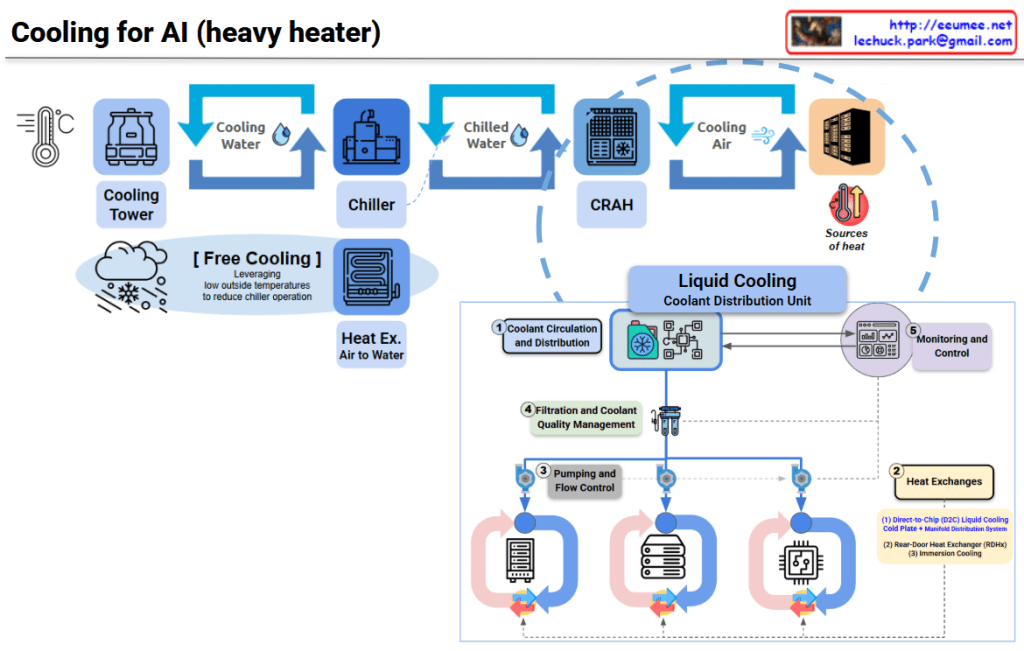
This diagram illustrates the evolution of data center cooling systems designed for high-heat AI workloads.

Traditional Cooling System (Top Section)

Three-Stage Cooling Process:

  1. Cooling Tower – Uses ambient air to cool water
  2. Chiller – Further refrigerates the cooled water
  3. CRAH (Computer Room Air Handler) – Distributes cold air to the server room

Free Cooling option is shown, which reduces chiller operation by leveraging low outside temperatures for energy savings.

New Approach for AI DC: Liquid Cooling System (Bottom Section)

To address extreme heat generation from high-density AI chips, a CDU (Coolant Distribution Unit) based liquid cooling system has been introduced.

Key Components:

① Coolant Circulation and Distribution

  • Direct coolant circulation system to servers

② Heat Exchanges (Two Methods)

  • Direct-to-Chip (D2C) Liquid Cooling: Cold plate with manifold distribution system directly contacting chips
  • Rear-Door Heat Exchanger (RDHx): Heat exchanger mounted on rack rear door (immersion cooling)

③ Pumping and Flow Control

  • Pumps and flow control for coolant circulation

④ Filtration and Coolant Quality Management

  • Maintains coolant quality and removes contaminants

⑤ Monitoring and Control

  • Real-time monitoring and cooling performance control

Critical Differences

Traditional Method: Air cooling → Indirect, suitable for low-density workloads

AI DC Method: Liquid cooling → Direct, high-efficiency, capable of handling high TDP (Thermal Design Power) of AI chips

Liquid has approximately 25x better heat transfer efficiency than air, making it effective for cooling AI accelerators (GPUs, TPUs) that generate hundreds of watts to kilowatt-level heat.


Summary:

  1. Traditional data centers use air-based cooling (Cooling Tower → Chiller → CRAH), suitable for standard workloads.
  2. AI data centers require liquid cooling with CDU systems due to extreme heat from high-density AI chips.
  3. Liquid cooling offers direct-to-chip heat removal with 25x better thermal efficiency than air, supporting kW-level heat dissipation.

#AIDataCenter #LiquidCooling #DataCenterInfrastructure #CDU #ThermalManagement #DirectToChip #AIInfrastructure #GreenDataCenter #HeatDissipation #HyperscaleComputing #AIWorkload #DataCenterCooling #ImmersionCooling #EnergyEfficiency #NextGenDataCenter

With Claude

Power for AI

AI Data Center Power Infrastructure: 3 Key Transformations

Traditional Data Center Power Structure (Baseline)

Power Grid → Transformer → UPS → Server (220V AC)

  • Single power grid connection
  • Standard UPS backup (10-15 minutes)
  • AC power distribution
  • 200-300W per server

3 Critical Changes for AI Data Centers

🔴 1. More Power (Massive Power Supply)

Key Changes:

  • Diversified power sources:
    • SMR (Small Modular Reactor) – Stable baseload power
    • Renewable energy integration
    • Natural gas turbines
    • Long-term backup generators + large fuel tanks

Why: AI chips (GPU/TPU) consume kW to tens of kW per server

  • Traditional server: 200-300W
  • AI server: 5-10 kW (25-50x increase)
  • Total data center power demand: Hundreds of MW scale

🔴 2. Stable Power (Power Quality & Conditioning)

Key Changes:

  • 800V HVDC system – High-voltage DC transmission
  • ESS (Energy Storage System) – Large-scale battery storage
  • Peak Shaving – Peak load control and leveling
  • UPS + Battery/Flywheel – Instantaneous outage protection
  • Power conditioning equipment – Voltage/frequency stabilization

Why: AI workload characteristics

  • Instantaneous power surges (during inference/training startup)
  • High power density (30-100 kW per rack)
  • Power fluctuation sensitivity – Training interruption = days of work lost
  • 24/7 uptime requirements

🔴 3. Server Power (High-Efficiency Direct DC Delivery)

Key Changes:

  • Direct-to-Chip DC power delivery
  • Rack-level battery systems (Lithium/Supercapacitor)
  • High-density power distribution

Why: Maximize efficiency

  • Eliminate AC→DC conversion losses (5-15% efficiency gain)
  • Direct chip-level power supply – Minimize conversion stages
  • Ultra-high rack density support (100+ kW/rack)
  • Even minor voltage fluctuations are critical – Chip-level stabilization needed

Key Differences Summary

CategoryTraditional DCAI Data Center
Power ScaleFew MWHundreds of MW
Rack Density5-10 kW/rack30-100+ kW/rack
Power MethodAC-centricHVDC + Direct DC
Backup PowerUPS (10-15 min)Multi-tier (Generator+ESS+UPS)
Power StabilityStandardExtremely high reliability
Energy SourcesSingle gridMultiple sources (Nuclear+Renewable)

Summary

AI data centers require 25-50x more power per server, demanding massive power infrastructure with diversified sources including SMRs and renewables

Extreme workload stability needs drive multi-tier backup systems (ESS+UPS+Generator) and advanced power conditioning with 800V HVDC

Direct-to-chip DC power delivery eliminates conversion losses, achieving 5-15% efficiency gains critical for 100+ kW/rack densities

#AIDataCenter #DataCenterPower #HVDC #DirectDC #EnergyStorageSystem #PeakShaving #SMR #PowerInfrastructure #HighDensityComputing #GPUPower #DataCenterDesign #EnergyEfficiency #UPS #BackupPower #AIInfrastructure #HyperscaleDataCenter #PowerConditioning #DCPower #GreenDataCenter #FutureOfComputing

With Claude

From Stability to Turbulence: Why Smart Operations Matter Most

History always alternates between periods of stability and turbulence. In turbulent times, management and operations become critical, since small decisions can determine survival. This shift mirrors the move from static, stability-focused maintenance to agile, data-driven, and adaptive operations.

#PhilosophyShift #DataDriven #AdaptiveOps #AIDataCenter #ResilientManagement #StabilityToAgility

“Tightly Fused” in AI DC

This diagram illustrates a “Tightly Fused” AI datacenter architecture showing the interdependencies between system components and their failure points.

System Components

  • LLM SW: Large Language Model Software
  • GPU Server: Computing infrastructure with cooling fans
  • Power: Electrical power supply system
  • Cooling: Thermal management system

Critical Issues

1. Power Constraints

  • Lack of power leads to power-limited throttling in GPU servers
  • Results in decreased TFLOPS/kW (computational efficiency per watt)

2. Cooling Limitations

  • Insufficient cooling causes thermal throttling
  • Increases risk of device errors and failures

3. Cost Escalation

  • Already high baseline costs
  • System bottlenecks drive costs even higher

Core Principle

The bottom equation demonstrates the fundamental relationship: Computing (→ Heat) = Power = Cooling

This shows that computational workload generates heat, requiring equivalent power supply and cooling capacity to maintain optimal performance.

Summary

This diagram highlights how AI datacenters require perfect balance between computing, power, and cooling systems – any bottleneck in one area cascades into performance degradation and cost increases across the entire infrastructure.

#AIDatacenter #MLInfrastructure #GPUComputing #DataCenterDesign #AIInfrastructure #ThermalManagement #PowerEfficiency #ScalableAI #HPC #CloudInfrastructure #AIHardware #SystemArchitecture

With Claude