Hardware Scaling Era

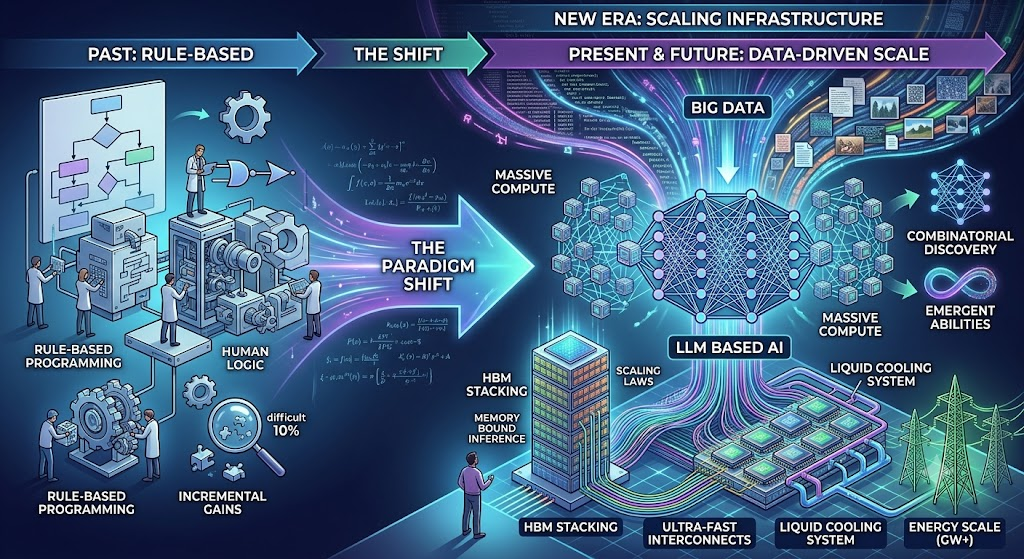
This image is a detailed conceptual infographic illustrating the paradigm shift in Artificial Intelligence development, moving from traditional rule-based programming to massive, data-driven large language models supported by extensive hardware infrastructure.

Past: Rule-Based (The Left Section)

This section, labeled “PAST: RULE-BASED,” depicts the old approach to software engineering.

  • Visuals: Human scientists are shown meticulously working with complex gears, flowchart diagrams, and logic gates on a giant, complex machine. They are carefully adjusting small puzzle pieces with a magnifying glass.
  • Key Terms: Labels include “RULE-BASED PROGRAMMING,” “HUMAN LOGIC,” “INCREMENTAL GAINS,” and “difficult 10%.”
  • Message: This represents an era where software was built upon explicit, human-defined rules and logic. Development was slow, focused on manual optimization, and faced diminishing returns.

The Shift (The Center Section)

A massive central arrow labeled “THE SHIFT” (and “THE PARADIGM SHIFT”) cuts across the timeline, pointing toward the new era. Floating mathematical formulas indicate the algorithmic breakthroughs that enable the change.

  • Message: This arrow symbolizes the critical transition where the focus moved from human-written rules to data-driven learning and scaling.

Present & Future: Data-Driven Scale (The Right Section)

The right half, labeled “PRESENT & FUTURE: DATA-DRIVEN SCALE” and headlined “NEW ERA: SCALING INFRASTRUCTURE,” details the current landscape.

  • LLM Based AI: At the center is a gigantic, multi-layered neural network core labeled “LLM BASED AI.” Massive streams of diverse “BIG DATA” (text, images, code, documents) pour into this core.
  • Emergent Abilities: This massive data processing leads to new, complex outcomes labeled “COMBINATORIAL DISCOVERY” and “EMERGENT ABILITIES,” which are represented by an infinite loop symbol. A small human figure stands at the bottom, looking up in awe at this colossal system.
  • Scaling Infrastructure (The Bottom and Right): The lower part of this section highlights the critical physical hardware needed to sustain this large-scale AI. This includes:
    • HBM Stacking: Tall memory towers with “HBM STACKING” and “MEMORY BOUND INFERENCE” labels, showing high-bandwidth memory.
    • Scaling Laws: A label pointing to the neural network, referencing the scaling laws that dictate performance gains.
    • Liquid Cooling System: Detailed pipes and coolant flow, labeled “LIQUID COOLING SYSTEM,” showing the need for advanced thermal management.
    • Ultra-Fast Interconnects: Networks of optical fibers linking massive numbers of GPU units, labeled “ULTRA-FAST INTERCONNECTS.”
    • Energy Scale (GW+): Massive power infrastructure, including transmission towers, labeled “ENERGY SCALE (GW+),” signifying the immense power demands.

Summary

The infographic perfectly captures the evolution from human-driven rule-based programming to a new epoch of data-driven AI, centered on Large Language Models (LLMs). It emphasizes that the core of AI innovation has shifted from purely mathematical algorithms to the development of massive scaling infrastructure, including advanced high-bandwidth memory (HBM), ultra-fast interconnections, complex liquid cooling systems, and enormous power grids (GW+) capable of sustaining these colossal computational demands.

#AIInfra #LargeLanguageModels #AInfrastructure #DataDrivenScale #HBM #ScalingLaws #FutureOfTech #AIHardware #NewAIERA #ParadigShift

with Gemini
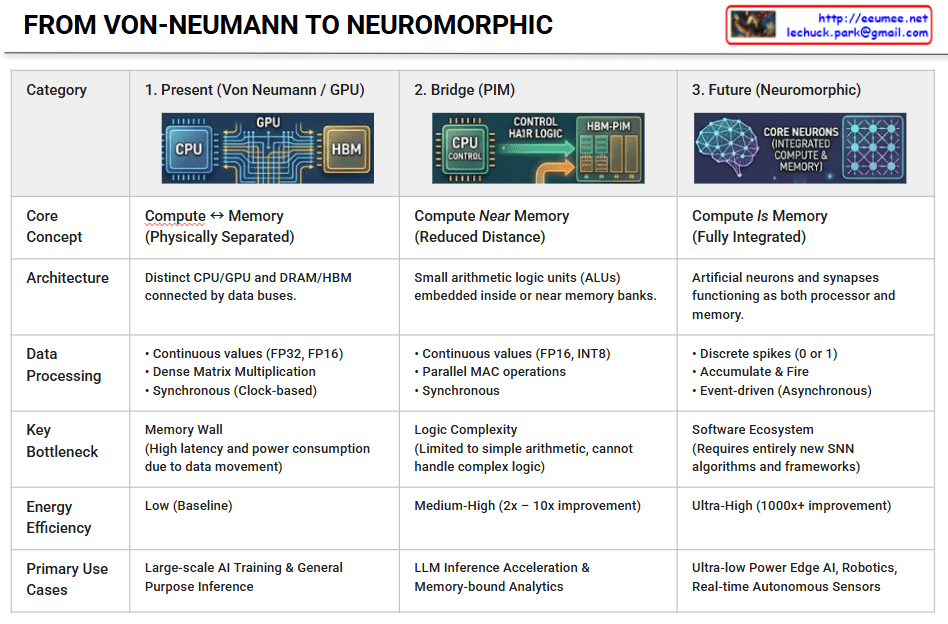
FROM VON-NEUMANN TO NEUROMORPHIC

From Von Neumann to Neuromorphic Computing

1. Core Concept

  • Present (Von Neumann / GPU): Compute -> Memory (Physically Separated) – Processing units and memory units are distinct and physically separated, requiring constant data transfer.
  • Bridge (PIM – Processing-In-Memory): Compute Near Memory (Reduced Distance) – Processing capabilities are brought closer to or inside the memory to drastically minimize data movement distance.
  • Future (Neuromorphic): Compute Is Memory (Fully Integrated) – Processing and memory functions are entirely integrated into a single unified structure, mimicking the human brain.

2. Architecture

  • Present (Von Neumann / GPU): Composed of distinct CPU/GPU and DRAM/HBM components interconnected via traditional data buses.
  • Bridge (PIM): Small arithmetic logic units (ALUs) are embedded directly inside or adjacent to the memory banks.
  • Future (Neuromorphic): Built with artificial neurons and synapses that simultaneously function as both processors and memory storage.

3. Data Processing

  • Present (Von Neumann / GPU): Processes continuous values (e.g., FP32, FP16) utilizing dense matrix multiplication under a synchronous (clock-based) mechanism.
  • Bridge (PIM): Processes continuous values (e.g., FP16, INT8) using parallel MAC (Multiply-Accumulate) operations under a synchronous mechanism.
  • Future (Neuromorphic): Processes discrete spikes (0 or 1) using an “Accumulate & Fire” method under an event-driven (asynchronous) mechanism.

4. Key Bottleneck

  • Present (Von Neumann / GPU): Memory Wall – High latency and massive power consumption caused by the constant bottleneck of moving data back and forth between the processor and memory.
  • Bridge (PIM): Logic Complexity – Restricted to simple arithmetic and operations; struggles to handle highly complex logic tasks natively.
  • Future (Neuromorphic): Software Ecosystem – Lacks standard adoption; requires completely new Spiking Neural Network (SNN) algorithms, programming paradigms, and software frameworks.

5. Energy Efficiency

  • Present (Von Neumann / GPU): Low (Serves as the baseline).
  • Bridge (PIM): Medium-High (2x to 10x improvement compared to the baseline).
  • Future (Neuromorphic): Ultra-High (1000x+ improvement compared to the baseline).

6. Primary Use Cases

  • Present (Von Neumann / GPU): Large-scale AI model training and general-purpose inference workloads.
  • Bridge (PIM): Large Language Model (LLM) inference acceleration and memory-bound big data analytics.
  • Future (Neuromorphic): Ultra-low-power Edge AI devices, advanced robotics, and real-time autonomous sensor systems.

Summary

The landscape of computing architecture is shifting from the traditional Von Neumann model to brain-inspired Neuromorphic computing to overcome the critical “Memory Wall” bottleneck. PIM (Processing-In-Memory) serves as an immediate bridge by placing basic computing logic inside memory chips to accelerate data-heavy tasks like LLM inference. Ultimately, the future lies in Neuromorphic architecture, which completely integrates processing and memory using asynchronous, event-driven spikes. This evolution promises an unparalleled leap in energy efficiency (over 1000x), paving the way for autonomous, ultra-low-power intelligent systems at the edge.

#AIHardware #NeuromorphicComputing #ProcessingInMemory #PIM #VonNeumann #GPU #Semiconductor #NextGenTech #EdgeAI #ComputerArchitecture

With Gemini

Groq_LPU

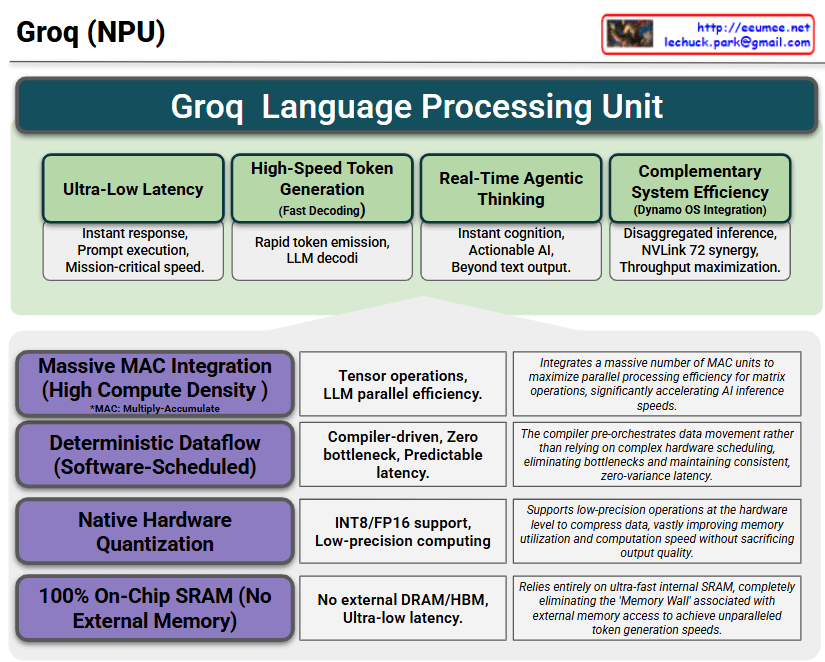
The core strength of this slide is how it connects the Capabilities/Benefits (The “What”) at the top with the Core Technologies (The “How”) at the bottom.

1. Top Section (Green): The Capabilities & Benefits of LPU

This section highlights the immediate, tangible values achieved by deploying the Groq architecture.

  • Ultra-Low Latency & High-Speed Token Gen: Emphasizes the crucial need for instant response times and rapid LLM decoding for real-time services. (Note: There is a minor typo in the second box—”decodi” should be “decoding”.)
  • Real-Time Agentic Thinking: Shows that this speed elevates the AI from a simple text generator to an actionable agent capable of instant cognition.
  • Complementary System Efficiency: Highlights the strategic advantage of “Disaggregated Inference,” where the LPU handles fast generation while partnering with high-throughput systems (like NVLink 72) to maximize the overall data center throughput.

2. Bottom Section (Grey): The 4 Core Technologies

This section details the specific engineering choices that make the top section’s performance possible.

  • Massive MAC Integration: The sheer density of compute units required for parallel tensor operations.
  • Deterministic Dataflow: The software/compiler-driven approach that eliminates hardware scheduling bottlenecks, ensuring predictable, zero-variance latency.
  • Native Hardware Quantization: The built-in support for low-precision formats (INT8/FP16) to speed up math and save memory.
  • 100% On-Chip SRAM: The most critical differentiator—completely bypassing external memory (DRAM/HBM) to shatter the “Memory Wall.”

Summary

  • Logical Architecture: The slide perfectly visualizes how four radical hardware design choices directly enable four critical performance benefits for AI inference.
  • The Speed Secret: It highlights that Groq’s unprecedented speed and predictable latency come from eliminating external memory (100% SRAM) and relying on software-scheduled dataflow.
  • System Synergy: It effectively positions the LPU not as a standalone replacement, but as a specialized engine for real-time agentic thinking that complements high-throughput data center systems.

#Groq #LPU #AIHardware #DataCenter #AIInference #NPU #AIAgents #DisaggregatedInference

With Gemini

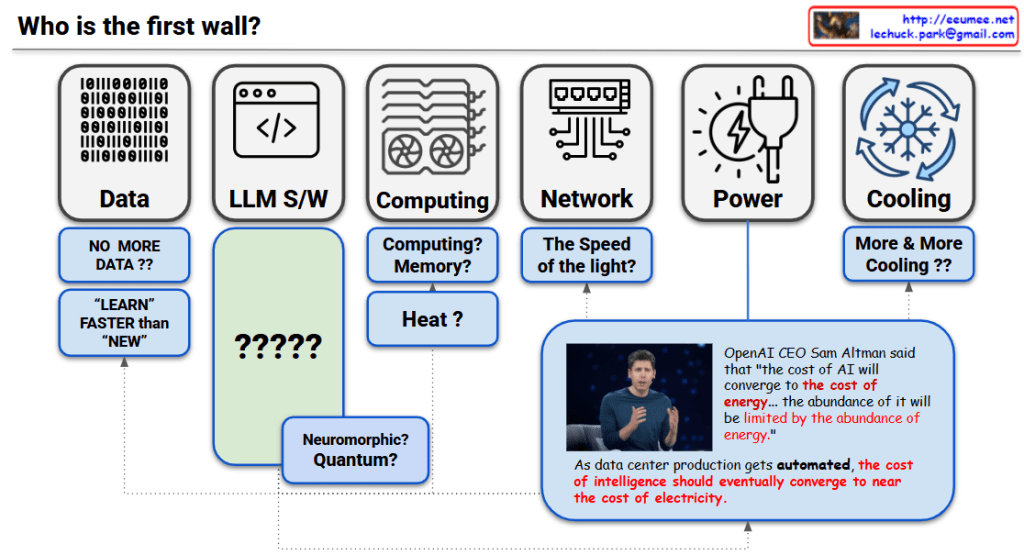
Who is the first wall?

AI Scaling: The 6 Major Bottlenecks (2025)

1. Data

  • High-quality text data expected to be depleted by 2026
  • Solutions: Synthetic data (fraud detection in finance, medical data), Few-shot learning

2. LLM S/W (Algorithms)

  • Ilya Sutskever: “The era of simple scaling is over. Now it’s about scaling the right things”
  • Innovation directions: Test-time compute scaling (OpenAI o1), Mixture-of-Experts architecture, Hybrid AI

3. Computing → Heat

  • GPT-3 training required 1,024 A100 GPUs for several months
  • By 2030, largest training runs projected at 2-45GW scale
  • GPU cluster heat generation makes cooling a critical challenge

4. Memory & Network ⚠️ Current Critical Bottleneck

Memory

  • LLMs grow 410x/2yr, computing power 750x/2yr vs DRAM bandwidth only 2x/2yr
  • HBM3E completely sold out for 2024-2025. AI memory market projected to grow at 27.5% CAGR

Network

  • Speed of light limitation causes tens to hundreds of ms latency over distance. Critical for real-time applications (autonomous vehicles, AR)
  • Large-scale GPU clusters require 800Gbps+, microsecond-level ultra-low latency

5. Power 💡 Long-term Core Constraint

  • Sam Altman: “The cost of AI will converge to the cost of energy. The abundance of AI will be limited by the abundance of energy”
  • Power infrastructure (transmission lines, transformers) takes years to build
  • Data centers projected to consume 7.5% of US electricity by 2030

6. Cooling

  • Advanced technologies like liquid cooling required. Infrastructure upgrades take 1+ year

“Who is the first wall?”

Critical Bottlenecks by Timeline:

  1. Current (2025): Memory bandwidth + Data quality
  2. Short-to-Mid term: Power infrastructure (5-10 years to build)
  3. Long-term: Physical limit of the speed of light

Summary

The “first wall” in AI scaling is not a single barrier but a multi-layered constraint system that emerges sequentially over time. Today’s immediate challenges are memory bandwidth and data quality, followed by power infrastructure limitations in the mid-term, and ultimately the fundamental physical constraint of the speed of light. As Sam Altman emphasized, AI’s future abundance will be fundamentally limited by energy abundance, with all bottlenecks interconnected through the computing→heat→cooling→power chain.


#AIScaling #AIBottleneck #MemoryBandwidth #HBM #DataCenterPower #AIInfrastructure #SpeedOfLight #SyntheticData #EnergyConstraint #AIFuture #ComputingLimits #GPUCluster #TestTimeCompute #MixtureOfExperts #SamAltman #AIResearch #MachineLearning #DeepLearning #AIHardware #TechInfrastructure

With Claude

“Tightly Fused” in AI DC

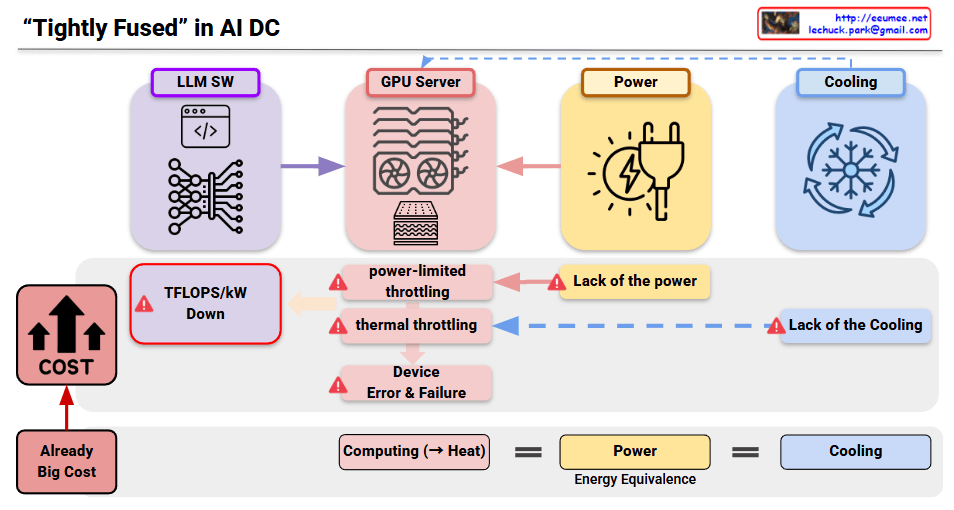
This diagram illustrates a “Tightly Fused” AI datacenter architecture showing the interdependencies between system components and their failure points.

System Components

  • LLM SW: Large Language Model Software
  • GPU Server: Computing infrastructure with cooling fans
  • Power: Electrical power supply system
  • Cooling: Thermal management system

Critical Issues

1. Power Constraints

  • Lack of power leads to power-limited throttling in GPU servers
  • Results in decreased TFLOPS/kW (computational efficiency per watt)

2. Cooling Limitations

  • Insufficient cooling causes thermal throttling
  • Increases risk of device errors and failures

3. Cost Escalation

  • Already high baseline costs
  • System bottlenecks drive costs even higher

Core Principle

The bottom equation demonstrates the fundamental relationship: Computing (→ Heat) = Power = Cooling

This shows that computational workload generates heat, requiring equivalent power supply and cooling capacity to maintain optimal performance.

Summary

This diagram highlights how AI datacenters require perfect balance between computing, power, and cooling systems – any bottleneck in one area cascades into performance degradation and cost increases across the entire infrastructure.

#AIDatacenter #MLInfrastructure #GPUComputing #DataCenterDesign #AIInfrastructure #ThermalManagement #PowerEfficiency #ScalableAI #HPC #CloudInfrastructure #AIHardware #SystemArchitecture

With Claude