RMC (Rack Management Controller) More

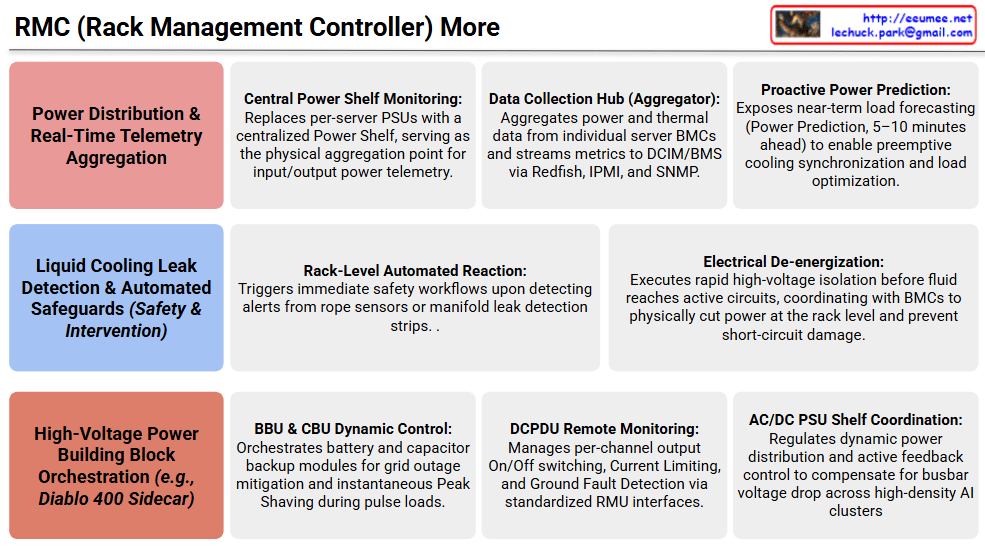
This infographic, titled “RMC (Rack Management Controller) More,” details the three advanced core roles and operational capabilities of the RMC (or RMU) in high-density AI data center environments across three color-coded horizontal rows.

1. Power Distribution & Real-Time Telemetry Aggregation

The top pink row covers IT-domain centralized power management and data aggregation.

  • Central Power Shelf Monitoring: Replaces per-server PSUs with a centralized Power Shelf, serving as the physical aggregation point for input/output power telemetry.
  • Data Collection Hub (Aggregator): Aggregates power and thermal data from individual server BMCs and streams metrics to DCIM/BMS via Redfish, IPMI, and SNMP.
  • Proactive Power Prediction: Exposes near-term load forecasting (Power Prediction, 5–10 minutes ahead) to enable preemptive cooling synchronization and load optimization.

2. Liquid Cooling Leak Detection & Automated Safeguards (Safety & Intervention)

The middle green row outlines safety workflows and physical intervention capabilities for liquid cooling architectures.

  • Rack-Level Automated Reaction: Triggers immediate safety workflows upon detecting alerts from rope sensors or manifold leak detection strips.
  • Electrical De-energization: Executes rapid high-voltage isolation before fluid reaches active circuits, coordinating with BMCs to physically cut power at the rack level and prevent short-circuit damage.

3. High-Voltage Power Building Block Orchestration (e.g., Diablo 400 Sidecar)

The bottom blue row highlights hardware-level orchestration across high-voltage power components.

  • BBU & CBU Dynamic Control: Orchestrates battery and capacitor backup modules for grid outage mitigation and instantaneous Peak Shaving during pulse loads.
  • DCPDU Remote Monitoring: Manages per-channel output On/Off switching, Current Limiting, and Ground Fault Detection via standardized RMU interfaces.
  • AC/DC PSU Shelf Coordination: Regulates dynamic power distribution and active feedback control to compensate for busbar voltage drop across high-density AI clusters.

Summary

This infographic highlights the evolution of the RMC from a passive monitoring unit to an active, rack-scale brain. It operates as an IT telemetry neural hub aggregating real-time BMC data and power forecasts, a safety intervention authority enforcing electrical de-energization during liquid cooling leaks, and a power orchestrator managing complex building blocks (BBU, CBU, DCPDU, PSU) in next-generation high-voltage architectures like Diablo 400.

#OCP #OpenRack #ORv3 #RMC #RMU #DataCenterInfrastructure #LiquidCooling #LeakDetection #PeakShaving #Diablo400 #PowerManagement #AIOps #Redfish

With Gemini
RMC (Rack Management Controller) in ORv3

RMC (Rack Management Controller) Features in ORv3

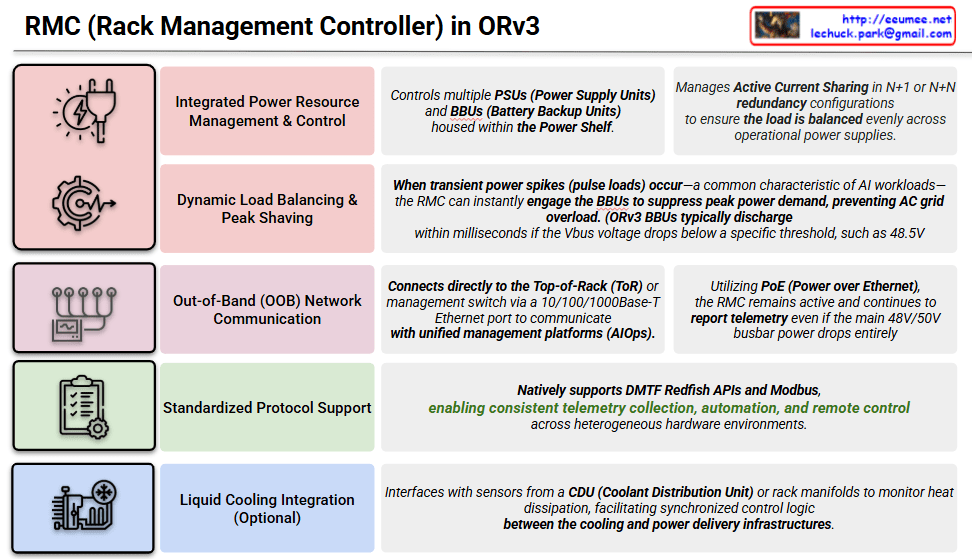
This image is an infographic that intuitively explains the five key functions of the RMC (Rack Management Controller) defined in the Open Compute Project (OCP) Open Rack v3 (ORv3) specification. Each function is categorized into a color-coded row, featuring a representative icon and title on the left, paired with a detailed description on the right.

1. Integrated Power Resource Management & Control

  • Icon: A gear with a power plug and a lightning bolt.
  • Detailed Description: This function controls multiple PSUs (Power Supply Units) and BBUs (Battery Backup Units) housed within the Power Shelf. It manages Active Current Sharing in N+1 or N+N redundancy configurations to ensure the load is balanced evenly across operational power supplies. This optimizes power efficiency and reliability.

2. Dynamic Load Balancing & Peak Shaving

  • Icon: A gear with a wave graph.
  • Detailed Description: When transient power spikes (pulse loads) occur—a common characteristic of AI workloads—the RMC can instantly engage the BBUs to suppress peak power demand, preventing AC grid overload. Note that ORv3 BBUs typically discharge within milliseconds if the Vbus voltage drops below a specific threshold, such as 48.5V.

3. Out-of-Band (OOB) Network Communication

  • Icon: A metering device with multiple cable connections.
  • Detailed Description: It connects directly to the Top-of-Rack (ToR) or management switch via a 10/100/1000Base-T Ethernet port to communicate with unified management platforms (AIOps). Utilizing PoE (Power over Ethernet), the RMC remains active and continues to report telemetry even if the main 48V/50V busbar power drops entirely, ensuring high availability of management functions.

4. Standardized Protocol Support

  • Icon: A clipboard with a checklist and a gear.
  • Detailed Description: The RMC natively supports DMTF Redfish APIs and Modbus. This enables consistent telemetry collection, automation, and remote control across heterogeneous hardware environments, facilitating interoperability in multi-vendor data centers.

5. Liquid Cooling Integration (Optional)

  • Icon: A gear shaped like a cooling system with piping and a fan.
  • Detailed Description: This optional feature interfaces with sensors from a CDU (Coolant Distribution Unit) or rack manifolds to monitor heat dissipation. This facilitates synchronized control logic between the cooling and power delivery infrastructures for holistic rack management.

Summary

This image illustrates the five core values of the RMC, a critical component of the OCP ORv3 standard rack. The RMC provides essential capabilities for advanced data center infrastructure management, including maximizing power efficiency, handling sudden power spikes typical of AI workloads, and maintaining management operations via PoE even during main power failures. Additionally, it addresses the complex demands of modern data centers through standardized protocol support and optional integration with liquid cooling systems.

#OCP #OpenComputeProject #ORv3 #RMC #RackManagementController #DataCenter #PowerManagement #PeakShaving #LiquidCooling #AIOps #Redfish

With Gemini
Redfish for AI DC

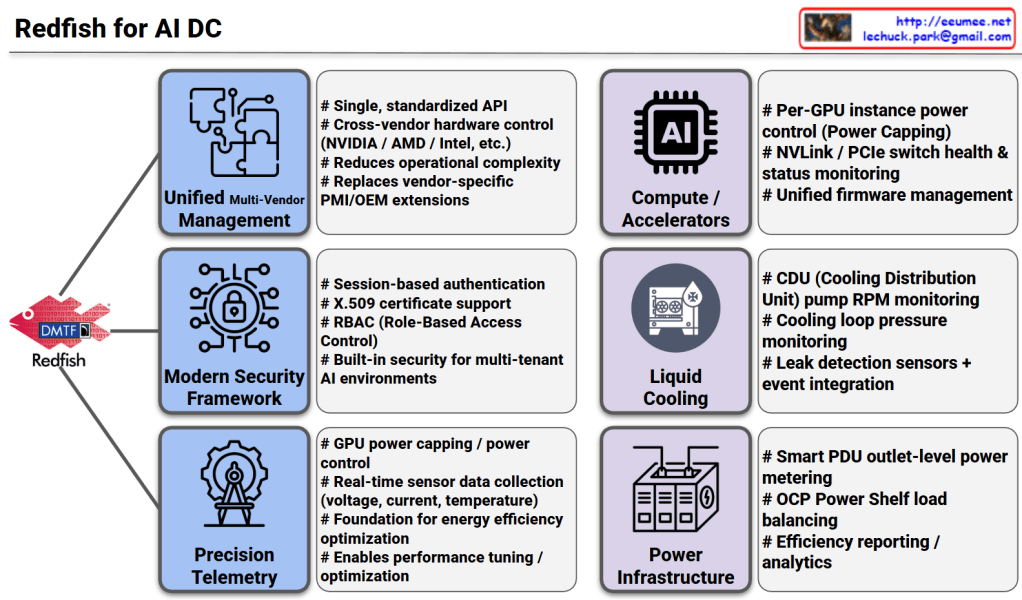
This image illustrates the pivotal role of the Redfish API (developed by DMTF) as the standardized management backbone for modern AI Data Centers (AI DC). As AI workloads demand unprecedented levels of power and cooling, Redfish moves beyond traditional server management to provide a unified framework for the entire infrastructure stack.


1. Management & Security Framework (Left Column)

  • Unified Multi-Vendor Management:
    • Acts as a single, standardized API to manage diverse hardware from different vendors (NVIDIA, AMD, Intel, etc.).
    • It reduces operational complexity by replacing fragmented, vendor-specific IPMI or OEM extensions with a consistent interface.
  • Modern Security Framework:
    • Designed for multi-tenant AI environments where security is paramount.
    • Supports robust protocols like session-based authentication, X.509 certificates, and RBAC (Role-Based Access Control) to ensure only authorized entities can modify critical infrastructure.
  • Precision Telemetry:
    • Provides high-granularity, real-time data collection for voltage, current, and temperature.
    • This serves as the foundation for energy efficiency optimization and fine-tuning performance based on real-time hardware health.

2. Infrastructure & Hardware Control (Right Column)

  • Compute / Accelerators:
    • Enables per-GPU instance power capping, allowing operators to limit power consumption at a granular level.
    • Monitors the health of high-speed interconnects like NVLink and PCIe switches, and simplifies firmware lifecycle management across the cluster.
  • Liquid Cooling:
    • As AI chips run hotter, Redfish integrates with CDU (Cooling Distribution Unit) systems to monitor pump RPM and loop pressure.
    • It includes critical safety features like leak detection sensors and integrated event handling to prevent hardware damage.
  • Power Infrastructure:
    • Extends management to the rack level, including Smart PDU outlet metering and OCP (Open Compute Project) Power Shelf load balancing.
    • Facilitates advanced efficiency analytics to drive down PUE (Power Usage Effectiveness).

Summary

For an AI DC Optimization Architect, Redfish is the essential “language” that enables Software-Defined Infrastructure. By moving away from manual, siloed hardware management and toward this API-driven approach, data centers can achieve the extreme automation required to shift OPEX structures predominantly toward electricity costs rather than labor.

#AIDataCenter #RedfishAPI #DMTF #DataCenterInfrastructure #GPUComputing #LiquidCooling #SustainableIT #SmartPDU #OCP #InfrastructureAutomation #TechArchitecture #EnergyEfficiency


With Gemini

CDU ( OCP Project Deschutes ) Numbers

OCP CDU (Deschutes) Standard Overview

The provided visual summarizes the key performance metrics of the CDU (Cooling Distribution Unit) that adheres to the OCP (Open Compute Project) ‘Project Deschutes’ specification. This CDU is designed for high-performance computing environments, particularly for massive-scale liquid cooling of AI/ML workloads.


Key Performance Indicators

  • System Availability: The primary target for system availability is 99.999%. This represents an extremely high level of reliability, with less than 5 minutes and 15 seconds of downtime per year.
  • Thermal Load Capacity: The CDU is designed to handle a thermal load of up to 2,000 kW, which is among the highest thermal capacities in the industry.
  • Power Usage: The CDU itself consumes 74 kW of power.
  • IT Flow Rate: It supplies coolant to the servers at a rate of 500 GPM (approximately 1,900 LPM).
  • Operating Pressure: The overall system operating pressure is within a range of 0-130 psig (approximately 0-900 kPa).
  • IT Differential Pressure: The pressure difference required on the server side is 80-90 psi (approximately 550-620 kPa).
  • Approach Temperature: The approach temperature, a key indicator of heat exchange efficiency, is targeted at ≤3∘C. A lower value is better, as it signifies more efficient heat removal.

Why Cooling is Crucial for GPU Performance

Cooling has a direct and significant impact on GPU performance and stability. Because GPUs are highly sensitive to heat, if they are not maintained within an optimal temperature range, they will automatically reduce their performance through a process called thermal throttling to prevent damage.

The ‘Project Deschutes’ CDU is engineered to prevent this by handling a massive thermal load of 2,000 kW with a powerful 500 GPM flow rate and a low approach temperature of ≤3∘C. This robust cooling capability ensures that GPUs can operate at their maximum potential without being limited by heat, which is essential for maximizing performance in demanding AI workloads.

with Gemini