RMC (Rack Management Controller) Features in ORv3
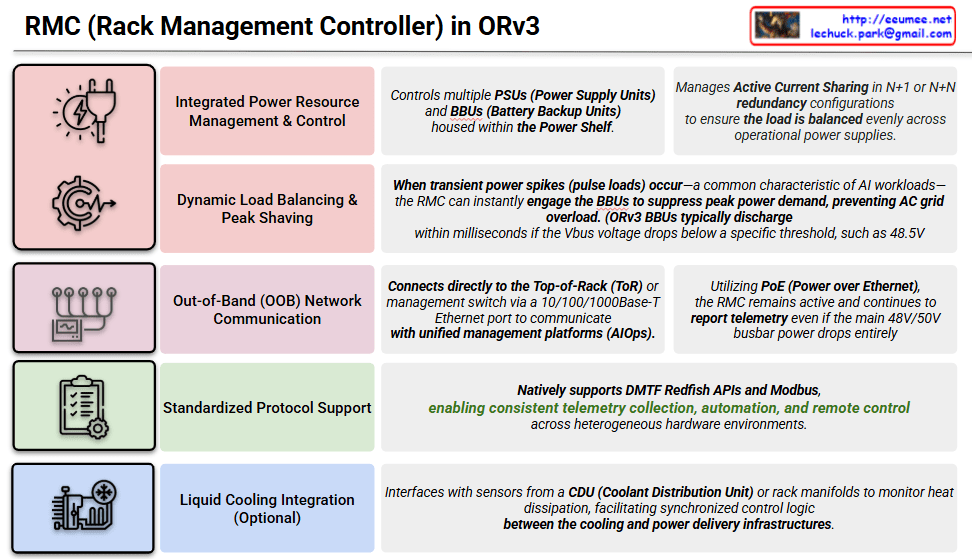
This image is an infographic that intuitively explains the five key functions of the RMC (Rack Management Controller) defined in the Open Compute Project (OCP) Open Rack v3 (ORv3) specification. Each function is categorized into a color-coded row, featuring a representative icon and title on the left, paired with a detailed description on the right.
1. Integrated Power Resource Management & Control
- Icon: A gear with a power plug and a lightning bolt.
- Detailed Description: This function controls multiple PSUs (Power Supply Units) and BBUs (Battery Backup Units) housed within the Power Shelf. It manages Active Current Sharing in N+1 or N+N redundancy configurations to ensure the load is balanced evenly across operational power supplies. This optimizes power efficiency and reliability.
2. Dynamic Load Balancing & Peak Shaving
- Icon: A gear with a wave graph.
- Detailed Description: When transient power spikes (pulse loads) occur—a common characteristic of AI workloads—the RMC can instantly engage the BBUs to suppress peak power demand, preventing AC grid overload. Note that ORv3 BBUs typically discharge within milliseconds if the Vbus voltage drops below a specific threshold, such as 48.5V.
3. Out-of-Band (OOB) Network Communication
- Icon: A metering device with multiple cable connections.
- Detailed Description: It connects directly to the Top-of-Rack (ToR) or management switch via a 10/100/1000Base-T Ethernet port to communicate with unified management platforms (AIOps). Utilizing PoE (Power over Ethernet), the RMC remains active and continues to report telemetry even if the main 48V/50V busbar power drops entirely, ensuring high availability of management functions.
4. Standardized Protocol Support
- Icon: A clipboard with a checklist and a gear.
- Detailed Description: The RMC natively supports DMTF Redfish APIs and Modbus. This enables consistent telemetry collection, automation, and remote control across heterogeneous hardware environments, facilitating interoperability in multi-vendor data centers.
5. Liquid Cooling Integration (Optional)
- Icon: A gear shaped like a cooling system with piping and a fan.
- Detailed Description: This optional feature interfaces with sensors from a CDU (Coolant Distribution Unit) or rack manifolds to monitor heat dissipation. This facilitates synchronized control logic between the cooling and power delivery infrastructures for holistic rack management.
Summary
This image illustrates the five core values of the RMC, a critical component of the OCP ORv3 standard rack. The RMC provides essential capabilities for advanced data center infrastructure management, including maximizing power efficiency, handling sudden power spikes typical of AI workloads, and maintaining management operations via PoE even during main power failures. Additionally, it addresses the complex demands of modern data centers through standardized protocol support and optional integration with liquid cooling systems.
#OCP #OpenComputeProject #ORv3 #RMC #RackManagementController #DataCenter #PowerManagement #PeakShaving #LiquidCooling #AIOps #Redfish
With Gemini


