’26 OCP Korea Techday https://ocpkorea.com/
#OCPKoreaTechDay #OCP #OpenComputerProject #DataCenter #OCPKorea #OpenSourece #TechConference #AIDataCenter
The Computing for the Fair Human Life.
’26 OCP Korea Techday https://ocpkorea.com/
#OCPKoreaTechDay #OCP #OpenComputerProject #DataCenter #OCPKorea #OpenSourece #TechConference #AIDataCenter
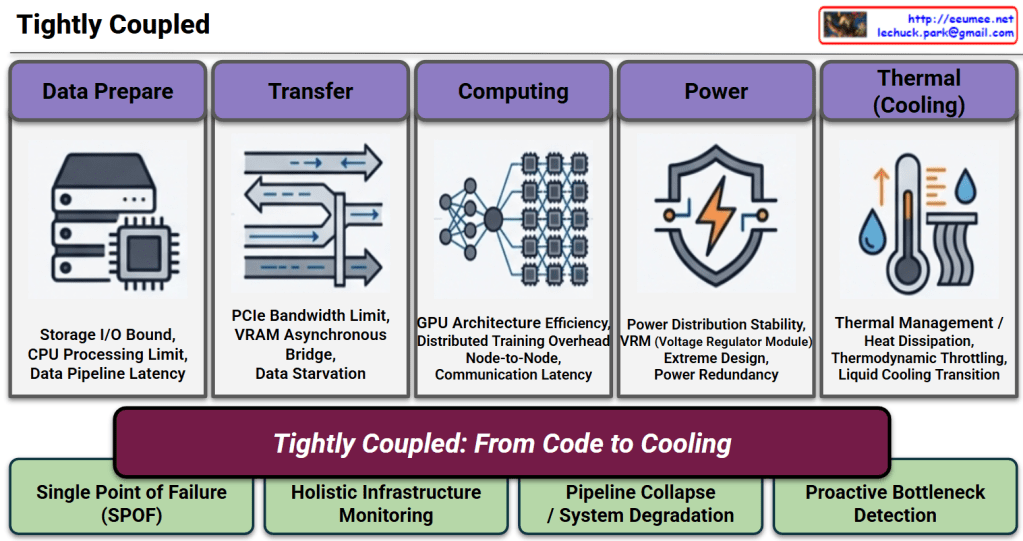
1. The 5 Pillars & Potential Bottlenecks (Top Section)
Data Prepare ➔ Transfer ➔ Computing ➔ Power ➔ Thermal (Cooling).2. The Core Message (Center Section)
3. Strategic Implications & Solutions (Bottom Section)
#AIDataCenter #TightlyCoupled #InfrastructureMonitoring #ProactiveOperations #DataCenterArchitecture #AIInfrastructure #Power #Computing #Cooling #Data #IO #Memory
With Gemini

This illustration visualizes the evolution of data centers, contrasting the traditionally separated components with the modern AI data center where software, compute, network, and crucially, power and cooling systems are ‘tightly fused’ together. It emphasizes how power and advanced cooling are organically intertwined with GPU and memory, directly impacting AI performance and highlighting their inseparable role in meeting the demands of high-performance AI. This tight integration symbolizes a pivotal shift for the modern AI era.
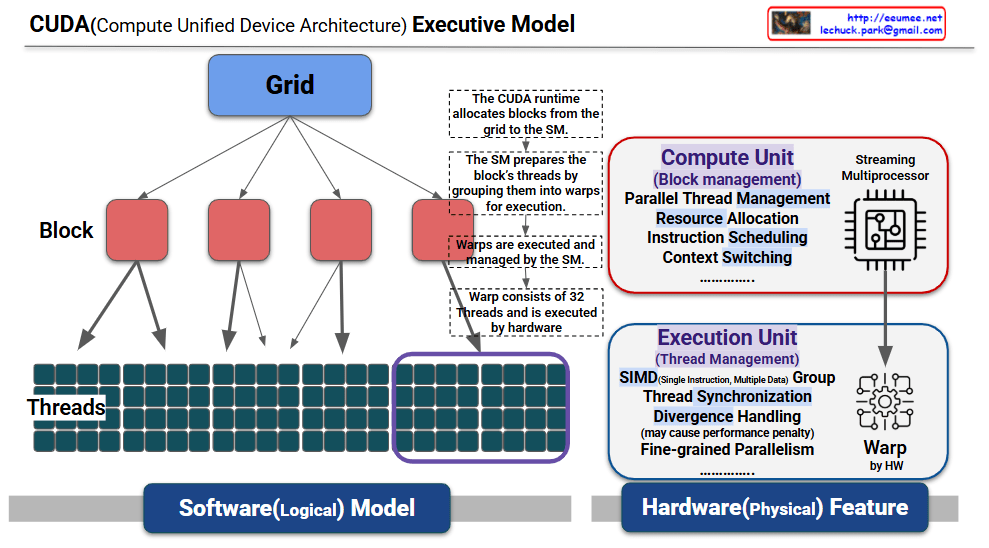
This is a structured explanation based on the provided CUDA (Compute Unified Device Architecture) execution model diagram. This diagram visually represents the relationship between the software (logical model) and hardware (physical device) layers in CUDA, illustrating the parallel processing mechanism step by step. The explanation reflects the diagram’s annotations and structure.
<<<blocksPerGrid, threadsPerBlock>>>).threadIdx) and processes different data.if-else), sequential execution occurs, potentially causing a performance penalty, as noted in “Divergence Handling (may cause performance penalty).”This diagram illustrates the CUDA execution model by mapping the software layers (grid → block → threads) to the hardware (SM → warp). The CUDA runtime allocates blocks from the grid to the SM, the SM groups threads into warps for execution, and warps perform parallel computations using the SIMT model.
Work with Grok
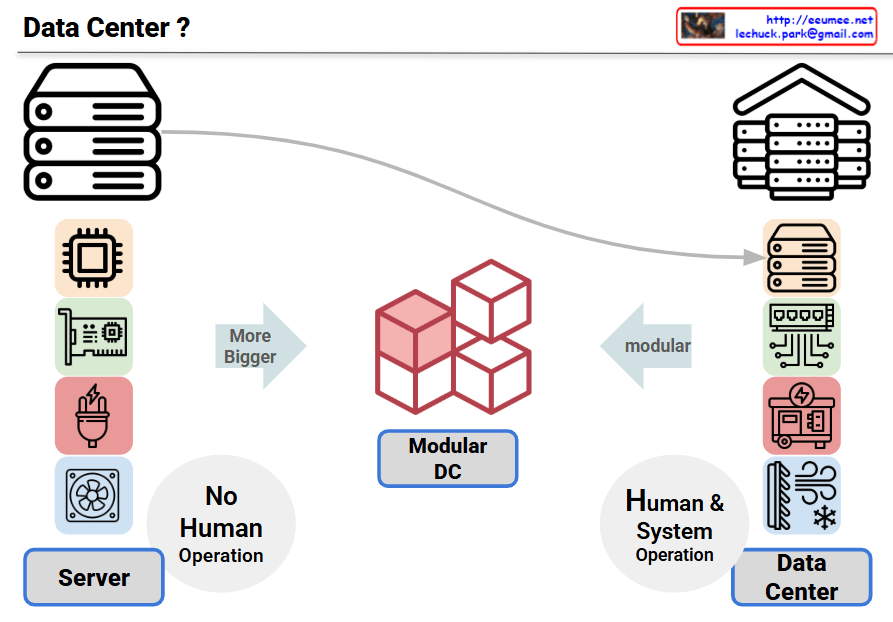
This infographic compares the evolution from servers to data centers, showing the progression of IT infrastructure complexity and operational requirements.
Left – Server
Center – Modular DC
Right – Data Center
Additional Perspective on Automation Evolution:
While the image shows data centers requiring human intervention, the actual industry trend points toward increasing automation:
Summary: This diagram illustrates the current transition from simple automated servers to complex data centers requiring human oversight, but the ultimate industry goal is achieving fully automated “lights-out” data center operations. The evolution shows increasing complexity followed by sophisticated automation that eventually reduces the need for human intervention.
With Claude

This diagram presents a systematic framework that defines the essence of AI LLMs as “Massive Simple Parallel Computing” and systematically outlines the resulting issues and challenges that need to be addressed.
Massive: Enormous scale with billions of parameters Simple: Fundamentally simple computational operations (matrix multiplications, etc.) Parallel: Architecture capable of simultaneous parallel processing Computing: All of this implemented through computational processes
Big Issues:
Very Required:
How can we solve all these requirements?
In other words, this framework poses the fundamental question about specific solutions and approaches to overcome the problems inherent in the essential characteristics of current LLMs. This represents a compressed framework showing the core challenges for next-generation AI technology development.
The diagram effectively illustrates how the defining characteristics of LLMs directly lead to significant challenges, which in turn demand specific capabilities, ultimately raising the critical question of implementation methodology.
With Claude
 Lechuck Park