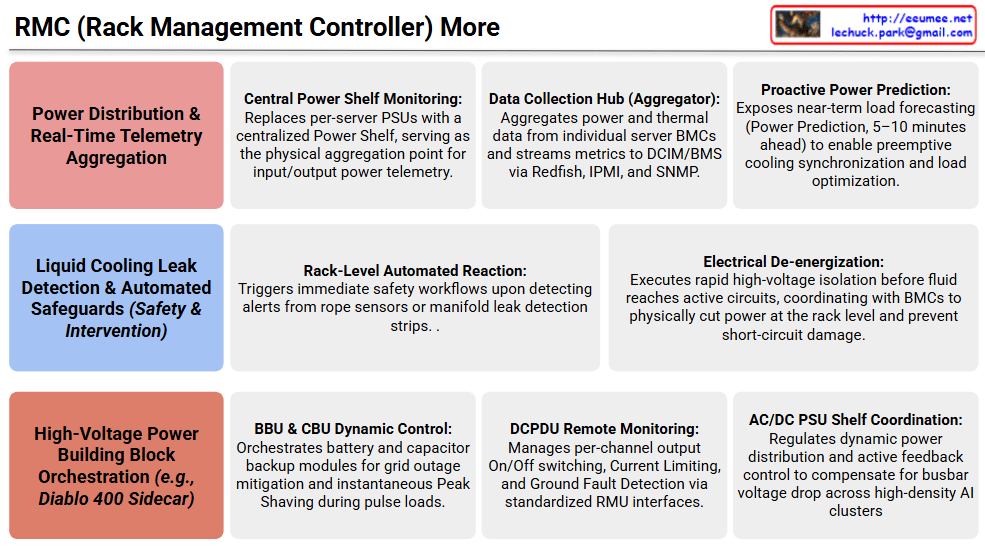
This infographic, titled “RMC (Rack Management Controller) More,” details the three advanced core roles and operational capabilities of the RMC (or RMU) in high-density AI data center environments across three color-coded horizontal rows.
1. Power Distribution & Real-Time Telemetry Aggregation
The top pink row covers IT-domain centralized power management and data aggregation.
- Central Power Shelf Monitoring: Replaces per-server PSUs with a centralized Power Shelf, serving as the physical aggregation point for input/output power telemetry.
- Data Collection Hub (Aggregator): Aggregates power and thermal data from individual server BMCs and streams metrics to DCIM/BMS via Redfish, IPMI, and SNMP.
- Proactive Power Prediction: Exposes near-term load forecasting (Power Prediction, 5–10 minutes ahead) to enable preemptive cooling synchronization and load optimization.
2. Liquid Cooling Leak Detection & Automated Safeguards (Safety & Intervention)
The middle green row outlines safety workflows and physical intervention capabilities for liquid cooling architectures.
- Rack-Level Automated Reaction: Triggers immediate safety workflows upon detecting alerts from rope sensors or manifold leak detection strips.
- Electrical De-energization: Executes rapid high-voltage isolation before fluid reaches active circuits, coordinating with BMCs to physically cut power at the rack level and prevent short-circuit damage.
3. High-Voltage Power Building Block Orchestration (e.g., Diablo 400 Sidecar)
The bottom blue row highlights hardware-level orchestration across high-voltage power components.
- BBU & CBU Dynamic Control: Orchestrates battery and capacitor backup modules for grid outage mitigation and instantaneous Peak Shaving during pulse loads.
- DCPDU Remote Monitoring: Manages per-channel output On/Off switching, Current Limiting, and Ground Fault Detection via standardized RMU interfaces.
- AC/DC PSU Shelf Coordination: Regulates dynamic power distribution and active feedback control to compensate for busbar voltage drop across high-density AI clusters.
Summary
This infographic highlights the evolution of the RMC from a passive monitoring unit to an active, rack-scale brain. It operates as an IT telemetry neural hub aggregating real-time BMC data and power forecasts, a safety intervention authority enforcing electrical de-energization during liquid cooling leaks, and a power orchestrator managing complex building blocks (BBU, CBU, DCPDU, PSU) in next-generation high-voltage architectures like Diablo 400.
#OCP #OpenRack #ORv3 #RMC #RMU #DataCenterInfrastructure #LiquidCooling #LeakDetection #PeakShaving #Diablo400 #PowerManagement #AIOps #Redfish
With Gemini

