Hybrid Analysis for Autonomous Operation (2)

Framework Overview

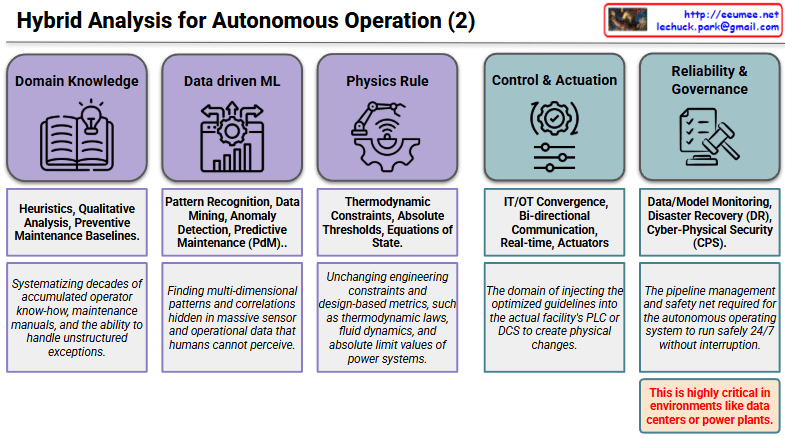
The image illustrates a “Hybrid Analysis” framework designed to achieve true Autonomous Operation. It outlines five core pillars required to build a reliable, self-driving system for high-stakes environments like AI data centers or power plants. The architecture combines three analytical foundations (purple) with two execution and safety layers (teal).


1. The Analytical Foundation (The Hybrid Triad)

This section forms the “brain” of the autonomous system, blending human expertise, artificial intelligence, and absolute scientific laws.

  • Domain Knowledge (Human Experience):
    • Core: Systematized heuristics, decades of operator know-how, and maintenance manuals.
    • Role: Provides qualitative analysis, establishes preventive maintenance baselines, and handles unstructured exceptions that algorithms might miss.
  • Data-driven ML (Artificial Intelligence):
    • Core: Pattern recognition, anomaly detection, and Predictive Maintenance (PdM).
    • Role: Analyzes massive volumes of multi-dimensional sensor and operational data to find hidden correlations and risks that are imperceptible to human operators.
  • Physics Rule (Engineering Guardrails):
    • Core: Thermodynamic constraints, equations of state, fluid dynamics, and absolute power limits.
    • Role: Acts as the ultimate boundary. It ensures that the operational commands generated by ML models are physically possible and safe, preventing the AI from violating unchanging engineering laws.

2. Execution and Safety Nets

This section translates the insights from the analytical triad into real-world, physical changes while guaranteeing system stability.

  • Control & Actuation (The Hands):
    • Core: IT/OT (Information Technology / Operational Technology) convergence and real-time bi-directional communication.
    • Role: The domain of injecting the optimized setpoints and guidelines directly into the facility’s PLC (Programmable Logic Controller) or DCS (Distributed Control System) to drive physical actuators.
  • Reliability & Governance (The Shield):
    • Core: Data/Model monitoring, Disaster Recovery (DR), and Cyber-Physical Security (CPS).
    • Role: The overarching safety net and pipeline management required to ensure the autonomous operating system runs securely and continuously, 24/7, without interruption.

๐Ÿ’ก Key Takeaway

As emphasized by the red text at the bottom, this multi-layered approach is highly critical in environments like data centers or power plants. Relying solely on data-driven ML is too risky for high-density infrastructure; true autonomous stability is only achieved when AI is anchored by human domain expertise and strict physical laws.

#AutonomousOperations #AIOps #HybridAnalysis #PredictiveMaintenance #ITOTConvergence #CyberPhysicalSystems #MissionCritical #TechVisualization #EngineeringInfographic

With Gemini

Prerequisites for ML


Architecture Overview: Prerequisites for ML

1. Data Sources: Convergence of IT and OT (Top Layer)

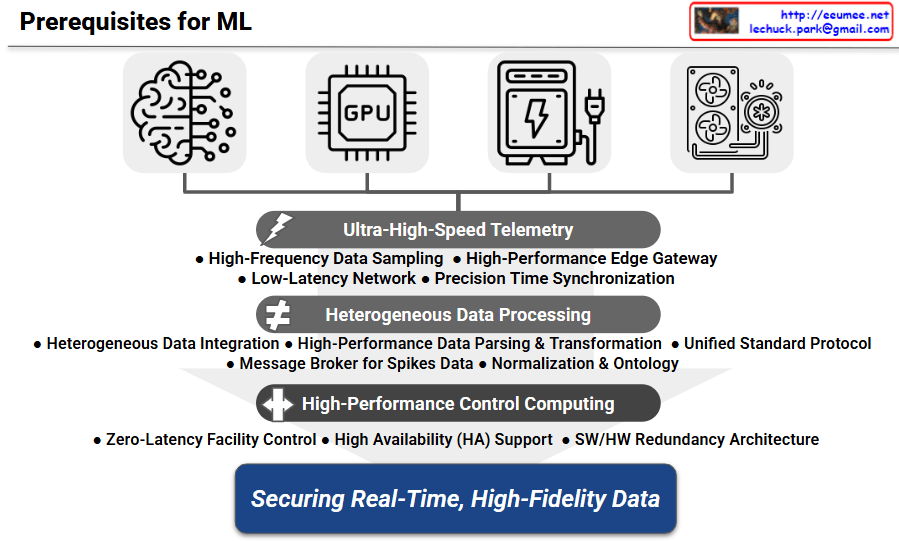
The diagram outlines four core domains essential for machine learning-based control in an AI data center. The top layer illustrates the necessary integration of IT components (AI workloads and GPUs) and Operational Technology (Power/ESS and Cooling systems). It emphasizes that the first prerequisite for an AI data center agent is to aggregate status data from these historically siloed equipment groups into a unified pipeline.

2. Collection Phase: Ultra-High-Speed Telemetry

The subsequent layer focuses on data collection. Because power spikes unique to AI workloads occur in milliseconds, the architecture demands High-Frequency Data Sampling and a Low-Latency Network. Furthermore, Precision Time Synchronization is highlighted as a critical requirement; the timestamps of a sudden GPU load spike must perfectly align with temperature changes in the cooling system for the ML model to establish accurate causal relationships.

3. Processing Phase: Heterogeneous Data Processing

As incoming data points utilize varying communication protocols and polling intervals, the third layer addresses data refinement. It employs a Unified Standard Protocol to convert heterogeneous data, along with Normalization & Ontology mapping so the ML model can comprehend the physical relationships between IT servers and facility cooling units. Additionally, a Message Broker for Spikes Data is included as a buffer to prevent system bottlenecks or data loss during the massive influx of telemetry that occurs at the onset of large-scale distributed training.

4. Execution Phase: High-Performance Control Computing

Following data processing, the execution layer is designed to take direct action on the facility infrastructure. This phase requires Zero-Latency Facility Control computing power to enable immediate physical responses. To meet the zero-downtime demands of data center operations, this layer incorporates a comprehensive SW/HW Redundancy Architecture to guarantee absolute High Availability (HA).

5. Ultimate Goal: Securing Real-Time, High-Fidelity Data

The foundational layers culminate in the ultimate goal shown at the bottom: Securing Real-Time, High-Fidelity Data. This emphasizes that predictive control algorithms cannot function effectively with noisy or delayed inputs. A robust data infrastructure is the definitive prerequisite for enabling proactive pre-cooling and ESS optimization.


๐Ÿ“ Summary

  1. A successful ML-driven data center operation requires a robust, high-speed data foundation prior to deploying predictive algorithms.
  2. Bridging the gap between IT (GPUs) and OT (Power/Cooling) through synchronized, high-frequency telemetry forms the core of this architecture.
  3. Securing real-time, high-fidelity data enables the crucial transition from delayed reactive responses to proactive predictive cooling and energy optimization.

#AIDataCenter #MachineLearning #ITOTConvergence #DataPipeline #PredictiveControl #Telemetry

Legacy vs AI DC

Legacy DC vs. AI Factory

1. Legacy Data Center

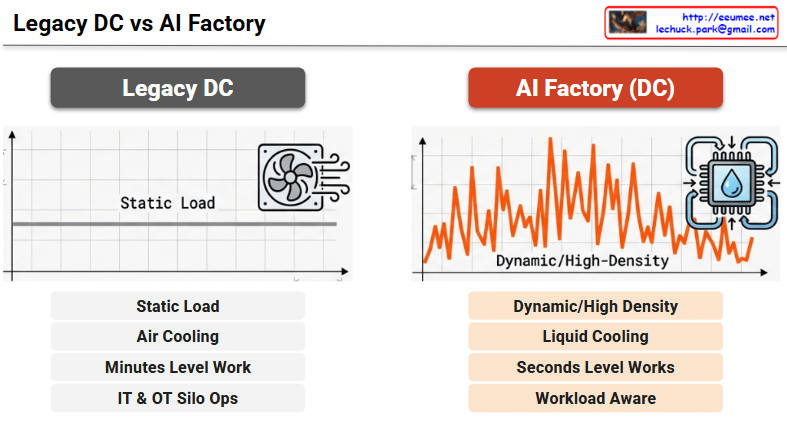
  • Static Load: The flat line on the graph indicates that power and compute demands are stable, continuous, and highly predictable.
  • Air Cooling: Traditional fan-based air cooling systems are sufficient to manage the heat generated by standard, lower-density server racks.
  • Minutes Level Work: System responses, resource provisioning, and facility adjustments generally occur on a scale of minutes.
  • IT & OT Silo Ops: Information Technology (servers, networking) and Operational Technology (power, cooling facilities) are managed independently in isolated silos, with no real-time data exchange.

2. AI Factory (DC)

  • Dynamic/High-Density: The volatile, jagged graph illustrates how AI workloads create extreme, rapid power spikes and demand highly dense computing resources.
  • Liquid Cooling: The immense heat output from high-performance AI chips necessitates advanced liquid cooling solutions (represented by the water drop and circulation arrows) to maintain thermal efficiency.
  • Seconds Level Works: The physical infrastructure must be highly agile, detecting and responding to sudden dynamic workload changes and thermal shifts within seconds.
  • Workload Aware: The facility dynamically adapts its cooling and power based on real-time AI computing needs. Establishing this requires robust “IT/OT Data Convergence” and the utilization of “High-Fidelity Data” as key components of a broader “Digitalization” strategy.

Summary

  1. Legacy data centers are designed for predictable, static loads using traditional air cooling, with IT and facility operations (OT) isolated from one another.
  2. AI Factories must handle highly volatile, high-density workloads, making liquid cooling and instantaneous, seconds-level infrastructure responses mandatory.
  3. Transitioning to a true “Workload Aware” facility requires a strong “Digitalization” strategy centered around “IT/OT Data Convergence” and “High-Fidelity Data.”

#AIFactory #DataCenter #LiquidCooling #WorkloadAware #ITOTConvergence #HighFidelityData #Digitalization #AIInfrastructure

With Gemini

DC Digitalizations with ISA-95


5-Layer Breakdown of DC Digitalization

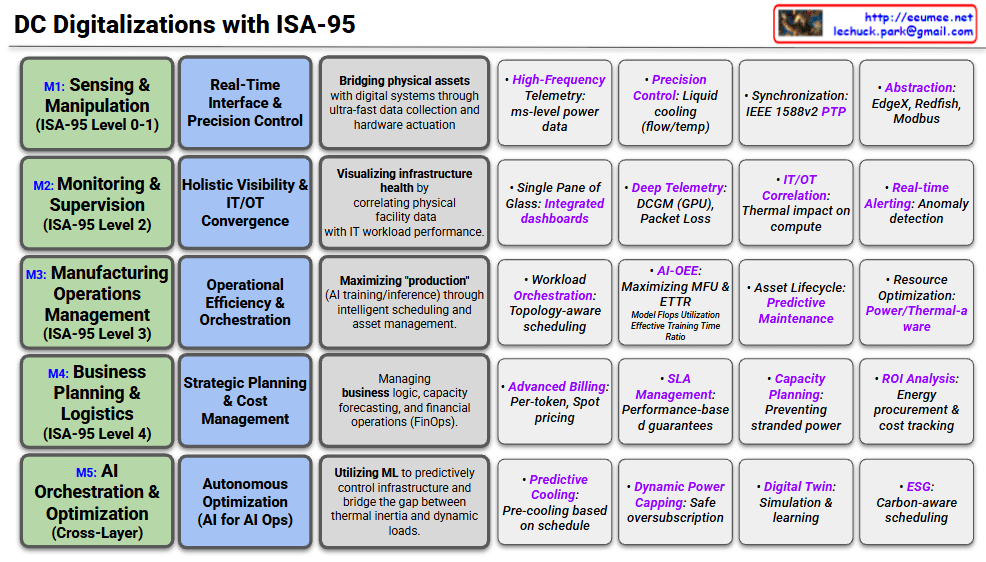
M1: Sensing & Manipulation (ISA-95 Level 0-1)

  • Focus: Bridging physical assets with digital systems.
  • Key Activities: Ultra-fast data collection and hardware actuation.
  • Examples: High-frequency power telemetry (ms-level), precision liquid cooling control, and PTP (Precision Time Protocol) for synchronization.

M2: Monitoring & Supervision (ISA-95 Level 2)

  • Focus: Holistic visibility and IT/OT Convergence.
  • Key Activities: Correlating physical facility health (cooling/power) with IT workload performance.
  • Examples: Integrated dashboards (“Single Pane of Glass”), GPU telemetry via DCGM, and real-time anomaly detection.

M3: Manufacturing Operations Management (ISA-95 Level 3)

  • Focus: Operational efficiency and workload orchestration.
  • Key Activities: Maximizing “production” (AI output) through intelligent scheduling.
  • Examples: Topology-aware scheduling, AI-OEE (maximizing Model Flops Utilization), and predictive maintenance for assets.

M4: Business Planning & Logistics (ISA-95 Level 4)

  • Focus: Strategic planning, FinOps, and cost management.
  • Key Activities: Managing business logic, forecasting capacity, and financial tracking.
  • Examples: Per-token billing, SLA management with performance guarantees, and ROI analysis on energy procurement.

M5: AI Orchestration & Optimization (Cross-Layer)

  • Focus: Autonomous optimization (AI for AI Ops).
  • Key Activities: Using ML to predictively control infrastructure and bridge the gap between thermal inertia and dynamic loads.
  • Examples: Predictive cooling (cooling down before a heavy job starts), Digital Twins, and Carbon-aware scheduling (ESG).

Summary of Core Concepts

  • IT/OT Convergence: Integrating Information Technology (servers/software) with Operational Technology (power/cooling).
  • AI-OEE: Adapting the “Overall Equipment Effectiveness” metric from manufacturing to measure how efficiently a DC produces AI models.
  • Predictive Control: Moving from reactive monitoring to proactive, AI-driven management of power and heat.

#DataCenter #DigitalTransformation #ISA95 #AIOps #SmartFactory #ITOTConvergence #SustainableIT #GPUOrchestration #FinOps #LiquidCooling

With Gemini