LLM works ( Pure Digital Vs Digitized Analog )

How LLM Works: Pure Digital vs. Digitized Analog

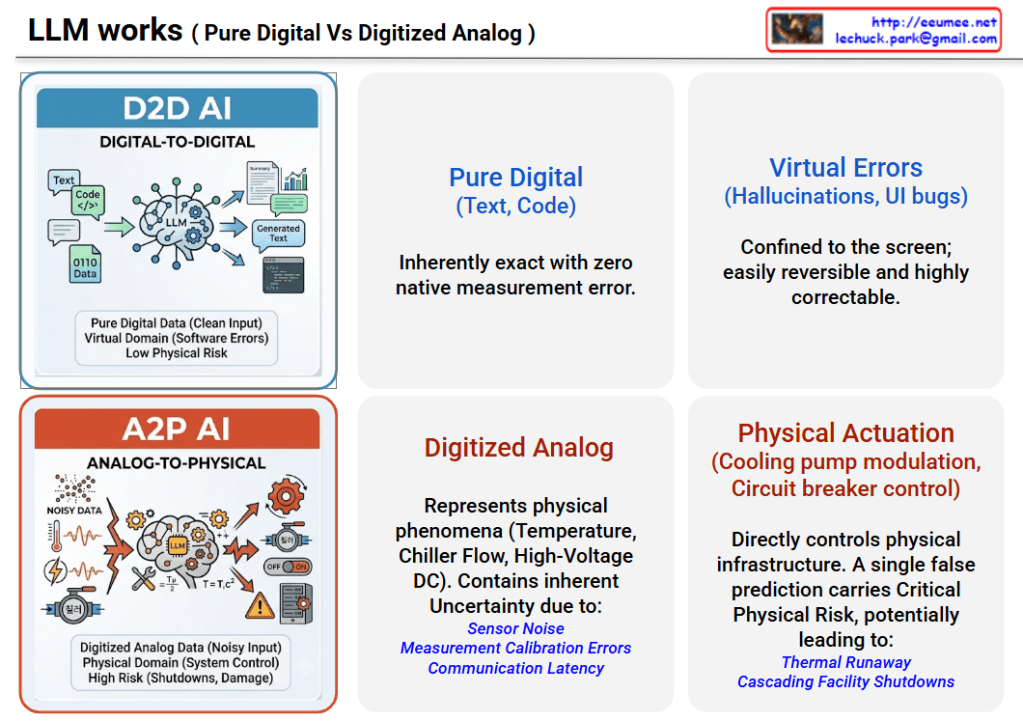
This infographic is titled “LLM works (Pure Digital Vs Digitized Analog)” at the top, with the creator’s source information (website and email) displayed in the top right corner. The image is horizontally divided to provide an intuitive comparison between general IT-environment AI (D2D AI) and industrial/data center AI (A2P AI).

1. Top Section: D2D AI (Digital-to-Digital AI) Designed with a blue theme, this section illustrates an AI operating within a virtual environment.

  • Input: Icons depict clean, “Pure Digital” data, such as text and code, being fed into a Large Language Model (LLM).
  • Characteristics: The text emphasizes that this pure digital input is “inherently exact with zero native measurement error.”
  • Output & Risk: The errors produced here are classified as “Virtual Errors” (e.g., hallucinations or UI bugs). Because these errors are confined strictly to the screen, they pose a low physical risk and are described as highly correctable and easily reversible.

2. Bottom Section: A2P AI (Analog-to-Physical AI) Designed with an orange theme, this section depicts an AI used for data center and industrial facility control.

  • Input: Graphics illustrate noisy data representing physical phenomena—such as temperature, chiller flow, and high-voltage DC—flowing into the LLM.
  • Characteristics: This data is defined as “Digitized Analog.” It contains inherent “Uncertainty” driven by physical realities such as sensor noise, measurement calibration errors, and communication latency.
  • Output & Risk: The AI’s output results in direct “Physical Actuation” (e.g., cooling pump modulation or circuit breaker control). The text strongly warns that a single false prediction carries “Critical Physical Risk,” potentially leading to catastrophic real-world consequences like “Thermal Runaway” and “Cascading Facility Shutdowns.”

💡 Summary This infographic perfectly contrasts the fundamental differences between D2D AI, which operates safely within software and is easily correctable, and A2P AI, which interprets uncertain digitized analog data to control physical infrastructure, thereby carrying significant and potentially destructive real-world risks.

#LLM #DataCenterAI #OperationalTechnology #D2DAI #A2PAI #CyberPhysicalSystems #AIGuardrails #IndustrialAI

With Gemini

Hybrid Analysis for Autonomous Operation (1)


Hybrid Analysis for Autonomous Operation (1)

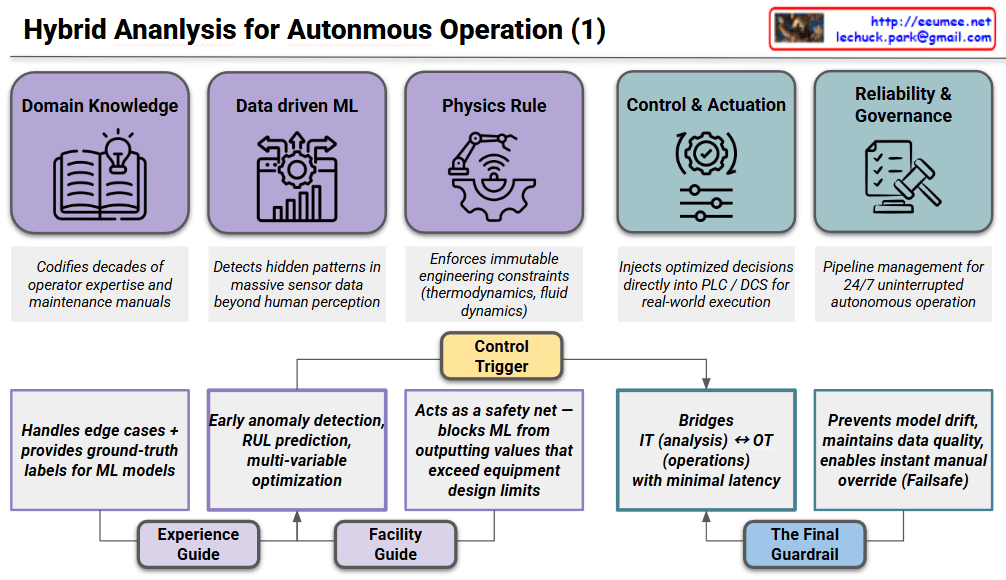
This framework illustrates a holistic approach to autonomous systems, integrating human expertise, physical laws, and AI to ensure safe and efficient real-world execution.

1. Five Core Modules (Top Layer)

  • Domain Knowledge: Codifies decades of operator expertise and maintenance manuals into digital logic.
  • Data-driven ML: Detects hidden patterns in massive sensor data that go beyond human perception.
  • Physics Rule: Enforces immutable engineering constraints (such as thermodynamics or fluid dynamics) to ground the AI in reality.
  • Control & Actuation: Injects optimized decisions directly into PLC / DCS (Distributed Control Systems) for real-world execution.
  • Reliability & Governance: Manages the entire pipeline to ensure 24/7 uninterrupted autonomous operation.

2. Integrated Value Drivers (Bottom Layer)

These modules work in synergy to create three essential “Guides” for the system:

  • Experience Guide: Combines domain expertise with ML to handle edge cases and provide high-quality ground-truth labels for model training.
  • Facility Guide: Acts as a safety net by combining ML predictions with physical rules. It predicts Remaining Useful Life (RUL) while blocking outputs that exceed equipment design limits.
  • The Final Guardrail: Bridges the gap between IT (Analysis) and OT (Operations). It prevents model drift and ensures an instant manual override (Failsafe) is always available.

3. Key Takeaways

The architecture centers on a “Control Trigger” that converts digital insights into physical action. By anchoring machine learning with physical laws and human experience, the system achieves a level of reliability required for mission-critical environments like data centers or industrial plants.

#AutonomousOperations #IndustrialAI #MachineLearning #SmartFactory #DataCenterManagement #PredictiveMaintenance #ControlSystems #OTSecurity #AIOps #HybridAI

With Gemini

To the full Automation

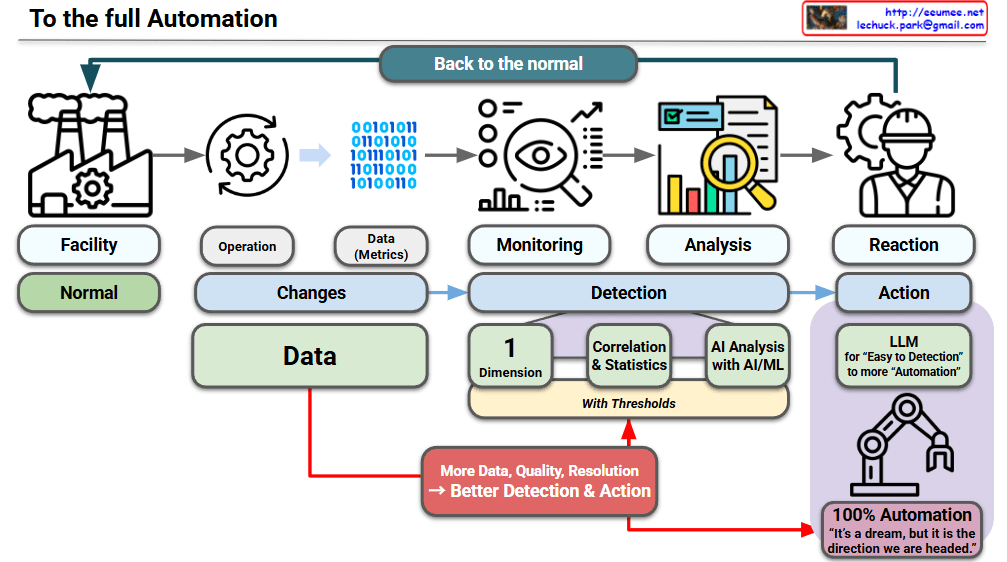
This visual emphasizes the critical role of high-quality data as the engine driving the transition from human-led reactions to fully autonomous operations. This roadmap illustrates how increasing data resolution directly enhances detection and automated actions.


Comprehensive Analysis of the Updated Roadmap

1. The Standard Operational Loop

The top flow describes the current state of industrial maintenance:

  • Facility (Normal): The baseline state where everything functions correctly.
  • Operation (Changes) & Data: Any deviation in operation produces data metrics.
  • Monitoring & Analysis: The system observes these metrics to identify anomalies.
  • Reaction: Currently, a human operator (the worker icon) must intervene to bring the system “Back to the normal”.

2. The Data Engine

The most significant addition is the emphasized Data block and its impact on the automation cycle:

  • Quality and Resolution: The diagram highlights that “More Data, Quality, Resolution” are the foundation.
  • Optimization Path: This high-quality data feeds directly into the “Detection” layer and the final “100% Automation” goal, stating that better data leads to “Better Detection & Action”.

3. Evolution of Detection Layers

Detection matures through three distinct levels, all governed by specific thresholds:

  • 1 Dimension: Basic monitoring of single variables.
  • Correlation & Statistics: Analyzing relationships between different data points.
  • AI Analysis with AI/ML: Utilizing advanced machine learning for complex pattern recognition.

4. The Goal: 100% Automation

The final stage replaces human “Reaction” with autonomous “Action”:

  • LLM Integration: Large Language Models are utilized to bridge the gap from “Easy Detection” to complex “Automation”.
  • The Vision: The process culminates in 100% Automation, where a robotic system handles the recovery loop independently.
  • The Philosophy: It concludes with the defining quote: “It’s a dream, but it is the direction we are headed”.

Summary

  • The roadmap evolves from human intervention (Reaction) to autonomous execution (Action) powered by AI and LLMs.
  • High-resolution data quality is identified as the core driver that enables more accurate detection and reliable automated outcomes.
  • The ultimate objective is a self-correcting system that returns to a “Normal” state without manual effort.

#HyperAutomation #DataQuality #IndustrialAI #SmartManufacturing #LLM #DigitalTwin #AutonomousOperations #AIOp

With Gemini