
2026 and
The Computing for the Fair Human Life.
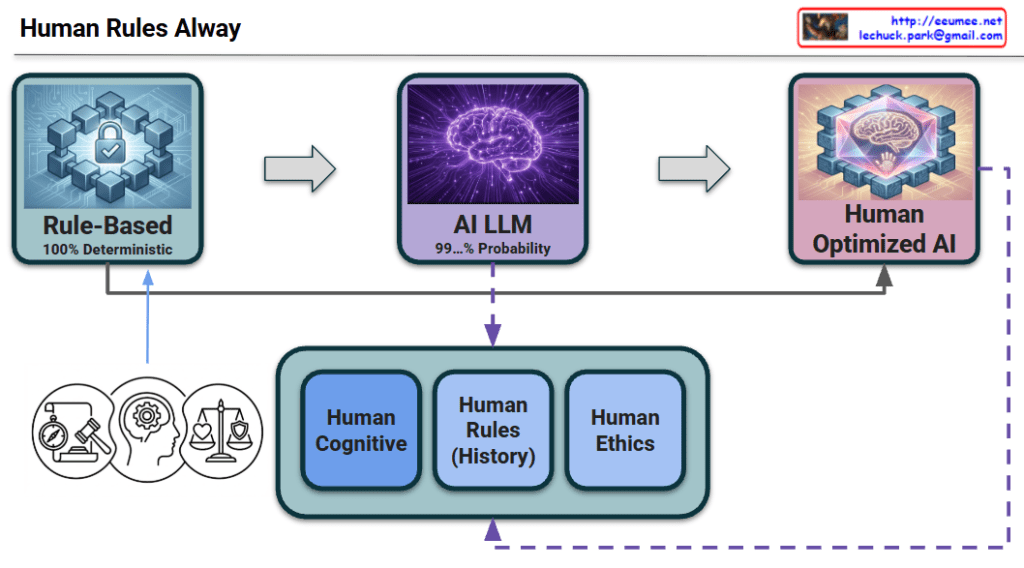
This diagram visualizes the history and future direction of intelligent systems. It illustrates the evolution from the era of manual programming to the current age of generative AI, and finally to the ultimate goal where human standards perfect the technology.
This section represents the mechanism that drives the evolution from Stage 2 to Stage 3.
This diagram declares that the future of AI lies not in discarding the old “Rule-Based” ways, but in fusing that deterministic precision with modern probabilistic power to create a truly optimized intelligence.
#AIEvolution #FutureOfAI #HybridAI #DeterministicVsProbabilistic #HumanInTheLoop #TechRoadmap #AIArchitecture #Optimization #ResponsibleAI
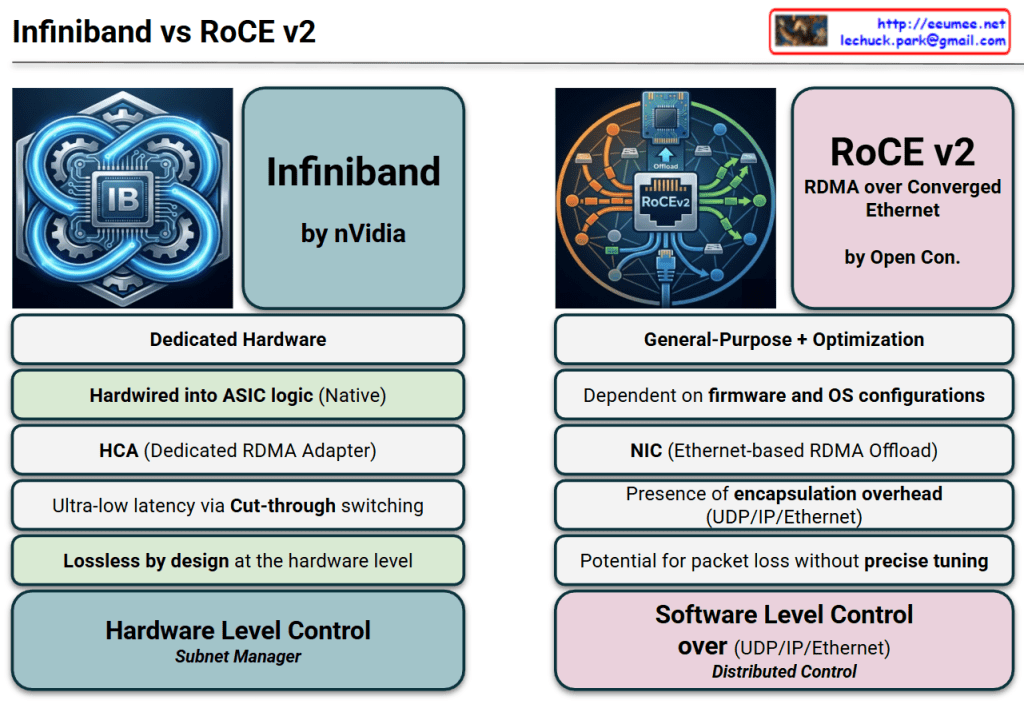
This image provides a technical comparison between InfiniBand and RoCE v2 (RDMA over Converged Ethernet), the two dominant networking protocols used in modern AI data centers and High-Performance Computing (HPC) environments.
| Feature | InfiniBand | RoCE v2 |
| Primary Driver | Performance & Stability | Cost-effectiveness & Compatibility |
| Complexity | Plug-and-play (within IB ecosystem) | Requires expert-level network tuning |
| Latency | Absolute Lowest | Low (but higher than IB) |
| Scalability | High (specifically for AI/HPC) | High (standard Ethernet scalability) |
Design & Logic: InfiniBand is a dedicated, hardware-native solution for ultra-low latency, whereas RoCE v2 adapts general-purpose Ethernet for RDMA through software-defined optimization and firmware.
Efficiency & Reliability: InfiniBand is “lossless by design” with minimal overhead via cut-through switching, while RoCE v2 incurs encapsulation overhead and requires precise network tuning to prevent packet loss.
Control & Management: InfiniBand utilizes centralized hardware-level management (Subnet Manager) for peak stability, while RoCE v2 relies on distributed software-level control over standard UDP/IP/Ethernet stacks.
#InfiniBand #RoCEv2 #RDMA #AIDataCenter #NetworkingArchitecture #NVIDIA #HighPerformanceComputing #GPUCluster #DataCenterDesign #Ethernet #AITraining
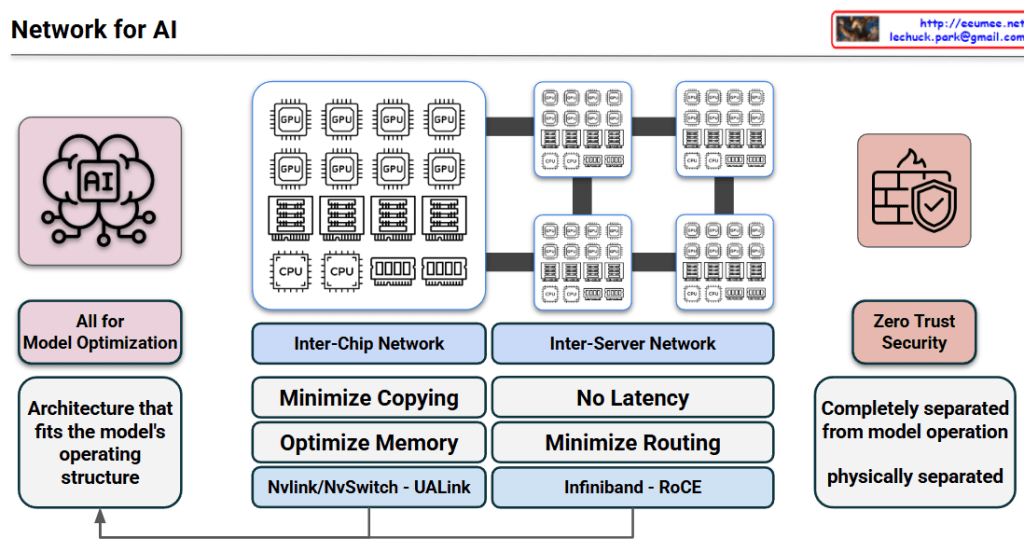
The primary goal is to create an “Architecture that fits the model’s operating structure.” Unlike traditional general-purpose data centers, AI infrastructure is specialized to handle the massive data throughput and synchronized computations required by LLMs (Large Language Models).
The architecture is divided into two critical layers to handle different levels of data exchange:
This layer focuses on the communication between individual GPUs/Accelerators within a single server or node.
This layer connects multiple server nodes to form a massive AI cluster.
A unique aspect of this architecture is the treatment of security.
The arrow at the bottom indicates a feedback loop: the performance metrics and requirements of the inter-chip and inter-server networks directly inform the ongoing optimization of the overall architecture. This ensures the platform evolves alongside advancing AI model structures.
The architecture prioritizes model-centric optimization, ensuring infrastructure is purpose-built to match the specific operating requirements of large-scale AI workloads.
It employs a dual-tier network strategy using Inter-chip (NVLink/UALink) for memory efficiency and Inter-server (InfiniBand/RoCE) for ultra-low latency cluster scaling.
Zero Trust security is integrated through complete physical separation from the compute fabric, allowing for robust protection without causing any performance bottlenecks.
#AIDC #ArtificialIntelligence #GPU #Networking #NVLink #UALink #InfiniBand #RoCEv2 #ZeroTrust #DataCenterArchitecture #MachineLearningOps #ScaleOut




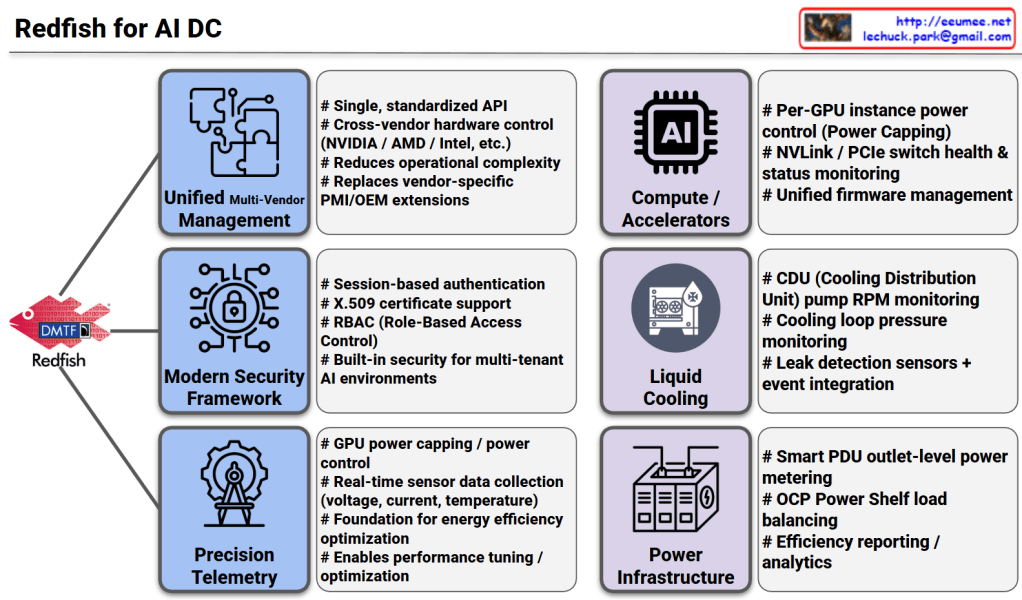
This image illustrates the pivotal role of the Redfish API (developed by DMTF) as the standardized management backbone for modern AI Data Centers (AI DC). As AI workloads demand unprecedented levels of power and cooling, Redfish moves beyond traditional server management to provide a unified framework for the entire infrastructure stack.
For an AI DC Optimization Architect, Redfish is the essential “language” that enables Software-Defined Infrastructure. By moving away from manual, siloed hardware management and toward this API-driven approach, data centers can achieve the extreme automation required to shift OPEX structures predominantly toward electricity costs rather than labor.
#AIDataCenter #RedfishAPI #DMTF #DataCenterInfrastructure #GPUComputing #LiquidCooling #SustainableIT #SmartPDU #OCP #InfrastructureAutomation #TechArchitecture #EnergyEfficiency
With Gemini
 Lechuck Park