Distributed Training Optimization : Network Traffic Control (eBPF) – Bottleneck

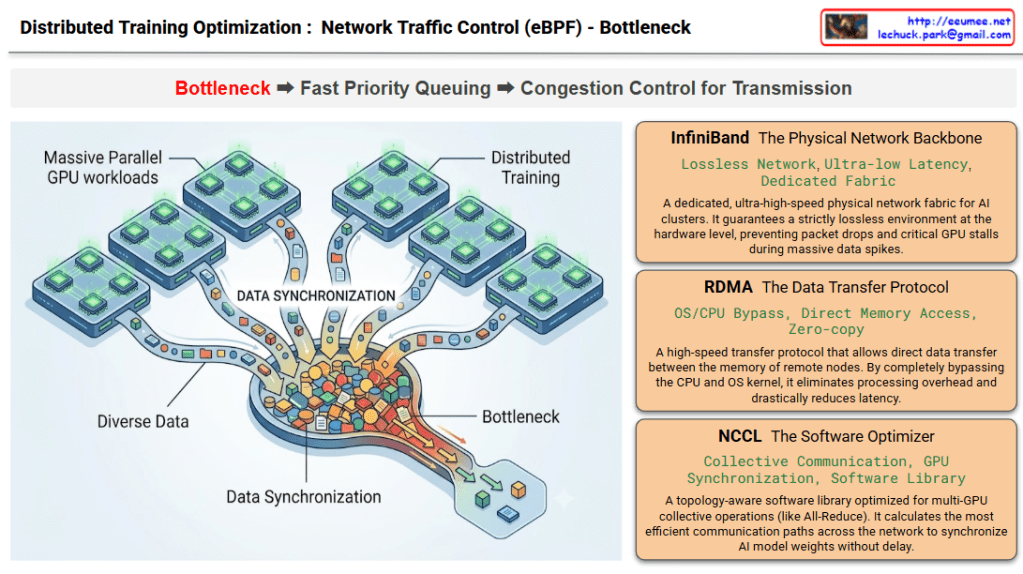
This infographic intuitively visualizes the “Bottleneck” phase—the very first step in network optimization for large-scale AI distributed training environments. It also outlines the three foundational infrastructure technologies involved in this process. As indicated by the red highlight on the word Bottleneck in the top workflow process, this specific diagram is entirely focused on defining the problem area.

1. Visual Context Description (Left Illustration)

  • The graphic on the left depicts a Massive Parallel GPU workloads environment, where numerous GPU clusters are operating simultaneously.
  • “Diverse Data” pouring out from each distinct GPU node converges into a massive, funnel-like channel labeled “DATA SYNCHRONIZATION.”
  • The illustration brilliantly captures a severe “Bottleneck” occurring as a massive volume of data packets (represented by the colorful blocks) attempts to squeeze through this narrow passage all at once, causing a massive traffic jam.

2. Core Infrastructure Technologies (Right Panels) The right side details the three core infrastructure stacks where this physical and logical data synchronization (and the resulting bottleneck) takes place.

  • InfiniBand (The Physical Network Backbone): A dedicated, ultra-high-speed physical network fabric for AI clusters. It guarantees a strictly lossless environment at the hardware level, preventing packet drops and critical GPU stalls during massive data spikes as seen on the left.
  • RDMA (The Data Transfer Protocol): A high-speed transfer protocol that allows direct data transfer between the memory of remote nodes. By completely bypassing the CPU and OS kernel, it eliminates processing overhead and drastically reduces latency.
  • NCCL (The Software Optimizer): A topology-aware software library optimized for multi-GPU collective operations (like All-Reduce). It calculates the most efficient communication paths across the network to synchronize AI model weights without delay.

📝 Summary

This diagram defines the problem state by using a funnel metaphor to visualize the inevitable network bottleneck that occurs when multiple GPUs synchronize data during distributed AI training. Simultaneously, it serves as an introductory technical overview, clearly outlining the keyword-centric roles of the underlying infrastructure stack—InfiniBand, RDMA, and NCCL—that handles this immense traffic.

#AIInfrastructure #DistributedTraining #NetworkBottleneck #DataCenter #InfiniBand #RDMA #NCCL #GPUCluster

With Gemini
Infiniband vs RoCE v2

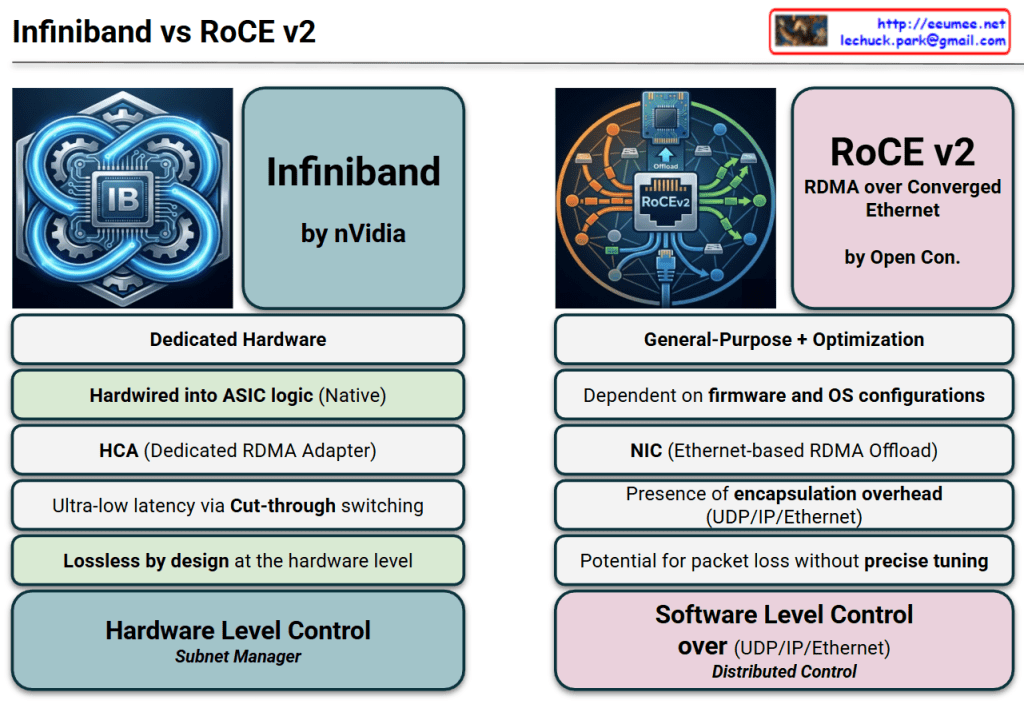
This image provides a technical comparison between InfiniBand and RoCE v2 (RDMA over Converged Ethernet), the two dominant networking protocols used in modern AI data centers and High-Performance Computing (HPC) environments.


1. Architectural Philosophy

  • InfiniBand (Dedicated Hardware): Designed from the ground up specifically for high-throughput, low-latency communication. It is a proprietary ecosystem largely driven by NVIDIA (Mellanox).
  • RoCE v2 (General-Purpose + Optimization): An evolution of standard Ethernet designed to bring RDMA (Remote Direct Memory Access) capabilities to traditional network infrastructures. It is backed by the Open Consortium.

2. Hardware vs. Software Logic

  • Hardwired ASIC (InfiniBand): The protocol logic is baked directly into the silicon. This “Native” approach ensures consistent performance with minimal jitter.
  • Firmware & OS Dependent (RoCE v2): Relies more heavily on the NIC’s firmware and operating system configurations, making it more flexible but potentially more complex to stabilize.

3. Data Transfer Efficiency

  • Ultra-low Latency (InfiniBand): Utilizes Cut-through switching, where the switch starts forwarding the packet as soon as the destination address is read, without waiting for the full packet to arrive.
  • Encapsulation Overhead (RoCE v2): Because it runs on Ethernet, it must wrap RDMA data in UDP/IP/Ethernet headers. This adds “overhead” (extra data bits) and processing time compared to the leaner InfiniBand frames.

4. Reliability and Loss Management

  • Lossless by Design (InfiniBand): It uses a credit-based flow control mechanism at the hardware level, ensuring that a sender never transmits data unless the receiver has room to buffer it. This guarantees zero packet loss.
  • Tuning-Dependent (RoCE v2): Ethernet is natively “lossy.” To make RoCE v2 work effectively, the network must be “Converged” using complex features like PFC (Priority Flow Control) and ECN (Explicit Congestion Notification). Without precise tuning, performance can collapse during congestion.

5. Network Management

  • Subnet Manager (InfiniBand): Uses a centralized “Subnet Manager” to discover the topology and manage routing, which simplifies the management of massive GPU clusters.
  • Distributed Control (RoCE v2): Functions like a traditional IP network where routing and control are distributed across the switches and routers.

Comparison Summary

FeatureInfiniBandRoCE v2
Primary DriverPerformance & StabilityCost-effectiveness & Compatibility
ComplexityPlug-and-play (within IB ecosystem)Requires expert-level network tuning
LatencyAbsolute LowestLow (but higher than IB)
ScalabilityHigh (specifically for AI/HPC)High (standard Ethernet scalability)

Design & Logic: InfiniBand is a dedicated, hardware-native solution for ultra-low latency, whereas RoCE v2 adapts general-purpose Ethernet for RDMA through software-defined optimization and firmware.

Efficiency & Reliability: InfiniBand is “lossless by design” with minimal overhead via cut-through switching, while RoCE v2 incurs encapsulation overhead and requires precise network tuning to prevent packet loss.

Control & Management: InfiniBand utilizes centralized hardware-level management (Subnet Manager) for peak stability, while RoCE v2 relies on distributed software-level control over standard UDP/IP/Ethernet stacks.

#InfiniBand #RoCEv2 #RDMA #AIDataCenter #NetworkingArchitecture #NVIDIA #HighPerformanceComputing #GPUCluster #DataCenterDesign #Ethernet #AITraining

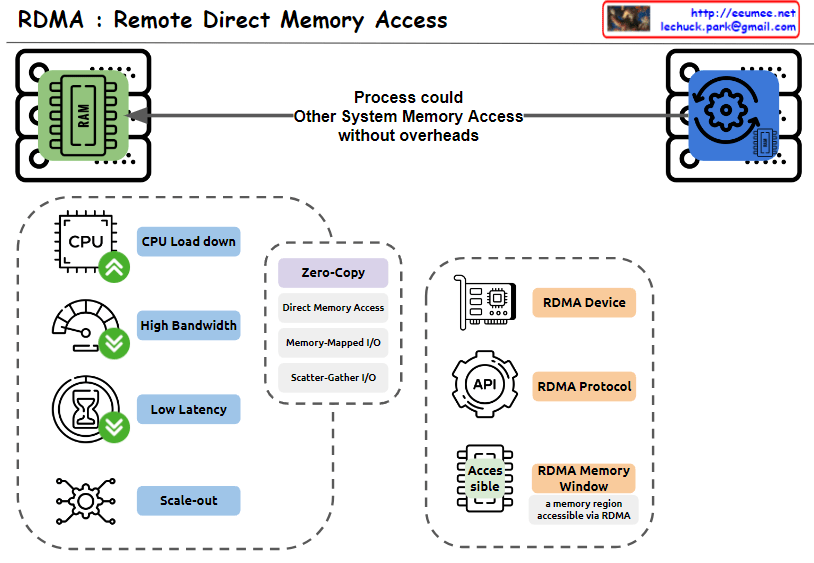
RDMA : Remote Direct Memory Access

From Claude with some prompting
This image explains RDMA (Remote Direct Memory Access). Here’s an interpretation in English:

  1. The top of the image shows that RDMA allows one system to access the memory of another system without overheads.
  2. The bottom left box lists the main advantages of RDMA:
    • CPU Load down
    • High Bandwidth
    • Low Latency
    • Scale-out
  3. The central box describes key features of RDMA:
    • Zero-Copy
    • Direct Memory Access
    • Memory-Mapped I/O
    • Scatter-Gather I/O
  4. The bottom right box lists RDMA-related components:
    • RDMA Device
    • RDMA Protocol
    • RDMA Memory Window (defined as “a memory region accessible via RDMA”)

The image provides a concise overview of RDMA technology, highlighting its main features and benefits. It illustrates how RDMA enables efficient, direct memory access between systems, reducing CPU load and improving performance in terms of bandwidth and latency.

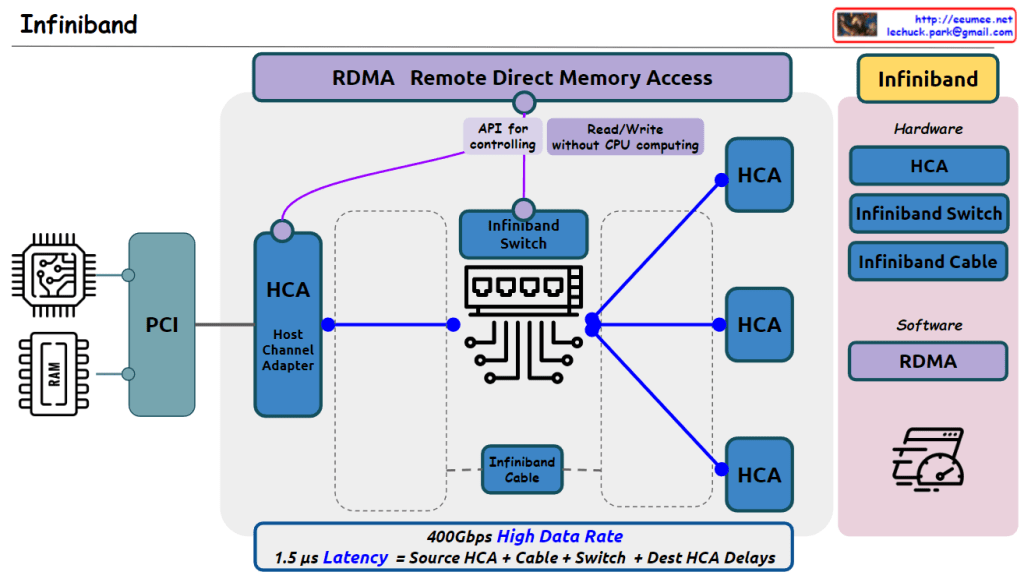
Infiniband

From claude with some prompting
The image correctly depicts the essential hardware elements of an InfiniBand network, including the PCI interface, Host Channel Adapters (HCAs), InfiniBand Switch, and InfiniBand cables connecting the HCAs to the switch.

It highlights RDMA (Remote Direct Memory Access) as a key technology that enables read/write operations without CPU involvement, facilitated by APIs for controlling the HCAs.

The hardware components listed (HCA, InfiniBand Switch, InfiniBand Cable) are accurate.

However, there is one potential inaccuracy in the details provided. The stated latency of 1.5μs seems quite low for an end-to-end InfiniBand communication. Typical InfiniBand latencies are in the range of a few microseconds, depending on the specific InfiniBand generation and configuration.

Additionally, while the image mentions a “400Gbps High Data Rate,” it’s important to note that this is an aggregate bandwidth across multiple links or ports, not necessarily the speed of a single link.

Overall, the image effectively conveys the main concepts and components of InfiniBand technology, with just a minor potential discrepancy in the stated latency value.