Road to the Automation

Diagram Description: The Paradigm Shift to Autonomous Operations

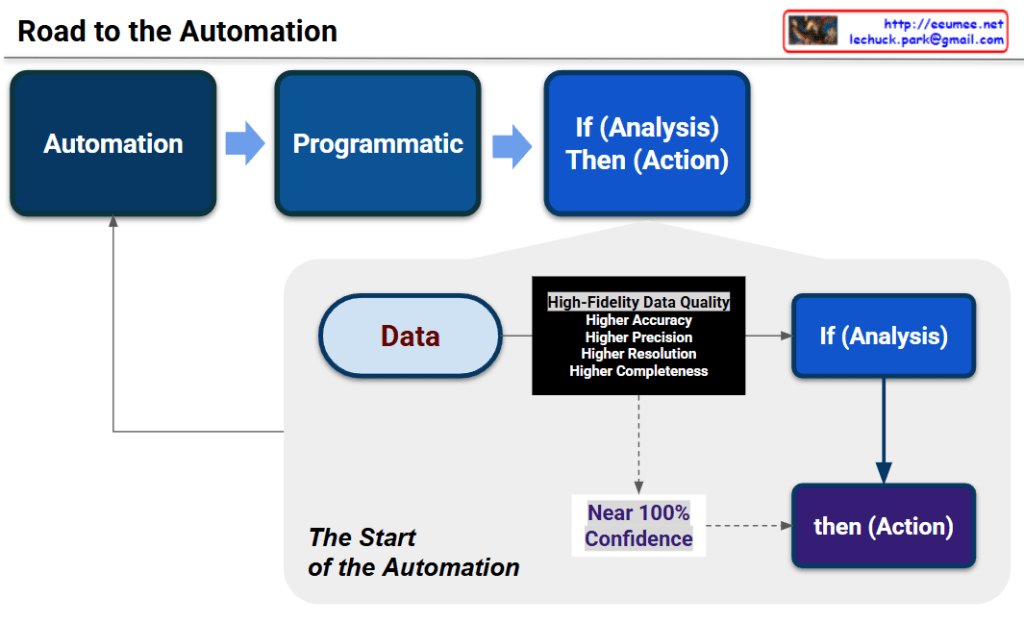
This infographic, titled “Road to the Automation,” visually explains the evolution from traditional, rule-based automation to a highly reliable, data-driven autonomous architecture.

  • The Traditional Approach (Top Flow):The upper section outlines the conventional path of automation. It transitions from a general “Automation” state to a “Programmatic” structure, ultimately relying on a standard, predefined logic: “If (Analysis) Then (Action).” This represents a system that reacts based on statically programmed rules.
  • The Start of True Automation (Bottom Flow):The core philosophy of the diagram lies in the lower, shaded area labeled “The Start of the Automation.” It asserts that true autonomous operation does not start with logic, but with “Data.”
    • The Quality Gate: The raw data must meet a strict standard of “High-Fidelity Data Quality,” which is defined by a comprehensive, four-pillar framework: Higher Accuracy, Higher Precision, Higher Resolution, and Higher Completeness.
    • Generating Systemic Trust: As the high-fidelity data feeds into the “If (Analysis)” phase, it concurrently establishes “Near 100% Confidence.”
    • Triggering Safe Action: This near-perfect confidence level is the critical catalyst. It provides the necessary systemic trust to safely execute the “then (Action).” This implies that a system can only act autonomously and safely when the underlying data quality eliminates uncertainty.
  • The Continuous Loop:Finally, an arrow points from the bottom automated framework back to the initial “Automation” block, illustrating a feedback loop. It shows that high-quality, confidence-backed autonomous actions are what continuously elevate and refine the entire automation ecosystem.

#AIOps #DataQuality #AutonomousSystems #InfrastructureAutomation #HighFidelityData #DataDriven #TechVisualization
Legacy vs AI DC

Legacy DC vs. AI Factory

1. Legacy Data Center

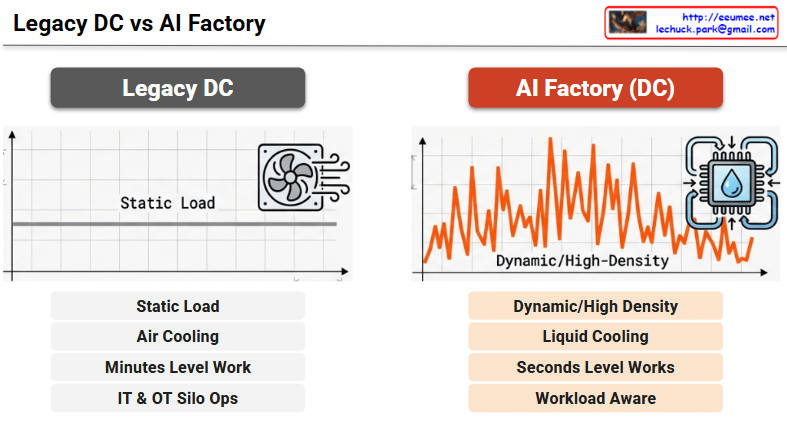
  • Static Load: The flat line on the graph indicates that power and compute demands are stable, continuous, and highly predictable.
  • Air Cooling: Traditional fan-based air cooling systems are sufficient to manage the heat generated by standard, lower-density server racks.
  • Minutes Level Work: System responses, resource provisioning, and facility adjustments generally occur on a scale of minutes.
  • IT & OT Silo Ops: Information Technology (servers, networking) and Operational Technology (power, cooling facilities) are managed independently in isolated silos, with no real-time data exchange.

2. AI Factory (DC)

  • Dynamic/High-Density: The volatile, jagged graph illustrates how AI workloads create extreme, rapid power spikes and demand highly dense computing resources.
  • Liquid Cooling: The immense heat output from high-performance AI chips necessitates advanced liquid cooling solutions (represented by the water drop and circulation arrows) to maintain thermal efficiency.
  • Seconds Level Works: The physical infrastructure must be highly agile, detecting and responding to sudden dynamic workload changes and thermal shifts within seconds.
  • Workload Aware: The facility dynamically adapts its cooling and power based on real-time AI computing needs. Establishing this requires robust “IT/OT Data Convergence” and the utilization of “High-Fidelity Data” as key components of a broader “Digitalization” strategy.

Summary

  1. Legacy data centers are designed for predictable, static loads using traditional air cooling, with IT and facility operations (OT) isolated from one another.
  2. AI Factories must handle highly volatile, high-density workloads, making liquid cooling and instantaneous, seconds-level infrastructure responses mandatory.
  3. Transitioning to a true “Workload Aware” facility requires a strong “Digitalization” strategy centered around “IT/OT Data Convergence” and “High-Fidelity Data.”

#AIFactory #DataCenter #LiquidCooling #WorkloadAware #ITOTConvergence #HighFidelityData #Digitalization #AIInfrastructure

With Gemini